Louisiana Group Ride Planning
A Louisiana group ride can unravel before the first trail if someone assumes every route allows every machine, a rain-soaked track is still passable, or the trailhead has room for a convoy of trailers. This guide walks you through choosing a suitable riding area, checking access and conditions, coordinating riders, and building a safer plan for the day.
Choose a riding area that fits your group
Match the destination to the machines and riders
Start with the least experienced rider and the most restricted machine in your group—not the most confident rider or the biggest vehicle. A route that feels easy on a nimble ATV may be tight for a wide side-by-side, and a trail that works for experienced adults may not suit children or first-time riders. Before committing, compare the riding area’s rules and trail descriptions with your group’s actual machines, experience, and comfort levels.
Louisiana offers very different kinds of riding. Forest trails around Kisatchie National Forest can involve narrow routes, changing surfaces, and shared trail use. A private mud park may have a different mix of obstacles, event traffic, and facility rules. Those are not interchangeable outings: a new rider who is comfortable on a wide, clearly marked path might feel overwhelmed in deep mud or on a busy event weekend.
Check whether the trails allow the types and sizes of machines your group plans to bring. If some riders have side-by-sides and others have ATVs, don’t assume they can follow the same route everywhere. Start with [Louisiana Trails That Allow Side-by-Sides] and [Louisiana Trail Difficulty Ratings], then confirm details with the land manager or park before towing. Width, weight, tire, and seasonal restrictions can matter, especially on public land.
It also helps to agree on what kind of day everyone wants. A family outing with younger riders may call for short loops and frequent breaks. A group of experienced riders may want longer routes—but should still plan around the slowest machine and the least familiar rider. Decide together whether the priority is sightseeing, technical riding, mud, or a relaxed social day. That small conversation prevents a common group-ride frustration: half the riders are looking for a challenge while the other half are trying to get back to the trailer.
Confirm legal access, rules, and current conditions
A line on a map is not proof that a route is open or that motorized riding is allowed there. Public forests, wildlife areas, private parks, and private timber land can have different access rules. On public land, riding may be limited to designated routes, and permits or passes may apply. Private property requires permission, even if a road or trail looks inviting from the edge.
Before leaving, check the riding area’s official information for closures, access requirements, machine limits, and any seasonal restrictions. For forest riding, review [Louisiana Forest Trail Use Passes] and [Louisiana Trail Closures After a Storm]. For a private park, read [Louisiana Private Park Waivers and Rules] so your group knows about admission procedures, age limits, helmets, passengers, alcohol, camping, and other site-specific conditions.
Rain deserves special attention. In Louisiana, heavy or persistent rain can turn a familiar trail into a much more difficult ride, and a closure may be in place to prevent damage or protect riders. A trail that looks manageable on a dry weekend can conceal deep standing water, soft shoulders, washouts, or blocked sections after a storm. Check [Louisiana Trail Conditions After Rain] and [Checking a Trail Status Page First] close to departure, then check again before unloading if conditions have changed.
Use a mapping app such as onX Offroad as a planning aid, not as final permission to ride. It can help the group discuss routes and landmarks, but riders should still confirm access, closures, and restrictions through the relevant land manager or park. Download maps for offline use when possible, and make sure everyone knows which map, trail names, and meeting points the group is using.
| Planning question | What to confirm | Why it matters |
|---|---|---|
| Does the area allow our machines? | ATV or UTV access, dimensions, and any machine restrictions | A route may not accommodate every vehicle in the group |
| Is the area open? | Current closures, seasonal rules, and weather-related notices | Conditions and access can change after rain or storms |
| Do we need a pass or permit? | Required passes, permits, or check-in steps | Riders may need to handle these before reaching the trail |
| Where can we park? | Trailer space, staging area, and unloading procedure | A large convoy can create congestion or block access |
| What is the route like? | Difficulty, surface, length, and shared-use expectations | Helps match the ride to everyone’s skill and equipment |
Coordinate the group before ride day
Set a meeting plan, a pace, and a clear ride structure
A group ride works better when nobody is guessing where to meet or whether the group has left without them. Choose a main meeting place with enough space for trailers and a backup location in case the first one is full or access is restricted. Give everyone the exact destination name, the entrance or staging area to use, and a realistic arrival window. If cell reception may be unreliable, share these details before the convoy leaves town.
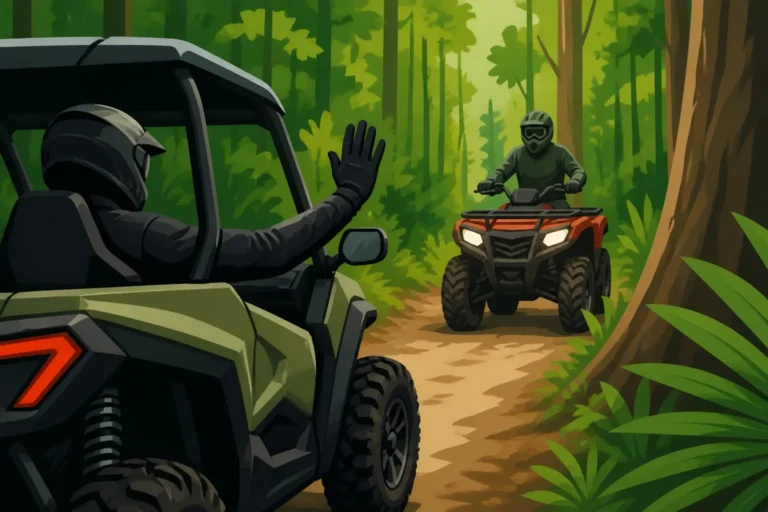
Decide how the group will ride together. A simple arrangement is a lead rider who knows the route and a sweep rider who stays at the back. The lead can set a conservative pace and stop at agreed junctions; the sweep can check that no one has been left behind. The middle riders should know the basic plan too, so the whole ride does not depend on one person’s phone or memory.
Agree on a few regrouping points before starting. These might be a trailhead, a marked junction, or a wide, safe place to pull off without blocking the route. At an intersection, the group can pause until everyone is accounted for. Avoid relying on the assumption that riders will simply follow tire tracks: trails can split, and a rider who stops to adjust equipment can quickly lose sight of the group.
For a large group, split into smaller riding pods that share the same destination and schedule. Smaller groups are easier to keep together, create less congestion, and can be more manageable on narrow trails. Keep the pods within the area’s rules, and don’t let the faster group turn a social outing into a race. For more on courteous riding, review [Louisiana Trail Etiquette Locals Expect].
Share practical information and prepare the machines
Ask each rider to confirm what they are bringing and whether their machine is ready for the planned conditions. A quick pre-ride check can catch simple problems before they become a long walk back: tires, brakes, lights where needed, fuel, battery condition, straps, and any obvious leaks or damage. For a mud-focused outing, riders should think carefully about recovery equipment and whether they know how to use it. A winch or tow strap is not a substitute for a safe recovery plan or compatible equipment.
Share a short checklist with the group ahead of time. Include water, food, weather-appropriate clothing, eye protection, basic first aid, and any required passes or paperwork. Ask riders to bring their own essentials rather than assuming the lead rider has enough for everyone. If someone has a medical concern, allergy, or emergency contact preference, discuss what they are comfortable sharing and make sure the lead and sweep know how to respond if needed.
Discuss fuel and turnaround points, too. A group ride moves at the pace of the least-ready machine, and a fuel stop can take longer when several riders need attention at once. Build in time for breaks rather than treating them as a failure to stay on schedule. In Louisiana heat and humidity, a rider who feels fine while moving may feel very different after a long stop or a physically demanding section.
Make a simple contact plan for separation. Pick a clear time or place where riders should wait if they become separated, and tell everyone not to take an unfamiliar shortcut to catch up. If the trail system has limited service, do not count on calling or messaging someone from every location. [Louisiana Riding Areas With Cell Service] can help you think about connectivity, but carry offline maps and share the route in advance as a backup.
Make the ride manageable and safer on the trail
Use a pace and spacing that work for mixed abilities
Set the tone before the machines start moving: this is a group outing, not a competition. Leave enough space between machines for braking, dust, and sudden stops. On a narrow or unfamiliar section, avoid crowding the rider ahead. Dust can make it hard to see ruts, roots, standing water, or a stopped machine, and close following leaves little room to react.
The lead rider should choose a pace that allows the group to stay together without pressuring less experienced riders. That does not mean stopping at every turn; it means choosing a speed that gives riders time to read the trail and control their machines. If one rider is repeatedly falling behind, stop somewhere safe and ask what would help. The answer may be a slower pace, a shorter route, a break, or a decision to turn back.
Avoid riding side by side unless the route is wide enough and the riding area permits it. On shared forest trails, horses, hikers, or other users may be present. Slow down, follow posted instructions, and give others room. If you encounter a logging or maintenance crew, follow their directions and do not assume that a familiar route is clear of work activity.
Make every stop useful. Pull completely out of the way where possible, check that the group is together, and give riders a moment to drink and adjust gear. Before moving again, confirm the next junction or regrouping point. If a rider needs more time, communicate that clearly rather than letting the group drift off in different directions.
Know when to shorten the route or call it
A good ride plan includes permission to change the plan. Weather, trail conditions, fatigue, a mechanical issue, or a rider’s discomfort can make the original route a poor choice. Decide ahead of time that turning around is an acceptable outcome—not an embarrassment. That expectation makes it easier for someone to speak up before a small problem becomes a bigger one.
If a machine breaks down, move the group to a safe place where it will not block the trail. Keep riders out of the route while someone assesses the problem, and avoid attempting a recovery that exceeds the group’s equipment or experience. If the machine cannot be moved safely, contact the park or land manager if possible and follow their instructions. Do not leave a rider alone on an unfamiliar route without agreeing on a clear plan.
When someone gets separated, use the agreed regrouping procedure rather than sending several people off searching in different directions. The lead and sweep should account for the group, check the last known meeting point, and avoid adding unnecessary riders to a confusing situation. If there is an injury or immediate danger, prioritize getting help over trying to preserve the day’s schedule.
After heavy rain or a change in conditions, be willing to choose an easier route or postpone the outing. Mud can make a short section unexpectedly demanding, and repeated attempts to power through can damage a trail or create a recovery problem. A conservative decision protects both the group and the riding area.
Finish with a smooth departure and a better next ride
Plan the end of the day before everyone is tired
Set a turnaround time that leaves room to return to the trailhead, load machines, and secure trailers before dark or before the park’s closing procedures. Riders often underestimate how long the end of a group outing takes. One machine may need washing, another may need a strap adjusted, and someone may realize their gear is still scattered around the staging area.
Before leaving, do a head count and make sure each rider has their machine, keys, phone, and personal items. Check the parking area for trash, loose straps, and anything left behind. At public sites, follow posted requirements for parking and trailhead use. At private parks, follow the exit and cleanup rules the staff provide.
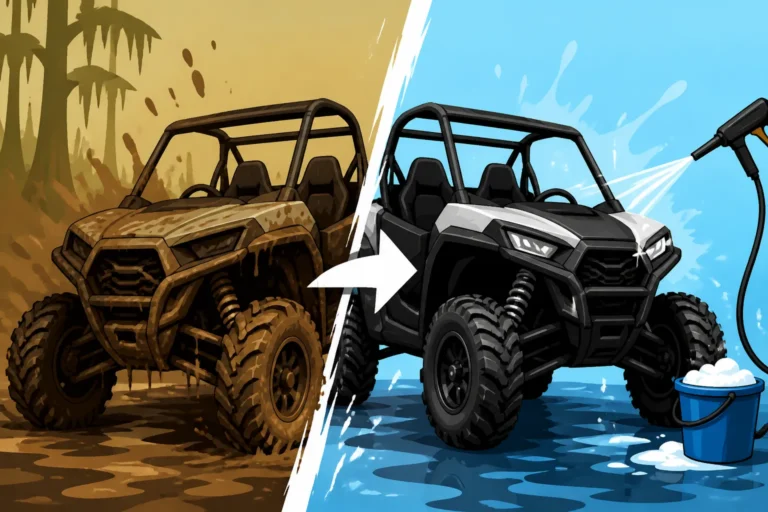
If the group has ridden in mud or standing water, plan for basic cleaning and inspection at home. Rinse away mud where appropriate, then check for packed debris, damaged components, or anything that needs attention before the next ride. Do not assume that a machine is ready for another outing just because it made it back to the trailer.
Use what you learned to improve the next outing
A brief debrief can make the next group ride noticeably easier. Ask what worked: Was the meeting point clear? Did the route match the group’s ability? Were the breaks frequent enough? Did anyone feel rushed or left out? Keep the conversation practical and nonjudgmental. The goal is to improve the plan, not blame the rider who needed a slower pace or the person who discovered a missing strap.
Make a note of useful details while they are fresh: which entrance was easiest for trailers, where the group regrouped, how long the route took, and what conditions made it harder. Do not treat those notes as a guarantee that the same route will be open or ride the same way next time; confirm current access and conditions before each outing.
For the next trip, update the shared route and contact plan, check official notices again, and confirm that everyone still has the right passes or equipment. A little preparation helps a Louisiana group spend less time sorting out logistics at the trailhead and more time enjoying the ride together.
Disclaimer
This article is for general informational purposes only and does not constitute professional advice. Laws, prices and regulations vary by location and change over time. Consult a qualified professional for guidance on your specific situation.