When a Paramedic Can Ride a Quad on Duty
It’s a sight that can make any seasoned off-road enthusiast scratch their head: an ATV or UTV with flashing lights, darting across a paved road or down a shoulder, clearly operating in a way the average rider simply can’t. We all know the strict rules about keeping our beloved machines off public thoroughfares in Louisiana, and for good reason. So, when you see a paramedic using a quad on duty, it naturally brings up questions. This guide will dive deep into the specific exceptions and circumstances that allow our dedicated emergency responders to utilize these versatile vehicles on public roads while performing their life-saving duties.
The General Rule: Why ATVs and UTVs Are Usually Off-Limits on Louisiana Roads
Let’s be honest, the roar of an ATV engine on a blacktop street usually means trouble. Most of us understand, perhaps from experience or from hearing tales, that taking your off-road machine onto public roads in Louisiana is a big no-no. These laws are in place for safety, and they apply to nearly everyone.
Understanding the Foundation of Louisiana's Off-Road Vehicle Laws
At its core, Louisiana’s legislation is designed to clearly delineate where off-road vehicles belong and where they don't. Think of it this way: your trusty quad, designed for mud, trails, and rough terrain, simply isn’t built for the same demands as a car or truck. It lacks many of the safety features, signaling capabilities, and structural integrity required for highway speeds and mixed traffic. The laws reflect this fundamental difference, aiming to prevent accidents and ensure the safety of all road users. You can find the nitty-gritty details in statutes like [Louisiana ATV Road Rules Under 32:299] and [Louisiana UTV Road Rules Under 32:299.3], which lay out the general prohibitions. These aren’t suggestions; they're the rules of the road for a reason.
The Rationale Behind the Restrictions
So, why are these machines generally banned from public roads? It boils down to a few key areas that impact safety and practicality. First, there’s the sheer physics of it. ATVs and UTVs have a higher center of gravity, narrower track widths compared to cars, and often knobby, low-pressure tires optimized for grip in dirt, not adhesion to asphalt. This combination can make them unstable at road speeds, especially during sudden turns or braking. They typically lack essential street-legal equipment like proper headlights (often too dim for night road use), brake lights, turn signals, and rearview mirrors, making communication with other drivers incredibly difficult and dangerous. Imagine trying to signal a lane change on a busy road with no turn signal! Furthermore, the lack of enclosed cabs, seatbelts (beyond simple lap belts on some UTVs), airbags, and crumple zones means that in the event of a collision with a standard vehicle, the ATV or UTV operator and any passengers are at a severe disadvantage. These machines are beasts on the trail, but they’re extremely vulnerable on the pavement.
Specific Exceptions for Emergency Responders in Louisiana
While the general prohibitions are strict, common sense (and common good) dictates that there must be exceptions for those who serve and protect us, especially when time is of the essence and terrain is a challenge.
The Statutory Carve-Out for Paramedics and Emergency Personnel
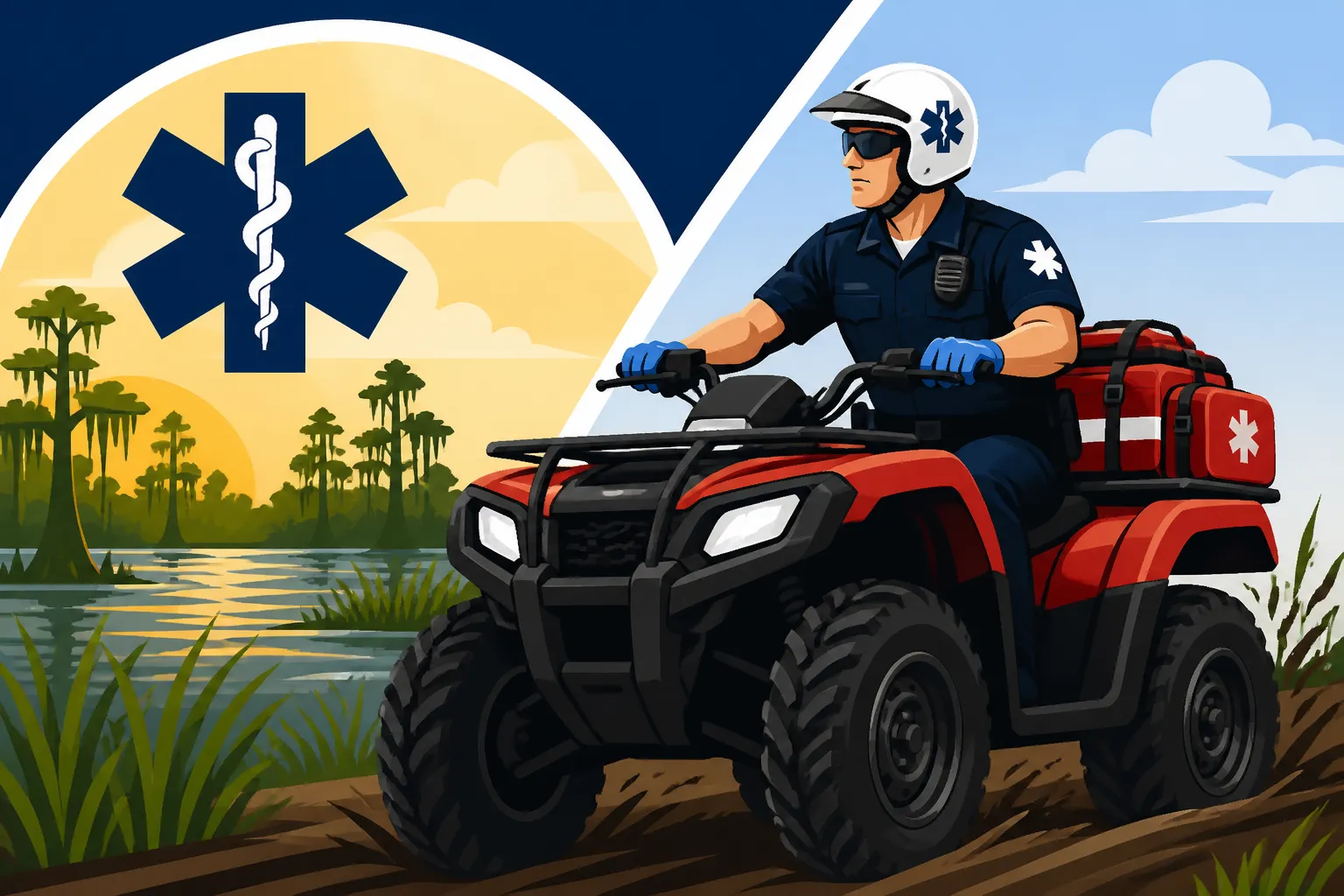
This is where the law makes a crucial distinction. Louisiana statutes, understanding the vital role of emergency services, include specific provisions that allow certain personnel to operate off-road vehicles on public roads when actively engaged in their official duties. For paramedics, this isn't just a courtesy; it's a critical tool for saving lives. Imagine an emergency deep within a remote hunting lease, a flooded area after a storm, or far down a muddy pipeline right-of-way where a traditional ambulance simply cannot go. That's precisely when a paramedic, equipped with an ATV or UTV, becomes the vital link. These vehicles can navigate rough terrain, shallow water, and tight spaces that would stop other emergency vehicles in their tracks. The why is simple: to provide rapid medical response and patient extraction in environments inaccessible to conventional ambulances, ensuring that help can reach even the most challenging locations. This specific exception is detailed for [Louisiana Paramedic Exceptions], recognizing their unique needs.
Conditions and Limitations for On-Duty Paramedic Use
It’s important to understand that this isn’t a free pass for anyone with a first-aid kit and a quad. The exception for paramedics is very specific and comes with strict conditions. First and foremost, the paramedic must be on duty and the use of the ATV or UTV must be in the course of official duties. This means they aren't just taking their personal machine to the grocery store; they are actively responding to an emergency, conducting a search and rescue, or performing other agency-approved tasks that necessitate the use of an off-road vehicle.
Additionally, these emergency ATVs and UTVs are typically outfitted to identify them as such. Think flashing lights (often red or blue), sirens, and official agency markings on the vehicle itself. While the statute might not prescribe every sticker or light, the intent is clear: these vehicles must be identifiable as official emergency response units. It’s also common for paramedics operating these machines to undergo specialized training that goes beyond basic riding skills. They learn how to safely navigate varied terrain, operate with emergency equipment, and even perform patient transport in challenging conditions. This ensures they can effectively utilize the machine as a tool, not just a recreational vehicle. This specialized allowance is similar to, though distinct from, the provisions made for [Louisiana Law Enforcement Exceptions], where officers also gain specific road use privileges for their duties. Even with these exceptions, the machines need to be maintained and equipped properly, and a trooper can still perform [Louisiana Equipment Checks by Troopers] to ensure they are safe and legal for emergency operations.
Practical Scenarios for Paramedic Quad Use in Louisiana
Louisiana's diverse landscape, from dense pine forests to sprawling marshes and agricultural fields, often presents unique challenges for emergency services. This is where the specialized capabilities of ATVs and UTVs truly shine for paramedics.
Reaching Remote Accident Scenes
Imagine a scenario: it's deer season, and a hunter, unfortunately, falls from a tree stand deep within the Kisatchie National Forest, miles from the nearest paved road. Or perhaps there's a vehicle rollover on a private oil field road, too narrow and rutted for a standard ambulance. These are not hypothetical situations in Louisiana; they are real challenges paramedics face regularly. In such cases, a conventional ambulance, designed for highways and city streets, would be absolutely useless. This is where an emergency ATV or UTV becomes a hero.
A paramedic can rapidly deploy on one of these machines, navigating through thick woods, crossing muddy ditches, or traversing rocky trails to reach the patient. The agility and compact size of these vehicles allow them to get where larger vehicles cannot, significantly cutting down response times in critical situations. Picture a powerful side-by-side, perhaps fortified with SuperATV aftermarket parts for enhanced durability or carrying specialized medical gear, speeding along a logging trail near [Louisiana Riding Near Colfax]. This ability to cover rough, inaccessible ground quickly means the difference between prompt medical attention and potentially life-threatening delays. They might even use designated routes like those found on [Kisatchie National Forest OHV Trails in Louisiana] to bypass impassable areas, under their emergency exception.
Search and Rescue Operations
Beyond accident scenes, paramedics often play a crucial role in search and rescue missions. Whether it’s searching for a lost child in a dense cane field, locating an elderly person who wandered off into a rural wooded area, or assisting during a natural disaster like a hurricane where roads are impassable due to debris or flooding, ATVs and UTVs are invaluable assets. These machines can cover vast amounts of varied terrain far more efficiently than foot teams and can access areas that even specialized search and rescue trucks might struggle with.
The UTV, in particular, often has the capacity to carry multiple team members, essential medical supplies, and even a patient litter. This means a paramedic can not only locate a person in distress but also provide immediate on-site medical care and then safely transport them out of a difficult environment to a waiting ambulance or helicopter. The rapid deployment and versatility of these machines allow search efforts to be more expansive and effective, saving precious time in scenarios where every minute counts. They might be operating in conditions that would normally violate [Louisiana Rules for Riding a Field Road] or require them to utilize [Louisiana Rules for Crossing a Highway] multiple times to reach their search area.
Event Stand-By and Large Gatherings
Louisiana loves its festivals, concerts, and, of course, mud events! From Mardi Gras parades in New Orleans to massive off-road gatherings like [Louisiana Mudfest and Event Weekends], large crowds and spread-out venues present unique logistical challenges for emergency medical services. In these environments, standard ambulances often get bogged down in traffic or can’t navigate pedestrian-heavy areas quickly.
This is another prime situation where paramedics rely on ATVs and UTVs for swift response. A UTV, for instance, can weave through crowds (with proper warning and clearance, of course), traverse grassy fields, or navigate the often-muddy terrain of a festival ground to reach someone experiencing a medical emergency. This quick access is vital, whether it’s for a heat-related illness at an outdoor concert or an injury at a motocross event. These machines are crucial for maintaining a rapid response capability across large, often chaotic, and difficult-to-access event sites, ensuring that medical help is never far away, even in the most congested or rugged settings.
Here’s a quick comparison of general public vs. paramedic ATV/UTV road use:
| Feature/Action | General Public (Civilian) | Paramedic (On Duty) |
|---|---|---|
| Road Use | Generally prohibited on public roads and highways. | Permitted on public roads only during official duties. |
| Identification | No special markings required; typically recreational. | Must be clearly marked as an emergency vehicle (lights, sirens, agency logos). |
| Purpose | Recreation, farm use (with specific exemptions), private land. | Emergency response, search & rescue, patient transport, event stand-by. |
| Training | Voluntary safety courses often recommended. | Specialized operational and tactical medical training for off-road environments. |
| Legal Basis | Subject to general prohibitions, e.g., [Louisiana ATV Road Rules Under 32:299]. | Specific statutory exceptions, e.g., [Louisiana Paramedic Exceptions]. |
| Equipment | Basic off-road equipment, may add aftermarket accessories. | Often includes enhanced suspension, winches, medical transport racks, communication gear, and other mission-specific additions like those from SuperATV. |
| Licensing/Permits | Driver typically needs a [What a Class E License Lets You Do] if crossing roads for farm use. | Driver typically holds a Class E license and specific agency authorization. |
| Vehicle Registration | Requires [Louisiana UTV Registration Before Road Use] and decal for any public land use. | Agency-owned vehicles may have specific registration/identification protocols, but still subject to general OMV requirements where applicable. |
| Enforcement | Strict penalties for illegal road use, e.g., [Louisiana Penalties for Illegal Road Riding]. | Exempt from most road use penalties when operating under emergency conditions. |
When you see a paramedic on a quad with lights flashing, know that they are operating within a very specific and vital legal framework. These exceptions aren't about convenience; they're about necessity and public safety, enabling our first responders to reach us when no one else can. They're a testament to the versatility of these machines and the ingenuity of emergency services in adapting to Louisiana's unique challenges. [What a Louisiana State Trooper Can Ask to See] might be different for an emergency vehicle versus a recreational one, but the need for professional operation remains constant.
Disclaimer
This article is for general informational purposes only and does not constitute professional advice. Laws, prices and regulations vary by location and change over time. Consult a qualified professional for guidance on your specific situation.