Louisiana Self-Clearing Permits
A ride can be planned, the machine loaded, and the trailer parked at a Louisiana wildlife management area before you discover the permit box at the entrance. This guide explains how self-clearing permits work, what to do before and during a visit, and why completing one does not automatically mean an ATV or UTV is allowed on every WMA road or trail.
What a Louisiana self-clearing permit does
It records your visit to a wildlife management area
A self-clearing permit is a visitor record used at designated Louisiana wildlife management areas. It helps document who entered an area, when they arrived, and what they planned to do there. The permit process is called “self-clearing” because visitors complete the required information themselves at a check station or permit box rather than waiting for a staffed entrance.
The exact form and instructions can differ by location and activity. Follow the directions printed on the permit and posted at the entrance. If the form has separate portions for entry and exit, complete and handle each portion as directed. Do not assume that a familiar process at one WMA applies identically at another.
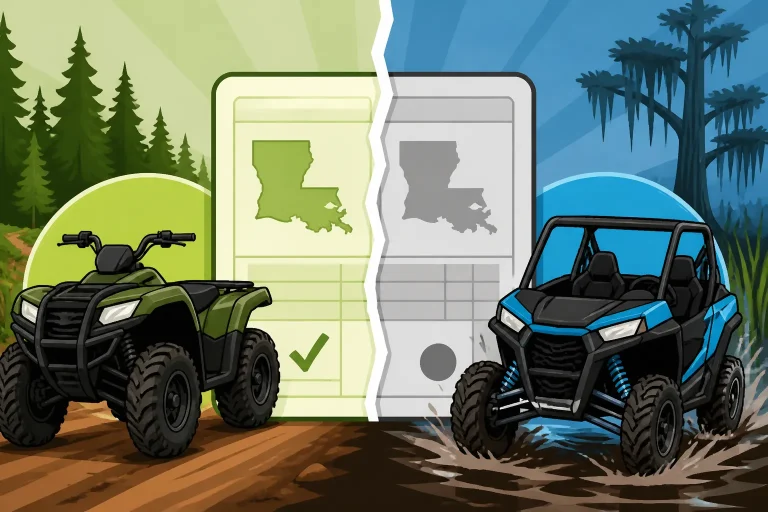
For an ATV or UTV rider, the permit is one part of access planning—not a trail pass that opens every road. It does not replace a required machine permit, a forest-use pass, a hunting license, or any other permission that applies to your activity. A permit also does not grant permission to ride on private land or on a route closed to machines.
It is not the same as a machine permit or forest pass
Several different documents or payments can come up when you are planning outdoor recreation in Louisiana. The names can sound interchangeable, especially when you are trying to sort out access rules at a gate, but they serve different purposes.
A self-clearing permit is associated with recording a visit to a WMA where that system is in use. A WMA machine permit, when required, concerns whether an eligible machine may be used under that area’s rules. A Kisatchie National Forest pass or day-use fee is a separate requirement for certain forest sites. One does not automatically substitute for another.
| Requirement | What it generally addresses | What it does not automatically allow |
|---|---|---|
| Self-clearing permit | Recording a visit where the WMA uses the system | Riding any machine on any road or trail |
| WMA machine permit or authorization | Machine access subject to area rules | Access to closed routes or private land |
| Forest pass or day-use fee | Use of applicable national forest sites | Entry to every WMA or private park |
| Hunting license or activity credential | Eligibility for a regulated activity | General ATV or UTV access |
Before heading out, compare the requirements for the exact property and the activity you have in mind. The broader overview in [Louisiana WMA Permit Requirements] can help you separate permit questions from machine-access and activity rules.
Why riders should complete the permit even for a short visit
It is tempting to think a self-clearing form is only for hunters or people staying all day. A rider who plans to unload, take a short permitted route, and leave may wonder whether the paperwork is worth the stop. If the entrance instructions require a permit, the length of your visit does not make the instruction optional.
A short trip still involves entering managed public land. Completing the form accurately helps avoid the awkward situation of being asked about a permit you skipped because you assumed it was meant for someone else. It also gives you a moment to check posted notices, access restrictions, and any seasonal closures before you unload.
This is especially useful when a group has multiple machines or riders who arrive in separate vehicles. Agree in advance on who will complete the required paperwork and make sure everyone understands the property’s rules. Do not rely on the first person’s permit as proof that every member of the group has satisfied every individual requirement.
How to complete a self-clearing permit at the gate
Find the permit station before you unload
When you arrive, look for the WMA entrance sign, permit station, collection box, or posted instructions. If the entrance has several roads or access points, do not assume that a permit box at one location covers a different entry point. Follow the directions at the access point you are using and check the property’s official access information before your trip.
Stations can be easy to miss when you are focused on maneuvering a trailer, especially in low light or when several vehicles are waiting behind you. Pull over safely before reading or filling out a form. Avoid blocking a narrow entrance while you sort through paperwork or search for a pen.
If you cannot find the permit station, do not guess that the requirement has been waived. Check posted signs, the managing agency’s information for that property, or contact the appropriate office before entering when practical. A little time spent confirming the procedure is preferable to discovering later that you missed a required step.
Fill in the form carefully and follow its handling directions
The form may ask for identifying details, the date, the WMA, your intended activity, or other information. Write legibly and answer each requested field. If you are unsure what an item means, use the instructions on the form or ask the relevant office rather than inventing an answer.
Pay particular attention to whether the permit has entry and exit sections, whether a portion must be deposited in a box, or whether you are instructed to keep a copy with you. These details matter. A common source of confusion is treating every self-clearing form as if it uses the same tear-off arrangement and return process.
The safest habit is simple: read all directions before separating, depositing, or retaining any portion. If you need to carry a copy, keep it somewhere dry and accessible rather than buried under gear in the trailer. For a more detailed walkthrough, see Louisiana Self-Clearing Permit Steps.
Make the permit process part of your arrival routine
A consistent arrival routine reduces the chance of forgetting something when the group is eager to ride. Before unloading, identify the permit station, read the current notices, complete the required form, and confirm that the group understands which routes are open. Then check that each rider has the documents and permissions relevant to their own activity.
For example, imagine a family arriving at a WMA with two ATVs and a youth rider. One adult can handle the permit form while another checks the machine rules and supervises the child. The group can then confirm that the planned route is designated for machines, the machines meet applicable limits, and any age or supervision rules are understood before the trailer ramps come down.
If a friend arrives later, tell them the entry procedure rather than assuming they saw your paperwork. A self-clearing permit is not a group reservation or a substitute for the later rider following entrance instructions. Each visitor should understand what the WMA requires for their own visit.
Where the permit fits into ATV and UTV access
A completed form does not open every route
The most important distinction for riders is between being permitted to enter a property and being permitted to ride a machine on a specific route. A self-clearing permit records a visit; it does not convert a walking path, nature trail, closed road, or unmarked track into an authorized ATV trail.
On a WMA, machine use can be limited to designated routes. Conditions may also include seasonal closures, machine weight or width restrictions, tire rules, and limits on where a vehicle may be parked. A route that looks rideable is not necessarily open to machines. Stay on routes the managing agency identifies as open and do not follow tire tracks as proof of permission.
This is one reason to review Louisiana WMA Riding Rules for Quads and Louisiana WMA Riding Rules for UTVs before traveling. The rules can differ by vehicle type, and a side-by-side that meets one standard may still be restricted by another rule, such as route access or seasonal closure.
Check the rules for the exact WMA and date
WMA rules are not one universal checklist that applies identically across the state. Property boundaries, designated routes, permitted activities, and seasonal access can vary. Conditions can also change when an area closes for management, weather, fire danger, habitat protection, or another reason posted by the managing agency.
Do your research for the specific property, not merely “Louisiana WMA trails.” If you are considering an area near Alexandria, Shreveport, or the Atchafalaya Basin, confirm that the machine route you intend to use belongs to the property you think it does and is open for your planned date. Nearby public land may have a different manager and a different set of requirements.
Seasonality can catch riders off guard. A family may have visited a WMA during one part of the year and assume the same access is available during a later hunting or habitat-management period. Check Louisiana WMA Season Closures and Why WMA Trails Close March Through August as part of planning, then verify current property notices before leaving home.
Check machine limits before loading the trailer
Some WMA access rules focus on details that are easy to overlook until an official checks the machine. Tire dimensions, lug height, tire pressure, vehicle weight, and width can matter on certain properties or routes. Do not assume that a machine is eligible simply because it is marketed as an ATV or UTV.
Read the specific limits that apply to the area and compare them with the machine’s actual specifications. For tire measurements, use the method described by the managing agency rather than relying on a vague estimate from a product listing. If your machine has aftermarket tires, a lift, added accessories, or a cargo rack, make sure you understand which measurements count toward the applicable limit.
The WMA’s rules may be especially relevant to riders who have heavily modified machines for mud. A setup that performs well at a private mud park can be unsuitable for a public trail system with restrictions intended to protect soil and habitat. Review Louisiana WMA Tire Rules Explained and Louisiana WMA Weight Limits Explained instead of assuming that a recreational machine is automatically within the permitted limits.
Self-clearing permits and other Louisiana access requirements
Keep WMA paperwork separate from Kisatchie requirements
A WMA and a national forest are different kinds of public land, and their access rules should not be blended together. A self-clearing WMA permit does not replace an applicable Kisatchie National Forest pass or day-use fee. In the same way, a forest pass should not be treated as a WMA permit.
This distinction matters because outdoor recreation plans often include multiple stops. A rider might camp near a forest trail, visit a WMA on another day, and finish the weekend at a private park. Each destination can have its own operator, entrance procedure, fees, and restrictions. Keep a simple list of each property and the requirements that apply there.
For forest access, review [Louisiana Forest Trail Use Passes] and the relevant information about Louisiana Kisatchie Day Use Passes. If the outing is on a WMA, use the property-specific WMA instructions instead. When a trip includes more than one land manager, confirm each stop separately before the trailer leaves the driveway.
A decal, title, and road permission solve different problems
Louisiana ATV owners can also confuse land-access paperwork with machine ownership and road-use paperwork. A title documents ownership. An off-road decal may be required for certain riding situations. Neither one, by itself, grants access to a WMA trail or makes an ATV street legal.
A rider may have a properly titled machine and still need to follow WMA entrance procedures and route restrictions. Another rider may have completed a self-clearing permit but still be missing a required decal or machine authorization. Think of each requirement as answering a different question: Who owns the machine? Is the machine properly documented? May it be operated on this particular property and route?
For help separating ownership documents from off-road access, see Why an ATV Needs Both a Title and a Decal and Louisiana Decal and Title Together. For road use, consult the specific public-road rules rather than treating a WMA permit as roadway registration.
Private parks and public areas are not interchangeable
A private mud park may ask visitors to sign a waiver, pay an admission charge, or follow park-specific riding rules. A WMA uses a different access system and may prohibit routes or activities that a private park allows. Permission to ride at one location says nothing about permission at another.
That difference can be frustrating when a group is used to riding wide, muddy routes at a private property and then encounters narrower public trails with machine limits. It is not a judgment about which riding style is better; it reflects the different purpose and management of the land. Follow the rules of the property you are actually on.
Before substituting one destination for another, check whether the alternative accepts your vehicle type, whether the planned activity is permitted, and whether the entry process changes. Louisiana Private Park Waivers and Rules is useful for private-park planning, but it should not be used as a guide to WMA access.
A practical planning checklist for a WMA ride
Before you leave home
Start with the exact WMA name and the date of your visit. Find the managing agency’s information for that property, check its current access notices, and confirm whether the self-clearing permit system applies to your planned entry. Look for machine-specific rules and identify the routes designated for the type of vehicle you will bring.
Next, compare your ATV or UTV with applicable limits. Check the machine’s weight, width, and tire setup where those measurements are relevant. If the machine has been modified, do not assume the original factory specifications are enough. A few minutes with the machine manual and the property’s rules can prevent a wasted tow.
Finally, make a document list for everyone in the group. Include anything needed for the activity, the vehicle, and the destination. If you are bringing a child, check age and supervision rules. If you are bringing a UTV, verify passenger and vehicle requirements rather than assuming quad rules cover it too.
At the entrance
Approach the entrance slowly and safely. Look for posted notices and the permit station before unloading. Complete the self-clearing form exactly as directed, and make sure the required portion is handled in the correct way. Keep any portion you are instructed to retain in a dry, accessible place.
Before riding, review the route information one more time. Confirm that the intended trail is designated for your machine, open on that date, and reachable without crossing a closed route. If signs at the site conflict with what you expected, follow the posted restriction and seek clarification from the managing agency.
For a group, take a minute to set expectations: where to meet if separated, who will carry the permit copy if one is required, and what to do if the planned trail is closed. This avoids the familiar scene where one rider heads down an attractive side road while the rest of the group is still checking the map.
When the ride is over
Follow the permit’s directions for the end of your visit. If the form specifies an exit step, do it before leaving. Do not leave a retained portion in a vehicle that is going home with someone else or discard paperwork before you have confirmed that you have completed every required part.
Take your machine out using an authorized route and leave the area as you found it. Avoid cutting around a barrier, riding across vegetation to bypass a closure, or creating a new path around a muddy section. These shortcuts can damage the property and may turn a routine recreational visit into an access violation.
After the trip, note anything that would help you plan the next one: which entrance you used, where the permit station was, whether the route matched the map, and what paperwork you needed. Keep the notes specific to that property. A successful permit routine at one WMA is a useful reminder, not a promise that the next area uses the same procedure.
Common self-clearing permit mistakes to avoid
Assuming the form is optional because no one is stationed at the gate
Self-clearing systems are designed for visitors to handle the process without a staffed booth. The absence of an employee does not mean the permit requirement is suspended. If there is a permit box or posted instruction, stop and read it rather than driving past because nobody is there to collect paperwork.
This mistake often happens when riders arrive early, late, or on a quiet weekday. The entrance may feel informal, especially if other vehicles are already inside. But other visitors’ behavior is not a reliable guide to the rules. Follow the posted directions for your own visit.
If the station is empty, damaged, or missing forms, document the situation mentally and contact the managing office for guidance when practical. Do not fabricate a form or use an unrelated permit from another property. The agency’s own instructions are the best guide when the normal process is unavailable.
Completing the permit but ignoring machine restrictions
A completed permit can create a false sense that the administrative part is finished and the ride is automatically cleared. That is not how the system works. The permit addresses the visit-record process; route access and vehicle restrictions remain separate.
For example, a rider could complete the form correctly and then take a machine onto an undesignated trail. The paperwork would not make the route lawful. A different rider might have the correct machine but fail to complete the entry requirement. Good preparation means handling both issues.
Use a two-part check: first, confirm that you have followed the entrance and permit process; second, confirm that your machine and planned route are allowed. If either answer is uncertain, pause before riding and seek clarification.
Treating old information or another rider’s advice as definitive
A friend may tell you that a certain trail was open last spring or that they never needed to fill out a form. That may be an honest description of their experience, but it does not establish what applies to your visit. Property notices, dates, routes, and rules can differ.
The same caution applies to old screenshots, forum posts, and maps that do not show when they were prepared. They can be useful starting points, but compare them with current official information and signs at the property. If the trailhead notice has changed, do not rely on a cached map to argue your way past it.
Build a habit of checking before every trip, even when you have been there many times. That may feel repetitive, but it is less frustrating than hauling a machine to a closed area or discovering after arrival that your tires or vehicle do not meet the applicable limits.
Questions riders commonly ask
Do you need a self-clearing permit just to ride an ATV on a Louisiana WMA?
The answer depends on the WMA’s instructions and the access system in use there. Where the property requires visitors to complete a self-clearing permit, riders should complete it before entering, even if the visit is brief or the planned activity is recreation rather than hunting.
A permit does not independently authorize ATV use. You must also confirm that the specific WMA allows your machine and that the route is designated and open. Check property-specific information rather than assuming that all WMAs have identical machine access.
Does a self-clearing permit allow a UTV onto a WMA trail?
No. Completing a visitor permit does not, by itself, establish that a UTV is eligible for a particular route. UTVs can have separate restrictions involving weight, width, permitted trails, seasonal access, or other conditions. Verify the rules for both the machine type and the individual property.
If you are taking a UTV, do not use quad guidance as a substitute. Review Louisiana WMA Riding Rules for UTVs and check whether any additional authorization applies to the property.
Is the WMA permit the same as a Louisiana forest pass?
No. A WMA self-clearing permit and a Kisatchie National Forest pass or day-use fee relate to different access systems. If your trip includes both kinds of land, check the requirement for each stop. One permit or pass should not be assumed to cover another property.
What should you do if you cannot find the permit box?
Look for another posted entrance instruction and confirm that you are at the correct access point. If you still cannot determine what to do, contact the property’s managing agency when possible. Do not assume the permit is unnecessary simply because a box or form is difficult to locate.
Should you carry proof after completing the form?
Follow the form’s directions. If the instructions say to retain a portion, keep it with you for the required period and make sure it stays readable. If the permit does not specify a carry copy, do not invent a rule—but keep any confirmation or information the agency tells you to retain.
Can you use a self-clearing permit for hunting and riding?
A self-clearing permit records a visit where the system applies; it does not replace a hunting license or other activity-specific credential. It also does not make machine use permissible where the WMA prohibits it. Check the rules for the activity and machine separately, especially during hunting seasons or periods when access is restricted.
Make the permit one small part of a well-planned ride
A self-clearing permit is easiest to handle when you treat it as one step in a broader access check. Confirm the correct property, complete the entrance form as directed, and check that your ATV or UTV and planned route meet the WMA’s rules. Keep WMA requirements separate from forest passes, ownership documents, decals, and private-park procedures.
Most frustrating permit problems are avoidable: arriving without checking the property’s instructions, assuming an empty gate means no paperwork, or mistaking a completed form for permission to ride anywhere. A quick review before the trip—and a careful look at the entrance signs when you arrive—can help you spend less time sorting out access and more time enjoying a ride that stays within the rules.
Disclaimer
This article is for general informational purposes only and does not constitute professional advice. Laws, prices and regulations vary by location and change over time. Consult a qualified professional for guidance on your specific situation.