Louisiana Poker Runs and Charity Rides
A Louisiana poker run or charity ride can sound simple until you’re trying to confirm the route, understand what your entry fee covers, and figure out whether your machine is allowed on the land. This guide explains how these rides usually work, what to check before you go, and how to plan a safer, smoother day without assuming every event follows the same rules.
How Louisiana poker runs and charity rides work
Poker run basics
An ATV poker run is generally a ride with several checkpoints. At each stop, participants receive a playing card or another piece of a poker hand. After the final checkpoint, the hand is compared with other riders’ hands, and prizes may be awarded. The “poker” part is usually about the game and the event’s scoring rules, not gambling in the usual casino sense—but rules and prize arrangements can differ, so read the event information before paying.
Some runs are organized around a marked course at a private riding park. Others use a trail network, a permitted route, or a combination of riding areas and gathering points. A checkpoint could be a staffed table, a sign-in station, or a designated spot along the course. Organizers may set a starting window, a final check-in time, or a specific route direction to keep riders from bunching up.
A charity ride may use the same general format, but its primary purpose is fundraising. The organizers might collect an entry fee, sell raffle tickets, accept donations, or donate proceeds from food and merchandise. Some events are casual group rides with a donation request rather than a formal poker run. Ask what your entry includes and how the fundraising works instead of assuming every dollar collected goes directly to the stated cause.
What varies from one event to another
There is no single format that applies to every Louisiana ride. One event may be designed for families and newer riders, while another may focus on deep mud, longer routes, or a busy event weekend. A route that looks manageable on a map can feel very different after rain, in heavy traffic, or when a large group spreads out across the trail.
Before registering, look for the basics: the riding location, machine types allowed, route length or riding area, event hours, check-in procedure, age and passenger rules, required safety equipment, and what happens if weather changes the plan. If the announcement only gives a date and a meeting point, contact the organizer and ask for the missing details.
| Event detail | What to confirm before you go |
|---|---|
| Route and land access | Whether the route is on private property, a managed trail, or public roads, and what permissions or permits apply |
| Machine eligibility | Whether ATVs, UTVs, dirt bikes, or other vehicles are allowed, including any size or equipment limits |
| Checkpoints | How many there are, whether riders must visit them in order, and when the last checkpoint closes |
| Registration | What the entry covers, whether advance registration is needed, and how refunds are handled if plans change |
| Safety and conduct | Helmet, passenger, alcohol, speed, noise, and group-riding rules |
| Fundraising | Which organization benefits, what portion of proceeds is donated, and whether donations are optional or included |
A ride’s name does not tell you where it takes place or which rules apply. A “charity ride” is not automatically a public-road ride, and a “poker run” is not permission to ride wherever the route seems to lead. If an event uses a private mud park, start with the organizer’s and park’s posted rules. For an overview of Louisiana riding options, see [Louisiana ATV Trails: Where to Ride] and [Louisiana Private Mud Parks Compared].
Choosing a ride and checking the route
Match the event to your riding experience
Think about the kind of day you actually want—not just the cause or prize. A novice rider who is comfortable on maintained trails may find a crowded mud event tiring or intimidating. A more experienced rider may prefer a longer course, but a challenging route can still be a poor fit if the machine is not set up for mud, the group has mixed skill levels, or recovery support is limited.
Ask whether the route is beginner-friendly and whether riders can take a shorter option or return to the staging area early. If you’re bringing children or a passenger, confirm that the event format and the machine are suitable for them. An event’s general family-friendly description does not replace checking its age, passenger, and helmet policies. Related guidance is available in [Louisiana Trail Difficulty Ratings] and [Louisiana Rules for Passengers on a UTV].
Also consider how the event is paced. Some rides are self-guided, with participants leaving in small groups. Others have a lead rider, sweep rider, or scheduled departure. A self-guided ride may require you to follow markings and manage your own timing; a group ride may require patience when the trail narrows or a machine needs help. Knowing the format helps you decide whether to ride with your usual crew, join a group, or sit the event out.
Confirm where the route is allowed
A route map, social media post, or GPS track does not by itself establish permission to ride. Routes can cross land controlled by different owners or agencies, and access may depend on a specific event permit, a private agreement, a designated trail, or current seasonal conditions. Ask the organizer which areas are included and whether riders are expected to stay on a marked course.
This matters especially when a route appears to follow a parish road, forest road, levee, canal bank, or hunting property. Louisiana has distinct rules for public roads and managed riding areas, and permissions for one location do not carry over to another. Do not treat a road connection on a map as a legal riding connection. For public-land trips, consult [Louisiana WMA Designated Trails Only] and [Kisatchie National Forest OHV Trails in Louisiana] before setting out.
A navigation app can help you understand terrain and keep track of your group, but it cannot grant land access or guarantee that a trail is open. onX Offroad may be useful for reviewing mapped routes and keeping a general sense of where you are, but confirm event-specific directions and access with the organizer and the land manager. If your group uses onX Offroad, download or prepare the information you need before entering an area where cell service may be unreliable.
Preparing for the ride
Get the event details in writing
Before you load the trailer, save the event announcement, registration confirmation, route instructions, and organizer contact information somewhere you can access offline. Check whether riders must arrive during a particular window, where to park, and whether there is a separate staging area for trailers. At a large event, showing up at the right property but the wrong entrance can waste time and create congestion.
If the ride includes a poker hand, understand how cards are distributed and recorded. Ask whether each rider collects a card at every checkpoint, whether the hand is drawn or selected in another way, and when results are announced. Clarify what happens if a checkpoint is missed or a rider arrives after the cutoff. These details may sound minor, but they prevent a frustrating disagreement at the finish.
For a charity event, it is reasonable to ask which organization receives the proceeds and how donations are handled. Look for a named beneficiary and a clear description of the fundraiser. If the event includes a raffle, auction, or separate donation drive, check whether those activities have their own terms. You do not need to be suspicious of every community ride; you simply deserve to understand what you’re supporting.
Prepare your machine and your group
Give the machine a practical check before leaving home. Inspect tires, brakes, steering, lights, battery connections, fluid levels, and any straps or accessories that could come loose. If you’ll be riding in wet conditions, check that the air intake and electrical components are in good shape for the way you intend to ride. A poker run is not the ideal place to discover a weak battery or a tire that has been slowly losing air.
Pack for the location and conditions rather than the event name. Bring water, basic first aid supplies, eye protection, weather-appropriate clothing, and a way to contact your group. Mud, heat, rain, and limited cell service can all affect a Louisiana ride. If the route enters wooded or remote areas, a paper map or saved offline map is a sensible backup. onX Offroad can help your group review a route beforehand, but keep the organizer’s official instructions as your source for event procedures.
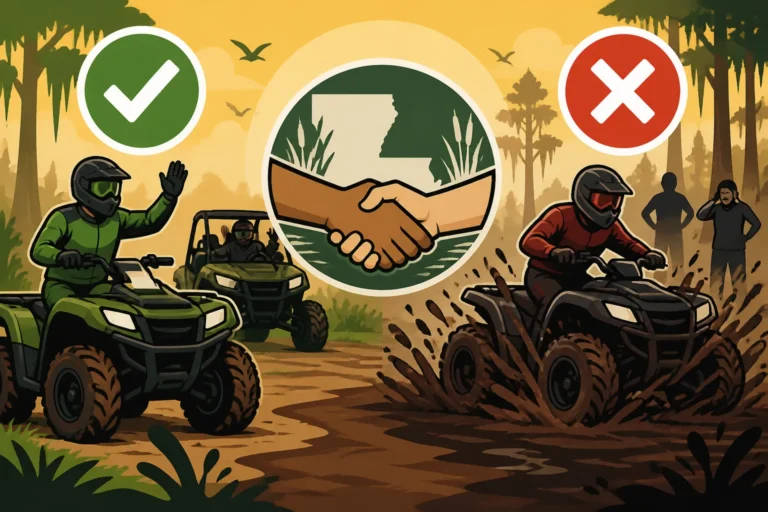
Set a few group expectations before departing. Agree on a meeting point if riders get separated, decide who will ride at the back, and make sure everyone knows not to leave an injured rider or disabled machine alone. Keep enough space to stop safely, avoid dusting out the rider behind you, and don’t pressure less experienced riders to keep up. For more practical preparation, see [Louisiana Trail Etiquette Locals Expect] and [First Aid at a Mud Park].
Riding safely and supporting the cause
Follow event rules and ride within your limits
At the start, listen to the organizer’s briefing even if you have attended similar events. The route may have changed, a checkpoint may have moved, or wet conditions may have led to a closure. Stay on the marked course, follow any one-way instructions, and slow down near check-in areas, spectators, campsites, and intersections.
A charity ride does not suspend normal safety or land-use rules. Wear appropriate protective gear, use a passenger seat only when the machine is designed for a passenger, and keep children within the event’s age and supervision requirements. Avoid alcohol before or during riding. If a machine becomes stuck or develops a problem, move out of the active route when it is safe to do so and let the group know rather than creating a blind obstacle for approaching riders.
Give other participants room to make mistakes. A rider may stop to read a marker, help a friend, or wait for a slower machine. On narrow trails, be patient and communicate clearly before passing. Mud and dust can hide ruts, branches, and standing water, so don’t follow so closely that you have no time to react. Even a familiar trail can change after heavy rain; check [Louisiana Trail Conditions After Rain] when weather has been unsettled.
Make the fundraising part meaningful
A well-run event makes it easy to understand how to participate and what the beneficiary is. You can support the cause by paying the entry fee, making an additional donation if you choose, buying food or merchandise, or sharing the event with others. If you are helping organize, state clearly whether an amount is an entry fee, a voluntary donation, or payment for a separate activity.
For participants, keep receipts or confirmations for registration and donations if you need them for your own records. Do not assume that every payment is tax-deductible; that depends on how the fundraiser is organized and the recipient’s status. If that matters to you, ask the organizers what documentation they provide and seek qualified tax guidance for your circumstances.
After the ride, follow through on any practical responsibilities: check that your machine is secure before towing, clean mud from equipment before it dries, and report a safety issue or route marker problem to the event staff. If you had a good experience, a thoughtful review or a direct thank-you can help local organizers keep community events going. When the next event comes around, compare its route, access details, and rules anew rather than assuming they will be identical.
Disclaimer
This article is for general informational purposes only and does not constitute professional advice. Laws, prices and regulations vary by location and change over time. Consult a qualified professional for guidance on your specific situation.