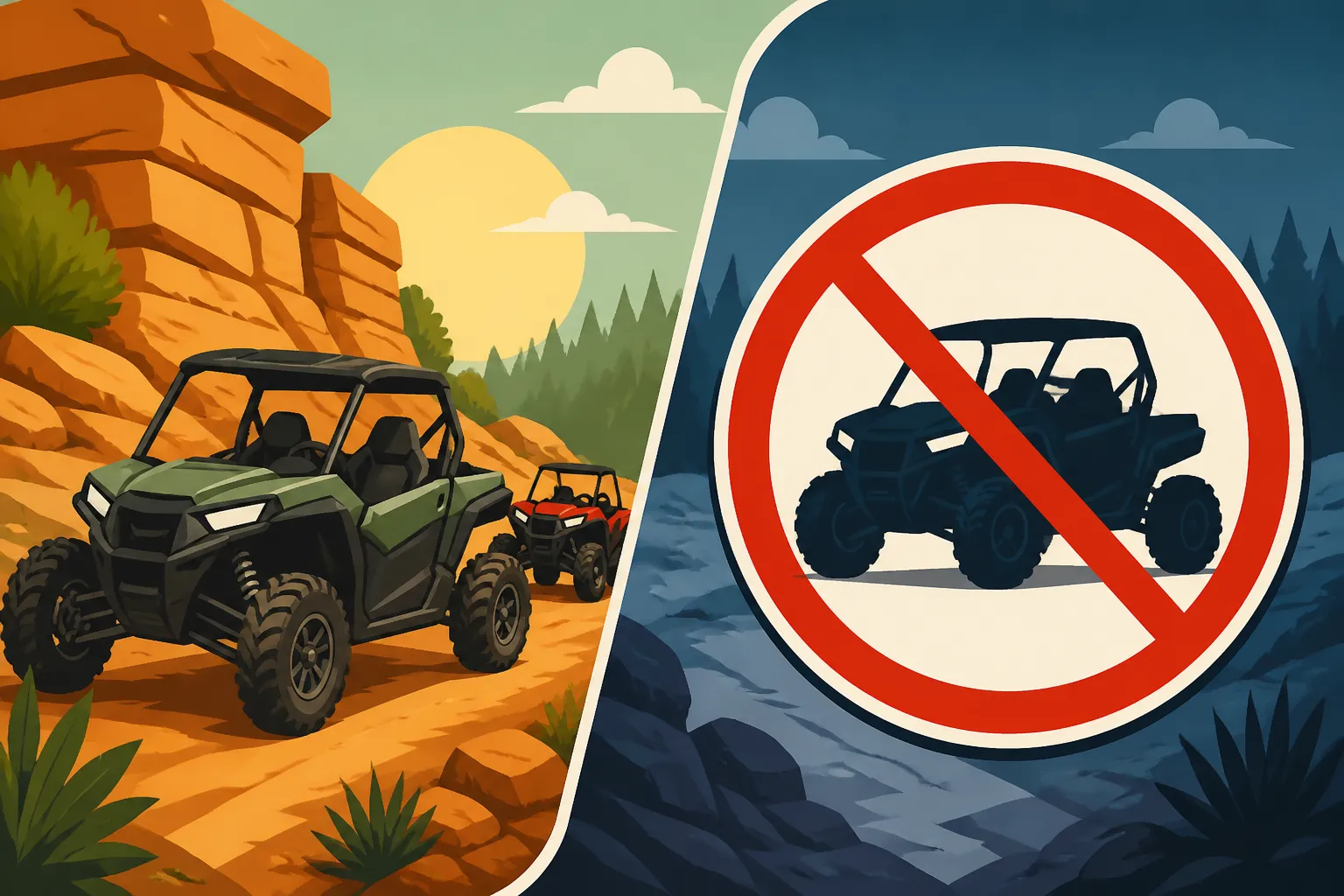
Sandstone Trail Closes to Motors January Through April
Sandstone Trail’s motorized closure from January through April can disrupt a carefully planned Louisiana riding weekend, especially if you have already lined up a trailer, a group, or a place to stay. This guide explains what the seasonal closure means, how to plan around it, what to check before heading to the Kisatchie National Forest, and how to avoid mistaking a mapped trail for one that is open to motorized use.
What the January Through April Closure Means
Motorized riding is off the table during the closure
The closure period in the title is straightforward: motorized trail use at Sandstone is closed from January through April. If you are planning to ride an ATV, UTV, or another motorized off-highway vehicle there during those months, do not treat the trail as an option unless current official information specifically says otherwise.
It helps to think of the closure as a restriction on motorized access, not as a suggestion about when riding might be less convenient. A quiet trail, an open gate, or a route visible on a map does not by itself mean motorized travel is allowed. A rider who unloads because the trail looks passable can still be on the wrong side of a seasonal restriction.
The seasonal dates also matter for practical planning. January through April includes several stretches when riders may be tempted by a mild weekend, a break in the rain, or a free day before summer heat arrives. But a pleasant forecast does not change a scheduled closure. Before you make the drive, check the current official trail information and any signs or notices at the access point.
The closure does not automatically settle every other use
A trail name can be misleading if you assume that “closed to motors” means every kind of access is prohibited, or that nonmotorized access is always allowed. Those are separate questions. Whether hiking, biking, horseback riding, or another activity is permitted during a motorized closure depends on the current rules for that trail and area.
That distinction matters if you are traveling with friends or family who do not all ride. A group might decide that riders will use a different area while others hike nearby, but that plan should be based on the rules for the specific location—not on an assumption that a motorized closure leaves every other activity open. Check the notice for the activity it covers and follow posted directions.
For more context on how seasonal access can differ across Louisiana riding areas, see [Louisiana Trail Closures and Seasons]. The important takeaway is to check the exact activity and trail segment you have in mind. A general forest map or an old trip report may help you orient yourself, but it does not replace current access information.
When to Plan a Sandstone Riding Trip
Treat May 1 as a planning milestone, not a guarantee
The listed seasonal closure runs through April, and Sandstone is identified as opening to OHVs on May 1. That makes May 1 a useful date to keep in mind when sketching out a riding calendar. But it is still wise to confirm the trail’s status before leaving home. A scheduled seasonal opening does not mean every section will necessarily be accessible under every condition.
For example, imagine you have booked a cabin near the Kisatchie area and invited three other riders for the first weekend of May. Before you load the machines, check for updates about trail status, access points, and any temporary restrictions. If conditions have changed, catching that information at home is much easier than discovering it after towing several hours.
You can read more about the seasonal opening in [Sandstone Trail Opens to OHVs on May 1]. Use the date as a planning cue, then verify what is actually open for your intended visit. That small extra step can save a group from arriving with no legal place to ride.
Choose dates with weather and trail conditions in mind
The first available riding date is not always the best riding date. In Louisiana, rain can affect trail conditions, access roads, and the experience of getting in and out with a truck and trailer. A trail that is technically open may still be muddy, difficult, or subject to a temporary closure after severe weather.
Give yourself room to change plans. If your trip is tied to a fixed event or a nonrefundable stay, identify a backup riding area in advance and check its rules separately. If the trip is flexible, choose a date after you have checked the latest trail and weather information. A little flexibility is especially valuable for riders bringing a larger group, because one vehicle getting stuck or one route being unavailable can change everyone’s day.
For a useful overview of how conditions affect ride planning, see [Louisiana Trail Conditions After Rain]. The practical point is not to guess at trail conditions from the sky over your house. Conditions can vary between your starting point and the forest, so check local information close to departure.
How to Check Whether Sandstone Is Open
Start with official trail and forest information
Before the trip, look for current information from the managing agency or the relevant forest office. Check the specific Sandstone trail page or status notice, and look for updates that identify the date, the affected route, and the type of use being restricted. If the information is unclear, contact the appropriate office rather than relying on a guess.
A trail status check is most useful when it happens more than once. Check while you are choosing dates, then check again shortly before you leave. If you are traveling from outside the area, consider checking on the morning of departure as well. That may feel repetitive, but it is much less frustrating than arriving to find a gate closed or a route restricted.
The guide [Louisiana Forest Trail Status Pages] can help you build this check into your trip routine. When you review a notice, pay attention to its date and wording. An old closure announcement may no longer apply, while a recently posted restriction may cover only a particular segment or activity.
Use maps for navigation, not permission
Digital maps are useful for seeing where routes run and how they connect, but a route appearing on a map is not proof that it is open to motorized travel. This is true whether you use a paper map, a phone app, or an off-road navigation tool. Maps may show roads or trails that are closed seasonally, restricted to certain users, or temporarily unavailable.
Tools such as onX Offroad can help you plan where a route sits in relation to access points and nearby roads. If you use an app, download the map area before you leave, especially if you expect limited cell service. Keep in mind that an app is a navigation aid—not the authority on whether a route is open today. Confirm access rules using official information and obey posted signs on the ground.
A paper map can be a useful backup if your phone battery runs down or you lose service. The [Louisiana ATV Trail Map Downloads] page is another helpful starting point for trip planning. Whichever map you use, compare it with current closure information rather than treating the line on the screen as permission to ride.
| What you are checking | Why it matters | Good planning habit |
|---|---|---|
| Seasonal dates | Motorized use is closed January through April | Do not schedule a motorized Sandstone ride during the closure |
| Current trail status | Temporary restrictions can affect a planned visit | Check official information before departure |
| Activity rules | A motorized closure may not answer rules for other uses | Confirm the rules for your specific activity |
| Route and access point | A map may show routes that are closed or restricted | Follow current notices and posted signs |
| Weather and trail conditions | Rain can affect access and rideability | Check local conditions close to the trip |
| Backup option | A closure or poor condition can change the day | Identify another legal riding area before towing |
Planning Around the Closure
Pick an alternative that matches your machine and riding style
If your preferred dates fall between January and April, start by deciding what you want from the day. Are you looking for a maintained forest trail, a private mud park, a route that works for a side-by-side, or a place where newer riders can take things slowly? The answer will help narrow your alternatives more effectively than simply searching for “ATV trails near me.”
Check the rules for each alternative independently. Riding permission, seasonal access, vehicle limits, fees, camping options, and trail difficulty can differ from one location to another. Do not assume that because a different area is also in Kisatchie National Forest—or is nearby—it follows Sandstone’s schedule or allows the same machines.
If you are comparing other forest routes, [Louisiana's Sandstone Multiple-Use Trail] and [Louisiana's Claiborne Multi-Use Trail] are relevant starting points for understanding Louisiana trail options. For a broader look at possible destinations, browse [Louisiana ATV Trails: Where to Ride]. Confirm current access for the specific destination you choose, rather than making a last-minute switch based only on distance.
Make the trip plan useful for everyone in the group
A closure can be especially frustrating when one person organizes the trip and everyone else assumes the riding location is settled. Share the dates, access information, and backup plan with the group before the machines are loaded. If someone is bringing a passenger, a youth rider, or a machine with a different size or setup, check that the alternative area’s requirements fit the whole group.
It is also worth agreeing on a turnaround plan. For instance, decide in advance what you will do if the primary area is closed, the route is too wet, or the group arrives later than expected. A backup can be another confirmed riding area, a different day, or a non-riding activity nearby. That conversation may not be exciting, but it prevents the familiar parking-lot debate after a long drive.
Once you have a destination, review [Louisiana Trail Etiquette Locals Expect]. Good planning includes more than knowing where the trail begins. Respect posted restrictions, keep to routes open for your vehicle, and avoid making a temporary inconvenience worse by creating a new route around a closure.
Common Mistakes to Avoid
Do not rely on an old trip report or a map pin
Trip reports can be helpful for learning what a ride felt like, how people reached a trailhead, or what kind of terrain to expect. Their weakness is that they reflect a particular time. A post from a previous season may describe a route that is now closed, or it may have been written before a temporary restriction was put in place.
Map pins have the same limitation. They can point to a trail entrance without telling you whether motorized use is currently allowed. Even a recent-looking map may not include the latest closure notice. Use these resources as clues for planning, then verify the legal status through current official channels.
This is where a layered approach helps: check the official status, compare it with your map, and pay attention to signs when you arrive. If those sources conflict, do not assume the most convenient one is correct. Pause and get clarification before riding.
Do not confuse access with trail readiness
A trail being open does not guarantee that it will be comfortable or suitable for every machine, rider, or group. Recent rain, standing water, damaged approaches, or changing conditions can make a route more demanding than expected. A novice rider may have a very different day on the same trail than someone who has spent years riding in Louisiana mud.
Before unloading, consider your machine, tires, recovery gear, and experience. If the trail looks beyond your group’s ability, turning around is a sensible decision, not a wasted trip. For a planned visit after wet weather, review [Louisiana Trail Closures and Seasons] alongside current conditions and any local notices.
Finally, avoid riding around a gate, barrier, or closure sign to reach a route. A detour can damage land, put riders in an unauthorized area, and create confusion for the next group. If Sandstone is closed to motors, choose a confirmed alternative or reschedule. Planning around the closure is far easier than trying to justify a ride after ignoring it.
A Practical Pre-Trip Checklist
Before you tow to Sandstone or choose another Louisiana riding area, work through a short checklist:
- Confirm the date. Sandstone’s motorized closure covers January through April. Plan a motorized visit outside that period.
- Check current official status. Look for seasonal notices, temporary restrictions, and access updates close to your trip.
- Verify the activity and vehicle. Confirm that your ATV or UTV is allowed on the route you intend to ride.
- Check conditions. Review local weather and trail information, especially after heavy rain.
- Compare your map with current notices. Use apps such as onX Offroad for navigation, but not as proof of access.
- Choose a backup. Identify another area with rules that fit your machine and group.
- Review posted signs at the site. Follow the instructions in place when you arrive.
- Tell the group what to expect. Share the plan and the backup before anyone starts towing.
A final map review can also help your group understand where you are going and where you can safely regroup if someone falls behind. If you rely on onX Offroad, save the relevant area for offline use and make sure other riders know that official notices and posted signs take precedence over the app.
The seasonal closure does not have to derail a Louisiana riding season. It simply means Sandstone is not a motorized option from January through April. Plan around those dates, verify status before you go, and keep a legal alternative in reserve so a changed plan does not become a wasted weekend.
Disclaimer
This article is for general informational purposes only and does not constitute professional advice. Laws, prices and regulations vary by location and change over time. Consult a qualified professional for guidance on your specific situation.