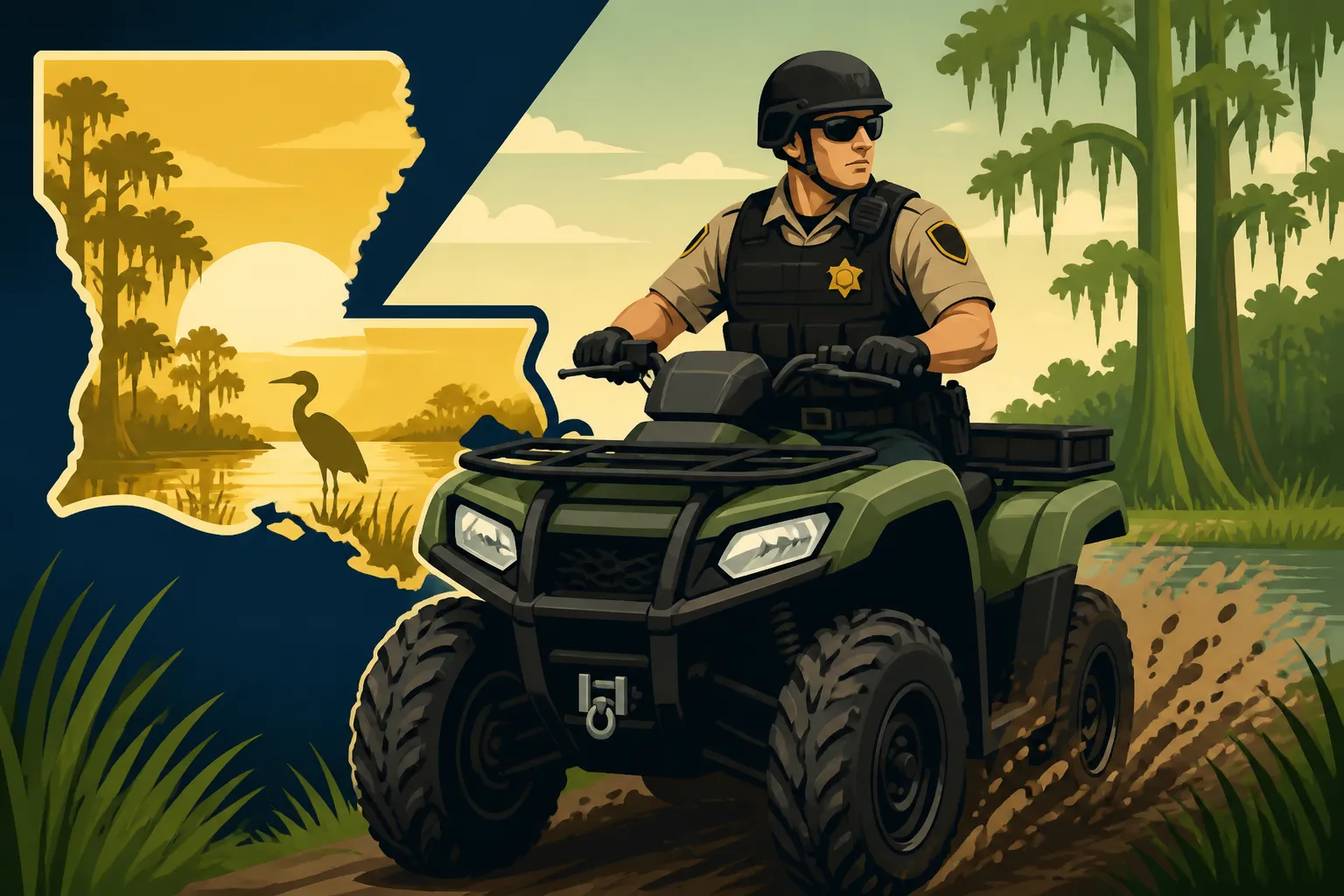
Law Enforcement Riding a Quad on Duty
It's easy to think of law enforcement vehicles as just patrol cars cruising down the highway, but here in Louisiana, our unique and often challenging terrain means our officers need a different kind of horsepower. For many folks who enjoy the outdoors, seeing an ATV or UTV with flashing lights might raise an eyebrow, especially since we're all so carefully tracking [Louisiana ATV Road Rules Under 32:299] and navigating the complexities of where we can and cannot ride. This guide is all about shedding light on why and how our law enforcement agencies utilize off-road machines to serve and protect, and what that means for you as a rider or citizen encountering them.
The Unique Role of ATVs and UTVs in Louisiana Law Enforcement
Louisiana's landscape is a diverse tapestry of bayous, swamps, dense forests, winding levee systems, and expansive agricultural fields. This isn't your typical grid-patterned urban environment, and traditional patrol vehicles simply can't reach every corner. This is precisely where ATVs (All-Terrain Vehicles) and UTVs (Utility Terrain Vehicles, often called side-by-sides) step in, becoming indispensable tools for various law enforcement agencies across our great state.
Bridging the Gap: Accessing Challenging Terrain
Imagine a situation where a missing person is believed to be lost deep within a remote hunting lease in Vernon Parish, or a flood has left entire rural roads impassable in Plaquemines Parish. A standard police cruiser would quickly get stuck, wasting critical time in an emergency. This is where the agility and off-road capabilities of ATVs and UTVs shine. Agencies like the Louisiana Department of Wildlife and Fisheries (LDWF) rely heavily on these machines to patrol vast wildlife management areas (WMAs), enforce hunting and fishing regulations, and respond to incidents far from paved roads. They're also crucial for parish sheriffs' departments needing to reach isolated camps, investigate reports of illegal activity on private timberland, or conduct search and rescue operations along muddy riverbanks. For instance, navigating a freshly rained-on logging trail or traversing the batture lands along the Mississippi River requires a machine built for that purpose, and nothing beats a side-by-side for carrying multiple officers and necessary equipment through such conditions.
Think about the massive agricultural operations we have, especially in areas growing sugarcane or rice. These farms often have miles of private field roads and levees that are not publicly accessible and can be incredibly muddy after a rain. If there's a report of equipment theft or trespassing, law enforcement needs to be able to get to those locations quickly. These machines allow officers to cover ground that would be impossible on foot or by truck, ensuring a rapid response in rural settings where every minute counts.
Beyond Patrol Cars: Specialized Operations
The use of ATVs and UTVs extends far beyond just getting to hard-to-reach places. These vehicles are integral to a variety of specialized law enforcement operations that demand specific capabilities. For instance, during large-scale public events, such as festivals in Lafayette or Mardi Gras parades in smaller towns, crowd control and rapid response in pedestrian-heavy areas are paramount. A UTV, with its ability to navigate tight spaces and carry personnel and medical equipment, becomes a mobile command center or first-aid station, offering quick access without the bulk of a patrol car.
Furthermore, our state troopers often use these machines for coastal patrols, monitoring sensitive ecological areas or responding to incidents on remote stretches of beach where traditional vehicles are forbidden or impractical. In the aftermath of hurricanes, when infrastructure is often severely damaged, ATVs and UTVs are critical for damage assessment, delivering supplies, and reaching stranded residents. Their versatility means they can be adapted with specialized equipment, from tow hooks for pulling out stuck vehicles to mounted spotlights for night operations, or even specific cargo beds to carry everything from medical supplies to K9 units. Companies like SuperATV offer heavy-duty accessories that can easily upgrade standard UTVs for these demanding applications, providing robust winches, protective skid plates, and enhanced lighting systems that are essential for operations in harsh environments.
Legal Framework: Exemptions for Official Use
It's common knowledge among Louisiana riders that off-road vehicles like ATVs and UTVs generally aren't street legal. You've probably spent time studying [Louisiana Rules for Riding a Shoulder] or figuring out [Louisiana Rules for Crossing a Highway] to make sure you're compliant. So, when you see a sheriff's deputy on a quad on a public road, it might seem contradictory. However, Louisiana law specifically carves out exemptions for official government use, recognizing the necessity of these machines for certain duties.
Understanding Louisiana's Off-Road Vehicle Statutes
Louisiana Revised Statute 32:299 (which specifically addresses ATVs) and 32:299.3 (which covers UTVs) lay out the general restrictions for operating these vehicles on public roads and highways. They explicitly state that ATVs and UTVs are generally not permitted on public roads unless specific conditions are met, such as crossing a highway, incidental farm use within a five-mile radius, or designated parish roads. However, both statutes include language that provides exemptions for "authorized emergency vehicles."
Specifically, under R.S. 32:299.1(B)(5), an "all-terrain vehicle operated by a law enforcement officer while in the performance of his official duties" is exempt from the typical prohibitions. A similar exception exists for UTVs. This means that when a law enforcement officer, whether it's a state trooper, a parish deputy, or an LDWF agent, is operating an ATV or UTV as part of their official duties, they are not subject to the same restrictions as a civilian rider. This isn't a loophole; it's a deliberate legal provision to ensure that our first responders and law enforcement can effectively do their jobs, especially in situations where conventional vehicles are inadequate. This legal allowance recognizes the necessity for officers to access areas and perform tasks that are simply impossible without these specialized machines, ensuring public safety and enforcement regardless of the terrain.
When "On Duty" Changes the Rules
The key phrase here is "in the performance of his official duties." This isn't a blanket permission for any officer to ride their personal ATV down Main Street. It specifically applies when the officer is actively engaged in their professional responsibilities, using a department-issued or authorized vehicle. This could mean:
- Responding to an emergency call: If a 911 call comes in from a remote fishing camp accessible only by a winding, unpaved track, an officer on an ATV/UTV can get there quickly, often faster than a vehicle trying to navigate difficult terrain.
- Patrolling inaccessible areas: Wildlife and Fisheries agents regularly patrol WMAs and remote bayou regions, areas where [Louisiana Levee Riding Is Prohibited] for civilians, but where officers need access to enforce regulations, monitor wildlife, or respond to illegal activity. These patrols are a clear "official duty."
- Search and rescue operations: In situations involving missing persons, disaster relief, or evidence searches in rough terrain, the ability to cover vast, rugged areas quickly and efficiently is paramount.
- Special event security: Providing security and crowd management at large outdoor gatherings or parades often requires vehicles that can navigate dense crowds and restricted areas.
These exemptions are critical for public safety and effective law enforcement in Louisiana's unique environment. Without them, response times in rural or challenging areas would be significantly hampered, putting lives and property at greater risk. It's a pragmatic approach to ensure that officers have the tools they need to do their job, whether it's preventing [Louisiana Trespass Law for Riders] violations or responding to a critical incident.
Equipping and Training for Off-Road Operations
You wouldn't send a highway patrolman into a deep swamp on a bicycle, right? The same logic applies to off-road operations. Law enforcement agencies don't just hand an officer the keys to a quad and say "go." There's a significant investment in specialized equipment and rigorous training to ensure both officer safety and operational effectiveness.
Specialized Gear and Vehicle Modifications
For law enforcement, an ATV or UTV isn't just a recreational toy; it's a tactical vehicle. This means they often come with significant modifications and specialized gear that differentiate them from civilian machines. You'll typically see:
- Emergency Lighting and Sirens: Just like a patrol car, these machines are equipped with flashing blue and red lights and sirens to establish their authority and alert the public, especially when operating on or near public thoroughfares, even with the [Louisiana Law Enforcement Exceptions].
- Communication Equipment: Two-way radios are standard, often integrated into helmets or vehicle systems, ensuring officers can communicate with dispatch and other units, even in remote areas where cell service might be spotty.
- Cargo and Storage Solutions: Many UTVs used by law enforcement have customized beds or racks to carry essential equipment, such as first-aid kits, rescue gear, evidence collection tools, K9 kennels, or even specialized surveillance equipment. Brands like SuperATV are well-known for producing robust cargo racks, storage boxes, and bed extenders that can withstand the rigors of law enforcement use and provide secure storage for critical tools.
- Protective Upgrades: Heavy-duty bumpers, skid plates, and brush guards are common additions to protect the vehicle from impacts in rugged terrain, allowing them to push through brush or over obstacles that would damage a standard machine.
- Navigation Systems: GPS units, often ruggedized and pre-loaded with detailed topographical maps, are crucial for navigating unfamiliar or off-grid areas, especially during search operations or patrols in vast areas like the Kisatchie National Forest.
These modifications ensure that the machines are not only capable of handling the terrain but are also fully functional as mobile command or response units, equipped for almost any scenario an officer might face in the field.
Officer Training and Safety Protocols
Operating an ATV or UTV effectively and safely, especially under emergency conditions, requires specialized skills. Law enforcement agencies don't just rely on an officer's personal riding experience; they provide comprehensive training programs. This training typically covers:
- Basic and Advanced Riding Techniques: Officers learn how to safely operate these machines on various terrains, including mud, sand, water crossings, steep inclines, and through dense vegetation. This includes mastering techniques for vehicle recovery, like using a winch effectively, and understanding the machine's limits.
- Tactical Operation: Training often incorporates tactical scenarios, such as pursuit driving in off-road environments, vehicle interdiction, and safely approaching suspects in remote locations.
- Maintenance and Field Repairs: Officers may receive basic instruction on common field repairs and routine maintenance to keep their vehicles operational in remote areas, reducing downtime.
- Situational Awareness: A significant component of training focuses on maintaining situational awareness in dynamic environments, identifying potential hazards, and understanding the unique challenges of operating an open-air vehicle in various weather conditions.
- Safety Gear and Protocols: Officers are trained on the importance of wearing appropriate personal protective equipment (PPE), including helmets, eye protection, gloves, and protective clothing. Departments have strict protocols regarding safe operation, passenger limits, and speed restrictions based on terrain and mission. You might wonder, for instance, [Is a Helmet Required on a Louisiana UTV?] for them – and for good reason, safety is paramount.
This rigorous training and specialized equipping aren't just about protecting the officers; they're about ensuring that when law enforcement uses these machines, they do so professionally, efficiently, and with the utmost regard for public safety.
Interacting with Law Enforcement on Quads: What Riders Should Know
So, you're out enjoying a ride on a designated trail or perhaps on a private property with permission, and you encounter an officer on an ATV or UTV. It's a scenario that might catch some off-guard, but knowing what to expect can make the interaction smooth and respectful.
Recognizing an Official Machine and Officer
The first thing to remember is that an officer on an ATV or UTV, especially one in uniform with a clearly marked vehicle, holds the same authority as an officer in a patrol car. Their machine will typically be identifiable:
- Markings: Most agency-owned ATVs and UTVs will have agency decals (e.g., "Sheriff," "LDWF," "State Police") prominently displayed.
- Emergency Equipment: Look for flashing lights (blue/red or amber, depending on the agency and specific role) and potentially a siren.
- Uniform: The officer will be in official uniform, often with a badge and identification visible.
If an officer on an ATV/UTV signals you to stop, you should comply just as you would for any other law enforcement vehicle. Pull over safely, turn off your engine, and keep your hands visible. Trying to outrun an officer on an ATV in off-road terrain is a dangerous and ultimately futile endeavor that can lead to serious legal consequences, including [Louisiana Penalties for Illegal Road Riding]. Remember, they are often patrolling specific areas precisely because they are hard to access, and they are trained for these environments.
Your Rights and Responsibilities During an Encounter
When an officer approaches you on an ATV or UTV, the interaction largely mirrors any other traffic stop or field encounter. You have rights, and you also have responsibilities:
- Be Polite and Cooperative: A respectful demeanor goes a long way.
- Provide Identification: The officer will likely ask for your identification, proof of ownership for your machine, and possibly proof of any required permits or [Louisiana WMA Access Permits] if you are on public land. This is where knowing [What a Louisiana State Trooper Can Ask to See] becomes really important. They are well within their rights to verify your identity and ensure your machine is legally operated.
- Answer Questions Truthfully: You are generally required to provide your name and address. You have the right to remain silent regarding questions that might incriminate you, but you should clearly state that you are exercising that right.
- Comply with Instructions: If an officer instructs you to stay in a certain area, move your machine, or put your hands on the handlebars, comply with those instructions for safety reasons.
- Documentation: Always carry the necessary paperwork for your ATV/UTV. This includes your title, registration (if applicable, though ATVs generally aren't registered like cars), and any permits for the area you're riding. For example, if you're riding a WMA, you'll need your [Louisiana Self-Clearing Permit Steps] complete. Without it, you could face fines. [Louisiana Requires an Assigned Title for a Used One] when you buy it, so make sure that paperwork is always with you, even if it's just a copy.
Officers on ATVs and UTVs are integral to maintaining safety and enforcing laws across Louisiana's diverse landscape. Understanding their role, the legal framework that allows them to operate, and how to interact with them respectfully ensures a safer and more positive experience for everyone enjoying the great outdoors.
Disclaimer
This article is for general informational purposes only and does not constitute professional advice. Laws, prices and regulations vary by location and change over time. Consult a qualified professional for guidance on your specific situation.