Louisiana Rules for an Out-of-State Machine
Bringing your beloved ATV or UTV into a new state for a weekend of riding, a hunting trip, or a family vacation often comes with a host of questions and anxieties. You've heard whispers about different rules for titles, decals, and even how you can use your machine on certain roads, and it's easy to feel overwhelmed by the thought of accidentally breaking a law. This guide is here to untangle the specific rules and expectations for out-of-state ATV and UTV owners planning to ride in Louisiana, helping you understand everything from required paperwork to road use and trail access.
Understanding Louisiana's Core Off-Road Vehicle Requirements
Navigating the specific requirements for off-road vehicles (ORVs) in Louisiana can feel like learning a new language, especially when you're coming from another state. The key thing to remember is that Louisiana has a dual system for ATVs and UTVs: a title, and an off-road decal. For out-of-state riders, the decal is often the most immediate concern, as it's what local law enforcement and park rangers will look for when you're out enjoying the trails or traversing certain roads.
Decal Requirements for Visitors
Let's cut right to it: if you plan to ride your ATV or UTV anywhere in Louisiana other than entirely private land (like a friend's hunting lease or a commercial mud park), you're going to need a Louisiana off-road decal. This is one of those rules that often catches visitors by surprise. Even if your machine is fully registered and street-legal in your home state, Louisiana has its own set of rules for off-road use on public land or designated roads. The state issues [Louisiana's Yearly Off-Road Decal], which signifies that your machine is recognized by the Louisiana Department of Public Safety and Corrections, Office of Motor Vehicles (OMV). This decal isn't about making your machine street-legal on every road, but rather about acknowledging its presence for off-highway use. It's a small sticker that goes a long way in keeping you on the right side of the law while enjoying our beautiful state.
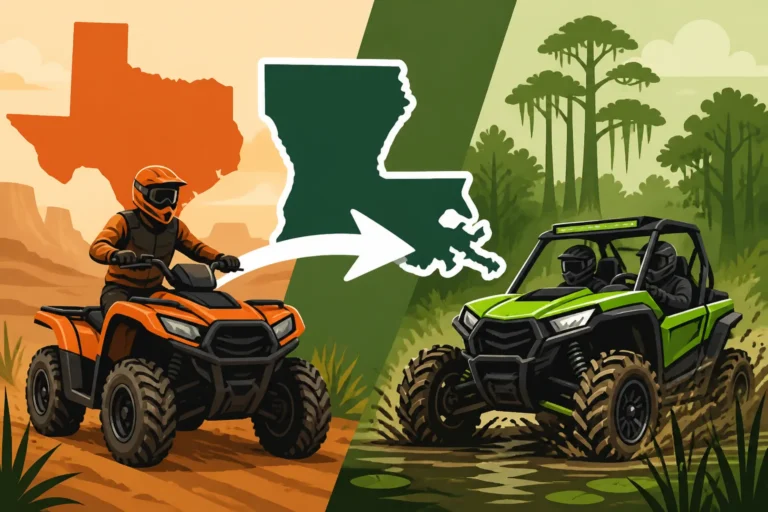
The cost for this decal is usually quite minimal, designed to cover administrative costs rather than generate significant revenue. While your home state might have a similar sticker, Louisiana doesn't typically offer reciprocity for out-of-state ORV decals. So, even if your Texas ATV has a current Texas Parks and Wildlife decal, you'll still need to secure a Louisiana one if you plan to ride in, say, Kisatchie National Forest or a state wildlife management area (WMA). Think of it like a temporary permit to play in Louisiana's sandbox. Failing to have one can lead to [Louisiana Penalties for No Decal], which nobody wants when they're trying to have a fun vacation.
Title and Registration Nuances for Out-of-Staters
When it comes to titles, out-of-state owners generally don't need to retitle their machines in Louisiana if they are merely visiting. Your existing title from your home state remains valid as proof of ownership. Louisiana uses titles primarily for ownership tracking and sales tax purposes within the state, as detailed in [Louisiana ORV Decals and Titles Explained]. As a visitor, you're not engaging in a sale within Louisiana or becoming a permanent resident, so the complexities of transferring a title usually don't apply to you.
However, if you're moving to Louisiana permanently with your ATV or UTV, that's a different story. In that scenario, you would be required to obtain a Louisiana title for your machine, just like you would for a car or truck. But for the purposes of a temporary visit, simply having your out-of-state title or registration documents readily available is usually sufficient to prove ownership if ever requested by authorities. The main hurdle for short-term visitors really revolves around that ORV decal for actual riding.
Proof of Ownership on the Trail
Regardless of whether you're from Louisiana or just visiting, having proof of ownership with you when you ride is always a smart move. While you don't necessarily need to carry your actual title document (it's often best to keep that secured at home), a copy of your title or vehicle registration from your home state, along with your driver's license, is highly recommended. This is particularly important if you are pulled over, involved in an accident, or if a park ranger questions the legality of your machine.
Consider putting copies of these documents, perhaps laminated, in a waterproof bag that you keep on your machine. This practice provides peace of mind and can simplify any unexpected interactions with law enforcement. [Louisiana Equipment Checks by Troopers] are a reality, especially in rural areas or near popular riding spots, and being prepared demonstrates responsibility and can prevent unnecessary delays or complications.
Road Use Rules for Visiting Riders
One of the biggest areas of confusion, for both residents and visitors alike, is the question of riding ATVs and UTVs on public roads in Louisiana. Many states have vastly different rules, and what's permissible in Texas or Arkansas might get you a hefty ticket in the Pelican State. Louisiana's laws are quite specific, and it's crucial to understand them before you venture onto any paved or gravel public road.
Parish and Municipal Ordinances
Generally, [Can You Ride an ATV on the Road in Louisiana]? The answer is, with very specific exceptions, usually "no." Louisiana state law, specifically Louisiana Revised Statute 32:299 (for ATVs) and 32:299.3 (for UTVs), largely prohibits the operation of these machines on public highways and roadways. However, there's a significant nuance: parishes and municipalities have the authority to create their own ordinances to designate specific roads or streets for UTV use. This means that while state law is restrictive, your ability to ride a UTV on a public road often depends entirely on the specific parish or town you're in.
This patchwork of regulations means that what's legal in, say, Vernon Parish, might be completely illegal just across the parish line in Rapides. For out-of-state riders, this can be incredibly frustrating. Before you even think about putting a wheel on a public road, you must check the local ordinances for the specific parish or municipality you'll be visiting. This often means a quick call to the parish sheriff's office or checking their official website. If you're wondering about [Louisiana UTV Street Legal Rules by Parish], you'll find that many parishes have not designated roads, keeping the state-level ban firmly in place. Don't assume anything; always verify locally.
Farm Exemption and Its Limitations
Louisiana law does offer a specific exemption for ATVs and UTVs used for agricultural purposes. If your machine is primarily used in the production of agricultural products, forestry, or similar activities, you might be able to operate it on the shoulder of a public highway, within five miles of your farm, during daylight hours, solely for agricultural purposes. This exemption also generally requires the machine to have the state-issued ORV decal.
However, for most out-of-state visitors, this "farm exemption" simply doesn't apply. You're likely visiting for recreation, hunting, or other non-agricultural purposes. Even if you're using your ATV on a friend's farm for hunting, that typically falls outside the strict definition of "agricultural purposes" as intended by the statute for road use. It's a very narrow exemption designed for working farmers, not recreational riders. Attempting to claim this exemption as a visitor for casual riding is almost certainly going to lead to a citation. So, unless you're legitimately moving equipment from one part of a working farm to another, assume this exemption isn't for you.
Equipment and Safety Considerations for Louisiana Roads
Should you find yourself in a parish or municipality that has designated certain roads for UTV use, there are typically very strict equipment and safety requirements that mirror those of street-legal vehicles. These often include:
- Headlights and Taillights: Functional and properly aimed.
- Brake Lights: Operational whenever brakes are applied.
- Turn Signals: Essential for signaling intentions on public roads.
- Horn: An audible warning device.
- Rearview Mirrors: At least one, typically two, for visibility.
- Windshield: Often required, possibly with a wiper.
- Seat Belts: For all occupants, and they must be worn.
- Roll Over Protection System (ROPS): A factory-installed cage or similar protection is usually mandatory for UTVs.
Many riders modify their machines with aftermarket parts to meet these requirements. Companies like SuperATV offer a wide range of accessories, from turn signal kits to full windshields, that can help bring a UTV up to snuff for road designation where it's allowed. However, even with all the right equipment, always remember that you'll still need the Louisiana ORV decal and must adhere to all traffic laws, speed limits, and any other local stipulations. Don't forget that [Louisiana Insurance Proof on Demand] is a requirement when operating on designated public roads, so make sure your policy covers such use.
Navigating Louisiana's Trail Systems and Public Lands
Louisiana offers some fantastic riding opportunities, from the deep woods of national forests to the unique mud parks that dot the landscape. Understanding the rules for these areas, especially as an out-of-state visitor, is key to an enjoyable and legal trip.
Kisatchie National Forest and WMA Rules
If you're looking for natural beauty and miles of trails, Kisatchie National Forest is a prime destination. However, like all public lands, it comes with its own set of rules. First and foremost, you will absolutely need that Louisiana ORV decal to ride on designated trails within Kisatchie. Your out-of-state registration isn't enough here. In addition to the decal, Kisatchie typically requires a trail permit or day-use pass, which can be purchased locally at ranger stations or online. These fees help maintain the trails and facilities.
Wildlife Management Areas (WMAs), managed by the Louisiana Department of Wildlife and Fisheries (LDWF), are another popular option, especially for hunters. WMAs have even more stringent rules, often including specific seasons when ORVs are allowed, size and weight restrictions for machines, and limitations on tire size and lug height. For instance, [Louisiana WMA Riding Rules for Quads] and UTVs specify designated trails only, with strict prohibitions against off-trail riding. You'll likely need an LDWF "self-clearing permit" for WMA access, even if just riding. It's crucial to check the specific WMA's regulations before you go, as they can vary greatly. Many WMAs also have specific rules about [Louisiana WMA Designated Trails Only], so don't assume every path is open to your machine.
Private Parks and Event Weekends
For many out-of-state riders, private mud parks and event weekends are the main draw to Louisiana. Places like Muddy Bottoms ATV Park or Louisiana Mudfest offer thousands of acres of dedicated riding space, often with camping, amenities, and a vibrant social scene. The good news here is that these private parks usually have their own rules, which often supersede state-level road use restrictions on their property. This means you won't need the Louisiana ORV decal or a special road permit to ride within the park, as it's private land.
However, this doesn't mean it's a free-for-all. Private parks have their own liability waivers, age restrictions, helmet requirements, and rules regarding alcohol, passengers, and machine modifications. Always check the park's website for their specific guidelines before you go. [Louisiana Private Park Waivers and Rules] are typically very comprehensive, and you'll often have to sign a release before you're allowed to enter. While you won't need a state decal to ride inside, remember that getting to these parks often involves hauling your machine on a trailer, so ensure your truck and trailer are legal for the journey.
Importance of Checking Local Regulations
The single most important piece of advice for any out-of-state rider coming to Louisiana is this: always check local regulations for your specific riding destination. Louisiana is incredibly diverse, and the rules can change not just from state to parish, but even from one WMA to another, or from a private park to a national forest. A quick call to the local sheriff's office, the park ranger station, or checking the official website of your planned riding area can save you a lot of headache and potential fines.
For example, if you're planning a trip to ride with a friend in [Louisiana Rules for a Visiting Texas Rider], don't assume their local knowledge is entirely comprehensive for your machine or your intended use. Double-check everything yourself. This proactive approach will ensure you have all the necessary decals, permits, and equipment, allowing you to focus on enjoying the unique riding experiences Louisiana has to offer.
Protecting Your Investment: Insurance and Maintenance for Travel
Bringing your off-road machine across state lines isn't just about paperwork; it's also about ensuring your investment is protected and your machine is ready for the unique challenges Louisiana riding can present. From humid conditions to deep mud, a little preparation goes a long way.
Insurance Coverage When Riding Out-of-State
This is a critical, yet often overlooked, aspect of traveling with your ATV or UTV. While Louisiana does not mandate insurance for all off-road use, it is absolutely essential if you plan to ride on any designated public roads, and highly recommended for any use. Your home state's insurance policy might have specific territorial limits, meaning your coverage might not extend to Louisiana. Or, even if it does, the types of coverage (e.g., liability, comprehensive, collision) might have different implications when you're far from home.
Before your trip, call your insurance provider and confirm your coverage. Ask specific questions:
- Does my policy cover me when riding in Louisiana?
- Are there any exclusions for out-of-state use?
- What are my liability limits, and are they sufficient if I'm involved in an accident on a designated road?
- Does my comprehensive or collision coverage apply if my machine is damaged or stolen while traveling or at a riding park?
Having proof of insurance is not just a good idea; it's often legally required if you're operating on public roads, and can be requested by law enforcement or park officials at any time. If you only carry the bare minimum liability in your home state, consider temporarily increasing your coverage for your trip, especially if you plan on participating in organized events or riding areas with higher risks.
Preparing Your Machine for Louisiana Terrain
Louisiana terrain can be tough on machines. Our humid climate, coupled with the prevalence of mud and water crossings, means your ATV or UTV needs to be in tip-top shape. Before you load up your trailer, give your machine a thorough inspection and perform any necessary maintenance.
- Tires: Check tire pressure and tread. Muddy conditions demand good lugs.
- Fluids: Ensure all fluids (oil, coolant, brake fluid) are at appropriate levels and in good condition. Consider an oil change if you're due, especially before a trip involving heavy use.
- Brakes: Inspect brake pads and rotors. You'll need good stopping power.
- Belts: For UTVs, check drive belts for wear and tear. Carrying a spare is always a smart move, especially if you're venturing into remote areas.
- Winches and Recovery Gear: If you plan on hitting deep mud, make sure your winch is operational and you have all necessary recovery gear like straps, shackles, and tree savers. Companies like SuperATV are well-known for their robust recovery products that stand up to the challenge of Louisiana's gnarliest mud.
- Lights: Ensure all lights are working. Even if you don't plan to ride after dark, clear visibility is crucial, especially on dusty trails or in dense tree cover.
Essential Gear for Your Trip
Beyond the machine itself, packing the right gear can make or break your Louisiana riding experience. Given our climate and common riding conditions, here are a few essentials:
- Hydration: Louisiana summers are hot and humid. Bring plenty of water or sports drinks. A hydration pack is a great investment.
- Bug Spray: Mosquitoes, ticks, and other biting insects are a given, especially in wooded or swampy areas. Pack industrial-strength repellent.
- First Aid Kit: A well-stocked kit for minor injuries is crucial. Consider one that's designed for outdoor and off-road use.
- Navigation: While cell service is improving, it can still be spotty in remote areas. Bring a physical map or a GPS device with downloaded maps of your riding area.
- Wet Weather Gear: Pop-up showers are common. A good quality waterproof jacket and pants can save you from being soaked and miserable.
- Tools: A basic tool kit for minor trailside repairs is invaluable.
- Spare Parts: Consider bringing a spare spark plug, extra oil, and a tire repair kit.
- Cooler: For drinks, snacks, and keeping anything you might harvest (if hunting).
- Sun Protection: Sunscreen, hats, and sunglasses are a must, even on cloudy days.
Summary of Louisiana ORV Rules for Out-of-State Visitors
| Aspect | General Rule for Out-of-State Visitors | Key Considerations |
|---|---|---|
| ORV Decal | Required for riding on public lands (Kisatchie, WMAs) and designated roads. | Your home state's decal is not reciprocal. Easy to obtain through the OMV for a small fee. Essential to avoid [Louisiana Penalties for No Decal]. |
| Title/Ownership | Home state title is sufficient proof of ownership. No need to re-title for a visit. | Keep a copy of your title or registration with you. If moving to LA permanently, then titling is required. |
| Road Use | Generally Prohibited on public highways/roads. Limited exceptions for UTVs on designated parish/municipal roads. | State law is restrictive. [Can You Ride an ATV on the Road in Louisiana]? Only UTVs on specifically designated roads, and only if they meet street-legal equipment requirements. [Louisiana UTV Street Legal Rules by Parish] vary widely. Always verify local ordinances. Farm exemption usually doesn't apply to visitors. |
| Trail Access | Requires Louisiana ORV decal. Public lands may have additional permit/fee requirements. | Kisatchie National Forest requires decals and often a use permit. WMAs have strict rules, specific seasons, machine limits (e.g., [Louisiana WMA Riding Rules for Quads]), and often require self-clearing permits. Private parks set their own rules and don't require the state decal to ride inside the park. Always check destination-specific rules. |
| Insurance | Not mandated for all off-road use, but highly recommended. Required for designated road use. | Confirm with your insurer that your policy covers out-of-state riding and specific types of use (e.g., road use). Be prepared to show [Louisiana Insurance Proof on Demand] if riding on public roads. Consider aftermarket accessories from SuperATV to enhance safety and meet road requirements if riding on designated streets. |
| Safety Gear | Helmets, eye protection, appropriate clothing. | Louisiana does not have a universal helmet law for ATVs/UTVs on private land or trails for adults, but private parks often mandate them. Helmets are typically required for riders under 16. Always wear appropriate safety gear. |
| Enforcement | Be prepared for [Louisiana Equipment Checks by Troopers] or park rangers. | Always be courteous and cooperative. Having all your paperwork in order, along with the correct decals and permits, will make any interaction smooth. |
With a little preparation and a clear understanding of Louisiana's rules, you can focus less on potential legal headaches and more on the thrill of exploring our beautiful bayous, forests, and mud pits. Happy riding!
Disclaimer
This article is for general informational purposes only and does not constitute professional advice. Laws, prices and regulations vary by location and change over time. Consult a qualified professional for guidance on your specific situation.