Louisiana UTV Registration Before Road Use
Navigating the rules for riding a UTV on public roads in Louisiana can feel like trying to untangle a fishing net after a hurricane – confusing, full of snags, and sometimes you just want to give up. Many folks assume that if they buy a UTV, they can just slap a plate on it and hit the asphalt, only to find themselves pulled over by a state trooper with a handful of tickets. This guide is here to cut through all that confusion, walking you through every step of what Louisiana UTV registration entails before you can legally hit the road, giving you the real-world clarity you need to ride with confidence.
The Nuances of Louisiana's UTV Road Laws
It's a common misconception that all off-road vehicles are treated equally under Louisiana law. The truth is, there's a significant difference in how the state views an ATV versus a UTV when it comes to road use, and even then, it's not a blanket "yes" or "no" across the board. This often leads to frustration for riders who just want to understand the rules.
Why "Street Legal" Isn't a Simple Yes or No
When you hear the term "street legal" for a UTV in Louisiana, it's really a patchwork of state statutes, parish ordinances, and even municipal rules that you have to piece together. Unlike a car, which is universally accepted on public roads, a UTV's legality depends heavily on where you are and how that specific parish or town has designated its roads. This creates a challenging situation for riders, especially those who travel between different areas. You might be perfectly legal on a designated parish road outside of Ville Platte, but then cross into the city limits or an undeclared parish, and suddenly you're breaking the law. It's not about what you think should be legal, but what the specific local governing body has explicitly allowed. This is a huge point of confusion and often the source of hefty fines.
The Statute That Changed Everything and Continues To
Louisiana's journey toward allowing UTVs on public roads began in 2015 with specific legislation, and it saw further refinements with the [Louisiana's 2022 UTV Amendment]. These statutes laid the groundwork, differentiating UTVs from ATVs and setting conditions for their use on public roads. Essentially, these laws empower local authorities – parishes and municipalities – to decide if and where UTVs can be operated on their streets. This means that while the state sets the framework, the actual permission comes from your local government. The legislation often specifies things like speed limits, times of day, and the types of roads that can be designated. Without these state statutes, there would be no legal mechanism whatsoever for UTVs to ever touch public asphalt. Understanding these foundational laws is key, because they outline the general boundaries that all local ordinances must adhere to. They prevent a parish from, say, allowing UTVs on interstates, which is explicitly forbidden by state law.
Essential Requirements for UTV Road Use Registration
Before your UTV can even think about rolling onto a designated public road in Louisiana, it needs to go through the proper channels at the Office of Motor Vehicles (OMV). This isn't just about paying fees; it's about proving ownership, paying your dues to the state, and ensuring you're financially protected.
Titling Your UTV Through the OMV
The very first hurdle to clear for any road-legal aspirations is getting your UTV titled in Louisiana. This isn't just a suggestion; it's a requirement. The OMV is the official state body responsible for this, not the Department of Wildlife and Fisheries, which some might mistakenly assume. The process for [Louisiana Titles ATVs Through the OMV] is fairly straightforward but demands meticulous attention to paperwork. If you bought your UTV new from a dealer, they should provide you with a Manufacturer's Statement of Origin (MSO). For a used UTV, you'll need the previous owner's properly assigned title. In either case, you'll fill out a Vehicle Application form (often DPSMV 1799) and present it with your proof of ownership, a valid photo ID, and payment for the title fee. Without a clear title in your name, you simply cannot proceed with registration for road use. It's the foundational document that proves the UTV belongs to you, and without it, you're dead in the water.
Proof of Sales Tax: A Non-Negotiable Step
Another critical step that often catches new UTV owners by surprise is the requirement for proof of sales tax payment before the OMV will issue a title or registration. Louisiana is quite particular about this. The state wants its share of the purchase price, and they want it before you get your paperwork finalized. [Louisiana Requires Proof of Sales Tax First] means that if you bought your UTV from a licensed dealer, they typically collect the state and local sales tax and provide you with a receipt. If you bought it in a private sale, you're responsible for paying the sales tax directly to the OMV when you apply for the title. This might mean getting a use tax bill at the counter. Even if you bought your UTV out of state, you'll likely owe Louisiana use tax if the rate paid elsewhere was lower than what Louisiana charges. Don't try to sidestep this; the OMV clerks are trained to look for it, and your application will be rejected until the tax is paid.
Meeting Louisiana's Insurance Minimums
Once your UTV is titled, and you've handled the sales tax, the next non-negotiable step for road use is obtaining proper insurance. Just like a car, if you're going to operate your UTV on public roads, Louisiana law mandates minimum liability coverage. These [Louisiana UTV Insurance Minimums] are there to protect you and others in case of an accident. It's not optional. You'll need to provide proof of insurance to the OMV during the registration process, and you should always carry that proof with you when riding on public roads, as [Louisiana Insurance Proof on Demand] is a real possibility if you're stopped. Many insurance companies offer specific UTV policies that can cover everything from basic liability to comprehensive and collision, protecting your investment from theft or damage, even when it's just parked. While some riders only consider the minimums, it’s often wise to discuss additional coverage options with your insurance agent, especially given the cost of UTVs and potential repair bills.
Navigating Parish and Municipal Designations
The state of Louisiana provides the framework, but it's at the local level – the parish and municipal governments – where the rubber truly meets the road for UTV legality. This is where much of the confusion lies, as rules can vary drastically from one community to the next.
Understanding Parish Designations and Signage
This is arguably the most crucial part of legal UTV road use in Louisiana. The state legislature has given parishes the power to designate roads for UTV operation, but it’s not an automatic right. [Louisiana Parishes Must Designate and Sign Roads] to make them legal for UTVs. This means that a parish governing body, like a police jury, has to pass an ordinance specifically allowing UTVs on certain roads. And it's not enough for them to just pass it; they also have to put up clear signage indicating which roads are designated. If you're on a parish road that isn't signed, or if your parish hasn't passed such an ordinance, then riding your UTV on that road is illegal. It’s imperative to check with your local parish clerk or visit the parish's official website to see if such ordinances exist and, if so, which roads are included. Don't rely on hearsay or what "everyone else is doing."
The Importance of Local Ordinances
Just because a parish has designated roads doesn't mean every town within that parish automatically follows suit. Many municipalities, like cities, towns, or villages, have their own authority to create ordinances regarding UTV use on their streets. This means you might be riding legally on a parish road, but as soon as you cross into a town's corporate limits, you could be breaking the law if that town hasn't also passed an ordinance. It’s vital to perform [Louisiana Municipal Ordinance Lookups] for any city or town you plan to ride through. These local rules can be even more restrictive, perhaps limiting UTV use to certain hours, specific streets, or even banning them entirely. Always confirm the local rules, because a parish designation doesn't trump a more restrictive municipal ordinance.
Specific Rules for Age and License
Beyond the vehicle itself, the operator also has to meet specific legal requirements. Louisiana law is clear on who can drive a UTV on public roads. First and foremost, [Louisiana Requires UTV Drivers to Be 21] years of age or older. This is a strict age minimum, and there are no exceptions for younger riders, even if they hold a driver's license for a car. Furthermore, every UTV operator on a public road must hold a valid Class E driver's license. If you're wondering [What a Class E License Lets You Do], it's the standard license for operating most passenger vehicles in Louisiana, and it's what's required for UTV road use. This isn't just about having a license; it's about having the right kind of license and meeting the age threshold. Riding without either of these can result in significant fines and legal trouble, regardless of whether the road is designated.
Equipping Your UTV for Legal Road Use
Getting your UTV titled and registered for road use is a huge step, but the paperwork is only part of the equation. Your machine itself needs to meet specific equipment standards to be considered street-legal in Louisiana. Think of it like getting a vehicle inspection for a car – there are certain features that simply must be present and functional.
Mandatory Equipment for Louisiana Streets
To legally operate your UTV on designated Louisiana roads, it needs to be outfitted with several pieces of equipment that ensure its visibility and safety for other motorists. This usually includes:
- Headlights and Taillights: These must be operational and properly illuminated, especially during low-light conditions or specific designated hours.
- Brake Lights: Essential for signaling when you're slowing down or stopping, preventing rear-end collisions.
- Turn Signals: Required to indicate your intentions to turn or change lanes.
- Horn: A functional horn is necessary for alerting other drivers or pedestrians to your presence.
- Rearview Mirrors: At least one, and ideally two, rearview mirrors are typically required to provide adequate visibility of traffic behind you.
- Parking Brake: A parking brake that can hold the UTV stationary is a safety must-have.
- Windshield: While not always explicitly stated for UTVs as it is for cars, a windshield can be a good idea for protection and may be required in some local ordinances.
- Seatbelts: All occupants must be properly secured with seatbelts.
Many of these components can be added or upgraded using aftermarket parts. Companies like SuperATV offer a wide range of UTV accessories, from full lighting kits and turn signal systems to mirrors and windshields, that can help ensure your machine meets these state and local requirements. It's often easier and more cost-effective to buy a kit designed to make a UTV street-legal rather than trying to source each component individually.
Displaying Your Registration and Signage
Once your UTV is registered for road use, there are specific requirements for how that registration, and other safety information, must be displayed. [Louisiana UTV Signage Requirements] are in place to ensure your vehicle is easily identifiable as a legitimate road-sharing machine. This typically includes:
- License Plate: Your official OMV-issued license plate must be securely attached to the rear of your UTV, clearly visible and free from obstruction.
- Slow-Moving Vehicle (SMV) Triangle: Often, a bright orange-red reflective SMV triangle is required to be displayed on the rear of the UTV, signaling to faster-moving traffic that your vehicle may be traveling below the posted speed limit.
- Proof of Registration: Always carry a physical copy of your UTV's registration with you, along with your driver's license and insurance card.
Failing to properly display these items can lead to a roadside stop and potential citations, even if you've done everything else correctly. Think of it as your UTV's official "uniform" for public roads – it needs to be worn correctly.
The Helmet Question and Passenger Rules
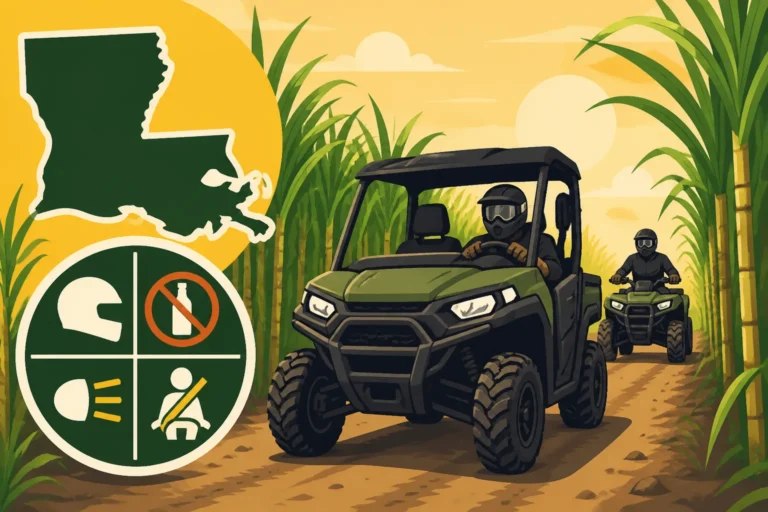
Beyond the vehicle itself, there are rules regarding the occupants. One common question is [Is a Helmet Required on a Louisiana UTV?]. Generally, Louisiana law does not mandate helmets for UTV operators or passengers when operating on designated public roads, provided they are using seatbelts. This is a key difference from ATVs, where helmets are usually required. However, while not legally mandated for UTVs on roads, wearing a helmet is always a smart safety choice, especially if you plan to transition from road use to trail riding.
When it comes to [Louisiana Rules for Passengers on a UTV], the primary rule is that all passengers must have a designated seating position with a working seatbelt. You cannot have more passengers than the UTV is designed for, nor can passengers ride in the cargo bed or in any position not equipped with a seatbelt. Children must also meet appropriate age and size requirements for the available restraints, similar to child safety seat laws for cars, though specific UTV age requirements for passengers might vary by local ordinance. Companies like SuperATV also offer various upgrades that enhance passenger safety, such as grab handles and stronger roll cages, providing an extra layer of protection beyond the minimum legal requirements.
Common Pitfalls and What to Avoid
Even with all the correct paperwork and equipment, there are still common mistakes UTV riders make that can land them in hot water. Understanding these pitfalls is just as important as knowing the rules themselves.
The Dangers of Assuming Legality
One of the biggest traps riders fall into is assuming that if a road looks like it should be okay, or if they've seen other UTVs on it, then it's legal. This is a dangerous assumption in Louisiana. As we've discussed, legality hinges on explicit parish and municipal designations and proper signage. Riding on an undesignated road can quickly lead to [Louisiana Penalties for Illegal Road Riding], which can include significant fines, court costs, and potentially even impoundment of your UTV. These penalties are not minor; they're designed to deter unauthorized road use. Always verify the designation of roads through official channels before you ride, and if there's any doubt, err on the side of caution and stick to private land or designated off-road trails.
Staying Within the Permitted Scope of Use
Even when you're on a legally designated road, there are still limitations to UTV operation. UTVs are not cars, and Louisiana law reflects this. For example, [Louisiana Bans ATVs From Travel Lanes] and also from interstates. This means your UTV can't be driven in the main flow of traffic on multi-lane highways or interstates. Designated roads are typically secondary roads, parish roads, or specific municipal streets. You also need to adhere to the posted speed limits for the designated roads, and some local ordinances might impose even lower speed limits specifically for UTVs. The intent behind these laws is to allow UTVs for specific purposes, often related to local commerce, agriculture, or accessing trails, not as a primary mode of transportation across the state. Understanding these operational boundaries is crucial to avoid unintended violations.
Maintaining Proper Documentation
Imagine doing everything right – getting your title, paying your taxes, insuring your UTV, and riding on a designated road – only to get pulled over and realize you left your paperwork at home. This is a common and easily avoidable mistake. Louisiana law, like many states, requires [Louisiana Insurance Proof on Demand], and similarly, you must be able to produce your driver's license and UTV registration. If you cannot provide these documents when requested by law enforcement, you could still face a citation, even if the records technically exist. It's best practice to keep all original documents in a secure, waterproof pouch on your UTV, or at the very least, a clear, legible copy of your registration and insurance card, along with your physical driver's license. Digital copies on your phone might be accepted by some officers, but a physical copy is always safest to ensure you're in full compliance.
| Requirement | Description | Who Enforces? | Where to Check? |
|---|---|---|---|
| Title | Official proof of ownership for your UTV. | Louisiana OMV | OMV office, required for registration. |
| Sales Tax Payment | Proof that state and local sales/use tax has been paid on the UTV purchase. | Louisiana OMV / Department of Revenue | OMV office (for private sales/use tax), dealer invoice (for new purchases). |
| Insurance | Minimum liability coverage for public road use. | Louisiana OMV / Law Enforcement | Insurance provider, OMV requires proof for registration, must carry proof while riding. |
| Age of Operator | Must be 21 years or older to drive a UTV on designated public roads. | Law Enforcement | Louisiana State Statute 32:299.3 |
| Driver's License | Must possess a valid Class E or higher driver's license. | Law Enforcement | Louisiana OMV / Louisiana State Statute 32:299.3 |
| Designated Roads | Roads explicitly approved by parish or municipal ordinance for UTV use, identified by signage. | Law Enforcement | Parish Police Jury/Clerk, Municipal Clerk's Office, local road signage. |
| Mandatory Equipment | Headlights, taillights, brake lights, turn signals, horn, rearview mirrors, seatbelts for all occupants, parking brake. | Law Enforcement | Louisiana State Statute 32:299.3, potentially local ordinances. SuperATV can assist with aftermarket parts. |
| Signage | Display of license plate and often a Slow-Moving Vehicle (SMV) triangle. | Law Enforcement | Louisiana State Statute 32:299.3 |
| Prohibited Areas | No riding on interstates, travel lanes, or non-designated public property (e.g., levees, battures, private land without permission). | Law Enforcement | Louisiana State Statute 32:299.3, local ordinances, private property law. |
Riding your UTV on public roads in Louisiana is definitely possible, but it's far from a free-for-all. It requires diligent adherence to state laws, local ordinances, and proper vehicle outfitting. By understanding the intricacies of titling, sales tax, insurance, age and license requirements, and making sure your UTV is equipped correctly – perhaps with some quality parts from SuperATV – you can navigate Louisiana's roads legally and safely. Always remember, the burden is on you, the rider, to know and follow the rules, ensuring your UTV registration before road use is complete and compliant. Stay informed, ride responsibly, and enjoy the beautiful state of Louisiana from the seat of your UTV.
Disclaimer
This article is for general informational purposes only and does not constitute professional advice. Laws, prices and regulations vary by location and change over time. Consult a qualified professional for guidance on your specific situation.