Louisiana Impoundment for No Decal
It's incredibly frustrating, confusing, and frankly, expensive, when your off-road machine gets impounded. One minute you're enjoying the back roads or heading to a hunting camp, and the next, a law enforcement officer is explaining that your ATV or UTV is being towed away because it lacks a simple sticker. This guide is here to unravel the mystery of why your machine might face impoundment in Louisiana for not having an ORV decal and, more importantly, how to navigate the process if it happens and prevent it from ever happening again.
Understanding Louisiana's Off-Road Vehicle Decal Mandate
Before we dive into the nitty-gritty of impoundment, let's get a clear picture of why Louisiana even requires a decal for your off-road machine in the first place. It's not just a revenue generator; it's a way for the state to manage and identify the sheer volume of ATVs, UTVs, and dirt bikes that traverse our diverse landscapes. Think of it as a small but mighty passport for your outdoor adventures.
Why the Decal Is Crucial for Public Land Use
Louisiana boasts some incredible natural beauty, from the piney woods of Kisatchie National Forest to the winding trails managed by the Department of Wildlife and Fisheries. These are prime spots for off-road enthusiasts, but with great trails comes great responsibility. The ORV decal is Louisiana's way of knowing that your machine is acknowledged within the state system, even if it's not a street-legal vehicle. It signals that you're a registered owner (or at least, the machine is registered) and helps fund the very trails and resources you enjoy. Without it, you're essentially an unregistered visitor, which can lead to complications. [Louisiana ORV Decals and Titles Explained] covers this distinction in more detail.
When you're out on public lands, whether it's a designated trail system or even just a levee you have permission to ride, law enforcement and park rangers need a quick way to verify that your machine is in compliance. That little sticker on your quad or side-by-side isn't just decoration; it's proof that you've met a fundamental state requirement. Ignoring this small step can suddenly transform a relaxing ride into a stressful encounter with authorities.
The Distinction Between a Decal and a Title
This is where a lot of riders get tripped up, and it's absolutely critical to understand the difference. Many people assume if they have a title, they're all set. Not true in Louisiana for off-road vehicles! A title is proof of ownership, like a deed for a house or a title for your car. It proves you own the machine. The ORV decal, on the other hand, is proof of registration for off-road use, similar to how your car has a license plate and registration sticker. You need both for most situations.
Consider a scenario where you've just purchased a used ATV from a private seller. You might diligently get the title transferred into your name at the OMV, which is fantastic. But if you then head straight to your favorite riding spot without applying for and affixing the ORV decal, you're still not fully compliant. The title says "I own it," but the decal says "It's registered for use." The OMV handles both, but they are separate processes with distinct purposes. [Why an ATV Needs Both a Title and a Decal] clarifies this common point of confusion. Without that decal, even a properly titled machine can fall afoul of the law, especially when it leaves private property.
What Actions Can Lead to Your Machine Being Impounded?
It's one thing to get a ticket, but having your beloved machine impounded is a whole different level of headache. Impoundment isn't usually the first resort for a minor infraction, but in certain circumstances, riding without that essential ORV decal can certainly lead to it. It often comes down to where you are riding and what other factors are at play.
Riding on Public Property Without a Decal
This is perhaps the most common scenario for impoundment. If you're caught riding your ATV or UTV on public land or designated trails without a current Louisiana ORV decal, you're opening yourself up to serious consequences. State parks, Wildlife Management Areas (WMAs), Kisatchie National Forest trails, and even certain parish-designated roads all fall under this umbrella. These areas have specific rules to manage off-road vehicle use, and the decal is a non-negotiable part of those rules.
Imagine you're visiting [Kisatchie National Forest OHV Trails in Louisiana] or enjoying a weekend at a local WMA. A ranger or state trooper spots you, and during a routine check, realizes you don't have the decal affixed. At that point, depending on the specifics of the situation, the officer might issue a citation, or, if they deem it necessary, especially if there are other violations or the rider is non-compliant, they could call for your machine to be impounded. The immediate goal is to remove the non-compliant vehicle from public property where its presence is prohibited. This isn't just about a simple ticket; it's about enforcing the regulations that protect these shared natural resources.
Compound Violations or Uncooperative Behavior
While a missing decal alone can lead to impoundment, it's often part of a larger picture, especially if there are other violations at play. Think about it: an officer stops you for no decal, but then also discovers you're riding in a prohibited area, perhaps on a public levee where [Louisiana Levee Riding Is Prohibited], or you're operating the machine recklessly. Maybe you don't have adequate proof of ownership or a valid ID on you. These compound factors can quickly escalate the situation from a citation to an impoundment.
An officer also has discretion. If you're uncooperative, argumentative, or give false information, it can impact their decision. They might view impoundment as a necessary step to ensure compliance and maintain public safety. It’s always best to be polite and cooperative, even if you disagree with the reason for the stop. This doesn't mean admitting guilt, but it does mean treating the officer with respect and providing any requested documentation promptly. Sometimes, the impoundment isn't just for the decal, but because the lack of the decal, combined with other circumstances, creates a situation where the officer cannot simply let you drive away.
The Stressful Journey: Retrieving an Impounded Machine
So, the worst has happened. Your quad or side-by-side has been loaded onto a tow truck and taken to an impound lot. Now what? The process of getting it back can be daunting, costly, and time-consuming. It's a series of steps that require patience, paperwork, and often, a hefty sum of money.
Locating Your Machine and Understanding the Charges
The very first hurdle is figuring out where your machine was taken. Law enforcement typically provides this information at the time of the impoundment, but if you didn't catch it or weren't present, you'll need to contact the agency that initiated the impound (e.g., State Police, Parish Sheriff's Office, Forest Service). They will direct you to the impound lot where your machine is being held.
Once you know where it is, you'll need to understand the full scope of charges. This isn't just the original citation for not having a decal; it includes towing fees, daily storage fees, and potentially administrative fees levied by the impound lot or the law enforcement agency. These fees can add up incredibly fast. Every day your machine sits in the lot, the cost grows, creating a strong incentive to act quickly. You'll want to get a clear breakdown of all charges before you even think about retrieval. It’s not uncommon for these combined fees to far exceed the cost of the original decal or even a typical fine.
Necessary Paperwork to Prove Ownership and Address Violations
To get your machine released, you'll need to prove two things: that you are the rightful owner and that you have addressed the underlying violation (or at least have a plan to). This means gathering specific documents:
- Proof of Ownership: This is usually your ATV or UTV's title. Make sure it's properly transferred into your name. If you recently purchased the machine, you might need the notarized bill of sale and the application for title. Sometimes, a sworn affidavit of ownership might be accepted, but it's always best to have the official title. For documenting private sales, resources like LawDepot can provide templates for a [Louisiana Notarized Bills of Sale] that can help solidify your ownership claims in such situations.
- Valid Photo ID: The impound lot and law enforcement will need to verify your identity.
- Proof of Addressing the Decal Issue: This might involve presenting proof that you've applied for the ORV decal or, in some cases, having already received and affixed it. If you were cited, you may also need proof that you've paid any fines associated with the citation or have a court date set. The goal is to show you're taking steps to become compliant.
- Payment for Impound Fees: Be prepared to pay all towing and storage fees upfront, usually in cash or with a certified check, though some lots may accept credit cards.
It's a good idea to call the impound lot and the issuing agency beforehand to confirm exactly what documents and forms of payment they require. Showing up unprepared can lead to wasted trips and more accumulated storage fees.
The Financial Burden and Time Investment
Let's be blunt: retrieving an impounded machine is a significant financial hit. Towing fees can range widely, often starting at a substantial amount just to get it off the ground. Then, daily storage fees kick in, which can add up to a significant sum very quickly. On top of that, you'll have the cost of the original citation, any court costs if you dispute it, and the fee for the actual ORV decal.
| Item | Description |
|---|---|
| Towing Fee | Initial charge to transport your machine from the impound location to the storage facility. Varies by distance and company. |
| Daily Storage Fee | A recurring charge for each day or part of a day your machine remains at the impound lot. These add up rapidly. |
| Administrative Fee | Some law enforcement agencies or impound lots may charge a separate fee for processing the impoundment paperwork. |
| Citation Fine | The penalty for the underlying violation, such as riding without a decal. This is separate from impoundment fees. [Louisiana Penalties for No Decal] can provide more context here. |
| Court Costs | If you were cited and go to court, additional court fees may apply, regardless of the outcome. |
| ORV Decal Fee | The actual cost to purchase the required Louisiana ORV decal, which you will need to do to avoid future impoundment. [Louisiana ORV Decal Cost] provides current figures. |
| Transportation Costs | The cost to get yourself to the impound lot, which may be out of your way, and potentially arrange for a trailer or truck to haul your recovered machine home. |
Beyond the money, consider the time. You'll spend hours on the phone, driving to different offices, waiting in lines at the OMV, and dealing with various personnel. It's a major disruption to your schedule and can be incredibly stressful. This is why prevention is so much better than the cure when it comes to ORV decals.
Proactive Steps to Prevent Impoundment
The best way to deal with impoundment for a missing decal is to ensure it never happens in the first place. A little foresight and understanding of Louisiana's regulations can save you a world of trouble, money, and stress.
Ensuring Your Machine Always Has a Current Decal
This might sound obvious, but it's the number one defense. When you purchase an ATV or UTV, whether new or used, make applying for and affixing the ORV decal a top priority, right alongside getting the title transferred. [Louisiana's 30-Day Decal Deadline] is a crucial piece of information here; you generally have a limited window to get that decal after acquisition. For a new machine, the dealer often handles some of the initial paperwork, but ultimately, it's your responsibility to ensure the decal is obtained and properly displayed.
For used machines, ensure you understand the process. The previous owner's decal doesn't automatically transfer to you, and it may expire soon after purchase anyway. Always assume you need to get a new decal yourself. Keep an eye on the expiration date of your current decal, which usually runs on a four-year cycle. Setting a reminder on your phone or marking it on a calendar can prevent you from inadvertently riding with an expired decal. [When a Louisiana ORV Decal Comes Up for Renewal] offers more details on renewal cycles. It's a small annual fee, typically very affordable, and well worth the peace of mind. [Louisiana Charges $3 a Year for a Decal] makes it clear that the cost is minimal compared to the penalties.
Proper Placement of the Decal
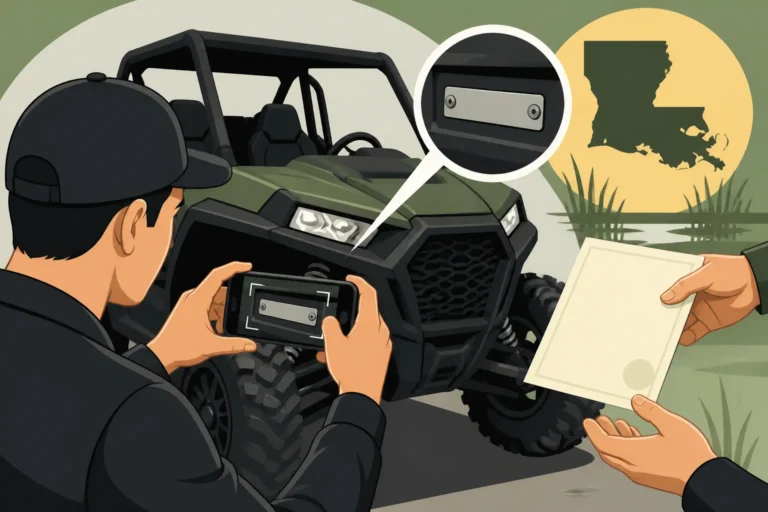
Once you have that decal in hand, don't just toss it in your glove box or tool kit. It needs to be properly affixed to your machine in a visible location. The exact requirements usually specify a prominent, unobstructed area, often on the left front fork for ATVs or the left side of the machine for UTVs, typically near the driver's side or on the frame. The goal is for a law enforcement officer to be able to easily see and verify it without needing to search your machine.
Failing to affix the decal properly, or having it in an obscure location, can be just as problematic as not having one at all. An officer might interpret it as an attempt to hide the decal or assume it's missing, leading to the same frustrating encounter. Always follow the instructions provided with the decal for proper placement. Think of it as your machine's visible license plate – it needs to be seen. [Louisiana Decal Placement on a Machine] provides specific guidance on where it should go.
Understanding Where You Can Legally Ride
A decal grants your machine permission to be registered for off-road use, but it doesn't grant you permission to ride anywhere. You still need to understand and respect local ordinances and state laws regarding where ATVs and UTVs can be operated. A decal does not make your machine street legal. [Why an Off-Road Decal Is Not Street-Legal Registration] is a critical read. Riding on paved parish roads, public highways, or in prohibited areas like city streets (unless specifically designated by parish or municipal ordinance) is still illegal, even with a valid decal.
Many impoundments occur when riders, despite having a decal, are operating their machines in areas where they are simply not permitted. Always check the rules of any specific riding area, WMA, or forest before you unload your machine. ignorance of the law is no defense, and a valid decal won't protect you if you're riding where you shouldn't be. Private land use typically doesn't require a decal, but as soon as you touch public property, the rules apply. Carrying a copy of your [Louisiana Agricultural Affidavits for an ATV] can be helpful if you're on farm property, but remember the limitations of that exemption.
Other Penalties for Operating Without a Decal
Impoundment is certainly the most impactful consequence, but it's not the only one you face if you're caught without a valid Louisiana ORV decal. There are other penalties that, while perhaps less severe than losing your machine temporarily, are still designed to ensure compliance and can hit your wallet hard.
Fines and Court Costs
The most immediate penalty you're likely to encounter when caught riding without a decal is a citation and an accompanying fine. These fines can vary depending on the jurisdiction (state, parish, or local municipality) and the discretion of the issuing officer. While the base fine for a decal violation might seem modest, it can quickly escalate once court costs and administrative fees are tacked on. These costs are often non-negotiable and must be paid, even if you eventually get your decal.
Consider a scenario where you're cited on a WMA. Not only might you face the state fine for the missing decal, but you could also be issued a separate citation for violating WMA rules. These fines are designed to be a deterrent, making it far more expensive to skip the decal than to simply pay the small annual fee. Ignoring the citation can lead to further legal complications, including warrants for your arrest, so it’s crucial to address it promptly, even if you plan to dispute it in court. [Louisiana Penalties for No Decal] can provide more detail on potential financial impacts.
Potential for License Suspension or Other Administrative Actions
While not as common for a first-time decal offense, repeated violations or combining a decal issue with other serious infractions could potentially lead to more severe administrative actions. For instance, if the operation of the off-road vehicle without a decal is part of a larger pattern of reckless behavior or disregard for state laws, authorities might consider additional measures.
In extreme cases, particularly if an incident involves public safety or property damage, law enforcement agencies can take steps that affect your driving privileges or access to public lands. While a missing decal alone is unlikely to result in a driver's license suspension for a single offense, accumulating multiple violations across different categories could certainly draw more scrutiny from state authorities. The bottom line is that any non-compliance with ORV laws carries potential consequences that extend beyond just a simple fine.
Conclusion
Navigating the world of Louisiana ATV and UTV regulations can feel like a minefield at times, but understanding the rules around ORV decals is fundamental to a stress-free riding experience. The potential for impoundment, with all its financial and logistical headaches, is a stark reminder that these small stickers carry significant weight. By ensuring your machine always sports a current and properly affixed decal, understanding where you can and cannot ride, and being prepared with proper documentation like a well-drafted bill of sale from resources such as LawDepot, you can avoid costly penalties and keep your adventures focused on the fun, not the frustrations of legal entanglement. Don't let a missing decal turn your exciting ride into an expensive ordeal.
Disclaimer
This article is for general informational purposes only and does not constitute professional advice. Laws, prices and regulations vary by location and change over time. Consult a qualified professional for guidance on your specific situation.