Group Size Limits on a Busy Event Weekend
A large group can turn a Louisiana ATV or UTV weekend into a logistics problem if everyone expects to ride, camp, and check in together. Group limits depend on the destination and the activity, not just the number of machines in your convoy. Here’s how to check the right rules, plan a manageable ride, and avoid surprises at a busy event.
There Is No One Group Limit for Every Louisiana Ride
A group-size rule is usually tied to a particular place or activity. A private mud park may set its own event policies; a public riding area may have separate trail, access, or land-management rules. A campsite or cabin reservation can have a capacity that has nothing to do with how many machines may ride together.
That means a limit you heard about from another rider may not apply to your destination. It might refer to one event weekend, a specific trail system, a lodging reservation, or the size of a riding party expected to travel together. Check with the operator or land manager for the location and dates you have in mind.
For a private park event, ask whether the rules distinguish between:
- The total number of people in your booking
- The number of machines in your party
- The number of machines allowed to travel as one riding group
- The number of people or machines allowed at a campsite
- The number of vehicles or trailers allowed in a reserved area
These are separate questions. For example, a large group might be welcome at an event but asked to split into smaller ride groups. Or several riders might be allowed to ride together while the group’s campsite has a lower occupancy limit.
If you are considering a public riding area, check its rules independently of any private event policy. Louisiana forest trails, wildlife management areas, and private parks do not necessarily follow the same access requirements. Louisiana Group Size on Forest Trails covers the separate question of group riding on forest trails, while Louisiana Private Park Waivers and Rules is useful for understanding why a private park’s terms need their own check.
A permit or pass also does not automatically settle the group-size question. It may cover access for a person, vehicle, or riding area, while the park or land manager sets other limits. Confirm what your permit covers and whether every rider or machine needs separate authorization. For public-land access details, see Louisiana Forest Trail Use Passes and Louisiana WMA Permit Requirements.
What to Confirm Before You Bring a Large Group
Contact the destination before you pay, tow machines, or tell the group that everyone is set. Busy event weekends can have different booking and entry procedures from ordinary riding days. The event operator is the best source for current capacity, arrival, and ride-group policies.
Ask direct questions and write down the answers. A vague question such as “Can our group come?” may not reveal whether your group can ride as one unit or share one camping area.
| What to check | Why it matters | Useful question |
|---|---|---|
| Event entry | Tickets or reservations may have their own capacity | Does every person or machine need a separate entry reservation? |
| Riding party size | Large parties may need to split on the trail or in busy areas | Is there a maximum number of machines allowed to ride together? |
| Camping capacity | Campsite occupancy may not match event entry | How many people, machines, and support vehicles may use our site? |
| Arrival and check-in | A large convoy can take longer to process or stage | Should we arrive together, or check in in smaller groups? |
| Parking and trailers | Space may be limited even when event entry is available | How many tow vehicles and trailers can we bring? |
| Reservations | Some areas or accommodations may require advance booking | Do we need to reserve a campsite, cabin, or riding slot? |
| Rules and waivers | Each rider may have individual requirements | Does every participant need to complete a waiver or show identification? |
| Changes and refunds | Plans can shift if the group cannot be accommodated | What happens if part of the group cancels or arrives late? |
Do not assume that one booking covers every person, machine, or support vehicle. Ask how the operator counts the group. A “party of ten” could mean ten people, ten machines, or ten reservations, depending on the policy.
If your destination is an event-based mud park, review its event calendar and booking details before organizing travel. Some Louisiana riding areas operate around scheduled events rather than a daily walk-in routine. Louisiana Mudfest and Event Weekends and Louisiana Riding Areas That Take Reservations can help you think through the difference between choosing a date and securing the space your group needs.
Keep the answers in a message or reservation confirmation if possible. That gives the group one reliable reference for arrival times, capacity, and any instructions about staging or riding together. If a policy is unclear, ask for clarification before the event rather than trying to negotiate at the gate.
Plan the Ride So the Group Stays Manageable
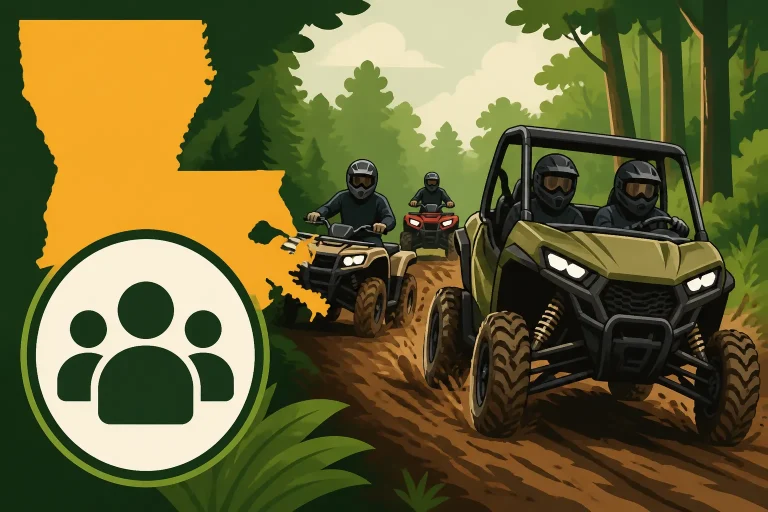
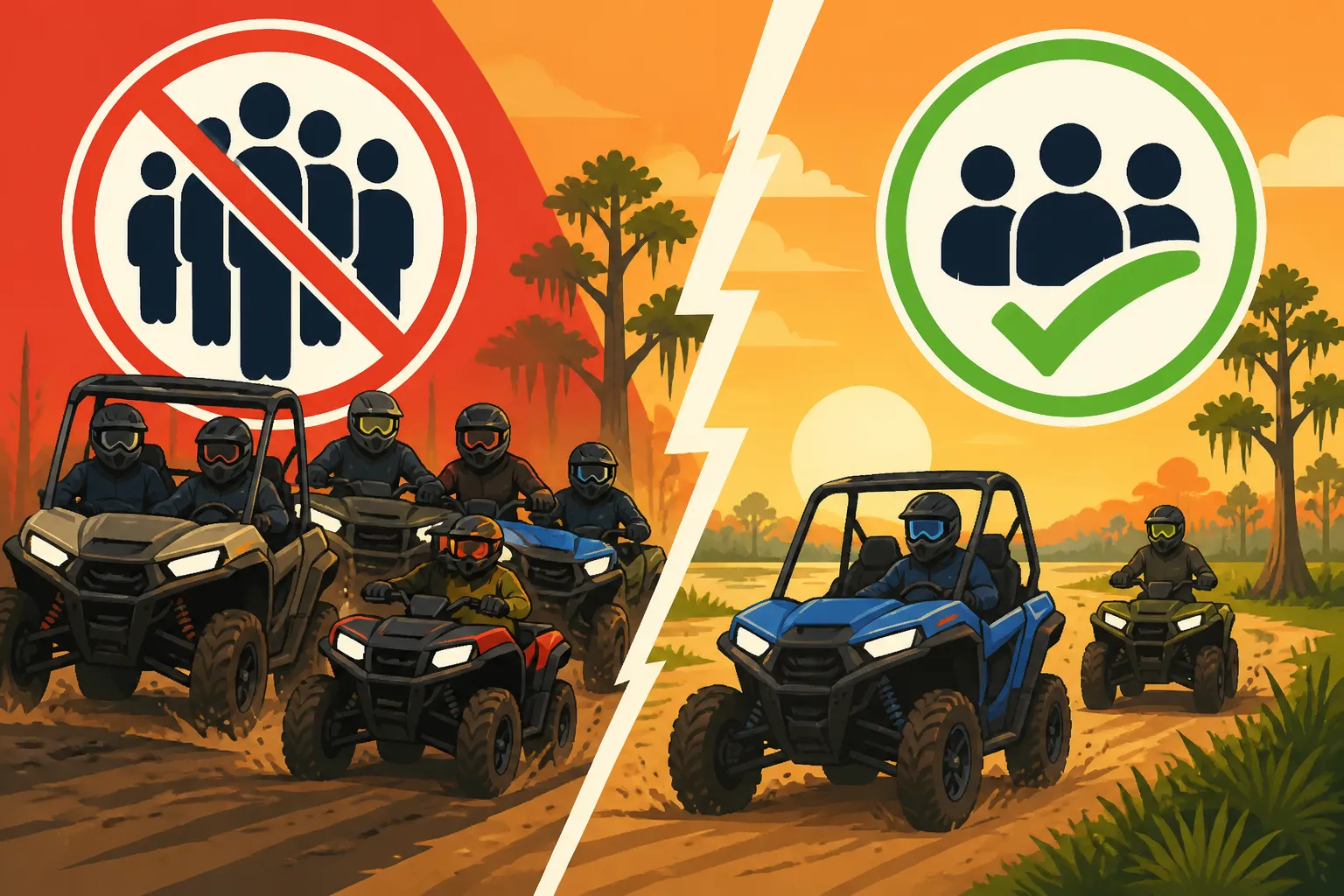
Even when a venue allows a large group, riding as one long convoy may not be the safest or smoothest choice. Narrow trails, mud holes, intersections, busy staging areas, and changes in pace can stretch a party out. Splitting into smaller groups makes it easier for riders to keep track of one another and respond if someone needs help.
Choose ride groups before unloading. Keep each group small enough that the lead and sweep riders can communicate, and make sure everyone knows who is responsible for the head count. There is no need to invent a number that the park has not set: follow the venue’s maximum if it has one, and divide the party further if the trail conditions call for it.
A practical plan includes:
- Name a lead and a sweep rider for each group. The lead knows the route or follows the agreed plan; the sweep stays behind the last rider.
- Match riders by pace and experience. A new rider may have a better day with a patient group than in a fast-moving convoy.
- Set a regrouping point. Choose an obvious place where groups can stop without blocking a trail or access road.
- Agree on a communication method. Confirm what radios or phones work in the area, and decide what to do if someone cannot make contact.
- Count people and machines at stops. A quick head count helps catch a missing rider before the group moves on.
- Leave room for other trail users. Do not block a trail entrance or assume a busy area belongs to your group.
Large parties should also agree on basics before setting out: the route, pace, expected return time, fuel and water stops, and what to do if a machine breaks down. Tell riders not to leave the group without telling the lead or sweep. If your chosen riding area has limited cell service, make that clear before anyone separates from the party.
For a wider ride-planning checklist, see Louisiana Group Ride Planning. Good group etiquette matters as well, particularly when other riders, campers, or trail users share the area; Louisiana Trail Etiquette Locals Expect offers useful context.
Do not treat a maximum as a target. A venue may permit a larger party than your group can safely manage in the conditions. After heavy rain, in deep mud, or on an unfamiliar trail, slow the plan down. Conditions can affect how long a ride takes and how difficult it is for the last rider to keep up.
Avoid Common Event-Weekend Problems
The most common planning errors come from treating entry, riding, and camping as one permission. They may be handled separately. A group might have event admission but not enough reserved camping space; it might have a campsite but still need to split into smaller riding parties. Confirm each part rather than relying on a single “we’re booked” message.
Another mistake is allowing everyone to arrive with a different understanding of the rules. Choose one organizer to collect the details and share them with the group. Send the exact check-in instructions, reservation information, park rules, and ride-group plan before departure. That reduces confusion when vehicles arrive at different times or the phone signal is poor.
For a smoother weekend:
- Set a head count early. Ask who is riding, who is camping, and who is bringing a support vehicle or trailer.
- Use one organizer for questions. Multiple people contacting the venue can lead to mixed or duplicated information.
- Check whether late arrivals need separate instructions. Do not assume they can find the group or enter through the same process.
- Leave space for changes. Mechanical problems, weather, and last-minute cancellations can affect the plan.
- Follow staff directions. If the operator asks you to split up, move a staging area, or adjust your ride plan, comply.
- Know the consequences of breaking venue rules. Private parks set their own conditions of entry and may take action when riders ignore them. Review When a Louisiana Mud Park Can Send You Home before you go.
If a destination publishes a group limit, ask what it applies to. Does it mean a maximum number of machines traveling together, a cap on one reservation, or a limit on a campsite? Also ask whether the rule changes during an event weekend. A clear answer prevents the group from making assumptions based on a different location or date.
For public land, follow the rules of the specific site rather than applying a private park’s policy. Access requirements, trail designations, closures, and permits can vary. Confirm that the intended route is open and that every rider has met the applicable requirements before unloading. A large group does not gain permission to use a closed route or travel off designated trails simply because its members arrived together.
Disclaimer
This article is for general informational purposes only and does not constitute professional advice. Laws, prices and regulations vary by location and change over time. Consult a qualified professional for guidance on your specific situation.