Quiet Hours at a Mud Park Campground
A late ride, a loud generator, or a machine starting before dawn can turn a fun campground stay into a tense one. The tricky part is that quiet-hour rules are not the same at every Louisiana riding area. Here’s how to tell what applies, plan around it, and avoid disturbing neighboring campers.
Quiet hours depend on where you camp
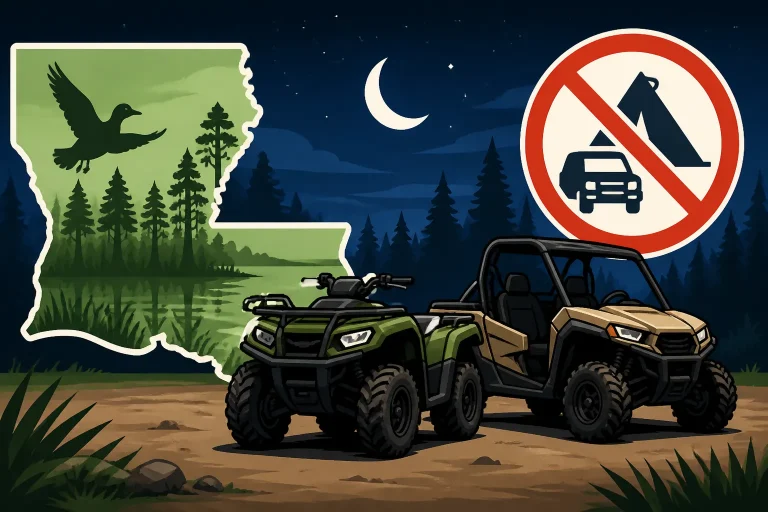
“Quiet hours” are set by the campground or land manager, not by a single statewide mud-park schedule. A private park may set its own hours and define what counts as noise, while public land follows the rules of the managing agency. Don’t assume the policy at one place carries over to another.
For a concrete Louisiana example, the Forest Service sets quiet time in camping areas in the Kisatchie National Forest from 10:00 p.m. to 6:00 a.m. That rule applies to the Forest Service camping areas covered by its policy; it does not establish quiet hours for every private mud park or campground in the state.
| Where you’re staying | What to check | Practical approach |
|---|---|---|
| Private mud park campground | The park’s posted rules, event information, and staff instructions | Confirm quiet hours before choosing a site or setting up |
| Kisatchie National Forest camping area | Forest Service rules for the specific campground and trail area | Keep noise down during the stated quiet time |
| Campground near a riding area | Both campground rules and riding-area rules | Don’t assume campground access means riding is allowed at all times |
| Event weekend campsite | The event’s current rules and schedule | Ask how generators, music, and vehicle movement are handled |
At a private property, the most reliable answer is the park’s own current policy. Check the campground rules when reserving, look for posted signs at arrival, and ask staff if the wording is unclear. If you’re comparing properties, Louisiana Private Mud Parks Compared can help you think through which details to ask about before booking.
Quiet hours are about more than music. Engines, generators, conversations, doors slamming, and headlights sweeping across neighboring sites can all interrupt rest. A campground may also have rules about machine use, parking, or movement that apply outside quiet hours. Read the full policy rather than treating “quiet hours” as the only restriction.
The Forest Service also sets a campground riding speed limit of 5 MPH in Kisatchie National Forest. That is a separate operating rule from quiet time, and it does not mean riding is permitted everywhere or at every hour. Check the rules for the particular trail and campground before starting or moving a machine.
For more background on where machines can be used in the forest, see Kisatchie National Forest OHV Trails in Louisiana and Louisiana OHV Camping With Trail Access. A campsite near a trail does not necessarily mean that the trail is open, or that riding directly through the camping area is allowed.
How to check a mud park’s policy before you arrive
A quick check before departure can prevent an awkward conversation after you have unloaded. Private parks may set policies differently for ordinary weekends and large events, so look for current instructions rather than relying on an old social media post or a friend’s memory.
Use this process:
- Read the campground rules. Look for quiet hours, generator restrictions, music rules, machine-use limits, and any limits on vehicle movement through the camping area.
- Check event information. If your visit is tied to a scheduled event, review the event-specific instructions as well as the general campground policy. Muddy Bottoms’ Event Calendar in Louisiana is a useful example of why dates and operating details matter when planning around an event.
- Ask about unclear wording. “Quiet” can mean different things in practice. Ask whether the rule covers generators, radios, music, idling engines, or movement between campsites.
- Confirm how the rule is enforced. Find out whether staff will issue a reminder, require a change, or ask a visitor to leave for repeated violations. Do not assume a consequence that the park has not stated.
- Check what applies to your specific site. Some facilities may have different arrangements for event areas, cabins, or other camping options. Ask rather than guessing.
If the campground has a waiver or visitor agreement, read it before signing. It may include conduct requirements that are not repeated on signs around the property. Louisiana Private Park Waivers and Rules covers the kinds of campground and riding-area policies worth reviewing.
When contacting the park, give a specific example. Instead of asking only, “What are quiet hours?” ask whether a generator may run overnight, whether a machine can be moved to the parking area after quiet time begins, or whether music must be turned off. A clear question is more likely to get you a useful answer.
For public land, check the managing agency’s information for the exact trail or campground you plan to use. Conditions and access can differ by site. The Forest Service says visitors can call its OHV Hotline 24 hours a day to confirm trail status. Trail status is not a substitute for campground rules, but checking both can keep you from arriving with plans that don’t fit current access.
For more on planning a public-land visit, see Checking a Trail Status Page First and Louisiana Forest Trail Use Passes. If you expect to ride, confirm the trail’s access conditions separately from the campsite’s quiet policy.
Set up camp to make less noise
Good campground etiquette does not require special equipment. It mostly comes down to doing noisy tasks before quiet time, keeping sound close to your own site, and avoiding unnecessary engine use.
Arrive with enough time to unload and organize before the campground becomes quiet. If you expect to reach camp late, have your gear arranged so you can set up without repeatedly opening storage boxes, revving a machine, or moving vehicles around. A small amount of preparation can prevent a lot of noise.
Before quiet time begins:
- Move the machine to its permitted parking spot and shut it off rather than letting it idle.
- Put away loose gear that could rattle or blow around.
- Finish cooking, washing, and other tasks that involve repeated trips or clattering equipment.
- Set up lighting so it points toward your own site rather than into a neighbor’s tent or windows.
- Let your group know the campground’s policy and agree on a plan for returning to camp.
Generators deserve special attention. Some parks restrict when they may run, while others may limit them by area or require campers to use quieter equipment. Confirm the policy before packing one. If a generator is allowed, keep it in the location and operating condition required by the campground, and avoid placing it where its sound carries directly into another campsite.
Music and conversation can carry farther than expected, especially in a quiet campground. Keep speakers close to your own group, use a modest volume, and stop amplified sound when the park’s rule requires it. If you want to continue socializing, move the group closer together rather than turning the volume up. Headphones may be a better option for a camper who wants to listen after others have gone to bed.
Earplugs can help with ordinary campground sounds, but they are not a reason to ignore a rule or create noise that affects others. If you need a small comfort item for sleeping, products sold through Amazon may be one option; check that the item suits your needs and remember that it cannot replace good campground etiquette.
Make a plan for late returns from the riding area. Check whether the route back to camp is open and whether the campground has rules about machine movement during quiet time. If you arrive after quiet time starts, avoid unnecessary stops, revving, or conversations beside other campers’ sleeping areas. Follow staff instructions if the park has a designated late-arrival procedure.
When children or guests are part of the group, explain the expectations before bedtime. A quiet campground is easier to maintain when everyone knows where to walk, where the machine is parked, and what activities need to wait until morning. Keep pets close and prevent barking or repeated movement around neighboring sites.
What to do if noise becomes a problem
Start by checking the written policy. If the situation appears to violate a posted rule, contact campground staff or the host rather than confronting another camper in the middle of the night. Staff can clarify what applies and address the issue without turning it into an argument between neighbors.
If you do speak with the other camper, keep it brief and polite. Explain what you can hear and ask whether they can lower the volume or move the activity. They may not realize how far the sound is carrying. If the disturbance continues, take the matter to staff and follow the campground’s complaint process.
Be specific when reporting a problem. Note what is happening, where it is coming from, and whether you have already asked for help. Avoid escalating a disagreement or entering another camper’s site. If you feel unsafe, keep your distance and contact campground personnel.
If you are the camper who receives a complaint, lower the sound first and discuss the details later. Even if you believe you are within the rules, the noise may be carrying more than expected. Ask staff to clarify the policy if needed. A quick adjustment is usually easier than letting a disagreement spoil the stay.
Quiet hours are also a useful cue to plan the next day. Prepare clothing, water, and riding gear before settling in so you are not searching through bins while others are asleep. But don’t assume that quiet-time rules determine when a trail opens. For trail access, consult the trail’s own operating information; Louisiana Trail Closures and Seasons explains why access may depend on the area and current conditions.
The basic rule is straightforward: follow the policy for the place where you are staying, and don’t treat a quiet-hours window as permission to make noise outside it. On Kisatchie National Forest camping areas, the Forest Service quiet period is 10:00 p.m. to 6:00 a.m. At a private mud park, check directly with the operator. Confirming the rules before you unload gives your group a clearer plan and helps everyone get a better night’s rest.
Sources
- Forest Service — Kisatchie National Forest | Off-Highway Vehicle Trail Status | Forest Service (checked November 3, 2026)
- Forest Service — Kisatchie National Forest | Claiborne Multiple-Use Trails | Forest Service (checked November 3, 2026)
Disclaimer
This article is for general informational purposes only and does not constitute professional advice. Laws, prices and regulations vary by location and change over time. Consult a qualified professional for guidance on your specific situation.