Reaching a Downed Deer in Thick Cover
A deer can fall well beyond a clear trail, but that does not automatically make it legal to drive an ATV or UTV to the spot. On Louisiana wildlife management areas, game retrieval is a limited exception, not general permission to ride off-trail or search for wounded game. Know the distinction, check the area’s current rules, and plan a safe recovery before unloading.
Know the Difference Between Retrieval and Tracking
The first question is whether the deer has been legally harvested and is ready to recover, or whether you are still trying to locate a wounded animal. Those situations are not interchangeable. Louisiana’s game-retrieval rules are narrow; they should not be treated as permission to use a machine to track, pursue, or search for a deer.
A useful rule of thumb is to separate the hunt from the recovery. If the deer is down and you know where it is, you may be dealing with retrieval. If you are following blood, looking for signs, or trying to determine whether a shot animal is still alive, you are still searching. Do not assume an ATV or UTV is allowed for that search simply because the animal may have been hit. The restrictions described in Never Searching for Wounded Game and Louisiana Game Retrieval Rules are important to understand before you ride.
This distinction matters even when thick cover makes recovery difficult. A machine can damage vegetation, create ruts, disturb other hunters, and take you into places where ordinary motorized travel is prohibited. A difficult recovery does not expand the rules. If you cannot tell whether the situation qualifies for the retrieval exception, stop before riding and check the current Louisiana Department of Wildlife and Fisheries rules or ask the WMA office or staff responsible for the area.
A retrieval exception is not general trail access
On a WMA, motorized use is generally controlled by designated routes, posted signs, seasonal restrictions, and area-specific rules. The game-retrieval allowance is not a second network of trails. It does not give every member of a hunting party permission to follow a machine through the woods, nor does it make a route open to motorized traffic for the rest of the day.
The rules associated with retrieval include limits on the number of machines and on what may be carried. Louisiana’s published guidance distinguishes retrieval from hunting activity, including restrictions involving firearms. Do not carry a firearm on the retrieval trip unless the current rule for that area clearly allows it. Check Louisiana Firearms and Retrieval Rules and Retrieving Without a Firearm rather than relying on what another hunter did in a different season or WMA.
The practical takeaway is to keep the recovery trip as narrow as the rule allows: retrieve the legally harvested animal, use no more machines than permitted, and do not turn the trip into a search or a recreational ride. The specific conditions can depend on current regulations and the WMA’s posted instructions, so verify them before the season and again before entering the area.
Keep recovery separate from a follow-up search
If a deer is wounded and runs into cover, the right response is to follow hunting and reporting rules, not to assume that a machine can shorten the search. A machine’s presence can also make it harder to read tracks or blood sign and can push an animal farther into cover. Use the methods and assistance allowed for locating wounded game, and ask a wildlife officer or area staff for direction when the situation is unclear.
If a deer is confirmed down, mark the location as accurately as possible before leaving it. A phone location pin can help, but do not rely on a phone alone in an area with weak service or a dead battery. Note a compass direction, nearby trail junction, distinctive tree, or other landmark. You can also mark the route on a paper map. Avoid cutting branches, damaging trees, or leaving permanent markers.
Check the WMA Rules Before You Bring a Machine
The recovery question is only one part of the decision. You also need to know whether you and your machine may be on that WMA, whether the area is open to motorized use, and what equipment restrictions apply. Rules can vary by location and season, and a rule that applies on private land or at a private park may not apply on public land.
Before the hunt, identify the exact WMA and review its current regulations, map, and access instructions. Do not assume that an old map or a trail shown in an online app is current. Check whether motorized access is limited to marked routes, whether there are seasonal closures, and whether a particular retrieval allowance applies. Louisiana WMA Designated Trails Only and Louisiana WMA Season Closures provide useful background, but the current WMA notice and signs should guide your decision.
| Check before riding | What to confirm |
|---|---|
| Access requirements | Whether a WMA access permit or self-clearing permit is required, and how to complete it |
| Motorized routes | Which trails or roads are open to machines and whether a retrieval exception applies |
| Machine limits | Current weight, tire, width, and other equipment restrictions |
| Seasonal status | Whether the area or a particular route is closed during the hunt |
| Retrieval conditions | Whether the allowance limits the party, machine, route, or equipment carried |
| Local instructions | Any posted restriction, closure, or direction from area staff |
Complete access requirements even if the trip is only for recovery
Do not skip an access or permit step because you expect to ride only a short distance. Where a self-clearing permit is required, fill it out as instructed and keep the portion you are told to retain. Check Louisiana Self-Clearing Permit Steps and Louisiana WMA Permit Requirements for the basic process, then confirm the requirements for the specific area. The permit process and the rules for riding are separate questions: having an access permit does not itself authorize off-trail vehicle use.
Read the WMA map before entering. Mark the parking area, the nearest legal route, and the location where you expect to recover the deer. If your intended route crosses a closed road, an unmarked trail, or land outside the WMA, do not treat the map pin as permission to go there. A boundary can be hard to see in the woods, so take the map with you rather than relying only on memory.
Confirm that your machine qualifies
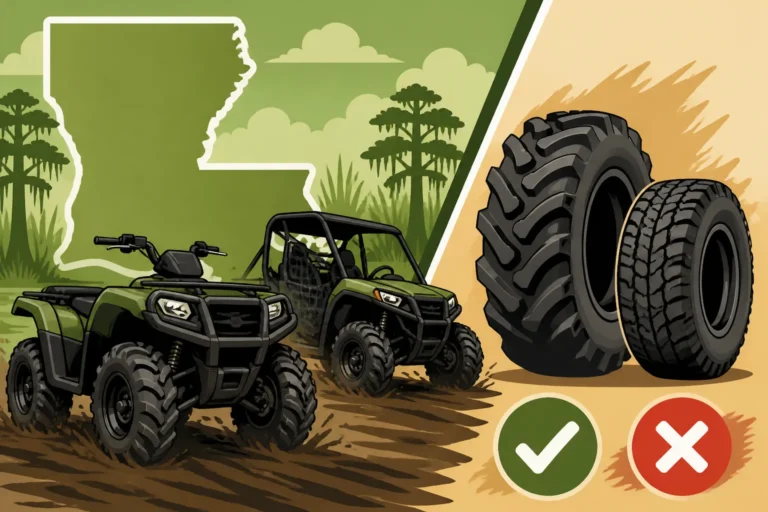
Public-land rules may set limits for machine size, weight, tires, or other equipment. A quad that is legal on a private property trail may not meet the rules for a particular WMA. The same goes for a side-by-side: its ability to carry a deer does not make it eligible for every trail or retrieval situation. Review Louisiana WMA Weight Limits Explained and Louisiana WMA Tire Rules Explained, and check any WMA-specific conditions.
Do not modify your machine or load it in a way that prevents it from meeting the applicable limits. Oversized tires, excessive lug height, or a machine that exceeds a posted weight limit can turn an otherwise straightforward recovery into a violation. If you are uncertain about a measurement or classification, confirm it before entering rather than asking a conservation officer to interpret it after the fact.
Plan a Safe, Limited Recovery
A legal recovery can still go wrong if the route is steep, wet, or too narrow for the machine. Louisiana woods can hide ditches, roots, soft ground, and water under leaves or grass. A deer’s location may be only a short distance away in a straight line, while the safe route requires backing out to a marked trail or approaching from another direction.
Begin with the simplest recovery method that works. If the deer can be carried or dragged to a legal access point without driving off an authorized route, that may be safer than taking a machine into unknown ground. If a machine is allowed for the retrieval, use the permitted route and avoid making a new track through the woods. Do not assume that a winch, trailer, or extra passenger changes what the rules allow.
Before setting out, tell someone in your party where the recovery is taking place and when you expect to return. Carry a charged phone, but plan for the possibility that it will not have service. A map and compass are useful backups. Bring water, a first-aid kit, a light, and suitable clothing for the conditions. Keep the machine’s keys and controls accessible, and do not ride alone into unfamiliar or flooded terrain if a safer option is available.
Keep the retrieval party small
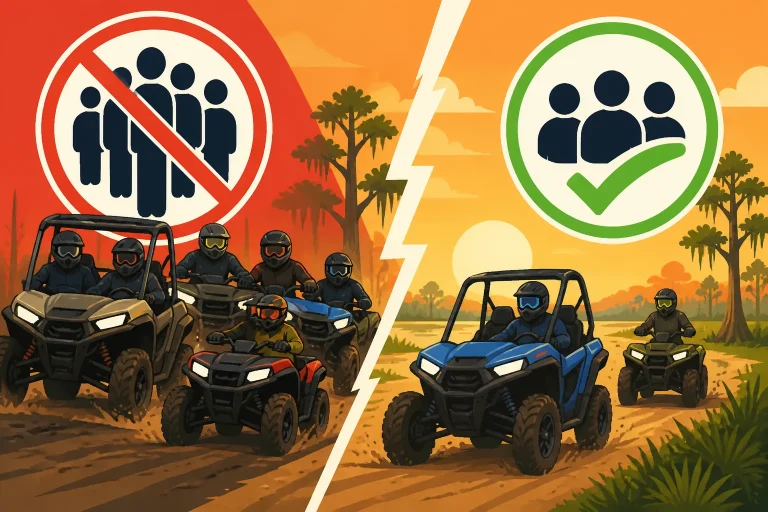
The retrieval allowance may limit how many machines can be used. Follow the limit exactly. If the rule allows one machine, a second ATV does not become acceptable because another person is helping or the route is difficult. Louisiana Retrieval Party Limits and One Machine and No More explain why the permitted party should not be expanded by assumption.
A larger group can also create practical problems: more people may follow the machine, spread out to search, or block a narrow route. Decide in advance who is operating the machine and who is handling the animal. Everyone else should remain at a lawful location unless the rules permit them to take part. Keep voices and lights directed toward the recovery, not toward nearby hunters or camps.
Do not use the retrieval as an excuse to carry hunting gear or continue hunting from the machine. Leave firearms behind where required, and do not stop to pursue another animal. If the recovery conditions do not allow the equipment or activity you planned, change the plan instead of stretching the rule.
Protect the deer and the machine
A deer is heavy and awkward to move, especially through brush. Keep the load low and secured so it cannot shift into the rider, wheels, exhaust, or controls. Do not exceed the machine’s carrying capacity. A rack is not necessarily designed for a full-grown deer, and a loose animal can affect steering and braking.
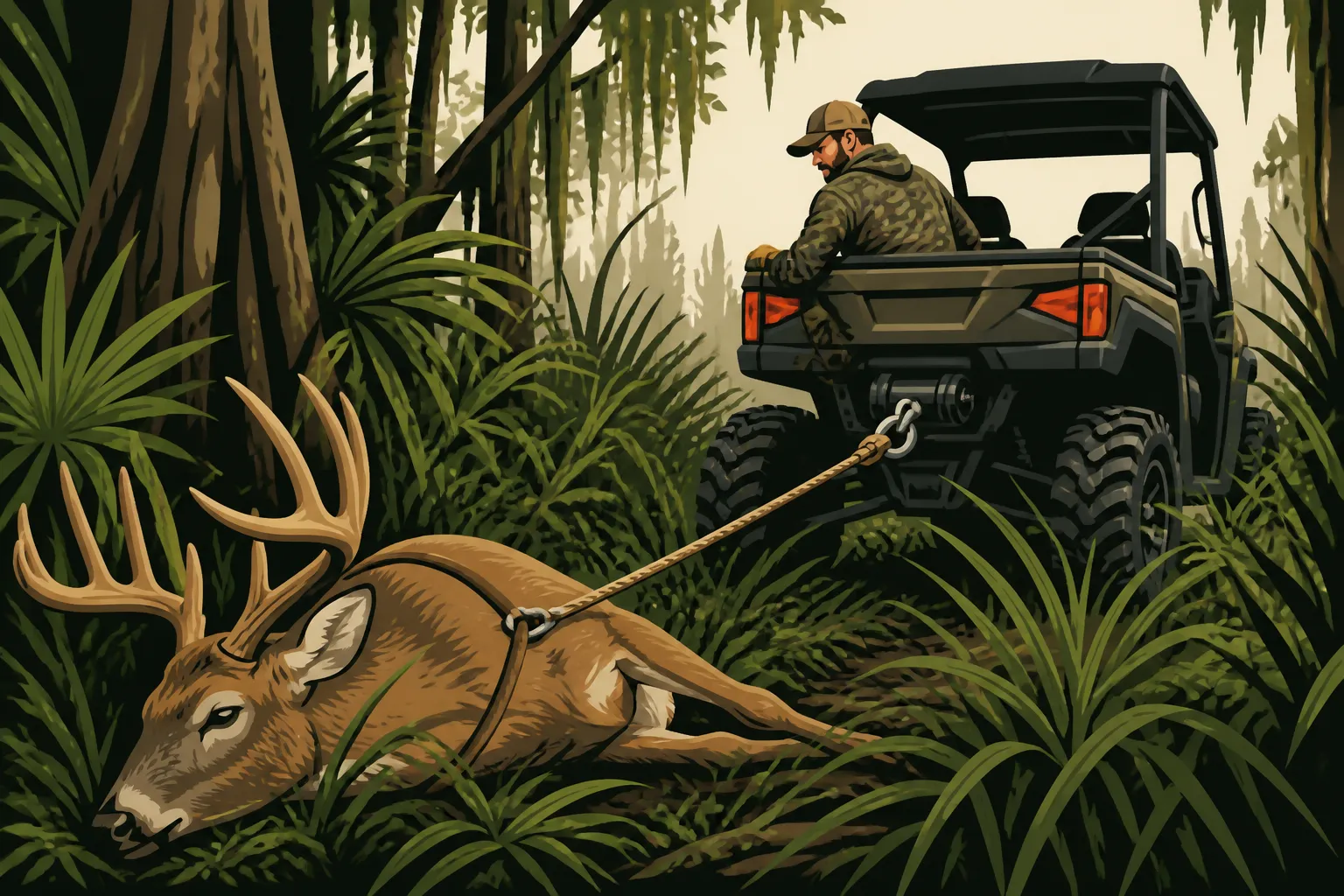
Dragging a deer behind a machine can snag on roots, catch in brush, or put a person too close to moving wheels. If you use a drag or sled, make sure the method is allowed and that the load cannot enter the wheels or track. Avoid standing between a moving machine and the animal. Never try to free a stuck load while the machine is in gear or under tension.
Wet ground deserves particular caution. A shallow-looking depression may be deeper than it appears, and a machine can become stuck quickly in saturated soil. Spinning tires can damage the trail and make recovery harder. If the route is too soft, steep, or narrow, stop and choose a different lawful method. A deer is not worth risking a rollover, injury, or a damaged public trail.
If the Route or Rule Is Unclear, Stop and Ask
The safest answer to an unclear rule is not to test it by riding into the cover. Stop at the legal access point and contact the appropriate WMA office, wildlife officer, or Louisiana Department of Wildlife and Fisheries representative. Explain the situation plainly: identify the WMA, say whether the deer is confirmed down or still being tracked, describe the machine, and ask what recovery method is allowed. Write down the guidance and follow any instructions you receive.
If no one is available, do not infer permission from silence. Use a lawful non-motorized recovery method if you can, or wait until you can get a clear answer. Avoid crossing a posted boundary or driving onto a closed route to reach the deer. If the animal is near a boundary, verify that the proposed route remains within land where you have permission to be.
A recovery exception is also not permission to enter private property. A WMA boundary may run close to timber land, a field, or a hunting lease, and the route that looks shortest may cross onto someone else’s land. Check the map and boundary markers. If access would require crossing private property, obtain permission before doing so.
After the recovery, return by the lawful route and leave the area as you found it. Remove any temporary marker or litter, check that no gear has been left behind, and report a damaged trail, blocked route, or other hazard to the responsible staff. Keep a record of the WMA and the instructions you followed; it can help you plan future hunts without relying on an old recollection.
A downed deer in thick cover is frustrating, but a machine is not automatically the answer. First determine whether you are retrieving a confirmed harvest or still searching for a wounded animal. Then verify the WMA’s current permit, route, machine, and retrieval rules. When those rules do not clearly allow the trip, stop and ask before riding.
Disclaimer
This article is for general informational purposes only and does not constitute professional advice. Laws, prices and regulations vary by location and change over time. Consult a qualified professional for guidance on your specific situation.