Why WMA Trails Close March Through August
Louisiana’s WMA trail closures can catch riders off guard: a machine that was legal on a marked route in winter may not be allowed there in spring or summer. The seasonal shutdown protects wildlife and habitat, but the dates and exceptions can be easy to misread. Here’s how to plan around the March-through-August closure and avoid mistaking access for permission to ride.
What the March-through-August closure means
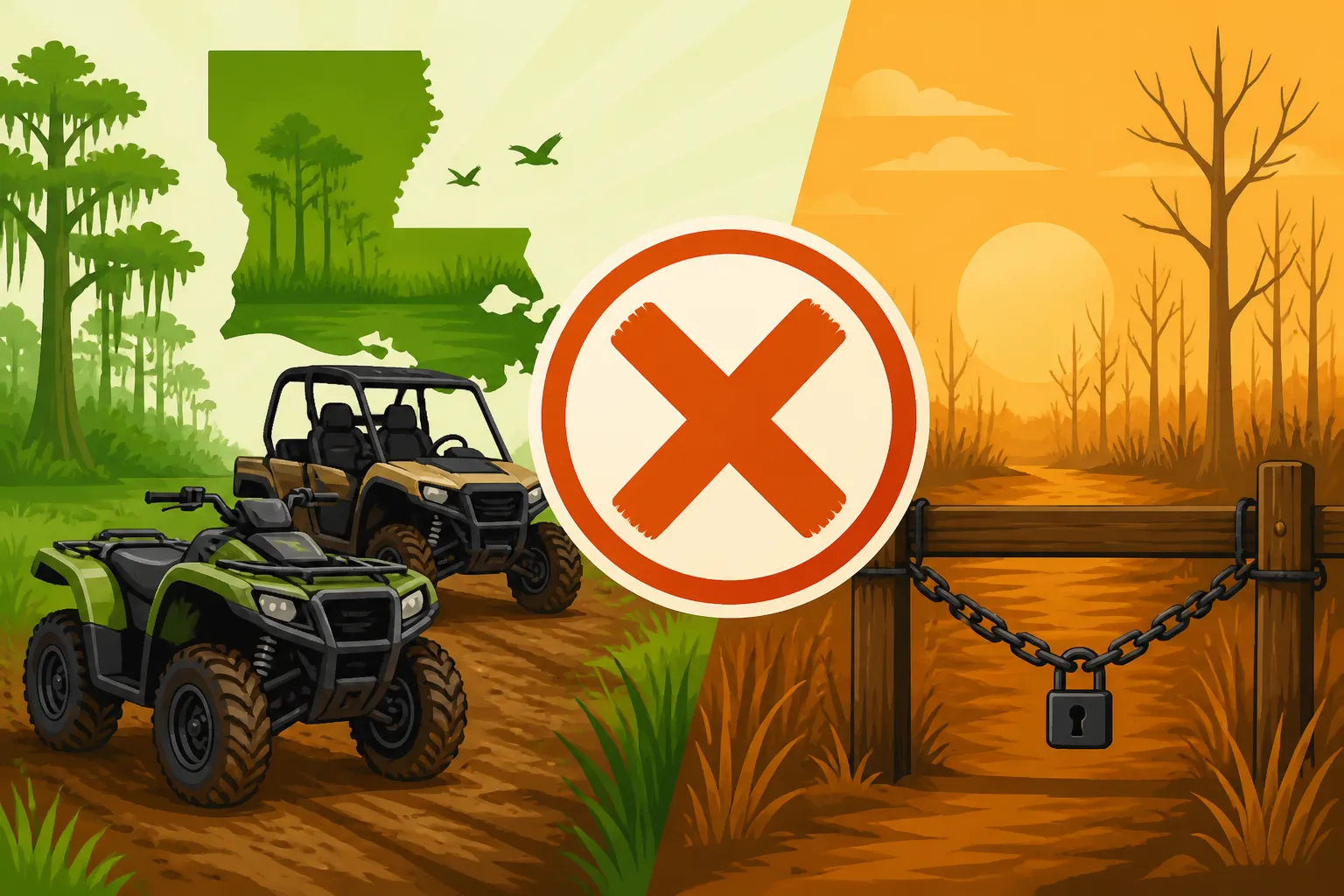
On many Louisiana wildlife management areas, recreational ATV and UTV trail riding is closed from March through August. In practical terms, riders should plan on marked WMA routes being unavailable during this period unless current rules for that specific area clearly say otherwise.
The closure is not simply a suggestion to avoid muddy trails. It is a seasonal access rule. A trail that looks passable, has no gate across it, or appears on an older map is not automatically open to motorized use. Riding there without permission can put you in violation of WMA rules.
The closure also does not necessarily mean the entire WMA is closed to people. An area may remain open for other activities while motorized trail use is restricted. Rules for walking, fishing, hunting, camping, and vehicle access can differ from the rules for riding an ATV or UTV. Check the activity-specific regulations rather than assuming that general WMA access includes riding.
There may also be limited seasonal exceptions, including access connected to spring squirrel hunting on some areas. An exception is not a blanket opening of the trail network. It may apply only during a specified season, on named trails, and under additional conditions. Confirm the current rules for the WMA before unloading. The details in Louisiana WMA Squirrel Season Access and The Spring Squirrel Exception to the WMA Ban can help explain what to check.
| Situation | What to assume before you ride |
|---|---|
| It is March through August | Recreational WMA trail riding is generally closed unless the current area rules state an exception |
| A trail is visible and appears passable | Physical access does not prove that motorized use is allowed |
| The WMA is open to hunters or visitors | That does not automatically open trails to recreational ATV or UTV riding |
| You are riding during a hunting-season exception | Check the allowed dates, route, permit requirements, and purpose of the exception |
| A map or sign conflicts with what you heard | Pause and verify the current rules with the managing agency |
The safest approach is to treat the closure as applying unless you can confirm a specific, current exception. Do not rely on an old trip report, a friend’s recollection, or a social media post. Rules can vary by WMA and may change with seasonal conditions or management needs.
Why the seasonal closure exists
WMA trails pass through public wildlife habitat, not just riding terrain. Seasonal restrictions help limit disturbance during sensitive periods, reduce damage to wet or vulnerable ground, and support management of wildlife and vegetation. A trail can be firm enough to ride and still be closed for conservation or management reasons.
Protecting habitat and wildlife
Spring and summer bring changes in wildlife activity and habitat use. Repeated motorized traffic can disturb animals and damage vegetation, particularly where routes cross low, wet, or easily eroded ground. The restriction gives land managers a period when recreational traffic is reduced.
The purpose is broader than preventing a rut in one trail. When riders leave a marked route to get around a wet spot or a closed section, they can widen the disturbance into surrounding habitat. That is one reason WMA rules commonly limit riding to routes specifically opened for motorized use. A road that appears on a general map may not be an approved ATV route. See Louisiana WMA Designated Trails Only for the distinction between a designated route and other visible roads or paths.
Reducing trail damage
Louisiana’s wet conditions can make a route especially vulnerable. A few passes through saturated soil may deepen ruts, push water into new channels, or make a trail harder to maintain. Damage can continue after the rider leaves, especially when later rain runs through the disturbed area.
That does not mean a dry-looking route is open. The closure applies because of the seasonal rule, not because a rider has judged the ground to be too soft. Conversely, if a trail is open during another part of the year, temporary closures can still apply after heavy rain, storm damage, or maintenance work. Check Louisiana Trail Closures After a Storm when weather may have affected access.
Making enforcement and management workable
A seasonal schedule gives riders and land managers a clear baseline. It helps reduce uncertainty about when recreational motorized use is expected to stop, while leaving room for carefully defined exceptions. Signs, maps, and permits help communicate those limits, but no single sign at a trailhead should be treated as a complete substitute for checking current WMA regulations.
An exception for a particular activity also serves a different purpose from recreational riding. For example, a rule that allows limited machine use in connection with a hunting activity does not necessarily authorize a recreational ride through the area. The reason for travel, the route, the season, and the permit conditions may all matter.
How to check whether a route is open
Before towing to a WMA, check the current regulations and the information for the specific area. Do this close to your planned ride, especially during spring and summer, when temporary closures or narrow exceptions may affect access.
- Identify the exact WMA. Do not rely on a nearby town or trail system name. Confirm which management area contains the route you intend to use.
- Check the current WMA regulations. Look for the seasonal dates, motorized-use restrictions, and any exception that applies to your intended activity.
- Confirm the route is designated for your machine. A WMA may allow riding only on marked trails or roads, and not every route is suitable or authorized for both an ATV and a UTV. Louisiana WMA Riding Rules for Quads covers related equipment and route restrictions.
- Check for temporary closures. Storm damage, maintenance, flooding, or management work may close a route even when the normal riding season is open.
- Review permit requirements. If a self-clearing permit or other access document is required, complete it as directed. The Louisiana Self-Clearing Permit Steps and Filling Out a Self-Clearing Permit at the Gate explain the process.
- Recheck before unloading. Look for current signs and notices at the entrance. If posted information conflicts with what you expected, stop and clarify before riding.
A map is useful for planning, but it cannot always tell you whether a trail is open today. Use a current map together with current rules. Reading a WMA Map Before You Unload can help you distinguish designated routes from nearby roads and recreation areas.
If official information is unclear, ask the agency responsible for that WMA before you go. Be specific: give the area name, the date, the type of machine, the route you want to ride, and whether you are asking about recreational use or a permitted hunting-related activity. A broad question such as “Are quads allowed?” may not get you the detail you need.
Planning a ride around the closure
For most recreational riders, the simplest plan is to treat March through August as the off-season for WMA trail riding. Choose a private riding park or another area that confirms it is open to your machine and intended activity, or plan a WMA trip for a period when the routes are open.
If you are considering a seasonal exception, verify the full set of conditions before packing the machine. Confirm that the exception applies to the specific area, date, purpose, and route. Make sure you understand whether a permit, hunting license, or other document is required. Do not assume that meeting one condition makes every other restriction disappear.
Before heading out during an open period, make sure your machine is allowed under the WMA’s equipment rules. WMA requirements can include limits or conditions involving machine type, tires, weight, and where you may ride. Seasonal access does not cancel those requirements. The current Louisiana WMA Riding Rules for UTVs or Louisiana WMA Riding Rules for Quads can help you identify the issues to verify.
Pressure is one detail riders can easily overlook if a particular area has a posted tire-pressure limit. Check the rules for the exact limit and measure pressure with a dependable gauge rather than estimating by feel. A basic tire-pressure gauge from an auto-parts store or Amazon can be useful in a riding kit, but the gauge does not replace checking the WMA’s current requirements.
Keep the trip practical:
- Save the current WMA regulations and a map where you can access them without a strong phone signal.
- Carry any required permit or access paperwork, and follow instructions for completing or displaying it.
- Stay on routes that are clearly designated for motorized use.
- Turn around at a closure sign, gate, or blocked route; do not go around it to reach an open-looking section.
- If conditions or signs leave you uncertain, choose another legal place to ride rather than testing the rule on the trail.
A little checking before departure is usually easier than dealing with a citation, having to turn back after towing to the area, or contributing to damage that can keep a trail closed longer. The key point is simple: the March-through-August closure is a seasonal restriction on WMA motorized trail riding, and any exception must be confirmed for the particular area and activity.
Disclaimer
This article is for general informational purposes only and does not constitute professional advice. Laws, prices and regulations vary by location and change over time. Consult a qualified professional for guidance on your specific situation.