Louisiana Supervision at a Private Park
Taking a child or teen to a Louisiana ATV park raises a practical question: can they ride while an adult watches, or must an adult ride with them? There is no single supervision rule that applies to every private park. Each operator can set its own age limits, riding conditions, and check-in requirements, so confirm the specific rules before you tow.
Why supervision rules vary by park
A private riding park is not the same as a public road or public riding area. The park operator controls access to its property and can set conditions for riding there. Those conditions may depend on the rider’s age, the machine, the trail or riding zone, and whether the rider is driving or riding as a passenger.
That means “a parent will be there” may not answer the park’s question. One park might require an adult to remain on the property. Another might require an adult to accompany a younger rider on the trail. A park could also set a minimum age for driving a particular type of ATV or UTV, regardless of adult supervision. These are park policies to confirm with the operator, not assumptions to make from another park’s rules.
Supervision can mean several different things:
- An adult is present at check-in and stays somewhere on the property.
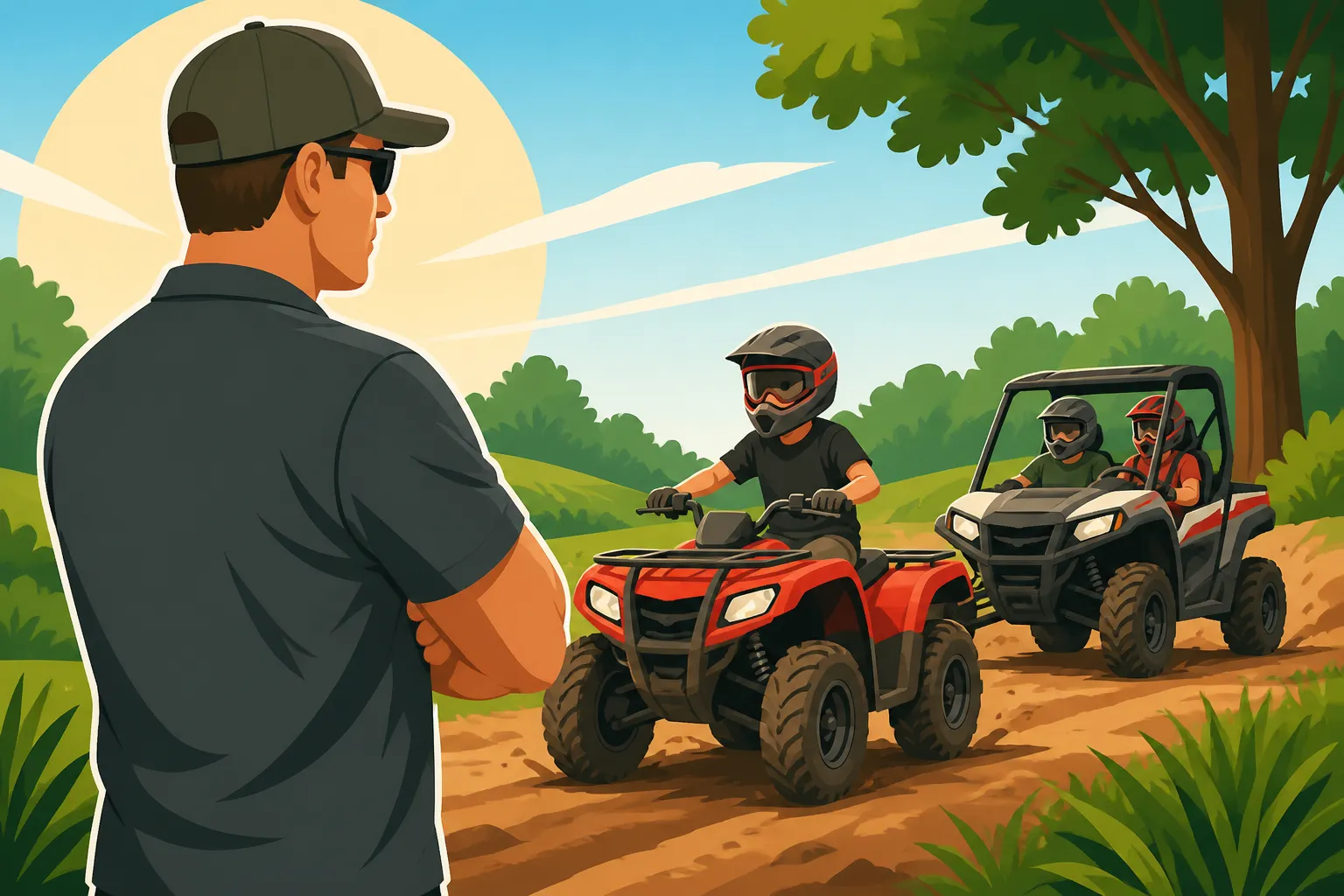
- An adult watches from a designated area while the child rides.
- An adult rides along on a separate machine.
- A qualified adult must ride in the same UTV as a young passenger.
- An adult must remain within sight or close enough to respond.
- A parent or guardian must sign the waiver, even if someone else supervises during the ride.
Ask what the park means by supervision instead of relying on the word alone. If the park says a child must be “accompanied,” clarify whether that means accompanied by an adult on the trail, in the same vehicle, or simply on the property.
The distinction matters because a parent who stays at the campground may not meet a rule requiring an adult to ride with the child. Likewise, an adult riding nearby may not satisfy a policy that requires a parent or legal guardian to complete the waiver. For related questions, see Why a Parent Signs the Waiver at the Gate and Minimum Ages a Private Mud Park Sets.
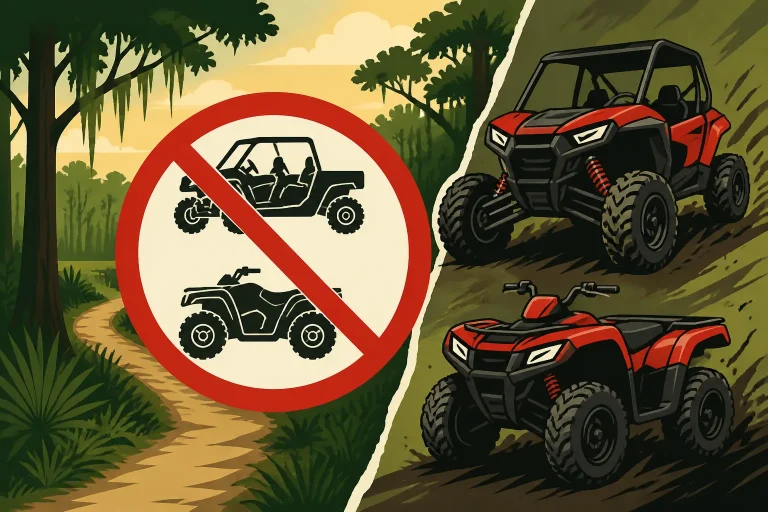
A park may have different policies for ATVs and UTVs. For example, it may treat a young passenger differently from a young driver, or set separate conditions for a two-seat and a four-seat UTV. Do not assume that permission for a child to ride as a passenger means the child may drive the same vehicle. Check Louisiana Private Park Age Minimums and Louisiana Private Park Helmet Rules as separate issues: age, supervision, and safety equipment are not interchangeable requirements.
| What to clarify | Why it matters |
|---|---|
| Minimum age to drive | A supervising adult may not override a park’s age limit |
| Minimum age to ride as a passenger | Passenger rules can differ from driver rules |
| What “supervision” means | The adult may need to ride along or stay in a particular area |
| Who must sign the waiver | The park may require a parent or legal guardian’s signature |
| Whether rules differ by machine | ATV, side-by-side, and other vehicles may have separate policies |
| Where the rule applies | A trail, mud area, campground, or event zone may have different conditions |
What to ask before bringing a young rider
Call or message the park before the visit, especially if the rider is near the park’s minimum age or will be riding a machine borrowed from someone else. Park websites and social media can be helpful, but a direct answer from the operator is better when a rule affects whether a child can ride at all.
Give the operator enough detail to answer accurately. State the rider’s age, whether the child will drive or ride as a passenger, and the machine type. If you know the machine’s size or seating arrangement, include that too. A general question such as “Are kids allowed?” may get a general answer that does not cover your situation.
Useful questions include:
- What is the minimum age to drive this type of machine at your park?
- Is there a separate minimum age for passengers?
- What exactly counts as adult supervision?
- Must the supervising adult ride on the same trail, in the same vehicle, or only remain on-site?
- Does the supervising adult need to be the child’s parent or legal guardian?
- Who must sign the waiver, and does each rider need a separate form?
- Do age or supervision rules change during an event weekend?
- Are there limits on machine size, speed, passenger seating, or where a child may ride?
- What helmet and protective gear must the child wear?
- What identification or proof of age should the adult bring?
Keep a written copy of the park’s response, especially if staff explain an exception or a rule that is not clearly posted. A message or email can help prevent confusion at the entrance. It does not guarantee that the park will allow a rider if conditions have changed, but it gives you something specific to confirm at check-in.
Ask whether the rule applies to the entire property or only certain parts. A child might be allowed in a campground or family area but not on a particular trail, in a deep-mud zone, or during a crowded event. Some parks divide riding areas by difficulty or vehicle type. If the park has a map, ask which areas are appropriate for the rider and whether an adult must accompany them between zones.
Also ask about the adult’s role if the child is riding a UTV. “Supervised” could mean an adult drives while the child rides as a passenger, or that an adult follows in a separate machine. The park may have a policy about who can drive, how many passengers are allowed, and whether a child may sit in a particular seat. Do not treat a seat belt or roll cage as a substitute for meeting the park’s age and supervision rules.
For equipment details, see Louisiana Private Park Helmet Rules. If the child needs a helmet, confirm the required type and fit before the trip. A helmet that is available at the park may not fit every rider, and a helmet the family already owns may not meet the park’s requirements.
Preparing for check-in and the ride
Once the operator confirms the rules, plan around them. A smooth visit starts with matching the child, machine, adult, and riding area to the park’s policy.
- Confirm the rider’s role. Decide whether the child will drive or ride as a passenger. Ask again if the plan changes; permission for one role does not automatically cover the other.
- Choose the right machine. Use a vehicle suited to the rider’s size and ability, and follow the park’s restrictions. Never carry a passenger on a machine that is not designed for one.
- Bring the required adult. If the policy requires a parent or guardian, do not assume another adult can sign in their place. Confirm whether a designated supervisor is acceptable.
- Complete the paperwork. Read the waiver and check-in forms before signing. Make sure the adult who is expected to sign is present, and ask staff about any unclear conditions.
- Review the boundaries. Find out where the child may ride, which areas are off limits, and how the park expects adults to supervise. Identify a meeting point in case the group gets separated.
- Set a simple riding plan. Agree on where to start, how far the child may go, and what to do if the machine stalls or the rider feels uncomfortable.
- Check protective gear and vehicle condition. Confirm helmets, eye protection, footwear, and any other required gear. Inspect the machine before riding and make sure the child can reach the controls safely.
A parent’s presence is important, but it does not make an unsuitable machine safe or turn an inexperienced rider into a capable one. A child should be able to understand basic instructions, control the machine at low speed, and stop when asked. If the child is tired, frightened, or overwhelmed by mud, noise, or traffic, end the ride or move to a quieter area if the park permits it.
Keep supervision active. Watching from a distance may be inadequate in a busy riding area where machines move quickly, visibility is limited, or the terrain changes. A younger rider may need an adult close enough to intervene and able to communicate clearly. Set expectations before the engine starts: stay in the approved area, leave space between machines, stop at the agreed signal, and do not follow other riders into an unfamiliar route.
An adult who is supervising should avoid distractions that make it hard to keep track of the child. If the adult is riding too, consider whether they can realistically monitor the child while managing their own machine. In a UTV, having a responsible adult in the vehicle may make it easier to observe a young passenger, but it still does not replace checking the park’s rules.
For a beginner, a short ride in a less demanding area is usually a better starting point than a long group ride or a crowded event zone. Ask staff where novice riders should go and whether the park offers a designated practice area. The park’s expectations may also differ between ordinary riding days and large events, so verify event-specific policies rather than relying on a previous visit.
When park rules and other riding rules differ
Permission to ride at a private park applies to that park under its conditions. It does not automatically authorize riding on public roads, public land, or neighboring property. Rules for a park visit should not be used to decide whether a machine may be ridden elsewhere.
Louisiana’s public-road requirements are a separate subject from private-park supervision. For a broader look at age-related riding rules, see Louisiana Rules for a Ten-Year-Old Rider and Louisiana Rules for a Sixteen-Year-Old Rider. Requirements can vary by where and how the machine is operated, so check the rules that apply to the specific location rather than treating the park’s policy as a statewide permission.
The same separation applies to training. A safety course can help a young rider build useful skills, but completing a course does not necessarily waive a park’s minimum age, adult-supervision, equipment, or waiver requirements. Louisiana does not have a mandatory safety course requirement for every private-park ride, but an operator may set its own expectations. See Louisiana Has No Mandatory Safety Course for the distinction between state requirements and park policy.
If the park says a child may ride only with an adult, get clarity on the details before leaving home. Ask whether the adult must be a parent, whether the adult must ride in the same machine, and whether the rule changes by trail or event. If the answer is uncertain, treat the ride as unconfirmed and contact the operator again. That is easier than arriving with a child who cannot participate.
A practical go-or-no-go check
Before loading the machine, make sure you can answer these questions:
- Has the park confirmed the rider’s age is allowed?
- Is the child driving or riding as a passenger, and has the park approved that specific role?
- Does the adult meet the park’s definition of a supervisor?
- Is the required parent or guardian available to sign the paperwork?
- Does the machine meet the park’s restrictions and safely fit the rider?
- Are the required helmet and other gear ready?
- Do you know which areas are appropriate and where the child must stay?
If any answer is unclear, resolve it with the park before the trip. Policies can differ even between nearby parks, and a rule that worked for an older sibling or a previous visit may not apply to a different child, machine, or event.
Disclaimer
This article is for general informational purposes only and does not constitute professional advice. Laws, prices and regulations vary by location and change over time. Consult a qualified professional for guidance on your specific situation.