Louisiana Physically Challenged Trail Access
Finding a Louisiana trail that works for a rider with mobility or other physical limitations takes more than locating a route marked accessible. You also need to confirm who may use it, whether it is open, and what permits and machine rules apply. Here’s how to plan around designated physically challenged trails without assuming the designation changes every other WMA rule.
What physically challenged trail access means
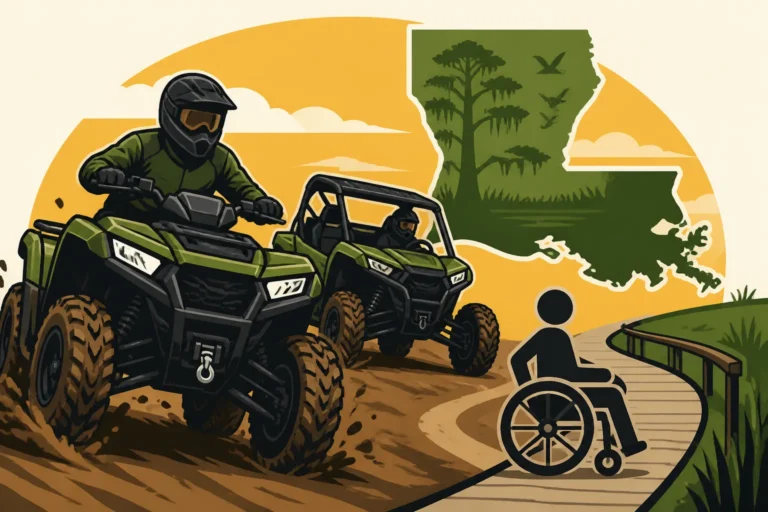
In Louisiana, physically challenged trail access is associated with designated trails on public Wildlife Management Areas (WMAs). It is a specific access provision, not a general permission to ride anywhere that is normally closed to vehicles. The location, eligibility details, and operating conditions matter.
The rules recognize riders age 60 and older on physically challenged trails. That does not mean every trail or WMA has the same access arrangements, or that age alone answers every question about a particular route. Check the current regulations for the area you plan to visit and confirm directly with the managing agency if the wording is unclear.
A trail’s designation also does not automatically promise that it will suit every person or machine. A route might be authorized for a particular type of access but still have uneven ground, mud, narrow turns, steep grades, or other obstacles. Accessibility is practical as well as legal: a trail can be open and still be difficult or unsafe for a specific rider.
Think of the designation as a starting point for planning. Before traveling, find out:
- Which trail or route is designated for physically challenged access.
- Who qualifies to use it under the current area rules.
- Whether the trail is open on your planned dates.
- What permits, documents, or check-in steps are required.
- Whether your ATV or UTV meets the area’s machine limits.
- What the terrain and facilities are actually like.
It also helps to separate public-land rules from private-park rules. A WMA is managed under its own access and wildlife regulations. A private riding area sets its own admission, age, equipment, and accessibility conditions. A physically challenged trail designation on public land does not determine what a private park will allow.
Check eligibility and conditions before you go
Start with the rules for the specific WMA, not with a general assumption about statewide access. Louisiana’s WMA regulations can set requirements for designated trails, vehicle types, seasons, and permits. A route’s status may also change because of weather, maintenance, wildlife management, or other closures.
The age-related provision is useful to know, but don’t rely on a short description or an old map to settle eligibility. Read the current area regulations and ask the manager or agency contact to clarify any condition that applies to your circumstances. If access is based on a physical limitation rather than age, confirm what documentation, if any, is expected before leaving home. Do not assume that a medical note, permit, or other proof is required—or that none is required—without checking.
A direct call or message can also answer questions that a map cannot. Ask about the exact trail entrance, vehicle access to the trailhead, parking, gates, and the surface condition. If the person you speak with cannot confirm the details, ask which office or area manager can. Make a note of the route name and the answer you receive so you can check that it matches the signage when you arrive.
| What to confirm | Why it matters |
|---|---|
| Trail designation and location | A WMA may have multiple routes, and not every route has the same access status. |
| Eligibility | The rule may specify who can use a designated physically challenged trail. |
| Opening dates and closures | Seasonal rules, weather, or management work can affect access. |
| Permit and check-in process | Public-land entry and riding may involve separate requirements. |
| ATV or UTV limits | A route designation does not necessarily waive machine restrictions. |
| Trailhead access and terrain | Legal access does not guarantee a suitable route for every rider. |
| Current contact information | Local staff can clarify conditions that are not obvious from a map. |
Use a current map to locate the route, then compare it with posted signs at the site. The advice in Reading a WMA Map Before You Unload can help you avoid treating an unmarked road or nearby route as an approved trail. If the map and signs seem to conflict, stop and ask rather than riding on the assumption that the route is allowed.
Trail closures deserve special attention. A designated route is not necessarily open year-round, and a past visit does not establish that it is open now. Check Louisiana WMA Season Closures and verify any area-specific notices before towing your machine to the trailhead. Recent rain, maintenance, or temporary management decisions can change what is usable even if the general trail rules have not changed.
Permits and machine rules still matter
Physical-challenge access should not be treated as a blanket exemption from WMA paperwork or riding restrictions. Requirements may differ by area and activity, so confirm the current rules for your destination rather than relying on what was required at another WMA.
Some public-land visits involve an access permit or a self-clearing permit process. Check the area instructions before you arrive, and complete any required steps at the correct location. Louisiana WMA Permit Requirements gives an overview of permit questions to sort out; Louisiana Self-Clearing Permit Steps can help you understand the check-in process. A permit is not the same thing as permission to ride a route that is closed or not designated for machine use.
Machine restrictions are another separate issue. WMA rules may limit where vehicles can travel and may set conditions involving machine weight or tires. Do not assume that a physically challenged trail allows a larger, wider, heavier, or differently equipped machine than the general rules permit. Check Louisiana WMA Riding Rules for Quads and the relevant Louisiana WMA Weight Limits Explained and Louisiana WMA Tire Rules Explained pages for the kinds of requirements that may apply. Confirm current details for the specific WMA before setting out.
If you ride a UTV, do not assume that rules written for quads apply to it in the same way. Ask whether that vehicle type is allowed on the designated route and whether its dimensions or configuration affect access. The same caution applies to modified machines, trailers, and equipment attached to the vehicle. A staff member can help you distinguish between a route that is open to motorized use generally and one that permits your particular machine.
Use this checklist before departure:
- Identify the WMA and the exact designated trail.
- Read the current area rules and confirm eligibility.
- Check opening dates, temporary closures, and weather-related notices.
- Confirm which permits or check-in steps apply.
- Verify that your machine meets the WMA’s restrictions.
- Ask about the route surface, trailhead, parking, and any access barriers.
- Carry any required documents and follow posted instructions at the site.
If you are uncertain about a permit or access condition, ask before unloading. Louisiana Permit Questions Riders Ask is a useful starting point for identifying what to clarify. Keep in mind that permission to enter a WMA and permission to ride a particular trail are not always the same thing.
Plan for the rider, not just the route
A route can be legally available but physically unsuitable. Ask about details that affect your needs: surface firmness, ruts, standing water, slopes, sharp turns, narrow sections, and the distance from parking to the trail. Also ask whether there are gates or barriers that could be difficult to pass and whether help is available if a machine becomes stuck or disabled. Conditions vary by location and can change after rain.
Plan for a way to turn around or stop if the terrain becomes uncomfortable. Riding with another person can make it easier to manage an unexpected obstacle, but it does not remove the need to follow access rules. Tell your companion what kind of assistance may be useful, and agree on what to do if either rider needs to leave the trail early.
Check practical facilities separately from trail access. A trail designation does not necessarily tell you whether parking, restrooms, or other facilities are accessible or nearby. Ask the area contact about the actual trailhead and available facilities, and consider visiting when you have enough daylight to assess the route without rushing.
Equipment choices should respond to the rider and terrain, not just the trail’s label. A phone, water, basic first aid supplies, and a way to contact your group can make a day more manageable. If you use a mobility aid away from the machine, consider whether the parking and trailhead surface will support it. Avoid counting on cell coverage in a remote area unless you have confirmed it.
At the site, follow signs and stay on the route authorized for your vehicle. If a gate is locked, a trail is posted closed, or the route appears to differ from the information you checked, do not try to work around the restriction. Contact the managing office for clarification. A physically challenged trail is a defined access option, not permission to cross closed land or ride off-trail.
The most reliable plan combines current rules with a realistic assessment of the rider’s needs. Verify eligibility, permits, machine limits, and closure status before the trip; then confirm the trailhead and terrain with someone familiar with the area. That extra check can prevent a long drive to a route that is closed, unsuitable, or not authorized for your machine.
Disclaimer
This article is for general informational purposes only and does not constitute professional advice. Laws, prices and regulations vary by location and change over time. Consult a qualified professional for guidance on your specific situation.