Louisiana WMA Nature Trail Bans
Louisiana WMA nature trails can look like inviting routes for a quad or side-by-side, but a trail’s presence on the ground does not mean machines may use it. The practical rule is to keep ATVs and UTVs off nature trails and ride only routes specifically authorized for your machine. Here’s how to tell the difference, plan a legal outing and avoid relying on a permit as permission to ride anywhere.
What Louisiana’s WMA nature trail ban means
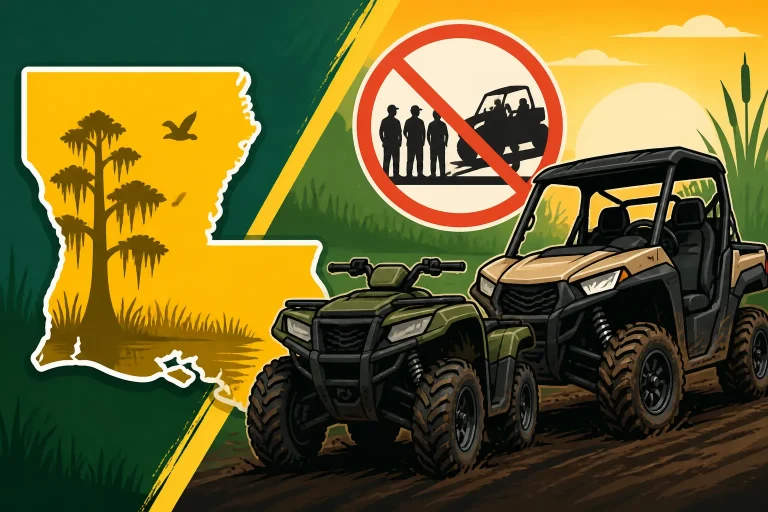
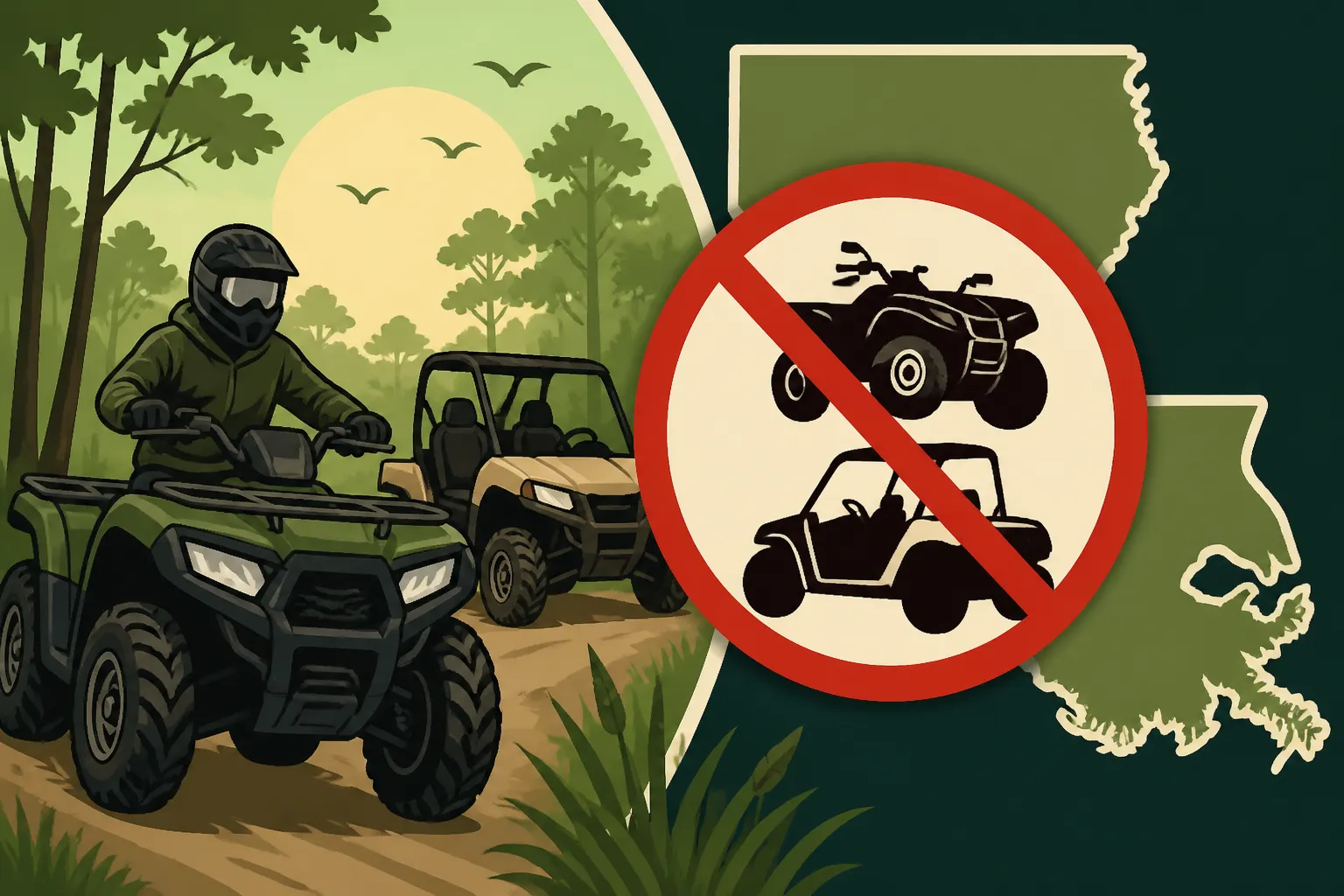
A nature trail on a Wildlife Management Area is closed to motorized off-road machines. That includes ATVs and UTVs, even if the route is wide, easy to follow or appears to connect with an approved riding area. A route’s condition or appearance is not a substitute for an official designation.
The distinction matters because a WMA may have several kinds of routes: trails intended for walking or nature viewing, roads used for management or access, and designated routes where particular off-road machines may be allowed. Permission to enter a WMA, or to use a marked motorized trail, does not automatically let you ride a nature trail.
A nature trail can be closed to machines while remaining open to hikers or other permitted users. The closure is about motorized access; it does not mean the entire WMA is closed to people. Other rules can also apply to walking, hunting, fishing, vehicles and seasonal access, so check the area’s current directions rather than assuming every user has the same access.
The best working rule is straightforward:
- If a route is identified as a nature trail, do not ride an ATV or UTV on it.
- If a route is not specifically designated for your kind of machine, do not assume it is open.
- Follow posted signs and current WMA maps, and check for temporary closures before unloading.
- Treat a permit as one requirement for access, not as permission to ignore route restrictions.
This approach aligns with Louisiana WMA Designated Trails Only: riding is limited to designated routes, not every path that happens to be visible. It also fits the broader Louisiana WMA Off-Trail Bans. A machine leaving an approved route to bypass a muddy patch, reach a scenic spot or rejoin a road by a shorter route can still be riding where it is not allowed.
A trail’s name is not the only clue
“Nature trail” is a useful warning, but riders should not depend on a name alone. A route may be labeled on a map, identified by a sign or described in area-specific information. Conversely, an unmarked path or old road does not become a legal riding route just because it looks established.
Check the current WMA map and any posted directions for the specific area you plan to visit. Look for the route designation and any limits on the machine type, season or hours of use. If the information does not clearly show that your ATV or UTV may use the route, choose another route or contact the managing office before riding.
Nature trails versus designated riding routes
The practical challenge is often telling a closed nature trail from a permitted route. A WMA can have a mix of public-use areas and restricted routes, and signs or maps may be more reliable than what you see from the seat of your machine. The road surface alone does not tell you whether motorized access is allowed.
| What you encounter | What to do |
|---|---|
| A route identified as a nature trail | Keep the ATV or UTV off it |
| A route shown as designated for your machine on current WMA information | Follow the route and all applicable limits |
| A path with no clear designation | Do not assume it is open; verify before using it |
| A closed gate, closure sign or blocked route | Do not go around it |
| A route that appears to continue beyond an authorized section | Stop where the authorized route ends |
| A route that is open to one type of machine but not clearly to yours | Confirm that your machine is included before riding |
Use the map and signs together
Before the trip, review the WMA map and area information, then check what you see at the trailhead. A map may show where an authorized route runs, while a sign may warn about a closure or a change in access. Neither should be treated casually. If they appear to conflict, stop and ask the managing office rather than choosing the interpretation that lets you continue.
The article Reading a WMA Map Before You Unload can help with the practical map-checking part. Look for the exact route, not just the general WMA boundary. A map showing that a WMA has riding access does not mean every path within that boundary is open to machines.
A map downloaded earlier or saved on a phone can also be out of date. Check the current information before leaving, especially if your destination has seasonal restrictions or if recent weather may have affected access. If cell service is unreliable, save or print the relevant map in advance. A clear waterproof map sleeve, including one available through Amazon, can help keep a paper copy readable in wet conditions; it does not replace checking that the map itself is current.
The permit does not make a closed trail legal
Some WMA access requires a self-clearing permit. Where one is required, complete it according to the posted instructions. But having a permit does not override a nature-trail closure, open an undesignated route or extend a riding season.
That distinction is easy to miss. A rider may complete the required entry step and then mistakenly assume that the permit covers the whole area. It does not. A permit addresses an access or reporting requirement; route rules separately determine where the machine may go. For details, see Why Louisiana WMAs Need a Self-Clearing Permit and [Louisiana Self-Clearing Permit Steps].
How to plan a WMA ride without entering a nature trail
A little route planning before unloading can prevent the most common mistake: following a path that looks convenient without confirming it is open to the machine. Use this process for each WMA, not just the first time you visit. A familiar area can have closures or limits that change the route you may use.
- Identify the specific WMA and access point. Do not rely only on a broad destination name or directions from a riding companion. Confirm the property and the trailhead where you intend to start.
- Review current area information. Find the current map, route designations, access instructions and notices for that WMA. Make sure you are looking at information for the correct area.
- Confirm the route is open to your machine. An ATV and a UTV may have different limits. Check the applicable Louisiana WMA Riding Rules for Quads or Louisiana WMA Riding Rules for UTVs, as well as the route designation.
- Check for season and time limits. A route that is designated for riding may still be unavailable at certain times. Review Louisiana WMA Season Closures and any area-specific notices before you go.
- Complete required access steps. If the area requires a self-clearing permit or another entry step, follow its instructions before beginning your ride. Keep any required portion with you as directed.
- Compare the map with trailhead signs. If signs show a closure or the route on the ground does not match your plan, stop and verify. Do not ride around a gate or sign to reach what looks like the same trail.
- Stay on the authorized route. Do not cut across a nature trail, use an unmarked connector or create a shortcut when the approved route is inconvenient.
- Recheck before a return visit. Do not assume that a route remains open because it was open on a previous trip. Check the current directions each time.
This is particularly useful when an authorized riding route and a nature trail are near each other. From a trailhead, the two may appear to be parts of one network. A route that turns off, crosses another path or reaches a viewpoint can still have a separate designation. Follow the marked route you verified, rather than following tire tracks or another rider’s lead.
When signs or maps are unclear
If you cannot tell whether a route is open to your machine, the safest practical choice is not to enter it until you have confirmed access. Ask the WMA’s managing office or use the contact information provided in official area materials. Give the name of the WMA, the access point and the route in question; that is more useful than asking generally whether “the trails” are open.
Avoid treating another rider’s account as a current ruling. They may have been on a different route, visited under different conditions or misunderstood a sign. Recent tire tracks do not establish permission, and a route’s long history of use does not necessarily mean it remains authorized.
If the information is still uncertain, choose a route that is clearly designated for your machine or select another riding location. Losing a little time to verify is better than turning a recreational ride into an access problem.
Common mistakes and what to do on the ground
Most avoidable violations begin with a reasonable-sounding assumption: the path looks like a road, another machine used it, or a permit was completed. The nature-trail ban is easier to follow when riders plan around those assumptions instead of relying on them.
Mistake: treating every path as a riding trail
A visible track may be a hiking route, a management path, an old road or a connection that is not open to public riding. Its width, surface or tire marks do not establish that ATVs and UTVs may use it.
Better choice: Verify the route on current WMA information and follow signs at the site. If it is identified as a nature trail, keep the machine off it.
Mistake: assuming a permit covers all routes
A required permit may be part of entering or using a WMA, but it does not erase separate restrictions on routes, seasons or machine types.
Better choice: Treat the permit and the route designation as separate checks. Complete the permit when required, then remain within the routes authorized for your vehicle.
Mistake: following another rider
A machine ahead may turn onto a closed route, take a wrong turn or be authorized under different circumstances. Following it does not transfer permission to you.
Better choice: Keep a map available and make route decisions based on the current designation, not on tire tracks or a group’s momentum.
Mistake: going around a closure
A gate or sign may be frustrating when it blocks the route you expected to use. Going around it, crossing a closed section or finding a parallel path does not make the access permitted.
Better choice: Turn back, use a confirmed open route or contact the managing office. Do not create a new route to avoid a closure.
Mistake: riding a short connector to rejoin an approved trail
A short cut across a nature trail may seem harmless, especially if the machine is only on it briefly. But the short distance does not change the route’s designation.
Better choice: Retrace your route or follow an authorized alternative. Plan a loop that stays on designated riding routes instead of using informal connectors.
If you realize you have entered a nature trail
Stop as soon as you recognize the issue. Do not continue farther in search of a convenient exit, and do not make a new shortcut through vegetation. Turn around carefully and return by the route you came from, provided doing so does not require going farther through a clearly closed area. If the trail is blocked or you cannot safely retrace your path, seek direction from the managing office or appropriate staff.
The goal is to minimize additional travel on the closed trail, avoid causing more disturbance and get back to an authorized route. Do not assume that explaining the mistake later makes continued riding acceptable.
If the route status changes during the visit
Weather, land management work or other conditions can affect access. If a sign or barrier indicates a closure that you did not see earlier, follow it. Do not rely on a previously saved map or a past visit as a reason to continue.
For other time-related restrictions, review Louisiana WMA Night Riding Bans alongside seasonal access information. Being on a designated trail does not necessarily mean it is open at every hour or during every season.
Frequently Asked Questions
Can I ride an ATV or UTV on a Louisiana WMA nature trail?
No. Keep motorized off-road machines off WMA nature trails. Use only routes specifically designated for your type of machine, and follow any additional access limits.
Does a self-clearing permit let me use a nature trail?
No. A permit does not override route restrictions. Complete any required permit steps, then ride only where your machine is authorized.
What if a nature trail is not marked at the entrance?
Do not assume it is open to machines just because a sign is missing at one point. Check the current WMA map and official area information. If you cannot confirm that your route is authorized, ask the managing office or choose a clearly designated route.
Can I ride across a nature trail to reach an approved trail?
Do not use a nature trail as a connector or shortcut. Plan a route that stays on authorized riding routes, or turn back and find a confirmed legal way to continue.
Are all WMA trails closed to ATVs and UTVs?
No. Some WMAs have designated routes where riding may be allowed, subject to route, machine, season and other restrictions. The key is to confirm that the specific route is open to your machine; the existence of riding access does not open every trail.
Disclaimer
This article is for general informational purposes only and does not constitute professional advice. Laws, prices and regulations vary by location and change over time. Consult a qualified professional for guidance on your specific situation.