Sharing the Claiborne Trail System With Horses
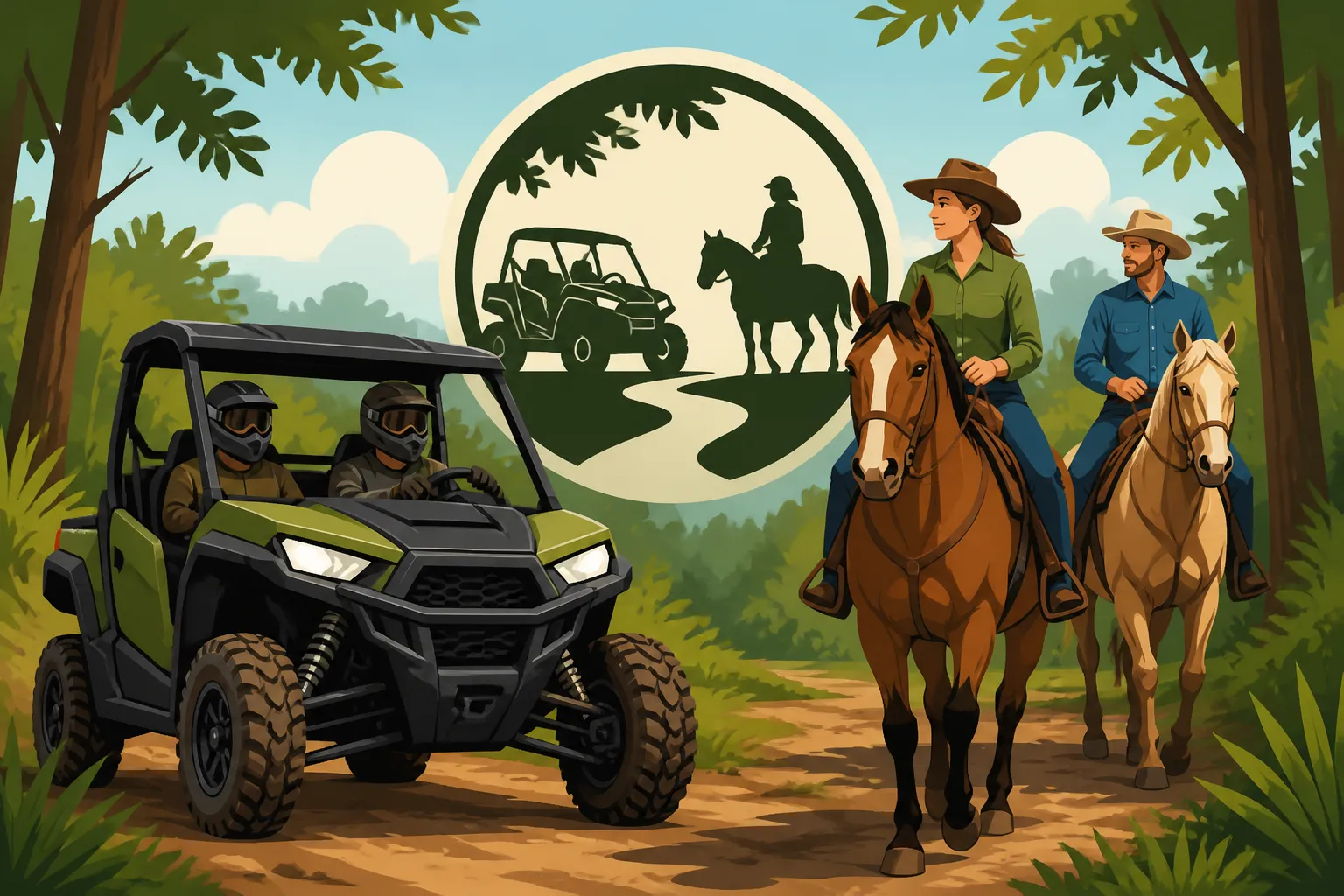
Sharing the Claiborne Trail System with horses takes more than slowing down at the last second. A horse can spook at engine noise, sudden movement, or a machine appearing around a blind bend. This guide explains how ATV and UTV riders can approach, pass, and plan around equestrians while checking that their chosen trail segment is open to motorized use.
Know the trail before you unload
Check which segments are open to your machine
A trail system can include routes with different uses, restrictions, or conditions. Before you head for the [Louisiana's Claiborne Multi-Use Trail], confirm that the specific route you plan to ride allows your kind of machine and is open that day. Don’t assume that a trail shown on a general map is automatically approved for ATVs or UTVs.
Start with the managing agency’s official trail information, posted notices, and signs at the entrance or junction. Check for temporary closures, seasonal restrictions, or instructions about particular users. If a sign or official notice conflicts with a downloaded map, follow the official direction and choose another route.
Digital maps can still be useful for planning where to park, identifying junctions, and keeping your group oriented. Some riders use onX Offroad to review routes before leaving home, but treat any app as a planning aid, not proof that a segment is currently open. Download the information you need ahead of time if you expect limited cell reception, and double-check local signs when you arrive.
Plan a route that leaves room for a calm encounter
A route with tight turns, steep approaches, or limited places to pull aside can make it harder to pass horses safely. If you’re riding with a group, talk through what everyone should do before starting: who will stop first, how the lead rider will signal, and where the group can wait without blocking the trail.
When checking a map, look for places where a stopped group can move well clear of the traveled surface. onX Offroad or another mapping tool may help you understand the general layout, but it won’t tell you whether the edge of a trail is stable, clear of hazards, or suitable for parking. Use what you see on the ground as well as what you saw on the screen.
It also helps to agree on a simple group rule: when anyone spots a horse, the whole group slows down. That prevents a common problem where the first rider stops but someone farther back continues around the bend before realizing why. Keep the group compact enough to communicate, but leave space so riders aren’t crowded together in a way that makes noise or movement harder to control.
What to do when you meet a horse
Slow down early and stop where you are visible
If you spot a horse or hear one approaching, ease off the throttle well before you reach it. Avoid accelerating, revving, or making a sudden turn. If you can do so safely, stop in a place where the equestrian can see you and where you are not blocking the trail. A blind corner is a poor place to wait if you can move a short distance to a more visible spot without closing in on the horse.
Keep your engine off while the horse passes unless the rider asks otherwise. The quiet pause matters: even a machine idling at a distance can be unsettling to an animal that is unsure what it is hearing. Don’t assume that a horse is comfortable around vehicles simply because it is on a multi-use trail.
Let the horseback rider decide when it is safe to proceed. They may need time to settle the horse, turn it toward you, or guide it to a wider section. A friendly wave is fine if it’s calm and unhurried, but avoid shouting across the trail or making sudden gestures. For more general passing guidance, see [Sharing a Forest Trail With Horses] and [Yielding on a Narrow Forest Trail].
Ask before passing and follow the rider’s directions
There isn’t one passing distance that works in every situation. Trail width, footing, vegetation, the horse’s behavior, and the rider’s instructions all matter. When the rider is close enough to hear you, ask whether they would prefer you to wait, pass slowly, or move to a particular side. If they ask you to remain stopped, do that rather than trying to negotiate while approaching.
If the rider says passing is safe, move slowly and steadily, leaving as much room as the trail allows. Avoid sudden steering or changing speed beside the horse. Don’t splash through a puddle, spin tires, or kick up dust as you pass. Once you are beyond the horse, continue at a controlled pace rather than immediately accelerating away.
If the trail is too narrow to pass comfortably, stay put and let the equestrian choose the safest option. They may lead the horse to a wider spot or ask you to back up a short distance. That can feel inconvenient when your group is eager to keep moving, but a brief delay is far better than startling a horse or creating a dangerous squeeze between a machine and the trail edge.
| Situation | Safer response | Avoid |
|---|---|---|
| You see a horse ahead | Slow down early, stop where visible, and turn off the engine | Closing the gap quickly or revving |
| The horse is approaching | Move clear of the trail if safe, then wait quietly | Stepping or driving into the horse’s path |
| The rider gives directions | Follow them and let the rider set the pace | Insisting that the horse pass your machine |
| The trail is narrow | Wait for a wider place or the rider’s signal | Squeezing past or crowding the trail edge |
| You have passed | Continue steadily and keep noise down | Accelerating hard right beside the horse |
Keep your group and machine under control
Make sure everyone knows the passing routine
A horse encounter is harder to manage when riders in a group react differently. One person may stop while another keeps rolling; a rider farther back may not hear the first person’s signal. Before setting out, explain that a horse sighting means the group slows, stops when appropriate, and waits for clear instructions before moving again.
Use a hand signal or another quiet method that everyone understands. Keep enough space between machines for each rider to stop without bunching up. If you’re leading, tell the group why you’ve stopped in a calm voice and avoid calling loudly toward the horse. Anyone who is unsure what to do should stay stopped rather than improvising.
Passengers also need a quick reminder. Ask them not to wave, shout, or make sudden movements as the horse passes. In a UTV, keep doors or arms in a safe position and avoid leaning out toward the animal. The goal is not to make the encounter dramatic; it’s to let the horse and rider continue with as little disturbance as possible.
Manage noise, speed, and trail-edge hazards
Noise that seems ordinary to a machine operator can sound abrupt to a horse, especially on a quiet forest trail. Keep your speed controlled, avoid unnecessary throttle, and don’t use a horn unless there is an immediate safety reason. If your group is approaching a blind bend, slow down enough to stop within the distance you can see.
Don’t assume the trail edge is a safe place to pull over. Soft soil, ditches, roots, washouts, or steep shoulders can make a quick move dangerous for both the machine and its occupants. If you cannot move fully out of the way without creating a hazard, stop in a visible location and let the rider decide how to proceed.
Weather and trail conditions can make these decisions more difficult. After heavy rain, a shoulder may be muddy or unstable, and dust can be a problem in dry conditions. Check [Louisiana Trail Conditions After Rain] before a ride when recent weather may have changed the surface, and use caution even if a route remains open. A posted route can still have rough or narrow sections that call for a slower pace.
Leave the trail ready for the next user
Be considerate at junctions and staging areas
Trailheads and intersections are natural places for different users to meet, but they can become crowded quickly. Park machines only where allowed, keep access points clear, and avoid gathering across the full trail. If you’re waiting for a member of your group, choose a safe place that does not force horses or other trail users to pass close by.
At a junction, pause long enough to check signs and confirm your direction before entering another route. Don’t follow horseback riders simply because they seem to be using a convenient path; the route may not be designated for your machine. When in doubt, stop and consult the posted information or a reliable official map rather than assuming the next segment has the same rules as the one you just rode.
Good manners at a trailhead can also prevent a tense encounter later. Keep conversations and machine noise low when horses are unloading or being prepared. Give trailers and animals room, and never drive close to a horse trailer just to get around a parked vehicle. A few minutes of patience helps everyone start and finish the day more comfortably.
Respond thoughtfully if a horse becomes unsettled
If a horse reacts by backing, turning, or moving away, don’t chase it, try to pass, or make a sudden move to “help.” Stop, keep the engine off, and give the rider space to regain control. Follow the rider’s instructions, even if that means waiting longer or backing away slowly when it is safe to do so.
If there is an immediate hazard, prioritize creating space without startling the horse further. Don’t approach the animal on foot unless the rider asks you to. Riders know their horses and can judge what is likely to help; an unexpected approach from a stranger may add stress instead of solving the problem.
After the encounter, continue carefully. The horse may still be nearby, and other riders could be following the same route. A respectful pace, predictable movement, and a quiet engine are useful well beyond one passing situation. These habits are central to [Louisiana Trail Etiquette Locals Expect] and help keep shared routes welcoming to riders on machines and horseback alike.
A practical checklist before riding Claiborne
Before leaving home, confirm that your intended route is open and designated for your machine. Review current official information, pack a map for areas with weak service, and make sure every person in your group understands the horse-passing routine. If you use onX Offroad to prepare, compare what you see there with official notices and signs at the trailhead.
At the trail, ride at a speed that allows you to stop safely, especially near bends and junctions. When you meet horses, slow down, stop where visible, turn off the engine, and ask the rider how they would like to proceed. Don’t pass until invited, and keep your group quiet and controlled throughout the encounter.
For broader route-planning help, read [Checking a Trail Status Page First] and [Louisiana Trail Etiquette Locals Expect]. Conditions and access rules can change, so build in enough time to choose a different route if a segment is closed or unsuitable. On a shared trail, a patient pause is part of the ride—not a delay that needs to be rushed through.
Disclaimer
This article is for general informational purposes only and does not constitute professional advice. Laws, prices and regulations vary by location and change over time. Consult a qualified professional for guidance on your specific situation.