Louisiana Machines Used Only in a Yard
It’s a tale as old as time in Louisiana: you’ve got a trusty ATV or UTV, and its sole purpose in life is to help you around your property. Maybe it hauls feed to the chickens, pulls a small trailer of tools across your acreage, or just serves as a fun way to get from one end of your land to the other. You might think, "It never leaves the yard, so why would I need to bother with all that paperwork?" But this assumption can lead to some real headaches down the line. This guide will help you understand the nuances of titling and decaling your "yard-only" machine in the Bayou State, so you can avoid unpleasant surprises and ensure you're squared away.
Defining "Yard-Only Use" in the Eyes of Louisiana Law
The phrase "yard-only" sounds pretty straightforward, doesn't it? But when it comes to the law, interpretations can get a little… swampy. It’s crucial to understand what the state considers truly private and what might unintentionally pull you into the realm of public use.
What "Private Property" Truly Means
When we talk about "private property" in the context of off-road vehicles, we're not just referring to your fenced-in backyard, though that certainly qualifies. This definition extends to private fields, timberland you own or lease, hunting club property, or any other land where public access is explicitly restricted. The absolute key here is that there should be no public right-of-way involved. You can ride your machine all day long on your own several acres, across a sprawling farm you manage, or deep into a hunting lease, and as long as every inch of that terrain is genuinely private and doesn't intersect with public access, you're meeting the "private property" criteria.
Many folks naturally assume that crossing their own private driveway to get from one part of their land to another, or traversing a small culvert between two sections of their property, keeps them in the clear. And generally, they’d be right. The minute your tires touch anything managed by the parish, state, or even a local municipality, however, the rules change dramatically.
The Slippery Slope of "Incidental Road Use"
Here's where many Louisiana riders, trying to do the right thing, can accidentally trip up. Louisiana law does have specific, and frankly, quite limited, exceptions for off-road vehicles on public roads. These usually pertain to things like agricultural operations where you might need to cross a public road from one field to another, or if you're engaging in certain emergency services. However, these are not "yard-only" situations; they are specific exemptions that trigger their own set of requirements, often including the need for a decal and certain equipment. [Louisiana Rules for Crossing a Highway]
The hard truth is that the moment your tires even briefly touch a public road or shoulder—even if it's just to wave at a neighbor, grab the mail from a roadside box, or take a shortcut to a different part of your land—you've likely exited the "yard-only" classification. Even if you think it's "just for a minute," or "nobody's around," a state trooper or local deputy might see it differently. The rules governing public road use for ATVs and UTVs are stringent and carry penalties, so it's always best to assume that if it's public pavement or shoulder, your "yard-only" machine doesn't belong there without the proper authorization and permits.
Do You Need a Title for a Louisiana Machine Used Only in a Yard?
This is one of the most common questions and a significant point of confusion for off-road enthusiasts in Louisiana. The short answer, for the vast majority of cases, is yes, you still need a title.
The OMV's Stance on Off-Road Vehicle Titles
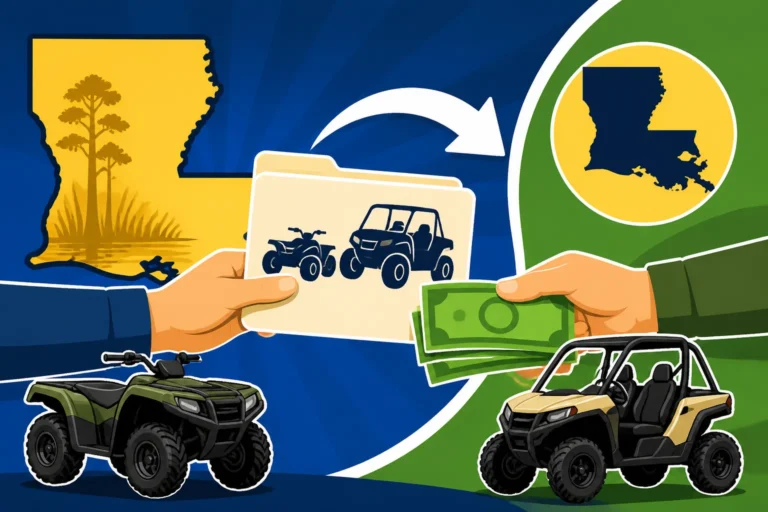
Louisiana state law generally requires a title for ATVs and UTVs, regardless of whether they ever see a public trail or road, or if they just putter around your property. The Louisiana Office of Motor Vehicles (OMV) is the agency responsible for issuing these titles. [Louisiana Titles ATVs Through the OMV] The title isn't about whether your machine is street-legal; it's about establishing clear, legal ownership. It acts as the official document proving that you are the rightful owner of that specific vehicle.
Think of it like the title to your car, even if you only drive that car on private roads or within a gated community. The state still wants to know who legally owns it. This process helps prevent theft, tracks ownership changes, and creates a paper trail for the machine's history. So, even if your quad's wildest adventure is chasing chickens around the coop, the OMV still expects it to have a title.
Why a Title is Essential, Even for Private Use
You might be thinking, "But if it never leaves my property, who cares who owns it?" Well, you might care a lot if certain unfortunate events unfold.
Imagine this scenario: your beloved "yard machine" goes missing from your shed one night. Without a title, proving to the police or your insurance company that the machine was yours can turn into an absolute nightmare. A bill of sale is certainly helpful, but a state-issued title is the definitive proof of ownership the authorities and insurers will look for. It streamlines the process of reporting it stolen and potentially recovering it.
Furthermore, consider the future. Even if you swear you'll never sell your trusted workhorse, circumstances change. When that day comes, whether you're upgrading or simply no longer need it, any savvy buyer will almost certainly demand a clean title. Trying to obtain a title years after purchase, especially if original paperwork is lost or the previous owner is unreachable, can be a frustrating and lengthy bureaucratic challenge. It's far easier to get it done when you first acquire the machine.
A clear chain of title also helps prevent future disputes. If, for instance, you inherited a machine from a family member, having a proper title in their name makes the transfer of ownership much smoother. [Louisiana Titles for an Inherited Machine] The small effort upfront can save you significant headaches down the road. If you find yourself needing to generate a bill of sale for an existing machine or for a future sale, resources like LawDepot can provide helpful templates to ensure all critical details are included, even while you’re working on getting that official title from the OMV.
What About a Decal for a Louisiana Yard-Only Machine?
Here's where the distinction between a title and a decal becomes crucial, and it’s good news for most true "yard-only" machine owners.
Decals and Public Land/Road Use
The Louisiana Off-Road Vehicle (ORV) decal, often just called a decal or sticker, is primarily tied to using your machine on public lands and designated public roads, or for specific agricultural exemptions. [Louisiana ORV Decals and Titles Explained] This is its main purpose. If your ATV or UTV truly never leaves private property – meaning it never touches a public road, WMA trail, or any other public-access area – then you generally do not need an ORV decal. This is a significant distinction from the title requirement.
The decal essentially acts as a permit for public access. If you're staying entirely on your own private land, you're not using public resources, so the state doesn't require you to pay for the privilege through a decal. However, being absolutely certain about what constitutes "never leaving private property" is paramount. Many riders mistake private access roads within a hunting lease, or powerline rights-of-way that crisscross private land, for entirely private areas. These might, in fact, be public or have public easements, making a decal necessary. Always err on the side of caution and check local ordinances or land agreements.
When a Decal Might Still Be Necessary (Even for "Yard" Machines)
While true "yard-only" machines generally don't need a decal, there are a few scenarios where you might find yourself needing one, even if you rarely venture far from home base.
- Agricultural Use with Road Crossings: If you operate your machine on a farm and your work requires you to occasionally cross a public road or use a road shoulder within a 5-mile radius of your farm, you'll need the agricultural exemption decal. This isn't "yard-only" in the strictest sense, but it’s a common use case for machines that primarily stay on private land. [Louisiana's Agricultural Registration Exemption]
- Wildlife Management Areas (WMAs): Have you decided to take your trusty "yard machine" to a nearby WMA for hunting, fishing, or recreation? As soon as you enter a WMA and plan to use designated trails, you absolutely will need a valid Louisiana ORV decal. You might also need other specific WMA permits or licenses. [Louisiana WMA Permit Requirements] Don't get caught without one, as penalties can be steep.
- Private Parks and Riding Areas: Believe it or not, some privately owned mud parks or dedicated riding areas in Louisiana might require you to have a valid state ORV decal as part of their entry rules, even though their land is private. They often do this to ensure riders are at least somewhat familiar with state regulations or for their own insurance purposes. Always check the specific park's rules before you hitch up the trailer. [Louisiana Private Park Waivers and Rules]
Considering the relatively low cost of the ORV decal (it's often just $3 a year), many owners opt to get one anyway, even if they mostly stick to private land. [Louisiana Charges $3 a Year for a Decal] It provides peace of mind and flexibility, allowing you to take advantage of public riding opportunities or visit a private park without having to scramble for paperwork at the last minute.
Establishing and Documenting Ownership for Yard Machines
Even if your ATV or UTV only ever sees the confines of your property, proving who owns it is incredibly important. Beyond the official title, other documents play a crucial role in safeguarding your investment and preventing future headaches.
The Importance of a Strong Bill of Sale
While a state-issued title is the ultimate proof of ownership, a well-drafted bill of sale is still a vital document, especially if you bought your "yard machine" from a private seller or plan to sell it yourself. It provides a detailed record of the transaction, clearly stating the purchase price, date of sale, and the condition of the machine at the time of sale. This document serves as your initial proof of ownership before the title is officially transferred to your name.
A comprehensive bill of sale should always include the Vehicle Identification Number (VIN), make, model, and year of the machine, along with the full names, addresses, and signatures of both the buyer and the seller. Going a step further and having the bill of sale notarized adds a significant layer of legal protection, making it much harder for anyone to dispute the details of the transaction later on. [Louisiana Notarized Bills of Sale] If you’re buying or selling a machine privately, using a reliable template from services like LawDepot can ensure that all the necessary information is accurately captured, protecting both parties from potential future disputes.
What if You Don't Have the Original Title or Bill of Sale?
This is a scenario many long-time "yard machine" owners face, and it's a frustrating one. Perhaps you bought the quad years ago for cash, never worried about the title, and now you can't find the original bill of sale. Or maybe you inherited it, and the original owner's paperwork is nowhere to be found. [Louisiana Title Without a Bill of Sale]
If you're in this bind, you'll likely need to go through a specific process with the OMV to establish ownership and obtain a new title. This often involves submitting affidavits of ownership, where you swear under oath that you are the rightful owner and explain the circumstances of how you acquired the machine. In some cases, depending on the value and history of the machine, the OMV might even require a bonded title, which involves purchasing a surety bond to protect against claims from a potential previous owner. This process can be complex and time-consuming, requiring patience and meticulous documentation.
To help your case, gather any available proof you might have: old registration documents (if it was ever registered elsewhere), insurance papers with the VIN, or even repair receipts that clearly list the VIN. All these pieces of evidence can help the OMV verify your claim. Again, if you need to create an affidavit of ownership to present to the OMV or other authorities, LawDepot offers templates that can guide you in properly articulating your claim to the machine.
Keeping Good Records
Regardless of whether your machine is a dedicated trail warrior or strictly a "yard angel," good record-keeping is paramount. Always keep original copies of your title, bill of sale, and any other ownership documents in a safe, secure place—not just in a digital folder that could be lost to a hard drive crash. A physical copy is often required for official transactions.
It's also a smart habit to photograph the VIN (Vehicle Identification Number) on your machine from multiple angles and keep those photos with your records. This can be invaluable if the VIN plate ever gets damaged, obscured, or if there's a dispute over the identity of your machine. [Photographing the VIN Before You Sign the Title Over] Having these records readily accessible can save you untold stress and time down the road, ensuring your "yard-only" machine remains unequivocally yours.
Summary of Key Differences: Title vs. Decal for Louisiana ATVs/UTVs
To help clarify the requirements, here's a quick comparison:
| Feature | Louisiana ATV/UTV Title | Louisiana ORV Decal |
|---|---|---|
| Purpose | Proves legal ownership and facilitates sales/transfers | Allows legal use on public lands/designated roads |
| Required For | Most ATVs/UTVs, regardless of use location | Public land/road use, some WMA access, some private parks, agricultural exemptions |
| "Yard-Only" | Generally YES, still required for ownership proof | Generally NO, if strictly on private property |
| Issued By | Louisiana Office of Motor Vehicles (OMV) | Louisiana Office of Motor Vehicles (OMV) |
| Cost | One-time fee (e.g., $68.50) | Annual fee (e.g., $3) |
| Protects Against | Theft, ownership disputes, difficulty selling | Penalties for illegal public use |
Disclaimer
This article is for general informational purposes only and does not constitute professional advice. Laws, prices and regulations vary by location and change over time. Consult a qualified professional for guidance on your specific situation.