Trailering to a Mud Park
A Louisiana mud-park trip can go sideways before you ever unload: a trailer may be too small, a tie-down may loosen, or the park entrance may be harder to find than expected. This guide walks through choosing and checking your setup, loading and securing your machine, planning the drive, and arriving ready to ride without making the tow itself the hardest part of the weekend.
Choose a trailer that fits the machine and the trip
Match the trailer to the load
Start with the ATV or UTV’s actual dimensions and weight, then account for everything else you plan to haul. A machine that fits between the trailer rails in a showroom may not leave enough room for its tires, a loading ramp, a fuel can, or another machine beside it. Side-by-sides can be especially challenging because their width may leave little space to walk or attach straps.
Check the trailer’s payload rating, not just its overall dimensions. Payload is the weight the trailer is designed to carry; the machine, accessories, tools, spare parts, and other cargo all count. Also check the trailer’s gross vehicle weight rating and the tow vehicle’s towing and payload limits. A trailer that physically holds your machine is not automatically a safe match for your truck.
Think about the trip you actually take. A short drive to a nearby riding area with one lightweight ATV is different from towing two machines, a full cooler, tools, and camping gear to a weekend event. For example, someone heading to a park near Sarepta with a single quad may need a simpler setup than a group hauling several machines and camping supplies to an event near Colfax. If you are comparing destinations and facilities, Louisiana Private Mud Parks Compared can help you think through which kind of outing fits your group.
| Trailer setup | Often works well for | Things to check |
|---|---|---|
| Small open utility trailer | One compact ATV and a short, straightforward trip | Deck length, payload rating, tire condition, and secure tie-down points |
| Larger open equipment trailer | A wider machine or more than one machine | Total payload, axle and tire ratings, machine spacing, and access to strap points |
| Enclosed trailer | Hauling gear that needs protection from weather or road debris | Interior height and width, payload, ventilation, and whether the machine can be secured to the floor |
| Rental trailer | An occasional trip or a machine that does not fit your usual trailer | Vehicle compatibility, pickup and return arrangements, coupler fit, lights, brakes, and trailer condition |
Treat the table as a starting point, not a substitute for the rating labels and equipment manuals. If you are unsure whether the truck, hitch, or trailer can handle the combined load, stop and confirm the ratings before you load. It is far easier to change plans at home than to discover a mismatch at a fuel stop.
Check the trailer before loading
Give the trailer a slow, practical inspection before every trip. Look at the tires for obvious damage, cracking, low pressure, or uneven wear. Check that the wheel fasteners appear secure, the coupler is the right size for the hitch ball, and the safety chains are attached correctly. Plug in the lights and test the running lights, turn signals, and brake lights with someone standing behind the trailer.
Look closely at the deck and tie-down points. A cracked board, a loose D-ring, or a bent ramp can become a serious problem once a heavy machine is moving. If your trailer has brakes, check that the equipment appears connected and operating as intended. Follow the trailer and vehicle manufacturers’ instructions, and have questionable brakes, tires, wiring, or hitch parts repaired before towing.
A quick check is worthwhile even if the trailer was fine on the last trip. A tire can lose pressure while parked, a light plug can work loose, and a strap can get damaged in storage. If you are borrowing or renting a trailer, make the same inspection rather than assuming someone else has already done it.
Load and secure your machine carefully
Make loading controlled and predictable
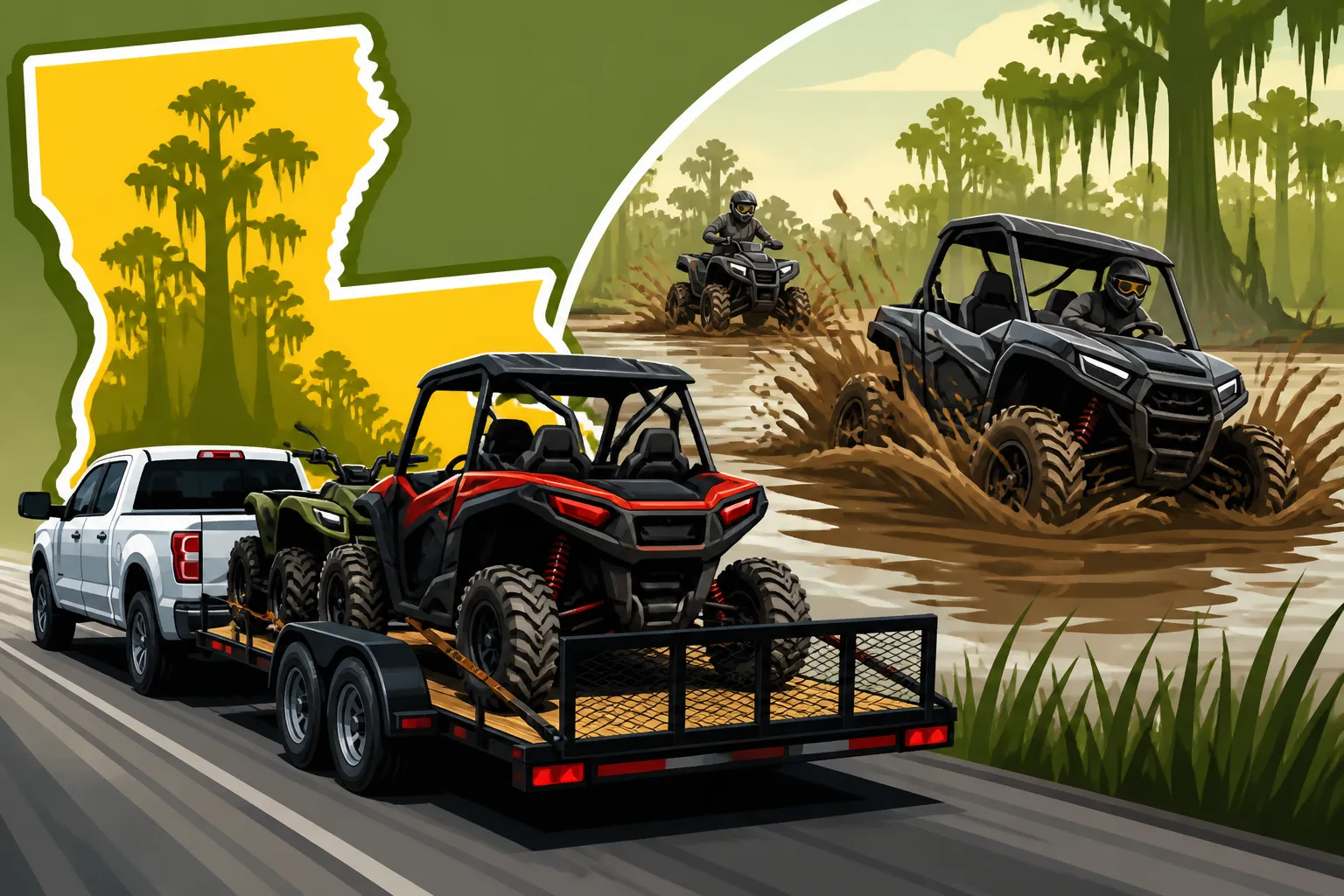
Load on firm, level ground whenever possible. Park the tow vehicle and trailer in line, secure the vehicle, and use ramps that are rated for the machine and positioned so they cannot shift. Keep other people clear of the ramp path. Mud tires can be unpredictable on a slick surface, so avoid loading on wet grass, soft shoulder ground, or a sloped driveway if you can choose a safer spot.
Move slowly and steadily. A helper can guide the machine from the side, but should not stand directly behind it or between the ATV and the trailer. If visibility is poor, stop and reposition rather than trying to guess where a tire is. For a side-by-side, make sure the roof, windshield, mirrors, and any raised accessories clear the trailer and overhead obstructions.
Once the machine is on the deck, park it in the position that gives the trailer a balanced load and leaves safe access to the tie-down points. Don’t assume that placing the machine as far forward as possible is always correct; the trailer and vehicle manufacturers’ guidance on load placement matters. If you are hauling more than one machine, plan where each one will sit before driving the first one up the ramp.
Use secure tie-downs and recheck them
Use straps in good condition and attach them to suitable points on the machine and trailer. Avoid hooking to plastic bodywork, racks, or parts that are not intended to carry the load. The operator’s manual can help identify appropriate securing points. Keep straps clear of sharp edges, hot components, and parts that could move or compress during transport.
Secure the machine so it cannot roll, shift sideways, or bounce loose. A strap that looks tight from a distance may still be poorly positioned or attached to a weak point. Once the straps are tensioned, check that the suspension and machine sit as intended and that no strap is rubbing against a tire or cutting across a control or fragile component. Use additional restraint where the machine or trailer instructions call for it.
Before leaving, walk around the entire load. Check the ramp is stowed and secured, loose cargo is tied down, the coupler is latched, and the safety chains are connected. After driving a short distance, pull over somewhere safe and inspect the straps and load again. Repeat the check at stops, particularly after rough pavement or a long stretch of highway. Strapping Down a Cooler for a Mud Weekend offers another useful reminder: anything loose in the trailer can shift, even when it seems too heavy to move.
Plan the drive to the riding area
Confirm access, timing, and route details
A mud park is not always as simple to reach as a pin on a map suggests. Event schedules, gate access, temporary traffic arrangements, road conditions, and parking instructions can affect your approach. Check the park’s own directions and current visitor information before you leave, and confirm whether trailers are allowed in the area where you plan to unload or camp.
Use a navigation app for general route planning, but don’t treat it as the final authority on an entrance or a trailer-friendly route. onX Offroad can help you review map context and get a sense of nearby roads, but compare that view with the park’s official directions and signs. A route that looks short on a screen may involve a narrow road, a restricted gate, or a turn that is awkward with a long trailer.
If you are considering a forest trailhead rather than a private mud park, verify that the site allows the machine you plan to bring and that suitable parking is available. Louisiana Trailheads With Trailer Parking is a useful place to start. For event-based parks, Checking Dates Before You Tow can help prevent the frustrating mistake of arriving with a loaded trailer when the destination is not open to visitors.
onX Offroad may also be useful for looking at surrounding roads before you set out, especially when your group is unfamiliar with the area. Still, save or write down the park’s official directions and the address or entrance details before leaving. Cell service can be unreliable in wooded areas, so do not depend on a live map connection for the entire drive. Cell Dead Zones in the Piney Woods covers why it is smart to prepare for gaps in reception.
Drive with the trailer in mind
Allow extra room for braking, turns, lane changes, and parking. A trailer follows a tighter path around corners than the tow vehicle, and a wide U-turn or quick lane change can be difficult when traffic is close. Keep a generous following distance and avoid sudden steering or braking. On a narrow rural road, slow down early if you need to make a turn or pull into a driveway.
Choose stops where you can get in and out without backing into traffic or blocking other drivers. Before entering a crowded fuel station, consider whether there is enough space to maneuver with the trailer attached. If you need to reverse, get out and look at the space first; a spotter can help, but agree on clear signals and stop if you lose sight of them.
Rain can make both travel and unloading more difficult. Check the forecast and the destination’s own updates before setting out, especially if the route includes unpaved access roads. Louisiana Trail Conditions After Rain is relevant when your destination depends on trails or access roads that can change after heavy weather. If rain makes a road or parking area unsuitable for your setup, changing plans is safer than forcing the trailer through soft ground.
Arrive ready to unload, ride, and head home
Make a simple arrival plan
Before you arrive, decide who will guide the trailer, who will manage the machines, and where the group will meet if vehicles get separated. A busy event weekend can mean more trailers, pedestrians, and machines moving in the same area. Follow staff directions, posted signs, and park rules instead of improvising a route through occupied campsites or riding areas.
Pick a flat, stable place to unload, if one is available. Keep people away from the ramps, and unload one machine at a time. Once the machines are off the trailer, secure the ramps and move the tow vehicle and trailer to the designated parking area. Avoid leaving a trailer where it blocks emergency access, a trail entrance, or another visitor’s path.
If you are camping as well as riding, keep riding gear and essential supplies easy to reach rather than buried beneath equipment. For a dry-camping trip, Packing for a Night of Dry Camping at Mudfest can help you prepare for the basics without overloading the trailer. If your destination has cleaning facilities, check their rules before assuming you can wash a muddy machine there. Louisiana Riding Areas With Wash Stations can help you look into that detail ahead of time.
onX Offroad can remain useful for orienting yourself around an unfamiliar area, but follow the park’s signs and staff instructions once you are on site. Maps are planning aids, not permission to use a closed road or trail. Keep the app or other navigation tools from distracting the driver, and set up the route before the vehicle is moving.
Check the machine and trailer before the return trip
Mud, water, and vibration can make small problems easier to miss. Before loading, look over the machine for loose parts, damaged straps, or items left on the ground. Remove mud from places where it could obscure a strap connection or make your hands slip. If the machine has been through deep water or heavy mud, give it a careful walk-around rather than rushing straight to the trailer.
Let the machine cool as appropriate before securing straps near hot components. Load it using the same controlled method as at home, then check the balance and all tie-down points. Make sure every tool, cooler, fuel container, and piece of riding gear is secured. A muddy strap or wet ramp may need extra attention to prevent slipping while you work.
Before pulling out, check lights, coupler, chains, ramp storage, and the entire load once more. If you stop during the drive home, inspect the straps again. When you get back, Washing a Machine After a Mud Weekend can help you think through cleanup before mud dries in hard-to-reach places. It is also worth checking the trailer itself for mud buildup, damaged wiring, or a strap that needs replacing before the next ride.
A little preparation makes trailering less stressful: confirm the ratings, inspect the equipment, secure the machine properly, and verify the destination’s access details before leaving. Those steps matter whether you are towing one ATV to a nearby park or bringing a group of machines to a Louisiana event weekend.
Disclaimer
This article is for general informational purposes only and does not constitute professional advice. Laws, prices and regulations vary by location and change over time. Consult a qualified professional for guidance on your specific situation.