Reading a Mud Hole Before You Ride Into It
A Louisiana mud hole can look shallow from the trail and still hide a rut, soft shoulder, or water deep enough to stall a machine. That uncertainty is frustrating when you’re riding with friends and don’t want to become the recovery job. This guide explains how to assess a muddy obstacle, choose a safer line, and decide when turning around is the smart ride.
Read the Mud Hole Before You Approach
Stop where you can see the whole obstacle
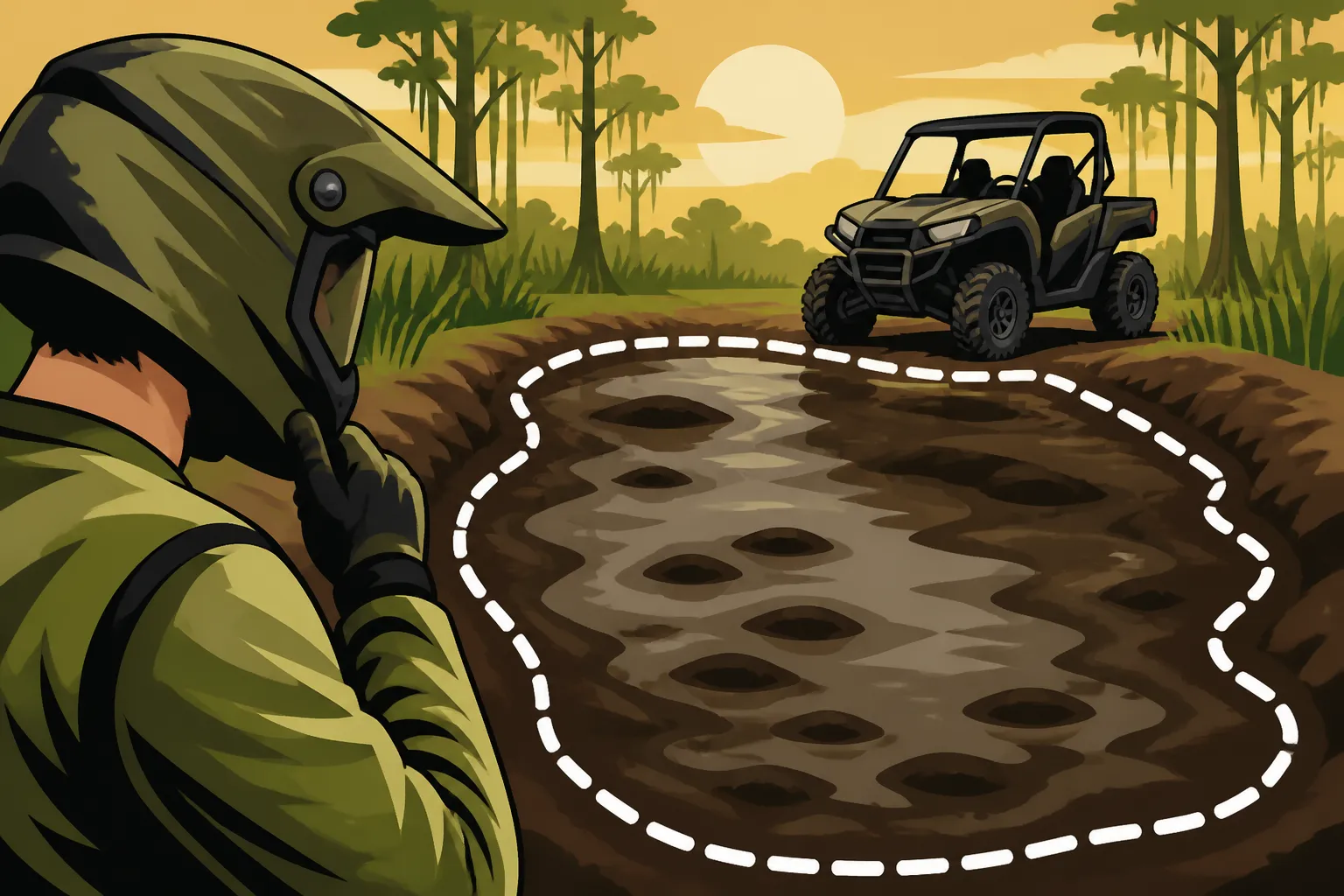
Ease off the throttle well before the mud and stop on firm ground. Give yourself time to look at the hole from more than one angle rather than judging it from the approach alone. A muddy trail can conceal a deeper center, a sharp drop at the entry, or a rut that angles across the line you first noticed.
Look for clues around the edges: fresh tire tracks, broken branches, exposed roots, water marks on vegetation, and places where the ground has slumped. Tracks can show that another machine made it through, but they don’t prove that the route is safe for your machine. A lighter ATV, a wider side-by-side, and a machine with different tires can all behave differently in the same hole.
Pay attention to the exit as much as the entrance. A hole that appears manageable may end at a steep muddy bank, a narrow turn, a tree, or a soft shoulder with little room to recover. If you can’t see where the far side levels out, don’t treat the visible surface as the whole obstacle.
This pause is especially useful on Louisiana trails after rain. The ground can change quickly between shaded pine stands, open sandy areas, and low spots where water collects. Before heading out, check [Louisiana Trail Conditions After Rain] and [Louisiana Trail Closures After a Storm]. A trail that was passable on a dry weekend may become a different challenge after heavy rainfall.
Look for signs that the mud is deeper or less stable than it appears
Color alone is not a reliable depth gauge. Dark water might cover a shallow, firm track, while a thin layer of brown water can hide a deep rut. Look for differences in the water’s surface, such as a sudden change in color or a gap in visible tracks, but treat these as clues rather than proof. Leaves and floating debris can also hide the bottom.
Notice how the edges behave. If the banks are collapsing, the mud is pulled away from roots, or the surface has a glossy, slick look, the ground may not support the machine’s weight. A firm-looking lip can give way under a tire, especially when the machine turns or climbs. The same risk applies to the far side: an exit that looks solid from a distance may be saturated underneath.
Think about what might be hidden below the water. Deep ruts, roots, rocks, branches, and discarded debris can catch a tire or undercarriage. On a familiar private route, you may know the usual layout, but even a well-known hole can change after a storm or repeated traffic. On unfamiliar trails, such as sections of Kisatchie National Forest or a private riding area, assume the bottom could be uneven until you have a safe reason to believe otherwise.
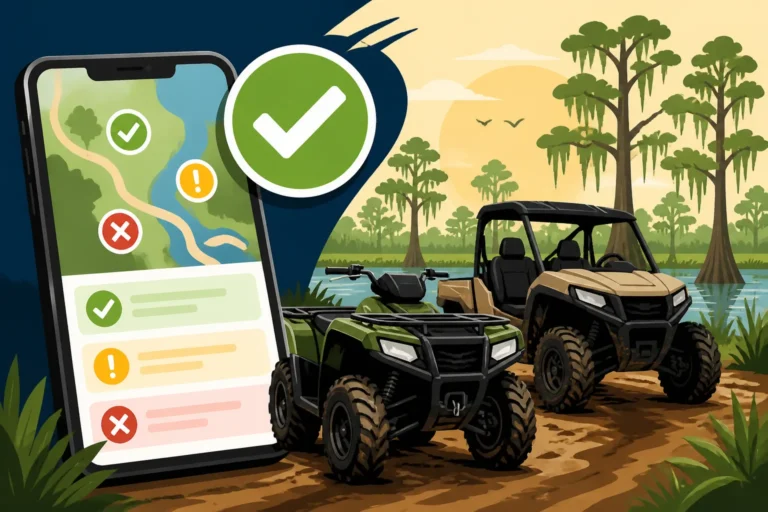
If a group is using a map app such as onX Offroad to plan the day, use it to understand the broader route and identify where you are—not to decide that a particular mud hole is passable. A mapped trail line does not reveal today’s water depth, soft spots, or recent damage. Local trail status and what you can safely observe on the ground matter more.
Decide Whether to Go Around, Cross, or Turn Back
Compare the obstacle with your machine and your ability
There is no universal mud-hole depth that every ATV or UTV can safely handle. Tire size and tread, ground clearance, weight, traction, and the machine’s design all affect how it behaves. So do the rider’s experience, the slope of the entry, and whether there is a safe exit. A machine that can move through a shallow, straight puddle may struggle in a deep rut that forces it to climb at an angle.
Be honest about your setup. A heavily loaded machine, a passenger, or a trailer can change how it handles. A winch may help with recovery, but it does not make every hole safe to enter. Likewise, tires intended for mud do not remove the risk of hidden obstacles or water reaching sensitive components. For more on that equipment, see [Tires for Deep Southern Mud] and [Winches for a Buried Machine].
Consider the consequence of getting stuck. If the hole is isolated, the group has limited recovery gear, or there is no safe place to anchor a winch, the cost of a bad decision goes up. Ask yourself: if the machine stops in the middle, can you get the rider out safely, recover the machine without putting someone in a dangerous position, and avoid blocking the trail? If the answer is unclear, the obstacle is not a good place to experiment.
A useful rule is to make the decision before the machine reaches the edge. Don’t let a running start, a cheering group, or the worry of looking cautious push you into a line you have not assessed. In Louisiana’s humid, muddy conditions, taking a few minutes to discuss the route is usually less frustrating than spending the afternoon trying to recover a stuck machine.
Choose a bypass only when it is permitted and stable
A bypass can be safer than crossing—but only if it is an established, permitted route with firm ground. Don’t cut a new line around a hole through brush, wetlands, private property, or an area marked closed. Riding off the trail can damage land, create new ruts, and put you in a more hazardous place than the obstacle you were trying to avoid.
Check for signs, gates, trail markers, and posted boundaries before taking an alternate path. On public land, including designated riding areas, an apparent track is not automatically an authorized trail. Review [Louisiana Forest Trail Status Pages] before the trip and follow the route rules for the specific riding area. Private parks have their own posted boundaries and operating rules.
If you can’t confirm that a bypass is allowed, turn around or wait for conditions to improve. That may feel like a disappointing choice when you’ve driven a long way to ride, but it protects the trail and keeps your group out of a situation where a simple detour becomes a trespass or recovery problem. For broader planning, [Louisiana Trail Etiquette Locals Expect] covers the kind of trail-sharing decisions that help prevent avoidable conflicts.
| What you observe | What it may mean | Safer response |
|---|---|---|
| The far edge or exit is out of sight | You cannot assess the full obstacle | Do not enter until you can inspect it safely |
| Fresh tracks disappear into water | Depth or the bottom may be unclear | Treat the hole as unknown, not proven safe |
| Banks are crumbling or deeply rutted | The edge may not support the machine | Avoid the edge and consider turning back |
| Water is moving or debris is floating | There may be a current or changing conditions | Do not enter; choose a safe alternate route |
| A bypass crosses brush or a closed area | The route may be unauthorized or damaging | Stay on the designated trail |
| Recovery gear and a safe anchor are unavailable | A stuck machine could become difficult to recover | Skip the obstacle |
If You Cross, Keep the Plan Simple
Inspect the route without putting yourself in danger
If the area is open to inspection and you can do so safely, walk the intended line from firm ground. Avoid stepping into water or mud that could conceal a drop, unstable edge, or object that could trap your foot. Never send a person into an unknown hole to “check the depth” by feel. If the bottom cannot be assessed without taking a risk, count that as a reason not to cross.
A long stick may help you check a visible, accessible spot from stable ground, but it cannot tell you everything about the route. It may miss a deep rut just to one side or fail to reveal a soft exit. Don’t lean over a bank, stand in the machine’s path, or ask a spotter to enter the hole to guide you. A spotter should remain somewhere visible and outside the likely path of the machine, with room to move away.
Before crossing, identify the entry, the line through the obstacle, and a clear exit. Avoid a route that requires a sudden turn, a sharp angle across a rut, or a steep climb onto an unstable bank. If the group cannot agree on a clear route, don’t try to solve the disagreement by charging in. Reassess, find an approved bypass, or turn around.
Cross slowly and keep the rider in control
If you’ve judged the obstacle to be manageable, approach at a controlled speed and follow the line you selected. Avoid an aggressive burst of throttle. Sudden acceleration can spin the tires, dig a deeper hole, or send the machine off the intended line. Trying to correct a bad entry with a sharp turn can make things worse, particularly in a rut or on a sloping bank.
Keep enough distance between machines that each rider can see the obstacle and make an independent decision. Don’t crowd the machine ahead or assume that its successful crossing guarantees the same result for yours. If someone becomes stuck, pause the rest of the group on firm ground rather than allowing several machines to enter the same uncertain area.
A spotter can be helpful if the rider and spotter agree on clear hand signals and the spotter stays out of the machine’s path. But a spotter is not a substitute for visibility or a safe route. If the rider loses sight of the spotter, or the spotter sees the machine moving toward a hazard, stop when it is safe to do so. Don’t let engine noise, a passenger, or several people giving different directions turn a simple crossing into confusion.
Recover Carefully and Plan for Changing Conditions
Know when a stuck machine needs a pause
If the tires begin spinning without forward movement, ease off rather than continuing to dig. Spinning tires can bury a machine more deeply and make the surrounding ground less stable. Once stopped, keep people away from the tires and any tensioned recovery line. A winch or strap can store force under load, so bystanders should stay clear of the line and its connection points.
Use recovery equipment only from a suitable anchor point and according to the equipment and machine instructions. Don’t attach a strap to a component that is not designed for recovery, and don’t stand over or beside a loaded line. If there is no reliable anchor, the machine is in deep water, or the recovery setup is unclear, stop and get experienced help rather than improvising.
Before attempting a recovery, check the rider and passenger first. If anyone is hurt, cold, disoriented, or in water, focus on people rather than the machine. Once the group is safe, reassess whether recovery is possible without putting anyone in the mud, under a machine, or near a moving vehicle. Sometimes the safest decision is to wait for help.
After a muddy ride, inspect the machine before heading home. Mud and water can hide damage, and a machine that made it through once may need attention before the next ride. Cleaning and checking it after a wet outing is easier than discovering a problem on the next trail day. See [Washing a Machine After a Mud Weekend] for practical post-ride care.
Plan around rain, trail rules, and local conditions
A good mud-hole decision begins before you unload. Check the official status of the area, confirm that the trail permits your type of machine, and make sure the route is open. Louisiana riding areas can have closures, seasonal rules, and distinct access requirements. Don’t assume that conditions or permissions at one place apply to another.
Use maps to plan navigation, not to replace on-the-ground judgment. onX Offroad can be part of a route-planning routine for locating trails and keeping track of where your group is, while trail status information and posted rules tell you whether the route is open and permitted. Keep a paper map or another backup if you’ll be riding somewhere with poor reception, and agree on a meeting point in case the group gets separated.
Rain can change both the trail and the safe route home. Before heading into a remote section, consider whether your group has enough fuel, communication options, recovery gear, and daylight to turn back if a route becomes impassable. Conditions can also vary within a single riding area: a sunny stretch may lead into a shaded low spot that has stayed wet.
If you’re unsure, skip the hole. That decision is not a failure of skill; it is a sound response to incomplete information. Riding another section, waiting for conditions to improve, or ending the day early is preferable to damaging a machine, injuring someone, or turning a recreational ride into a difficult recovery.
Disclaimer
This article is for general informational purposes only and does not constitute professional advice. Laws, prices and regulations vary by location and change over time. Consult a qualified professional for guidance on your specific situation.