Louisiana Trail Etiquette Locals Expect
A good Louisiana ride can turn sour quickly when a group roars past a campground, tears up a wet trail, or assumes every open-looking road is fair game. Trail etiquette helps protect access, keep other riders safe, and make the day more enjoyable. This guide explains what local riders tend to appreciate, from passing and mud-hole decisions to planning around weather and sharing public land.
Before You Ride, Check the Place and the Conditions
Confirm the trail is open and appropriate for your machine
Louisiana riding areas are not interchangeable. A route that works for a narrow ATV may not be suitable for a wider side-by-side, and public forest trails can have different restrictions from private mud parks. Before towing to a trailhead, check the land manager’s current rules, permitted vehicle types, closures, and any seasonal restrictions. Start with Louisiana ATV Trails: Where to Ride and the specific area information, such as Kisatchie National Forest OHV Trails in Louisiana, Louisiana's Sandstone Multiple-Use Trail, or Louisiana's Vernon Enduro Trail.
Don’t treat a line on a map—or tire tracks at a trail entrance—as permission to ride. A track might be closed, private, intended for another use, or temporarily unavailable after weather damage. If you use a mapping app such as onX Offroad to plan a route, treat it as a planning aid, not a substitute for posted signs or official trail information. Confirm that the route is open with the land manager before unloading.
It also helps to make sure everyone in the group understands the plan. Tell newer riders what kind of terrain to expect, agree on a turnaround point, and make sure the route fits the least experienced rider and the least capable machine in the group. A modest plan usually beats a complicated route that leaves someone stuck, worried, or far behind.
Check weather and trail conditions before loading up
Louisiana’s rain can change the character of a trail in a hurry. A route that was firm last weekend may have standing water, slick clay, deep ruts, or soft shoulders after a storm. Check the local forecast and the area’s trail-status information before you leave home. Checking a Trail Status Page First is a sensible habit, especially when your drive to the trailhead is long.
If recent rain has left a route fragile, consider postponing or choosing a more durable riding area. Repeated passes through saturated soil can widen a trail as riders steer around ruts and puddles. That extra width can damage vegetation, create new drainage problems, and make the original route harder to maintain. The urge to salvage a planned weekend is understandable, but Louisiana Trail Conditions After Rain are worth taking seriously.
A useful rule of thumb: if you cannot tell whether a wet section is shallow or safe to cross, do not charge in just to find out. Stop, assess it from firm ground, and choose a safe alternative if one exists. If the route is deteriorating or the group is unsure, turning around is a responsible ride decision—not a failure.
Share the Trail Without Surprising People
Slow down, communicate, and pass carefully
On narrow forest trails, blind corners and thick vegetation can leave very little time to react. Slow down where you cannot see ahead, near trail crossings, and wherever other users may be present. Keep enough space between machines to avoid dust, rocks, and sudden braking turning into a chain reaction. The faster rider is responsible for making a pass safely, not for expecting everyone else to get out of the way.
When you meet someone coming the other direction, ease off the throttle and stop in a spot where both parties have room. Make eye contact or use a simple wave when practical. If the trail is too narrow to pass comfortably, wait until there is a wider, stable section. Yielding on a Narrow Forest Trail is particularly important when visibility is limited or the ground beside the track is soft and easily damaged.
Pay attention to who has the safer place to stop. If you are on the uphill side of a steep or narrow section, it may be safer for the downhill rider to yield, but use judgment rather than treating a general convention as an absolute rule. Never crowd another machine toward a drop, ditch, tree, or unstable shoulder. A few seconds of patience are far less costly than a rollover or a damaged trail edge.
Give horses, hikers, and other trail users room
Some forest routes are shared with people on foot or horseback. An approaching horse may be startled by engine noise, sudden movement, or a machine that revs as it squeezes past. Slow well in advance, stop at a safe distance, and ask the rider how they would like you to proceed. Do not assume the horse is calm just because it is standing still. For more context, see Sharing a Forest Trail With Horses.
Avoid revving, accelerating hard, or circling around a horse to get by. Wait for clear instructions, and give the animal as much room as the trail safely allows. If you are riding with children or inexperienced drivers, explain this before the encounter happens. A rider who knows to stop calmly is less likely to panic or make a sudden move.
Hikers and cyclists deserve the same basic consideration. Ease off the throttle, keep your machine under control, and avoid blasting them with dust or spraying mud. When people step aside, acknowledge them rather than treating them as an obstacle. Friendly, predictable behavior helps maintain a good impression of motorized riders—and can make shared access easier for everyone.
Respect camps, trailheads, and quiet areas
A trailhead is a shared staging area, not an extension of the riding route. Keep vehicles and trailers from blocking entrances, parking spaces, or access for emergency vehicles. Secure loose gear, supervise children, and keep machines at a controlled speed around people who are unloading or walking between vehicles. If the parking area is busy, take a moment to organize your group away from the entrance rather than creating a bottleneck.
Near campsites, cabins, or quiet areas, reduce speed and throttle noise. Riders often travel to Louisiana’s piney woods for a mix of trail time and a peaceful night outdoors. A loud pass next to a campsite can turn a pleasant visit into a complaint, especially early in the morning or after dark. Riding Quietly Past Camps is a small courtesy that can make a noticeable difference.
Keep your group compact when passing through developed areas, and avoid unnecessary engine idling. If the area has posted quiet hours or specific campground rules, follow those rules even if your group is only stopping briefly. Good etiquette includes the time before and after the ride, not just the miles on the trail.
Handle Mud and Difficult Sections Responsibly
Choose lines that protect the trail
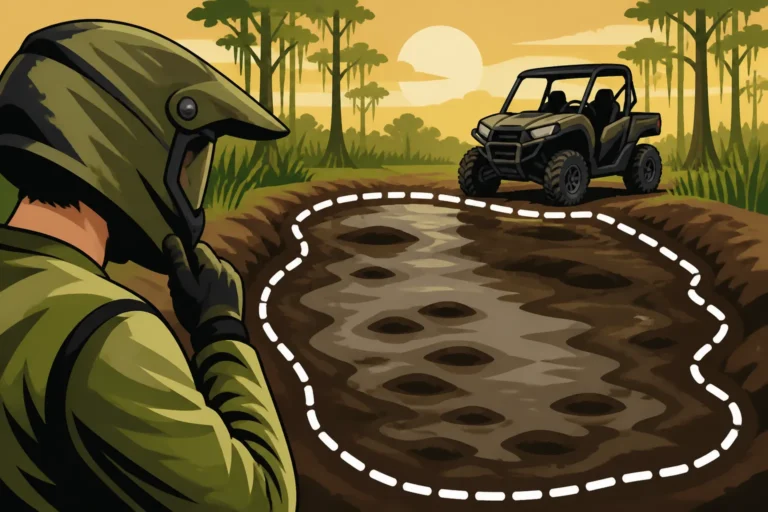
A mud hole can be tempting, particularly when everyone has tires and winches ready for a challenge. But not every muddy section is a good place to test a machine. First consider whether the trail is officially open, whether the feature is part of the intended route, and whether there is a safe way through without widening or damaging the trail. Reading a Mud Hole Before You Ride Into It can help you think through the risks before committing.
Do not cut a new bypass around a puddle or rut just because the existing line looks unpleasant. Repeated detours can turn a narrow trail into a broad, churned-up area. If the trail is too wet to pass without causing damage, turn around or wait for better conditions. Be especially cautious when the edges are soft, vegetation is being pushed aside, or the route appears to be washing out. A machine that can physically push through is not automatically a machine that should.
If the trail is dry enough to ride, follow the established route and leave room between machines. Driving too close can leave the next rider with no time to choose a line or stop if the lead machine bogs down. Agree on a simple signal for stopping, and do not crowd someone who is assessing a crossing. If a rider gets stuck, give them space to recover without surrounding the machine or blocking the entire route.
| Situation | Considerate choice | Why it helps |
|---|---|---|
| Recent heavy rain | Check status and consider postponing | Reduces rutting and trail widening |
| Deep or unclear water | Stop and assess from safe ground | Avoids hidden hazards and recovery problems |
| A puddle with a worn bypass | Stay on the established route if safe | Prevents new damage to surrounding ground |
| A machine gets stuck | Stop at a safe distance and coordinate | Leaves room for recovery and keeps others clear |
| The trail is deteriorating | Turn around or use an approved route | Protects access and limits further damage |
Keep recovery safe and avoid turning it into a spectacle
Getting stuck happens. What matters is how the group responds. Stop other machines at a safe distance, keep bystanders clear of cables and straps, and agree on who is directing the recovery. Avoid standing in line with a tensioned winch cable or towing strap. If the situation is beyond the group’s equipment or experience, stop before a rushed recovery makes it worse.
A stuck rider may be embarrassed or frustrated, but crowding them with advice rarely helps. Ask before attaching a strap or using someone else’s recovery gear. Give the rider room to follow the plan, and keep unnecessary machines off the soft ground. If a recovery has turned the trail into a hazard, notify the appropriate land manager or park staff rather than leaving the next group to discover it unexpectedly.
On a private park, follow staff directions and posted recovery rules. A park’s marked route, designated obstacle, or managed mud area may be intended for different use than a public forest trail. The key is not to assume that one place’s customs apply everywhere. Check the rules for the location you are actually riding.
Leave the Area Ready for the Next Group
Keep the group organized and take your litter with you
Before setting off, choose a lead rider and a sweep rider so nobody is quietly left behind. Agree on what to do if the group gets separated, and stop only in places where other riders can see and pass safely. If someone needs a break, move the group out of the traveled route rather than stopping around a blind corner or at the bottom of a narrow hill.
Carry out everything you bring in, including food wrappers, drink containers, broken parts, and used ties or straps. Do not leave trash beside a trailhead, toss it into the woods, or assume someone else will pick it up. Check the ground around your parking spot before driving away; small items often fall while people are unloading or packing muddy gear.
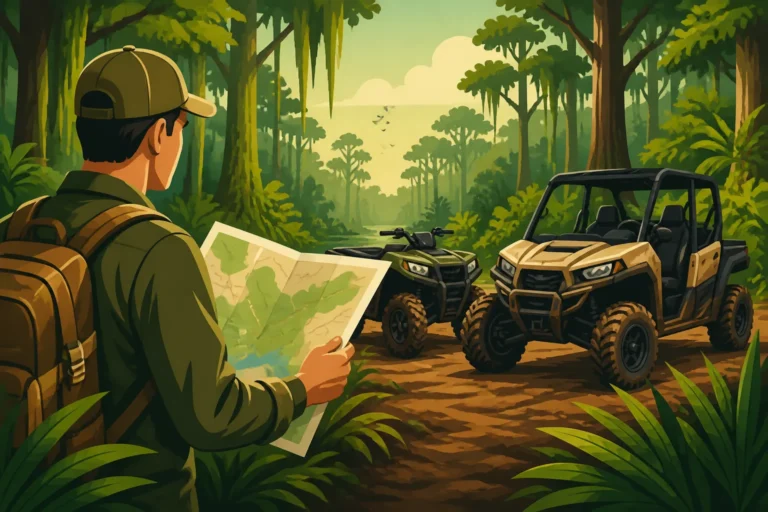
A map can help the group stay oriented, but do not follow a digital line without checking signs and access rules on the ground. onX Offroad may be useful for organizing a route and understanding where you expect to ride, while posted restrictions and official trail information should guide your final decision. If you find a closure sign, respect it rather than treating it as a suggestion.
Be a good neighbor at the trailhead and on the drive home
The ride is not over when the machines are strapped down. Keep loading areas clear, secure muddy equipment, and avoid letting water, mud, or loose gear spill into other people’s parking spaces. If you are using a public staging area, leave it as clean as you found it. Leaving a Kisatchie Trailhead the Way You Found It captures a simple expectation that applies well beyond one forest.
When returning to a public road, make sure your machine and trailer are secure and that mud is not obscuring lights or other required equipment. Keep noise and dust down near nearby homes and businesses. A respectful departure matters because local residents may see the trail traffic every weekend, even if a visitor is only there for one afternoon.
Finally, share useful information without presenting rumors as official updates. If you notice a downed tree, damaged sign, or unsafe washout, report it to the land manager or park staff through the appropriate channel. Let your riding group know what you observed, but avoid encouraging others to use a route that may be closed or unsafe. That kind of care helps keep Louisiana riding areas welcoming for the next visitor.
Disclaimer
This article is for general informational purposes only and does not constitute professional advice. Laws, prices and regulations vary by location and change over time. Consult a qualified professional for guidance on your specific situation.