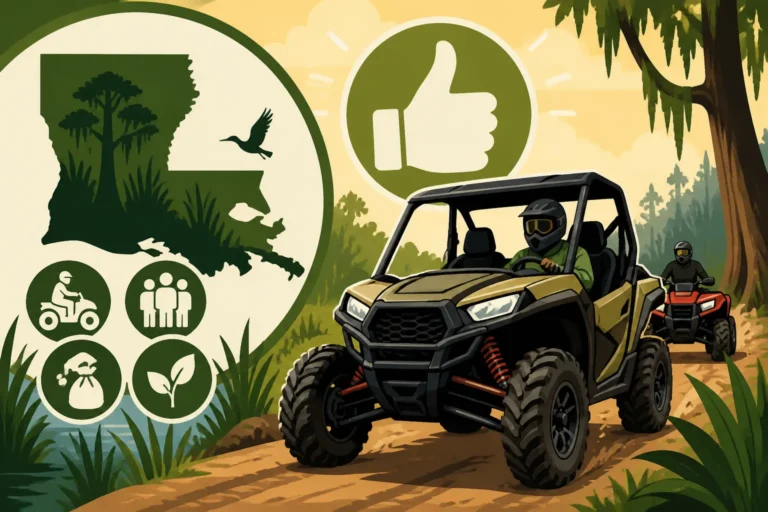
Louisiana Riding Near Alexandria
Alexandria is a handy base for exploring central Louisiana, but finding a place where an ATV or UTV is actually allowed can take more planning than expected. Forest roads, wildlife areas, private parks, and designated OHV trails all have different rules. This guide explains the main riding options near Alexandria, what to check before unloading, and how to plan a safer day out.
Start With the Type of Riding You Want
Choose between public trails and private parks
The riding options around Alexandria generally fall into two categories: managed public-land routes and private riding areas. On public land, access is tied to specific trails, seasons, permits, machine limits, or other land-management rules. A road that looks rideable on a map is not automatically open to ATVs, and an open forest road may not be an OHV trail.
Private parks offer a different experience. They may have mud, wooded routes, open areas, and event facilities, but you ride under the park’s own rules and schedule. A park may open only for an event weekend or require riders to follow age, helmet, passenger, camping, and noise policies. Check the park’s own information before towing from Alexandria so you are not relying on an old event listing or someone else’s recollection.
If your group wants a marked route, a predictable ride, or a chance to explore forest terrain, start by checking public trail areas and their official status. If the goal is deep mud, an event atmosphere, or riding with a larger group, a private park may be a better match. For more options across the state, see [Louisiana ATV Trails: Where to Ride](Louisiana ATV Trails: Where to Ride).
Match the trip to your machine and group
A family ride with a youth quad has different needs from a day of UTV riding in deep mud. Before settling on a destination, confirm that the area allows your machine type and size. Some public riding areas have limits on vehicle dimensions, weight, tires, or where machines may travel. A side-by-side that is too wide for a particular trail can turn a long drive into a frustrating turnaround.
Also think about how much time you want to spend riding versus traveling. An outing near Alexandria might mean a shorter drive to a nearby event or a longer trip to a forest trail network. If your group includes new riders, young children, or people who are not used to rough terrain, choose a destination with clear route information and a sensible place to regroup.
It helps to agree on the day’s priorities before you leave. One rider may want mud and steep challenges, while another is hoping for an easy scenic loop. Discuss terrain, machine limits, expected riding time, and whether everyone is comfortable with the same level of difficulty. For a broader look at what to expect on different routes, [Best Louisiana ATV Trails for Beginners](Best Louisiana ATV Trails for Beginners) is a useful related read.
Riding Near Alexandria on Kisatchie National Forest Land
Check designated trails, not just forest roads
Kisatchie National Forest is an important part of the riding picture in central Louisiana, but “near the forest” does not mean every track is open to motorized recreation. Public land can include designated OHV trails, roads with separate vehicle rules, closed areas, and places where motorized use is prohibited. Treat the official trail information as the deciding source before heading out.
The practical issue is easy to miss when planning from home. A route may appear on a recreational map or in an app, but the map may not show a seasonal closure, a local restriction, or a change to access. Use tools such as onX Offroad to help understand the general layout and organize your route, then compare what you see with the current information from the land manager. App mapping can support your planning; it does not grant permission to ride.
Before leaving Alexandria, check the trail’s status, access point, vehicle rules, and any required pass or fee. Save or print the information you will need, especially if you expect weak cell service. For help understanding public-forest access and fees, see [Louisiana Forest Trail Use Passes](Louisiana Forest Trail Use Passes) and [How to Buy a Louisiana Forest Pass](How to Buy a Louisiana Forest Pass).
Plan around trail conditions and seasonal closures
Central Louisiana’s weather can change a trail quickly. Heavy rain may leave low spots flooded, turn clay into slick mud, wash out a section, or make a route difficult for a stock machine. A trail that felt manageable on a dry weekend can become a recovery project after a storm. Check for closures and recent conditions before you load the trailer, and be prepared to change plans if the route is not suitable.
Seasonal access matters too. Some trails close during particular parts of the year, and those dates can affect whether a trip is possible even when the weather looks ideal. Do not assume that a trail is open because it was open on your last visit. Confirm the dates and permitted uses directly before traveling; [Louisiana Trail Closures and Seasons](Louisiana Trail Closures and Seasons) offers more background on why access can vary.
Give yourself a backup plan. If a trail is closed, muddy beyond your group’s comfort level, or unsuitable for one of the machines, decide in advance whether you will switch to another legal area or make the drive home. Checking status early can prevent a long tow for a ride that cannot happen. [Louisiana Trail Conditions After Rain](Louisiana Trail Conditions After Rain) is also worth reviewing when storms have recently moved through the area.
Other Riding Choices Within a Regional Drive
Consider a private event park near Colfax
For riders around Alexandria who want an organized private-park experience, Louisiana Mudfest near Colfax may be worth checking when its event calendar fits the trip. Private parks can offer an event-focused day or weekend with terrain and facilities that differ from a public forest trail. They may also have specific access windows, so it is important to confirm that the property is open to riders on the dates you are considering.
Do not treat an event listing as a complete set of riding instructions. Check current entry requirements, vehicle rules, camping arrangements, and what the admission covers. Ask whether the park has separate rules for youth riders, passengers, night riding, pets, alcohol, or sound. Those details affect what to pack and whether the whole group can participate.
An event park can be a good fit for friends who want to ride together and spend time at the site, but it may not suit someone looking for quiet, continuous trail mileage. The experience can depend on event timing, turnout, weather, and the park’s layout. For planning details about this type of outing, see [Louisiana Mudfest and Event Weekends](Louisiana Mudfest and Event Weekends) and [Louisiana Mudfest Camping Rates](Louisiana Mudfest Camping Rates). Confirm current arrangements with the organizer before making travel plans.
Compare with longer trips to established OHV trails
Some well-known Louisiana riding destinations are farther from Alexandria but may be worth considering for a full day or overnight trip. Sandstone Multiple-Use Trail and Vernon Enduro Trail are examples of established trail areas riders may compare when planning a trip beyond the immediate Alexandria area. Their terrain, access arrangements, seasonal status, and suitability for different machines may not be the same, so check the specific trail rather than assuming one set of rules applies statewide.
Travel time is only one part of the calculation. Consider how long it takes to reach the trailhead, whether you need a pass, whether camping is available nearby, and what time you must arrive to get a useful ride in. If you are towing, plan fuel stops and allow time for unloading, safety checks, and the drive home. A farther destination can be more rewarding when your group has enough time to ride without rushing.
A mapped route can help you compare access points and keep your group oriented, especially when planning an unfamiliar area. onX Offroad may be useful for reviewing route possibilities and saving a general plan, but verify trail access and closures through the responsible land manager. For specific overviews, see [Louisiana's Sandstone Multiple-Use Trail](Louisiana's Sandstone Multiple-Use Trail) and [Louisiana's Vernon Enduro Trail](Louisiana's Vernon Enduro Trail). For a closer look at the Alexandria region’s wider options, [Louisiana Riding Near Alexandria](Louisiana Riding Near Alexandria) is the companion topic for this local guide.
| Riding option | Best suited to | What to verify before leaving |
|---|---|---|
| Designated public OHV trail | Riders seeking managed routes on public land | Trail status, permitted machines, seasonal dates, passes, and access point |
| Other forest roads | Riders with a specific route and permission to use it | Whether motorized travel is allowed on that road |
| Private riding park | Groups seeking mud, events, or park facilities | Opening dates, admission details, vehicle rules, camping, and age requirements |
| Longer regional trail trip | Riders planning a full day or overnight outing | Drive time, current closures, route difficulty, and nearby services |
A Practical Checklist Before You Tow
Confirm access and paperwork
Start by identifying the exact riding location, not just the nearest town or forest name. Confirm the designated entrance, address or access directions, hours, and whether the route is open to the machine you plan to bring. For public land, check the relevant agency’s current trail information and permit requirements. For a private park, use the organizer’s own instructions for the date of your visit.
Make sure the machine’s paperwork and decals are in order for the kind of riding you plan to do. Louisiana’s off-road decal and title are separate matters, and an off-road decal should not be mistaken for street-legal registration. If you are uncertain about which requirements apply to your machine, read [Why an ATV Needs Both a Title and a Decal](Why an ATV Needs Both a Title and a Decal) and [How to Get a Louisiana ORV Decal](How to Get a Louisiana ORV Decal).
If your route involves public roads, do not assume that a short connector is legal simply because it leads to a trailhead or another riding area. Road use has separate restrictions from off-road riding. Check the specific rules before planning any segment on a parish road or highway; [Can You Ride an ATV on the Road in Louisiana?](Can You Ride an ATV on the Road in Louisiana?) explains why that distinction matters.
Prepare for heat, mud, and limited service
A Louisiana ride can be tiring even when the route is not especially technical. Heat, humidity, standing water, insects, and muddy recovery work all add to the day. Bring drinking water for every rider, food or snacks, appropriate clothing, and a first-aid kit. Pack extra supplies for children and anyone who may need more frequent breaks.
Inspect the machine before loading it. Check tires, controls, brakes, lights, fuel, and recovery gear. For a muddy route, bring equipment suited to your vehicle and experience level, and do not count on another group being available to pull you out. A winch or recovery strap is useful only when riders know how to use it safely and have suitable attachment points.
Cell coverage can be uneven in wooded or rural areas. Share the destination and expected return time with someone who is not riding, and keep your route plan available offline or on paper. onX Offroad can be one part of that planning, but a phone app should not be your only navigation or emergency resource. For more trip-preparation ideas, see [Louisiana Group Ride Planning](Louisiana Group Ride Planning) and [Louisiana Riding Season Month by Month](Louisiana Riding Season Month by Month).
Ride Legally and Leave Room for a Change of Plan
Keep machines on routes open to them
The clearest way to avoid an access problem is to stay on routes specifically open to your vehicle and follow posted signs. Do not cut around a closed gate, ride across a closed section, or assume that a track used by another vehicle is open to ATVs. Restrictions may protect wildlife, reduce erosion, separate riders from other recreation, or address safety concerns.
On public land, follow trail markings and any machine-specific limits. If a route has a width or weight restriction, measure or confirm your machine before you make the drive. A large UTV may not fit a trail intended for smaller machines, and tires that are unsuitable for an area may damage the surface or violate its rules. Read the destination’s requirements rather than relying on what was allowed at a different trail system.
At private parks, follow the property’s rules even when the terrain seems unrestricted. Stay within boundaries, respect speed limits, and give other riders room. A group that is having fun can still create problems if it blocks a trail, passes recklessly, or ignores a marked closure. For planning around designated public routes, see [Louisiana WMA Designated Trails Only](Louisiana WMA Designated Trails Only).
Make a backup plan for weather or closures
A good riding plan includes a decision point. If a trail is closed, flooding is present, or conditions are beyond your group’s ability, be willing to change destinations or call off the ride. That can feel disappointing after a long drive, but it is better than getting stuck, damaging a trail, or putting a rider at risk.
Before leaving Alexandria, identify a second legal option that fits your machines and your group. Check whether it is actually open that day, whether it has separate permit requirements, and whether the drive is realistic. If the alternative is a private park, verify its event schedule; if it is public land, confirm the designated trail and access details.
Once you arrive, take a few minutes to review the plan with everyone. Choose a meeting point, agree on a pace, and make sure each rider knows how to stop or signal if something goes wrong. For less experienced riders, keep the first loop conservative and reassess before taking on rougher terrain. Familiarity with a route is never a reason to ignore current conditions or posted restrictions.
Disclaimer
This article is for general informational purposes only and does not constitute professional advice. Laws, prices and regulations vary by location and change over time. Consult a qualified professional for guidance on your specific situation.