Where the 5-Mile Radius Is Measured From
It’s a common scenario across rural Louisiana: you’re a farmer, rancher, or just someone who uses their ATV or UTV for work, and you need to move your machine a short distance down a parish road. Maybe you’re checking fences, shifting between fields, or heading to the neighbor’s to borrow a tool. You know you can’t just cruise the highways, but there’s this whisper about a “5-mile radius” that allows it. This can be incredibly confusing, leaving many folks wondering exactly what that means and, more importantly, where that 5-mile radius is actually measured from. This guide is here to clear up that mystery, detailing the specifics of Louisiana's agricultural exemption for off-road vehicles on public roads and how to correctly understand and apply the 5-mile rule to your daily operations.
What the 5-Mile Farm Radius Means for Louisiana Riders
The idea of being able to legally operate your ATV or UTV on a public road in Louisiana often seems like a pipe dream, given the strict regulations that generally keep these machines off blacktop. However, there's a vital, often misunderstood, exception carved out specifically for those engaged in agricultural pursuits. This isn't a loophole for recreational riding, but a necessary allowance for the backbone of our state's economy – our farmers and ranchers.
Understanding the Legislative Intent
The legislative intent behind the 5-mile farm radius is crystal clear: it's designed to facilitate agricultural operations, plain and simple. Louisiana's lawmakers recognized that modern farming often requires moving equipment, checking irrigation systems, or transporting feed across short distances that might involve crossing or briefly traveling along a public road. Without this exemption, farmers would face significant logistical hurdles, having to load and unload their machines onto trailers just to move a few hundred yards. The goal was never to open up public roads for joyriding or casual transportation, but rather to ensure the efficiency and practicality of agricultural work. It's a pragmatic solution to a very real operational need, acknowledging that for many in rural areas, an ATV or UTV is an essential piece of farm equipment. The law aims to prevent unnecessary burdens on those who feed our communities, allowing them to keep their operations moving smoothly.
Who Qualifies for This Exemption
This exemption is not a blanket permission for every ATV or UTV owner in Louisiana. It is explicitly for individuals engaged in legitimate agricultural operations. This means you must be actively involved in farming, ranching, timber production, or similar endeavors where your off-road vehicle is integral to your work. Think of it this way: are you moving cattle, inspecting crops, maintaining fences, or transporting tools or supplies directly related to your farm? If so, you likely qualify. If you're simply using your buddy's hunting camp as your "farm" or trying to use the exemption to run to the convenience store, you're missing the intent entirely, and you could find yourself in a heap of trouble with law enforcement. The spirit of the law focuses on the utility of the machine for agricultural purposes, not merely its ownership by someone who might also happen to live in a rural area. You'll need to demonstrate a direct connection between your road use and your agricultural work.
Pinpointing the Starting Line: How the 5-Mile Radius is Measured
This is where the rubber meets the road, quite literally. Understanding how the 5-mile radius is measured is crucial to staying on the right side of the law. It’s not a vague concept; it has specific parameters that dictate where and how you can operate your machine under this exemption. Getting this wrong can turn a simple trip into a costly citation.
Defining the "Farm" or "Agricultural Operation"
The first and most critical step in understanding the 5-mile radius is defining its origin point: the "farm" or "agricultural operation." This isn't just any parcel of land you might own or use. For the purpose of this exemption, it refers to the primary location where your legitimate agricultural activities are centered. This could be your main farm property, a specific field you lease, or a timber tract you're actively managing. The "farm" must be a tangible location, identifiable by its use for cultivation, livestock, timber, or other recognized agricultural production. It's the central hub from which your farm-related movements originate and return. For instance, if you operate a crawfish farm, your main pond or processing area would be considered your operational base. If you have multiple disconnected land parcels that are all part of your larger farming business, each of those parcels could potentially serve as an origin point for a separate 5-mile radius, but the trip must always be tied to the agricultural activity of that specific parcel. The key is that the starting point must be clearly and actively used for agricultural purposes, not just a place you park your machine.
Calculating the Distance to Your Destination
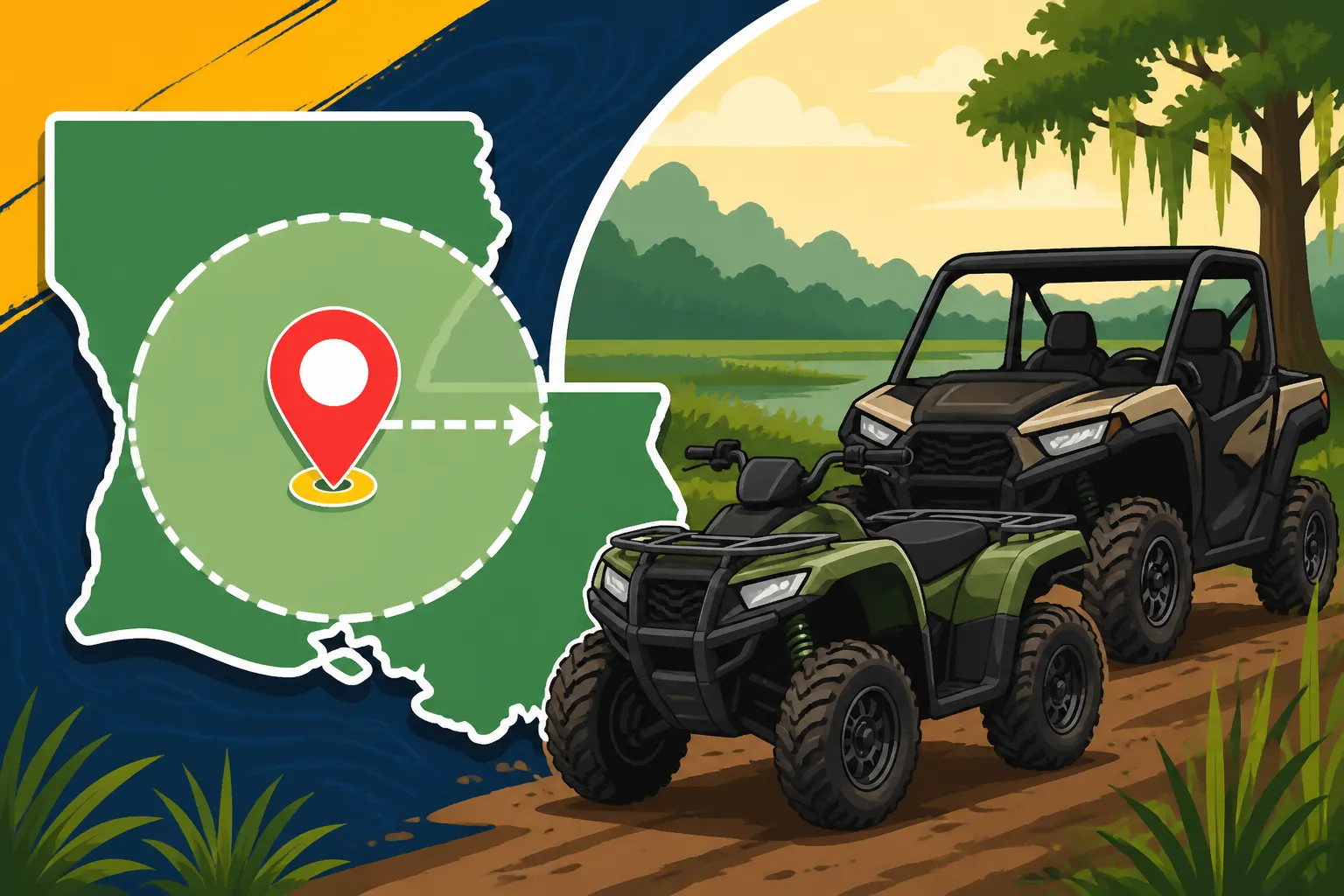
Once you've identified your starting point, the next challenge is to accurately calculate the 5-mile distance. It's not measured "as the crow flies," which would be a straight line regardless of roads or topography. Instead, the 5-mile radius is measured in road miles from a point on your farm or agricultural operation. This means you need to consider the actual route your machine would take on public roads to reach its destination. For example, if you're moving a sprayer from one field to another, the measurement begins where your ATV exits your field onto the public road and ends where it re-enters another field or a specific point relevant to your agricultural task. The destination must also be related to your farm operations, such as another field, a feed store, a repair shop, or a neighbor's farm for a shared task. Using a GPS device or a mapping app set to "driving directions" can be incredibly helpful for this, allowing you to trace your intended route and confirm it stays within the statutory limit. It’s essential to be precise, as even going a fraction of a mile over that limit invalidates the exemption. Remember, this isn't about stretching the rules; it's about adhering strictly to them for the specific purpose they were created.
Permitted Road Use Within the Radius
Even within the sacred 5-mile radius, the law doesn't grant you carte blanche to roam public roads. The exemption specifically limits your travel to the shoulder of parish roads. This is a critical distinction and often a point of confusion for riders. You are explicitly prohibited from riding in the actual travel lanes of any public road, and certainly not on state highways, interstates, or within city limits unless those specific municipalities have their own, often stricter, ordinances. The intent is to allow you to connect your farm operations with minimal impact on regular traffic flow. When riding on the shoulder, you must always be mindful of other vehicles, pedestrians, and cyclists, maintaining safe speeds and exhibiting defensive driving habits. This also means you need to be cautious at intersections and driveways, where you might briefly need to cross a lane or enter traffic to turn. The law, as outlined in [Louisiana ATV Road Rules Under 32:299] and [Louisiana UTV Road Rules Under 32:299.3], is very clear: the privilege is restricted to the shoulder, and it's solely for your agricultural purpose. Going into the main lane of traffic, unless absolutely necessary for a brief crossing, can quickly negate the protection of the 5-mile radius.
Essential Paperwork and Enforcement Realities
Even with a clear understanding of the 5-mile radius, the practical application of this exemption hinges on proper documentation and an awareness of how law enforcement approaches these situations. It's not enough to simply be a farmer; you need to be able to prove it and demonstrate your adherence to the rules.
The Critical Role of the Farm Affidavit
This cannot be stressed enough: if you intend to utilize the 5-mile farm radius exemption, you absolutely must carry a sworn farm affidavit. This document is your official declaration that your ATV or UTV is primarily used for bona fide agricultural purposes. Without it, even if you are truly a farmer moving between fields, you have no legal standing for the exemption. The affidavit essentially serves as your "permit" for this specific type of limited road use. You can obtain these affidavits from the Louisiana Office of Motor Vehicles (OMV), and it's crucial that you fill it out accurately and have it properly notarized. Think of it as your golden ticket – but only if it's correctly issued and readily available. Keep it with you whenever you're operating your machine on or near a public road, perhaps laminated and stored in a waterproof pouch on your ATV or UTV. For more detailed information, check out [Louisiana Farm Affidavits for Road Use] and [Carrying an Affidavit Sworn Before a Notary]. This document is your first line of defense if you're ever stopped by law enforcement, verifying your legitimate use of the exemption.
What Law Enforcement Looks For
When a state trooper or parish deputy encounters an ATV or UTV on a public road, their primary assumption will likely be that the machine is being operated illegally, given the general prohibition. Your farm affidavit and clear demonstration of agricultural activity are key to de-escalating the situation. Officers are trained to look for several things:
- Proof of Agricultural Purpose: Are you actively engaged in farm work? Are you carrying tools, equipment, or supplies related to farming? Or are you just out for a leisurely ride with no discernible agricultural connection?
- The Farm Affidavit: Do you have your current, properly notarized [Louisiana Farm Affidavits for Road Use] immediately accessible? This is non-negotiable.
- ORV Decal: Is your machine properly decaled? The farm exemption for road use does not exempt you from needing an off-road vehicle decal.
- Adherence to the 5-Mile Radius: Can you articulate your route and explain how it falls within five road miles of your farm operation?
- Road Position: Are you riding strictly on the shoulder, or have you encroached into the travel lanes?
- Driver's License: Do you possess a valid Class E driver's license? While not always strictly enforced for off-road use, if you're on a public road, even the shoulder, a Class E license is required.
- Machine Condition: Is your machine in safe operating condition with working lights, especially if you're operating near dawn or dusk?
Officers are generally understanding of legitimate farm use, but they are also vigilant about preventing abuse of the exemption. They know [Louisiana State Trooper Can Ask to See] your paperwork, and they will expect clear answers and compliance. If you're stopped, be polite, provide your documentation, and clearly explain your agricultural purpose and route. Compliance and clear communication can prevent a warning from turning into a citation.
Beyond the 5-Mile Radius: When the Exception Ends
It's critical to understand that the 5-mile radius is a hard limit. Go even a tenth of a mile over, and you are no longer operating under the protection of this exemption. The moment you exceed that geographical boundary, your ATV or UTV is considered to be on a public road illegally, and you become subject to all applicable penalties. This means fines, potential impoundment of your machine, and other legal repercussions.
Consider a scenario: you need to pick up a specific part for your tractor, and the closest dealership is 5.5 miles down the road from your farm. If you choose to ride your UTV there, you've technically violated the terms of the exemption for that last half-mile. While it might seem minor, the law doesn't make exceptions for "just a little bit over." The intent is for short, incidental travel, not extended journeys. If your destination is beyond that 5-mile threshold, even by a small margin, your only legal option is to load your machine onto a trailer for transport. This strict adherence emphasizes that the exemption is a privilege for specific, limited circumstances, not a general license for extended road travel. Always measure your routes carefully, and when in doubt, choose the safer, legal option of trailering your machine.
Practical Considerations for Louisiana Farm Riders
Understanding the letter of the law is one thing, but applying it safely and effectively in the real world requires a few more practical considerations. Even with the farm exemption, responsible operation means thinking beyond just the rules and focusing on safety and community relations.
Ensuring Your Machine is Road-Ready (Even for the Shoulder)
While the farm exemption allows limited use on the shoulder, it doesn't automatically mean your ATV or UTV is equipped for safe interaction with road traffic. For starters, visibility is paramount. Even if not strictly mandated for shoulder use, having working headlights, taillights, and brake lights is crucial, especially when operating near dawn, dusk, or in inclement weather. Adding reflective tape to your machine can significantly increase your visibility to other motorists.
Tires are another consideration. Many ATVs and UTVs have aggressive mud or off-road tires, which can be less stable and wear quickly on pavement. While you might not change tires just for a short hop on the shoulder, be aware of how your current tires perform on hard surfaces. Some farmers opt for more all-terrain style tires that offer a better compromise between off-road traction and pavement manners. Companies like SuperATV offer a wide range of tires and accessories that can enhance both the utility and safety of your machine, whether you're working fields or briefly navigating a parish road shoulder. Investing in robust components and safety accessories means your machine is not only capable of handling the demands of farm work but also safe for its limited stints on public thoroughfares.
Decals and Other Mandatory Requirements
A common misconception is that if you're using your machine for farm work and qualify for the 5-mile radius, you're exempt from other regulations. This is absolutely false. The 5-mile radius is an exception to road use restrictions, not a free pass from all OMV requirements. Your ATV or UTV, even if used exclusively on a farm, still needs to be titled and carry a current [Louisiana's Yearly Off-Road Decal]. This decal demonstrates that your machine is properly registered with the OMV, and failure to display it can result in penalties, regardless of your farm affidavit. The exemption for agricultural use only applies to certain types of road travel, not the general requirement for official identification of your machine. As highlighted in [The Decal a Farm-Exempt Quad Still Has to Carry], this decal is non-negotiable. Furthermore, while not always strictly enforced for shoulder-only use, carrying proof of insurance is always a wise decision. Although not state-mandated for off-road use, unforeseen accidents can still occur, and having coverage can protect you from significant financial burdens. Always make sure your paperwork, including title, affidavit, and proof of decal, is up to date and readily accessible when operating your machine.
Navigating Local Ordinances
While Louisiana state law provides the 5-mile farm radius exemption, it's vital to remember that local jurisdictions, such as parishes and municipalities, can sometimes implement their own ordinances that might affect ATV and UTV use. While a parish cannot outright ban agricultural vehicles operating under the state-granted 5-mile exemption, they might have specific rules regarding designated roads or times of operation. For example, some parishes might have specific signage requirements for designated UTV roads, or they might have stricter enforcement in certain areas. It's always a good practice to check with your local parish government or sheriff's office for any specific ordinances that might apply to your area. Although the state law generally takes precedence for the agricultural exemption, being aware of local nuances can help you avoid misunderstandings or potential conflicts. Information on [Louisiana Parish Ordinance Lookups] can be a valuable resource to stay informed. When in doubt, a quick call to your local law enforcement agency or parish council office can provide clarity and ensure you're fully compliant with all applicable regulations.
Here's a quick look at how the 5-mile farm radius compares to general road riding rules in Louisiana:
| Feature | 5-Mile Farm Radius Use | General Road Riding (Louisiana) |
|---|---|---|
| Purpose | Agricultural operations exclusively | Prohibited for ATVs; limited UTV use on designated roads only |
| Location | Shoulder of parish roads only | Travel lanes, interstates, state highways prohibited for all ORVs |
| Distance Limit | 5 Road Miles from primary farm operation | N/A |
| Required Paperwork | Valid Farm Affidavit, ORV Decal, Driver's License | ORV Decal (if off-road), UTV registration/insurance for designated road use, Driver's License |
| Machine Type | ATV/UTV | UTVs on designated parish/municipal roads only (ATVs generally banned) |
| Driver's License | Class E (standard driver's license) | Class E (required for UTVs on designated roads) |
| Helmet Required | Check local/state law (recommended for safety) | Check local/state law (recommended for safety) |
| Insurance Required | Not for farm use, but highly recommended | Yes, for UTVs operating on designated public roads |
| Speed Limit | Reasonable and prudent, often lower than posted road limits | Typically follows posted limits on designated UTV roads |
| Daylight Hours | Generally applies; specific lighting needed for low visibility | UTVs on designated roads typically adhere to daylight operating hours or strict lighting requirements |
Disclaimer
This article is for general informational purposes only and does not constitute professional advice. Laws, prices and regulations vary by location and change over time. Consult a qualified professional for guidance on your specific situation.