Louisiana Rules for Riding a Camp Road
Riding your ATV or UTV down a camp road in Louisiana seems like a quintessential experience for many, a way to easily access your deer stand, fishing hole, or simply connect to another part of your property. However, the reality of Louisiana's laws surrounding off-road vehicle use on these often-unmarked and seemingly private thoroughfares can be a confusing maze, leading to unwelcome citations or even trespass charges. This guide aims to clear up that confusion, helping you understand when and how you can legally operate your ATV or UTV on camp roads across our beautiful state.
Understanding "Camp Road" Legality in Louisiana
The biggest misconception people have about "camp roads" in Louisiana is that they're all the same. They're not. The legalities of riding your ATV or UTV on one depend entirely on who owns the land the road sits on, and whether it’s considered public or private access. This distinction is absolutely crucial and often misunderstood, leading many well-meaning riders into trouble.
Public vs. Private Camp Roads
It’s easy to look at a narrow, gravel path winding through dense pines or cypress swamps and assume it’s exclusively private, only for the use of those with camps nearby. In Louisiana, this assumption can be a costly mistake. A "camp road" might be private, maintained by a landowner or a hunting club, or it could be a public road, maintained by the parish or even the state, despite its rustic appearance. The moment a road is officially recognized and maintained by a public entity, even if it feels incredibly remote, it often falls under the same rules as any other public road in Louisiana.
Think about it: a road leading to a dozen hunting camps, all leased from a large timber company, might still be privately owned by that company. But if that same road eventually connects to a state highway and is regularly graded by the parish, even without a clear sign, it can suddenly become a public thoroughfare in the eyes of the law. This subtle shift in legal status is where many riders get tripped up, assuming that just because a road isn't paved, it's fair game for unrestricted off-road vehicle use. It's a frustrating nuance, but one we absolutely have to respect to stay legal.
The Role of Property Ownership
Ultimately, the ownership of the land beneath the "camp road" is the foundational element that dictates your rights and responsibilities as a rider. Many camp roads traverse vast tracts of privately owned timberland, often leased out for hunting or recreation. In such cases, the timber company or private landowner controls access and sets the rules. Your access might come through a hunting lease, a verbal agreement, or simply by the grace of the owner. Without explicit permission, you're trespassing, plain and simple.
However, some "camp roads" are actually parish roads. They might not be well-marked, or they might even have a small, almost unnoticeable sign indicating their public status. These roads serve as access points for multiple private properties or provide connectivity within a rural community. Identifying the true owner of the land and the road is paramount. A quick check with the parish clerk's office or even observing who maintains the road (e.g., parish graders) can offer clues. Never assume; always verify. For instance, a road leading to several fishing camps might cross land owned by a private individual, then a section of state-owned batture, and then a parish right-of-way. Each segment could have entirely different rules.
Riding on Private Camp Roads: Permission is Key
When a camp road is truly private, whether it's on your own property, leased land, or land owned by a friend or family member, the rules are much simpler: permission is absolutely paramount. Without it, you are risking serious legal trouble. This is where most recreational riding on ATVs and UTVs in Louisiana happens legally – on private property with explicit consent.
Securing Landowner Permission
If you're riding on a private camp road that you don't own, you must have permission from the landowner. While a verbal "yeah, sure, go ahead" might seem sufficient among friends, it's far better to have something in writing. A simple, signed document stating that you have permission to ride your ATV or UTV on their property, including specific dates or an open-ended agreement, can save you a world of heartache. This written proof is your best defense against any potential misunderstanding or, worse, a trespass complaint. Landowners change, memories fade, and a piece of paper is irrefutable.
For those of us involved in hunting leases or camp leases, this permission is typically baked into your lease agreement. Review your lease carefully for any specific clauses regarding ATV or UTV use. Some leases might restrict riding to certain times of year, specific trails, or even prohibit guests from bringing their own machines. Always know the terms of your agreement. Even if you're just visiting a friend's camp, having them confirm their permission (and their right to give it) in writing, especially if you're bringing your own machine, is a smart move. When you're dealing with private land, "getting written permission from a Louisiana landowner" is not just good practice, it's essential for peace of mind.
Adhering to Lease Agreements and Rules
Many of us enjoy access to private camp roads through hunting clubs or land leases. These agreements are legally binding contracts, and they often include specific rules about how and when ATVs and UTVs can be used. These rules are put in place for a reason, often to prevent over-pressuring game, minimize property damage, or ensure safety among all users. Ignoring them can lead to losing your lease, fines from the club, or worse.
For instance, a lease might stipulate no riding after dark, or that machines must stay on designated trails to prevent erosion and habitat disturbance. It might also specify speed limits or noise restrictions to keep the peace among members or neighbors. These are not arbitrary suggestions; they are part of your agreement. When equipping your machine for these conditions, consider what accessories can help you comply while enhancing your experience. For navigating varying terrains and potentially recovering stuck machines in challenging conditions typical of Louisiana camp roads, a robust winch system can be invaluable, and brands like SuperATV offer a variety of options designed for durability and performance. It’s all about respecting the land and the agreement that grants you access.
Navigating Publicly Accessible Camp Roads: The "Road Rules"
This is where things get truly tricky for many Louisiana riders. Just because a road looks like a camp road doesn't mean it's exempt from the state's very specific and often restrictive laws concerning ATVs and UTVs on public roads. Mistaking a public camp road for a private one can lead directly to penalties.
When a Camp Road is Considered a Public Road
How do you know if that rustic path is a public road? Generally, if a road is maintained by the parish or state, or if it provides access to multiple properties and is not clearly marked as private or gated, it likely falls under public road statutes. This can include anything from graveled service roads in wildlife management areas to unpaved roads connecting several fishing camps or rural homes. Even if it's rarely traveled, if the public has a right to use it, and a public entity maintains it, it's a public road.
The key is often maintenance and access. Does the parish grade it? Are there public utility easements? Is it open to anyone, or is access restricted by gates or "No Trespassing" signs? If a state trooper pulls you over on such a road, arguing that it's "just a camp road" won't hold water if it's legally designated as a public right-of-way. This is a common source of frustration for riders who feel like they're miles from civilization, only to find themselves facing a citation on what they thought was private territory. Always err on the side of caution or, better yet, get a definitive answer from the local parish.
Louisiana's ATV/UTV Road Use Statutes
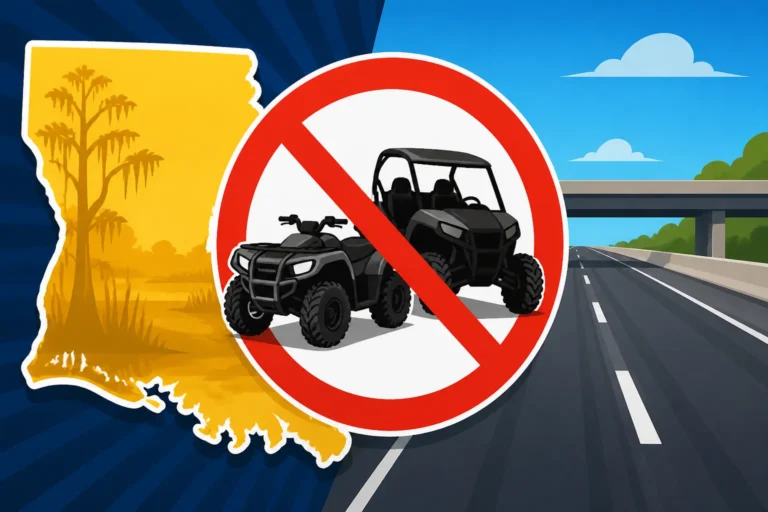
Louisiana law is very specific about where ATVs and UTVs can be operated on public roads, and it’s generally quite restrictive. The overarching principle is that ATVs and UTVs are not street-legal vehicles and are mostly prohibited from public roads, with very narrow exceptions. For ATVs, you're primarily looking at [Louisiana ATV Road Rules Under 32:299], which generally limits use to agricultural purposes within a five-mile radius of a farm, on the shoulder only, and with specific equipment. This is where the concept of [Louisiana agricultural affidavits for an ATV] comes into play, allowing farmers limited road access for legitimate farm work.
UTVs have slightly broader, but still very specific, allowances under [Louisiana UTV Road Rules Under 32:299.3]. UTVs can be operated on parish roads that have been officially designated and signed by the parish council for UTV use. Even then, drivers must be at least [Louisiana's 21 age minimum for UTV drivers], hold a valid [What a Class E license lets you do], and the UTV must be insured to state minimums and equipped with specific features like headlights, taillights, brake lights, and a horn. Most camp roads, even if public, will not meet these strict designation requirements. Therefore, for general recreational riding, if your "camp road" is public and not specifically designated for UTVs, you're typically out of luck.
It's also important to remember that the [Louisiana insurance proof on demand] requirement applies if you're operating your UTV on a designated public road. If your camp road happens to be one of the rare few that a parish council has designated for UTV use, or if you need to cross a short stretch of public road to access private property, you’ll want to ensure your UTV meets all the equipment requirements. Brands like SuperATV offer street-legal accessory kits, including mirrors, turn signals, and horns, which can help bring your UTV into compliance with these specific road-use requirements where permitted by law.
Common Pitfalls and Best Practices
Navigating the complexities of Louisiana's camp road rules requires vigilance and a proactive approach. Understanding the potential consequences and adopting best practices can save you a lot of headache, heartache, and money.
Trespass and Penalties
Operating your ATV or UTV on private land without explicit permission constitutes trespassing. In Louisiana, trespass is not a minor infraction; it can lead to significant fines, impoundment of your machine, and even criminal charges, especially if property damage occurs. If you're caught riding on a public road that is not designated for ATV/UTV use, you could face [Louisiana penalties for illegal road riding], which include fines, court costs, and potential impoundment. Game wardens and state troopers are well aware of these rules and frequently patrol areas where such infractions are common. It's a risk simply not worth taking.
Imagine heading out for a relaxing weekend at camp, only to have your machine seized and be slapped with a hefty fine because you took a shortcut down an unmarked logging road that turned out to be private. It’s a scenario no one wants, and it happens more often than you might think. Always know where you're riding and whose land you're on.
The Importance of Local Ordinances
Even with the state laws, parishes and municipalities in Louisiana can enact their own ordinances that further restrict or, in rare cases, allow ATV/UTV use on specific roads or within certain areas. While state law generally governs, local regulations can add another layer of complexity. This is particularly true for UTVs, as state law explicitly grants parishes the power to designate roads for UTV use. However, these designations must be accompanied by proper signage, meaning a road isn't "designated" just because someone told you it was.
Before you venture out on any camp road that isn't definitively your own private property, it’s always a good idea to check with the local parish sheriff's office or even visit the parish clerk's office. Many parishes now have their ordinances available online, making [Louisiana parish ordinance lookups] a much easier task. You might find that the "camp road" you've been eyeing has a specific local rule you weren't aware of. This due diligence is crucial to avoid an unexpected encounter with law enforcement.
Carrying the Right Documentation
Regardless of whether you're on private or public land, carrying the correct documentation is a non-negotiable best practice. For any off-road machine in Louisiana, you should always have [what paperwork a Louisiana mud machine needs]: proof of ownership (like your title or bill of sale) and your photo ID. If you're on private land, especially land you don't own, carrying [getting written permission from a Louisiana landowner] is your strongest defense against trespass accusations. A simple, signed letter outlining the scope of your permission can be invaluable.
If you are operating your UTV on a designated public camp road, then you must also carry proof of your Class E driver's license, and proof of insurance for your UTV, as this is required for any road-legal operation. For ATVs, if you're operating under the agricultural exemption within [the 5-mile farm radius on a shoulder], carrying your agricultural affidavit is crucial. Being prepared with your documents can turn a potentially negative interaction with law enforcement into a quick verification and a polite wave on your way.
| Scenario | Key Requirement | Required Documentation | Legal Risk (if non-compliant) |
|---|---|---|---|
| Private Camp Road | Landowner Permission | Written permission, Proof of Ownership, Photo ID | Trespassing, Fines, Impoundment |
| Public Camp Road (ATV) | Agricultural Exemption (specific use) | Agricultural Affidavit, Class E License, Proof of Ownership, Photo ID | Illegal Road Riding, Fines, Impoundment |
| Public Camp Road (UTV) | Parish Designation, Driver 21+ | Class E License, Proof of Insurance, UTV Registration, Proof of Ownership, Photo ID | Illegal Road Riding, Fines, Impoundment |
| Any Camp Road (General) | Proof of Ownership | Proof of Ownership, Photo ID | Difficulty proving legal possession |
Disclaimer
This article is for general informational purposes only and does not constitute professional advice. Laws, prices and regulations vary by location and change over time. Consult a qualified professional for guidance on your specific situation.