Louisiana Rules for a Visiting Mississippi Rider
Hitting the trails in a new state with your ATV or UTV can be a blast, but nothing sours a good time faster than getting a ticket because you didn't understand the local rules. Mississippi riders often wonder if their home state's regulations translate seamlessly across the border into Louisiana. This guide will walk you through everything you need to know to ensure your off-road adventure in the Bayou State is legal, safe, and stress-free.
Understanding Louisiana's Core Off-Road Vehicle Rules
Louisiana has its own set of distinct regulations for off-road vehicles, and they can be quite different from what you might be used to in Mississippi. These rules cover everything from basic identification to where and how you can ride. It's crucial for any visiting rider to understand these foundational elements before they even think about hitting a trail or a designated road. Ignorance of the law isn't a valid excuse, and Louisiana troopers are well-versed in their state's ORV statutes.
Decals and Titles: The Louisiana Basics
First things first: Louisiana requires both a title and an off-road decal for most ATVs and UTVs operated within the state, even if they've already been titled or registered in another state. Your Mississippi title and registration are certainly valid proof of ownership, but they don't exempt you from Louisiana's operational requirements. The state views these machines much like it views a car – it needs to know who owns it (title) and that it's allowed to operate (decal). This can often be a point of confusion for out-of-state riders who expect reciprocity, but Louisiana maintains its own system. You can learn more about this general requirement in [Louisiana ORV Decals and Titles Explained].
The Louisiana yearly off-road decal is a small sticker that signifies your machine is permitted for use on designated trails and private property within Louisiana. This decal is required for almost all off-road vehicles, whether they're new or used, and even if they're only used part-time in Louisiana. The fee for this decal is nominal, but the requirement is absolute. While your Mississippi plates might get you by in some other states, Louisiana's unique decal system is pretty firm. Many riders mistakenly believe that because their machine is street legal in Mississippi, it's automatically compliant everywhere, but that's not the case here. This decal shows you've paid the necessary use fee for Louisiana's trail system, which helps fund upkeep and maintenance.
Why Louisiana Rules Differ from Mississippi
The differences between Louisiana and Mississippi's off-road vehicle laws often stem from historical legislative approaches and the distinct geographical and recreational landscapes of each state. Mississippi, with its slightly different population density and rural characteristics, might have more liberal rules regarding certain aspects of ATV/UTV use, particularly on smaller county roads or for agricultural purposes. Louisiana, on the other hand, has carved out specific statutes that dictate very precise conditions for off-road vehicle operation. For instance, Louisiana's emphasis on both a title and a decal for almost every machine, even those brought in temporarily, is a prime example of this divergence. This dual requirement ensures that the state has a clear record of every machine operating within its borders and collects a small fee to support related programs. This is a fundamental concept for riders to grasp; it's not just about owning the machine, but about its legal status for operation in Louisiana, as highlighted in [Why an ATV Needs Both a Title and a Decal].
Another key difference often lies in road use. Mississippi might allow certain ATVs or UTVs to be street-legal under specific conditions, often involving turn signals, horns, and other safety equipment. Louisiana's road use laws, however, are notoriously strict and have very few exceptions, which we'll dive into later. These variations mean that even a UTV fully equipped with turn signals, mirrors, and a horn from a company like SuperATV, which makes excellent street-legal conversion kits, might still not be considered legal on Louisiana public roads without meeting the state's very specific (and often challenging) criteria. It’s not just about the equipment; it’s about the underlying state statute that dictates where and by whom these machines can be operated.
What a Mississippi Rider Needs to Know on Louisiana's Trails and Parks
When you're coming from Mississippi, you're probably used to some fantastic riding spots. Louisiana offers equally thrilling experiences, from the pine forests of Kisatchie to sprawling mud parks. However, just like the foundational rules, access to these areas comes with its own set of regulations that out-of-state riders must understand. Whether it's public land managed by the state or federal government, or private parks, there are specific permits, age limits, and safety requirements to consider.
Public Land Access: Kisatchie National Forest and WMAs
Louisiana is home to incredible public lands, most notably the Kisatchie National Forest and various Wildlife Management Areas (WMAs) managed by the Louisiana Department of Wildlife and Fisheries. These areas often have designated trails for ATVs and UTVs, but access is not always free or automatic, especially for out-of-state visitors. For Kisatchie, you'll typically need a Forest Pass, which can be a daily or annual permit. While a Mississippi resident might be used to driving onto some public lands with just a hunting or fishing license, Louisiana's system for OHV use can be separate. Always check the specific district or WMA you plan to visit, as rules can vary greatly. Some trails might have seasonal closures, especially during wet periods or certain hunting seasons, so looking up the specific trail status online before you haul your machine over is a smart move.
WMAs have even more stringent rules, often requiring a Self-Clearing Permit upon entry, even for just trail riding. These permits typically involve filling out a card at a kiosk, tearing off a section to keep on your person, and leaving the other part in a drop box. Beyond permits, WMAs also have specific machine requirements. They often have weight limits, tire size restrictions (e.g., maximum tire width and lug height), and sometimes even bans on certain types of aggressive tread patterns. These rules are in place to minimize environmental impact and reduce trail degradation. A Mississippi rider bringing a heavily customized mud machine might find it doesn't meet the WMA's specifications for [Louisiana WMA Riding Rules for Quads]. For example, tires with lugs over a certain height or machines exceeding specific weight limits may be prohibited. It’s crucial to verify these details well in advance; otherwise, you could make a long trip only to be turned away at the gate.
Private Mud Parks: Waivers and Reciprocity
Louisiana is famous for its private mud parks, like Muddy Bottoms ATV Park or Louisiana Mudfest. These parks offer vast areas for riding, camping, and often host major events. While they are private property, they still operate under certain state and local guidelines, and they certainly have their own specific rules you'll need to follow. The good news is that for private parks, your Mississippi title and registration typically aren't an issue for entry, as long as you can prove ownership. However, you will almost certainly be required to sign a liability waiver. These waivers are standard practice at nearly all private recreational facilities and are designed to protect the park from liability in case of accidents. Even if you're a seasoned rider, always read and understand what you're signing.
Reciprocity for things like safety courses or specific equipment isn't really a factor at private parks. What matters most is that you adhere to their rules. These can include helmet requirements, age limits for riders and passengers, quiet hours for campers, and sometimes even specific restrictions on vehicle modifications or alcohol consumption. While you might have a high-performance machine with a full SuperATV lift kit and aggressive tires, the park might still have rules about where and how you can ride it, or require specific safety flags. It's always best to check the park's website or call ahead to understand their specific policies. For more on this, check out [Louisiana Private Park Waivers and Rules]. They'll be clear about what they expect, and following their lead ensures a good time for everyone.
Road Use Rules for Out-of-State ATVs and UTVs in Louisiana
This is often the trickiest part for out-of-state riders, and it's where many misunderstandings lead to citations. Mississippi might have provisions for making ATVs or UTVs street legal, or for using them on county roads under certain circumstances. Louisiana, however, has a very different and generally much more restrictive approach to off-road vehicles on public roads. It's not about what your machine can do, but what Louisiana law allows it to do.
The Strict Reality of Public Road Riding
Let's get straight to it: In Louisiana, ATVs are generally not allowed on public roads, streets, or highways. This includes shoulders, ditches, and even crossing a road unless it's for a very specific, limited purpose, like accessing an adjacent private property or agricultural field, and even then, there are stipulations. Your Mississippi street-legal setup, complete with blinkers, mirrors, and a horn, will likely not protect you from a ticket if you're caught riding your ATV down a Louisiana highway. The state's statute is quite clear on this: ATVs are designed for off-road use, and that's where they're expected to stay. Many riders from other states are often surprised by the strictness, but Louisiana troopers are serious about enforcing these rules to ensure public safety. For a deep dive into the general restrictions, look at [Can You Ride an ATV on the Road in Louisiana?].
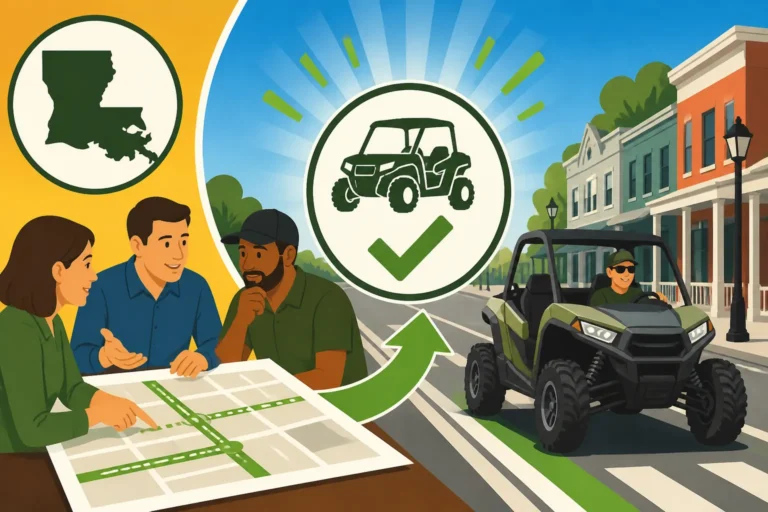
UTVs have a slight exception, but it's not a blanket allowance. Louisiana law, specifically R.S. 32:299.3, allows parishes and municipalities to designate certain roads for UTV use. This means a parish council or city government must actively vote to designate and then post signs on those specific roads. Without those signs, and without the underlying ordinance, UTVs are still prohibited. Even if a road is designated, there are usually conditions, such as a minimum driver age of 21, possession of a Class E driver's license, and carrying proof of insurance at statutory minimums. Furthermore, designated roads usually have speed limits, and travel is often restricted to daylight hours. It's not enough to assume; you have to know for sure that a road is designated and what conditions apply. Mississippi riders accustomed to more flexibility on backroads will find Louisiana's rules a stark contrast. This is especially true when considering [Louisiana UTV Street Legal Rules by Parish].
Farm Exemptions and Designated Roads (and why they likely don't apply)
You might hear about "farm exemptions" in Louisiana, which allow ATVs and UTVs to be operated on public road shoulders within a certain radius of a farm for agricultural purposes. While this exemption exists, it's typically designed for Louisiana residents operating bona fide farm equipment. For a visiting Mississippi rider, it's highly unlikely to apply. The exemption usually requires an affidavit sworn before a notary public stating the machine is used for farm purposes, and often mandates that the rider carry proof of this. It's not just a casual "I'm heading to a farm" excuse. If a trooper stops you and you can't produce the proper Louisiana agricultural affidavit, you're out of luck. This exemption is not meant for recreational riding or for commuting to a hunting camp.
Furthermore, even if a road is designated for UTV use by a parish, it doesn't mean all roads are open. The designation must be explicit and clearly marked with signage. Relying on local word-of-mouth or anecdotal evidence is a recipe for a ticket. If you're planning on riding your UTV on public roads, you absolutely need to verify the specific parish or municipal ordinances and look for the official signage. Without these, your out-of-state UTV, no matter how much you've invested in making it road-ready with parts from companies like SuperATV, will be treated like any other illegal off-road vehicle on a public thoroughfare. The consequences can range from a hefty fine to impoundment of your machine.
Essential Gear and Preparedness for Visiting Riders
When you're venturing into new territory, especially with an off-road machine, being prepared is key. Louisiana's climate and terrain can present unique challenges, and state law enforcement is vigilant about safety and compliance. Beyond just understanding the rules, having the right gear and paperwork can make all the difference between a fantastic trip and a regrettable one.
Safety Gear and Machine Readiness
Just like in Mississippi, safety should be your top priority. While Louisiana does not have a statewide mandatory helmet law for all ATV riders, many private parks and WMA trails do require them, especially for youth riders. For UTVs, if you're on a designated road, helmets might not be explicitly required, but eye protection and seatbelts (if equipped) are highly recommended, and sometimes mandatory. It's always best practice to wear a helmet, regardless of the law, as highlighted in [Louisiana ATV Helmet Rules]. Accidents happen, and head injuries are no joke. Beyond helmets, consider sturdy boots, gloves, and long sleeves/pants to protect against scrapes, sun, and insects.
Your machine itself needs to be ready for the Louisiana environment. If you're hitting the mud parks, make sure your tires are in good condition and suitable for deep mud. Many riders upgrade their machines with winches, heavy-duty suspension, and snorkels, often using high-quality components from brands like SuperATV, which are fantastic for handling the Bayou State's famous mud. If you're riding in Kisatchie, ensure your spark arrestor is in good working order to prevent forest fires. All machines should have working headlights and taillights, especially if you plan to be out near dusk. A small tool kit, tire repair kit, and a first-aid kit are also invaluable additions to any ride, regardless of where you are. Remember to check fluid levels, tire pressure, and brake functionality before you head out.
What Paperwork to Carry
When riding in Louisiana, regardless of whether you're a resident or visitor, you should always carry certain documentation. For starters, you need to prove ownership of your machine. Your Mississippi title or registration, along with your driver's license or state ID, is essential. If you managed to acquire a Louisiana off-road decal (which you should if you plan on riding often in the state), carry proof of that purchase and ensure the decal is properly affixed to your machine. For any road use of a UTV (if permitted), you absolutely need to have proof of valid insurance on your person, as Louisiana law enforcement can demand [Louisiana Insurance Proof on Demand].
It's also a good idea to have a copy of the specific rules or permits for the area you're riding in, especially for WMAs or designated parish roads. This can help clarify any ambiguities if you're stopped by law enforcement. A paper map of the area, especially for places like Kisatchie where cell service can be spotty, is also a smart addition. Keep all your important documents in a waterproof bag or container. Remember, if a state trooper or game warden asks to see your papers, you need to be able to produce them promptly. For more on what authorities might check, consult [Louisiana Equipment Checks by Troopers]. Being organized and having your documents ready shows responsibility and can help streamline any interaction with law enforcement.
| Rule Category | Mississippi Rider Expectation (Often) | Louisiana Reality for Visitors | Key Action for Visitor |
|---|---|---|---|
| Title/Registration | Home state documents suffice | Louisiana requires an ORV title and decal for operation within its borders (even for visitors) | Obtain a Louisiana ORV decal if frequently visiting. |
| Road Use (ATVs) | May have limited road access | Generally PROHIBITED on all public roads, streets, and highways. | Avoid public roads entirely. |
| Road Use (UTVs) | Often more liberal road access | Only on specifically designated and signed parish/municipal roads; strict conditions apply. | Verify local ordinances and look for signage; assume no road use. |
| Helmets | Varies by age/state law | Mandatory in some private parks/WMAs, recommended everywhere. | Always wear a helmet. |
| Insurance | Required for road use | Required for any UTV road use, highly recommended for all machines. | Carry proof if planning any road use; otherwise, recommended. |
| Public Land Access | Home state permits may apply | Separate Louisiana Forest Passes or WMA Self-Clearing Permits often required. | Check specific park/WMA rules and acquire permits. |
| DUI Laws | Standard DUI laws apply | Louisiana DUI laws apply to off-road machines as well. | Never ride under the influence. |
Disclaimer
This article is for general informational purposes only and does not constitute professional advice. Laws, prices and regulations vary by location and change over time. Consult a qualified professional for guidance on your specific situation.