Louisiana Rules for Towing a Trailer
There’s nothing quite like the versatility of an ATV or UTV, especially when you need to haul gear, tools, or even a deer out of the backwoods. For many of us in Louisiana, our off-road machines are more than just toys; they’re workhorses, integral to hunting, farming, or just maintaining our property. But when it comes to hitching up a trailer, things can get a little murky, especially if you ever plan to leave private land. This guide will help clarify the specific rules and best practices for towing a trailer with your ATV or UTV here in the Bayou State, helping you avoid headaches and stay safe.
The Basics of Towing with an Off-Road Machine in Louisiana
Let’s be honest, one of the biggest appeals of a utility-focused ATV or UTV is its towing capacity. Whether you’re pulling a small utility trailer loaded with feed, a sprayer for your fields, or a hunting blind deep into the woods, knowing your machine can handle the load is liberating. However, this capability comes with a crucial caveat: the rules change dramatically depending on where you are.
Understanding the Difference: Private vs. Public Land
This is the golden rule, the foundational truth, when it comes to nearly every aspect of off-road machine use in Louisiana, and towing is no exception. On your own private land, or on land where you have explicit permission from the landowner, the world is pretty much your oyster when it comes to towing. You can pull whatever your machine (and common sense) can safely handle. Need to haul a cord of firewood from one end of your property to the other? Go for it. Moving equipment around your farm? No problem. The state isn't going to tell you how to operate your machine on your own turf.
This freedom extends to places like designated private mud parks or hunting club leases. If you're riding in a controlled environment, such as a private park, you're typically operating under the park's specific rules, which usually focus on safety rather than state highway regulations. Similarly, at a hunting camp, you'll be using your ATV or UTV to transport gear, game, and supplies, often pulling trailers filled with essentials. The ability to tow effectively is a huge part of what makes these machines so valuable for these uses. For more on navigating your property or leases, check out our articles on [Louisiana Rules for Riding a Field Road] and [Louisiana Rules for Riding a Camp Road].
The Importance of Machine Capacity and Proper Hitching
Even on private land where the laws are relaxed, the laws of physics are not. Every ATV and UTV has a manufacturer-specified towing capacity and tongue weight limit. These aren't arbitrary numbers; they are engineered limits designed to ensure the stability, longevity, and safe operation of your machine. Exceeding these limits can lead to serious problems: premature wear on your engine, transmission, and brakes, compromised steering and handling, and a significant increase in the risk of a rollover or loss of control. Imagine trying to stop a fully loaded utility trailer with an ATV that’s already at its braking limits – it’s a recipe for disaster.
Beyond the weight, proper hitching is critical. Most ATVs and UTVs come equipped with a receiver hitch or a ball hitch. Ensure that the hitch ball size matches your trailer’s coupler size perfectly. A loose connection can cause the trailer to disconnect, especially over rough terrain. Safety chains are also non-negotiable, even if you're only going a short distance. They're your last line of defense if the primary hitch fails. Always inspect your hitch, ball, and chains before every tow. When looking for heavy-duty towing solutions, especially for UTVs, you'll find companies like SuperATV offer a range of products, from receiver hitches to heavier springs, that can help maximize your machine's utility within its safe operating parameters. Remember, these accessories enhance capability but never override the manufacturer's maximum weight ratings.
Louisiana Road Rules for Towing a Trailer with an ATV or UTV
Now, this is where things get tricky, and where a lot of riders find themselves scratching their heads, or worse, facing a hefty fine. Louisiana has very specific, and often restrictive, laws regarding ATVs and UTVs on public roads. These regulations inherently impact what you can and cannot tow when you venture beyond private property.
The Shoulder-Only Rule and Farm Exceptions
For ATVs, the general rule is simple: they are not street legal. Period. You cannot ride an ATV in the travel lanes of a public road. However, Louisiana law does provide a very limited exception for farm use. Under certain conditions, you can ride an ATV on the shoulder of a public road, but only if it's for bona fide agricultural purposes and within a specific radius of your farm. This is laid out in statutes like Louisiana Revised Statute 32:299. For a deeper dive into these specifics, read our articles on [Louisiana's Shoulder-Only Farm Exception] and [Louisiana's 5-Mile Farm Radius].
So, does this farm exception extend to towing a trailer? Generally, yes, but it must strictly adhere to the "bona fide agricultural purpose" clause. If you're using your ATV to tow a sprayer between fields separated by a public road, or pulling a small trailer of feed from one part of your property to another (both within that 5-mile radius and on the shoulder), you're likely within the bounds of the law. You'll need to carry a [Louisiana Farm Affidavit Requirements] with you, sworn before a notary, attesting to the farm-only use of your machine. The key here is farm use only and shoulder only. This isn't an open invitation to tow your fishing boat down the highway with your quad.
UTV Road Use and Trailer Towing
UTVs have a slightly different, and potentially more flexible, set of rules compared to ATVs when it comes to road use in Louisiana. While still largely prohibited from main travel lanes, Louisiana Revised Statute 32:299.3 allows parishes and municipalities to pass ordinances designating specific roads or streets where UTVs can operate. This means that whether your UTV is street legal—and thus able to tow a trailer on public roads—depends entirely on where you live and ride. You'll need to check your local parish and municipal ordinances carefully. Our guide on [Louisiana UTV Street Legal Rules by Parish] can offer more insights into this complex topic.
If your UTV is legally operating on a designated public road, then towing a small utility trailer generally falls under the same traffic laws as any other vehicle towing a trailer. This means your trailer needs to be roadworthy:
- Lights: It must have functioning taillights, brake lights, and turn signals, especially if the trailer or its load obscures your UTV's lights.
- Safety Chains: Secure chains are mandatory, ensuring the trailer remains attached if the hitch fails.
- Weight Limits: You must stay within the UTV's towing capacity and the trailer's gross vehicle weight rating (GVWR).
- Registration/License Plates: Depending on its size and type, the trailer itself might require its own license plate and registration if regularly used on public roads. This is a common point of confusion, so be sure to investigate [Does Your Utility Trailer Need Its Own Plate?] if you're not sure.
Companies like SuperATV manufacture robust receiver hitches and other towing accessories designed for UTVs. These can be incredibly useful for both on and off-road towing, but remember that even the best aftermarket equipment doesn't override state or local laws regarding where and how you can operate your machine and trailer. It simply provides the capability to do so safely when permitted.
Safety Considerations and Best Practices for Towing
Regardless of whether you're on private land or legally navigating a designated public road, safety should always be your top priority when towing a trailer with an ATV or UTV. These machines handle differently with a load behind them, and ignoring basic safety practices can quickly lead to accidents.
Equipment Checks and Maintenance
Before you even hitch up, take a few minutes to conduct a thorough pre-tow inspection. This simple habit can prevent a lot of headaches.
- Tires: Check the air pressure on both your ATV/UTV and the trailer. Underinflated tires can lead to instability and blowouts. Ensure the tread is in good condition.
- Brakes: Test the brakes on your towing machine. If your trailer has its own braking system, ensure it's functioning correctly and properly connected. Towing puts extra strain on your brakes, so they need to be in top shape.
- Hitch and Coupler: Double-check that the hitch ball is the correct size for the trailer's coupler and that the coupler is fully seated and latched. Ensure safety chains are properly crossed and connected.
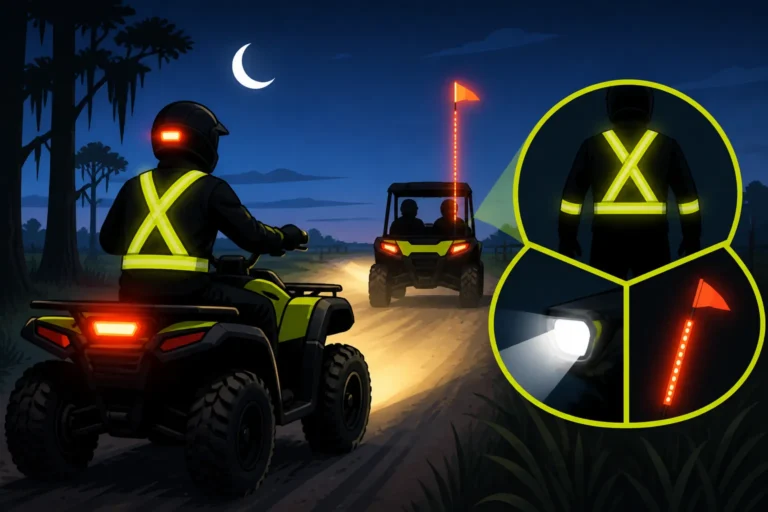
- Lights and Wiring: If towing on a public road, verify all trailer lights (taillights, brake lights, turn signals) are working. Check the wiring for any damage or loose connections. Even on private land, working lights are a good idea, especially if you might be out past [Louisiana Rules for Riding After Dark].
- Load Securement: This is huge! Make sure your load is evenly distributed over the trailer axles, with a slight bias towards the front (tongue weight). Secure everything with straps or tie-downs to prevent shifting, which can cause severe instability, especially during turns or braking.
- Machine Maintenance: Regular maintenance, including checking fluid levels, drive belts, and chassis components, is vital when your machine is regularly performing heavy work like towing. For more on keeping your machine in top shape, see [Louisiana Annual Maintenance Costs].
Driving Habits and Awareness
Driving with a trailer is fundamentally different from driving your unladen ATV or UTV. You need to adjust your habits significantly to ensure a safe journey.
- Slower Speeds: Resist the urge to go fast. A trailer adds weight, inertia, and takes longer to stop. Maintain a lower speed than you normally would, especially over uneven terrain or when making turns.
- Increased Braking Distance: Your stopping distance will increase significantly. Anticipate stops and begin braking much earlier.
- Wider Turns: Trailers cut corners. Always swing wider than you think necessary when turning to prevent the trailer from hitting obstacles or running off the edge of a road or trail.
- Visibility: Ensure your trailer doesn't block your line of sight or obscure your UTV's mirrors. If it does, consider adding extended mirrors.
- Rough Terrain: When towing off-road, approach hills, bumps, and water crossings with extreme caution. A heavy trailer can push your machine down a slippery slope or get bogged down in mud, making recovery difficult and dangerous. Always assess the path ahead.
Here's a quick comparison of towing considerations:
| Feature | Private Land Towing | Public Road Towing (if permitted) |
|---|---|---|
| Legal Basis | Landowner permission; machine capacity limits | State statutes (e.g., 32:299 for ATV, 32:299.3 for UTV), local ordinances |
| Machine Type | ATV or UTV | ATV (farm use, shoulder only); UTV (designated roads, parish/municipal) |
| Trailer Type | Generally unrestricted (within machine limits) | Utility trailers typically, adhering to roadworthiness requirements |
| Lighting | Recommended for safety, especially at night | Required by law if used after dark or visibility is low; brake/turn signals |
| Registration | Not required for machine or trailer | Machine (decal) & trailer (plate/registration) may be required |
| Speed | Based on terrain & safety; generally slow with a load | Must follow posted speed limits, but slower is always safer with a trailer |
| Safety Chains | Highly recommended for all towing | Legally required |
| Load Securement | Essential for stability & preventing damage | Legally required to prevent spills & hazards |
| Penalties | Property damage, injury (no legal fines for operation) | Fines, citations, potential impoundment for non-compliance |
In summary, while the ability to tow a trailer expands the utility of your Louisiana ATV or UTV tremendously, it's a capability that demands respect for both your machine's limits and the law. Always prioritize safety, understand where you're riding, and ensure your equipment is up to the task. Ignoring these rules can lead to serious consequences, from [Louisiana Penalties for Illegal Road Riding] to [Louisiana Ticket Costs for Road Riding] if you're caught breaking the law on public ways. Troopers conducting [Louisiana Equipment Checks by Troopers] will definitely be looking for proper towing setups if you're out on a road.
Disclaimer
This article is for general informational purposes only and does not constitute professional advice. Laws, prices and regulations vary by location and change over time. Consult a qualified professional for guidance on your specific situation.