Parishes Have to Post Signs on Designated Roads
It can be incredibly frustrating to own a powerful side-by-side or ATV in Louisiana, knowing it could handle more than just your private property, but feeling completely in the dark about where you can legally ride it on public roads. The laws can feel like a tangled mess of "maybes" and "depends," leaving many riders scratching their heads and worried about getting a ticket. This guide aims to untangle that knot, specifically focusing on the critical role that proper signage plays in whether your parish roads are open for UTVs.
The Foundation: Louisiana's UTV Road Rules and Parish Authority
When it comes to riding your UTV on public roads in Louisiana, it's not a free-for-all, nor is it an outright ban everywhere. The state has specific statutes that lay out the framework, but they also empower local parishes to make decisions within those guidelines. This creates a patchwork of rules across the state, which is precisely why clarity is so important. You can't just assume what's legal in one parish will be legal in the next.
Understanding Louisiana Revised Statute 32:299.3 for UTVs
The primary law governing UTVs on public roads in Louisiana is Revised Statute 32:299.3. This statute is the backbone of any legal UTV road use. It defines what a "utility task vehicle" (UTV) is in the eyes of the law, setting it apart from ATVs. Critically, it gives parishes and municipalities the authority to designate certain public roads and streets for UTV operation. This isn't an open invitation to ride anywhere, but rather a conditional permission based on local government action.
The statute also sets forth several non-negotiable requirements for UTVs to be considered road-legal, even on designated roads. These include things like headlamps, tail lamps, stop lamps, turn signals, a horn, a rearview mirror, and a windshield. It also specifies an age requirement for drivers; [Louisiana Requires UTV Drivers to Be 21] years old to operate a UTV on designated public roads. Failure to meet any of these equipment or driver age requirements can render your ride illegal, even if you’re on a properly designated and signed road.
Why ATVs Face Stricter Road Restrictions
It's vital to understand that the rules for ATVs (all-terrain vehicles) are significantly different and much more restrictive than those for UTVs. Louisiana Revised Statute 32:299 specifically addresses ATVs, generally prohibiting their operation on public roads and highways. There are very limited exceptions, primarily for agricultural purposes, and even those come with strict conditions like riding on the shoulder and within a specific radius of a farm.
This distinction between ATVs and UTVs is a common point of confusion for riders. Many assume that if one can be on the road, the other can too. Unfortunately, that's rarely the case. While UTVs, with their car-like controls and typically greater stability, are seen as more suitable for limited road use, ATVs are largely viewed as recreational off-road machines only. So, if your machine is an ATV, even if your parish has designated UTV roads, those rules likely do not apply to you, outside of the narrow farm exemptions. You can learn more about this distinction in [Can You Ride an ATV on the Road in Louisiana?].
The Parish's Authority: How Roads Become Designated for UTVs
The power to open up local roads for UTV use rests squarely with parish police juries or municipal governing authorities. This isn't a casual decision; it's a formal process that requires careful consideration and, most importantly, clear communication to the public. Without this official action, those roads remain off-limits to UTVs, no matter how much local riders might wish otherwise.
The Ordinance Process: A Formal Local Decision
For a public road or street to be designated for UTV operation in Louisiana, the local governing authority – typically the parish police jury or city council – must pass a specific ordinance. This isn't just a verbal agreement or a handshake deal; it's a legally binding document that officially declares certain roads or areas open to UTVs. The process usually involves public hearings, allowing residents, law enforcement, and other stakeholders to voice their opinions and concerns.
These ordinances specify which roads are included, any time restrictions (e.g., daylight hours only), and potentially other local rules that supplement the state statute. It's a deliberative process, and it can take time for an ordinance to be proposed, debated, and finally passed. Without this formal, documented action by your local government, no road, regardless of how rural or quiet it seems, is legally designated for UTV use. For instance, [How a Parish Council Votes to Designate a Road] involves several steps, including public notice and multiple readings.
Why Parishes Choose to Designate Roads (or Not)
Parishes decide to designate roads for UTVs for a variety of reasons. In some rural areas, UTVs are integral to agricultural operations, allowing farmers to travel between fields or access remote parts of their property more efficiently. Designating roads can formalize this use and provide clear guidelines. In other areas, particularly those with a strong outdoor recreation or tourism industry, allowing UTVs can boost local economies by attracting riders who want to explore the scenic routes or access trailheads without having to trailer their machines constantly.
However, many parishes also choose not to designate roads, or they do so very selectively. Concerns often include public safety, particularly where UTVs might mix with higher-speed traffic or in residential areas. Noise complaints, potential road damage, and the challenges of enforcement can also weigh heavily on local officials. Therefore, while the state statute provides the framework, the final decision on which roads, if any, are open for UTVs is a local one, balancing the desires of riders with broader community concerns.
The Crucial Element: What Signs Mean for Riders
This brings us to the absolute core of legal UTV road riding in Louisiana: signage. It's not enough for an ordinance to exist on paper. The law explicitly requires that designated roads be properly marked with signs. For riders, this means the absence of a sign is just as important as its presence, serving as a constant reminder of where you can and cannot ride.
The Mandatory Signage Requirement
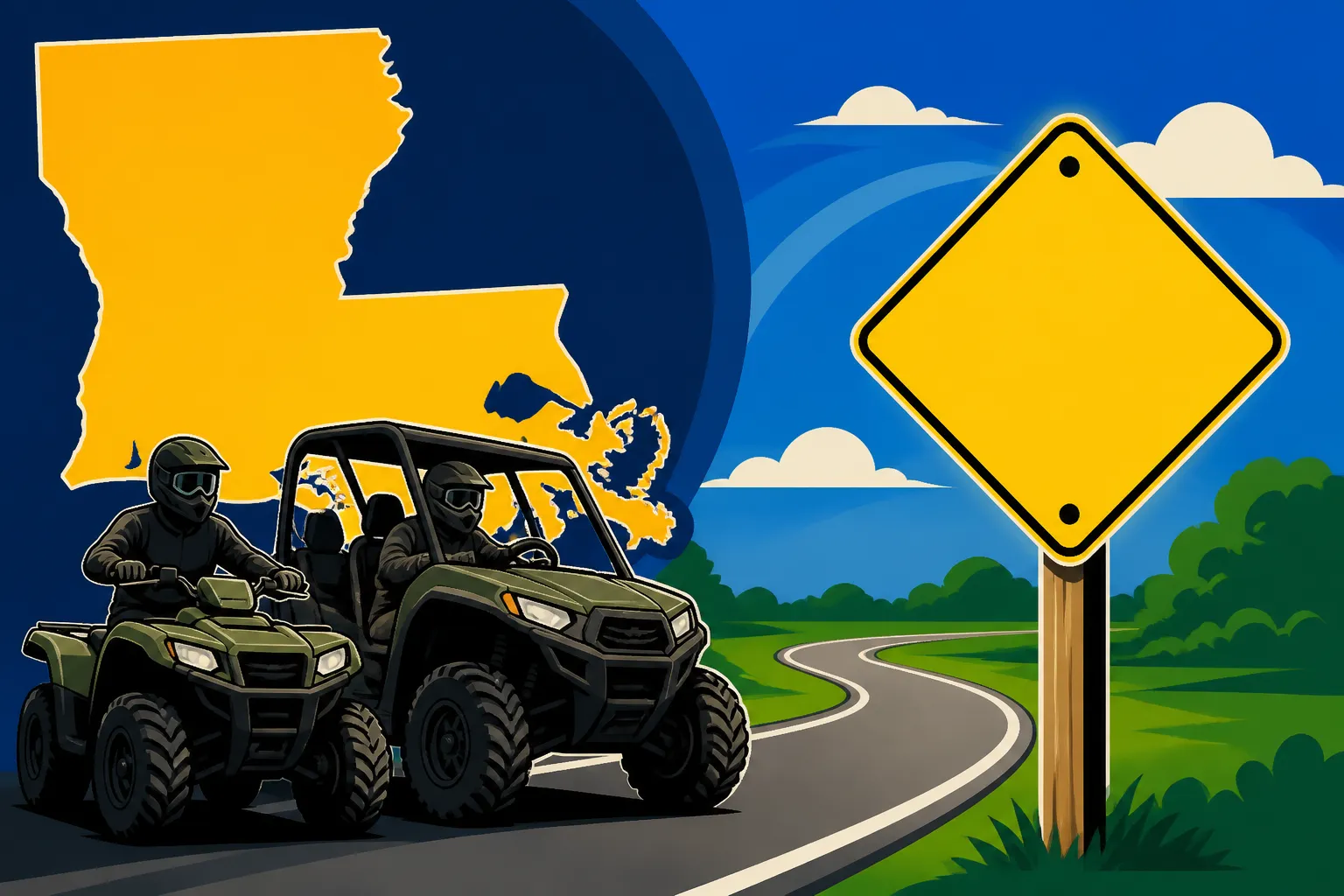
Louisiana Revised Statute 32:299.3 is unequivocally clear: if a parish or municipality designates a road for UTV use, they must post appropriate signs. These signs serve as the official notice to the public, both to UTV operators and to other motorists, that UTVs are permitted on that specific stretch of road. This isn't a suggestion; it's a non-negotiable mandate. Even if your parish has passed an ordinance allowing UTVs on certain roads, those roads are not legally open for UTV traffic until the required signage is physically installed.
Think of it this way: the sign is your green light. Without it, even with an ordinance in place, you’re essentially operating on a red light. The law specifies that these signs must be clearly visible and indicate the designated roads. This prevents confusion and ensures that riders have a clear visual cue for where they are legally allowed to operate their UTV. You can often spot these specific signs on [The Sign a Parish Has to Put Up First].
What Designated Road Signs Indicate
When you see a sign indicating a designated UTV road, it's not just a blanket permission. These signs are typically placed at the entry points to the designated area or road, clearly marking the boundaries. They might specify a speed limit, often lower than the regular posted speed limit for cars, or indicate that UTVs are only allowed during daylight hours. Some signs might also reference the local ordinance number or direct riders to specific rules.
It's crucial for riders to pay close attention to the details on these signs. They aren't just there for decoration; they convey the specific conditions under which UTVs are permitted. For example, a sign might say "UTV Route – Daylight Hours Only" or "UTV Speed Limit 25 MPH." These are not suggestions; they are enforceable rules. Riding outside these parameters, even on a designated road, could still lead to a citation. Therefore, always approach designated roads with an eye for detail and read any posted information carefully.
What Happens When There Are No Signs?
This is where many riders get into trouble. The assumption that a quiet, rural road must be open to UTVs because it feels like "off-road" territory is a dangerous one. In Louisiana, the absence of a sign designating a road for UTV use means one thing and one thing only: it's not a designated road, and UTVs are prohibited.
The "No Sign, No Ride" Reality
Let’s be crystal clear: if you don't see a sign explicitly designating a road or street for UTV use, you cannot legally ride your UTV on it. Period. It doesn't matter if your cousin rode his there last week, or if you've seen other people doing it. The law in Louisiana is tied directly to that physical signage. Local ordinances may define the roads, but the signs are the public-facing, legally required manifestation of that designation.
This "no sign, no ride" rule is designed to eliminate ambiguity. Without it, riders would be left guessing, potentially relying on outdated information or local rumors. It puts the onus on the local authority to properly mark its roads if it wishes to allow UTV traffic. For riders, this means vigilance. Always look for the signs. If you're on a road without them, assume it's off-limits to your UTV, regardless of your personal assessment of the road's suitability.
Enforcement and Potential Penalties
Law enforcement officers, whether state troopers or parish deputies, are trained to look for these designations. If they stop a UTV on a public road that is not properly signed as a designated route, they have grounds to issue a citation. The penalties for illegal road riding can range from fines to impoundment of the machine, and these can add up quickly. [Louisiana Penalties for Illegal Road Riding] can be significant, so it's always better to err on the side of caution.
Furthermore, driving a UTV on an undesignated public road could also lead to other charges if safety equipment is not up to par, or if the driver is under the age of 21. Even if you believe an ordinance exists, without the physical signs, you are exposing yourself to legal risk. Law enforcement often won't have the current list of ordinances memorized; they rely on the visual cues of signage on the road itself. So, always remember that a lack of signage is a signal to keep your UTV off that particular public thoroughfare.
Beyond the Signs: Other Requirements for Road-Legal UTVs
While proper signage on designated roads is paramount, it's only one piece of the puzzle for legal UTV operation on Louisiana's public roads. Even if you're on a designated route, your UTV and you, as the driver, must meet several other state-mandated requirements. Ignoring these can lead to tickets, even on otherwise legal roads.
Essential Equipment Mandates
Louisiana law specifies a comprehensive list of equipment that a UTV must have to be considered road-legal on designated routes. This isn't just about making your machine look good; it's about safety for you and other motorists. You’ll need:
- Headlamps: At least two, to illuminate the road ahead.
- Tail Lamps: At least two, visible from a certain distance to the rear.
- Stop Lamps (Brake Lights): To signal when you're slowing or stopping.
- Turn Signal Lamps: Front and rear, to indicate your intentions to turn.
- A Horn: Capable of emitting an audible sound, for signaling.
- A Rearview Mirror: To see traffic approaching from behind.
- A Windshield: To protect the driver and passengers from debris.
- A Safety Flag: At least six feet above the ground, often required for visibility.
Many UTVs come from the factory ready for off-road adventure, but they might lack some of these road-specific items. Thankfully, the aftermarket industry has stepped up. Companies like SuperATV offer a wide range of accessories, from full street-legal kits to individual components like windshields, turn signal kits, and mirrors, designed to help riders meet these requirements. It's crucial to ensure any parts you add are compliant with Louisiana's specific regulations, not just generic "street legal" claims. Equipping your machine correctly is as important as finding a designated road.
Driver Licensing and Insurance Requirements
Operating a UTV on a designated public road in Louisiana also comes with requirements for the driver. First and foremost, the driver must hold a valid Class E driver's license. This is the standard operator's license for most passenger vehicles, and it's essential for legal UTV road use. This requirement ensures that anyone operating a UTV on public roads has demonstrated basic driving competence. You can learn more about this by reading [What a Class E License Lets You Do].
Additionally, Louisiana law requires that any UTV operated on designated public roads be covered by a motor vehicle liability insurance policy. This is not optional; it’s a legal necessity to protect all parties in the event of an accident. The policy must meet the state's minimum coverage requirements. Carrying proof of insurance with you is also mandatory, as law enforcement can request it at any time. For detailed information on what minimums are required, refer to [Louisiana UTV Insurance Minimums]. Even if you typically ride on private land, if you venture onto public roads, insurance becomes a non-negotiable part of your setup.
Navigating the System: Finding Designated Roads
So, you understand the rules, your UTV is properly equipped, and you're ready to ride. But how do you actually find those elusive designated roads? It requires a bit of detective work, as there isn't one central statewide map or database. The information is held at the local level, within each parish or municipality.
How to Research Parish Ordinances and Designations
The first step in finding designated UTV roads is to research the local ordinances in the parish or municipality you plan to ride in. Here are some strategies:
- Parish or City Clerk's Office: This is often the best starting point. Call or visit the clerk's office for the parish or city. They are the keepers of all official documents, including ordinances. Ask specifically about ordinances related to UTV or side-by-side operation on public roads. They might even be able to provide copies of the relevant statutes or direct you to an online database.
- Official Websites: Many parishes and cities maintain websites where they post their codes of ordinances. Look for sections related to "traffic," "vehicles," "off-road vehicles," or "UTVs." Use the search function on their site with keywords like "UTV," "side-by-side," or "off-road vehicle."
- Local Law Enforcement: While not their primary job to educate on ordinances, local sheriff's offices or police departments can often point you in the right direction or confirm whether UTVs are permitted on certain local roads. Be polite and understand they are busy.
- Local Rider Groups: Online forums, social media groups, or local ATV/UTV clubs can be invaluable resources. Experienced local riders often know which parishes have designated roads and might even share maps or routes. However, always cross-reference this information with official sources.
When you find an ordinance, read it carefully. It will specify which roads or areas are designated, any specific hours of operation, or other local rules you need to follow.
Verifying Signage on the Ground
Even after you've found an ordinance that seems to designate roads in a particular area, the final, crucial step is physical verification of the signage. As we've discussed, no sign means no legal riding. Before you unload your UTV, drive the intended routes in a regular vehicle (or use satellite imagery if available) to visually confirm the presence of the required signs.
Pay attention to:
- Placement: Are the signs at the entry points of the designated road or area?
- Clarity: Is the signage clear and legible? Does it explicitly state that UTVs are allowed?
- Conditions: Do the signs list any conditions, like specific hours, speed limits, or restrictions?
It’s possible for an ordinance to exist, but for the signs to be damaged, removed, or simply never installed. If you don't see the signs, or if they are unclear, err on the side of caution and assume the road is not legally designated for UTV use. Your safety and your wallet will thank you for being thorough. Remember, the law is on the side of the signs.
Here’s a quick overview of UTV road-use requirements in Louisiana:
| Requirement | UTV on Designated Parish Roads | ATV (General Public Road Use) |
|---|---|---|
| State Statute | LA R.S. 32:299.3 | LA R.S. 32:299 |
| Local Authority | Parish/Municipality may designate specific roads via ordinance. | Generally prohibited; very limited farm exemptions by state law. |
| Mandatory Signage | Required on all designated roads. No sign = no legal riding. | N/A (as general road use is prohibited) |
| Minimum Driver Age | 21 years old | N/A (farm exemption may apply to younger licensed drivers). |
| Driver's License | Class E Driver's License required. | Required if operating with farm exemption (Class E or permit). |
| Insurance | Required, meeting state minimums. | Not required for farm exemption; highly recommended always. |
| Equipment | Head/tail/stop lamps, turn signals, horn, mirror, windshield, flag. | N/A for general road use. |
| Road Type | Specific roads designated by local ordinance. | Primarily shoulders within 5 miles of farm for agricultural work. |
Disclaimer
This article is for general informational purposes only and does not constitute professional advice. Laws, prices and regulations vary by location and change over time. Consult a qualified professional for guidance on your specific situation.