Louisiana Parishes Must Designate and Sign Roads
It’s a familiar scenario for many Louisiana riders: you’re trying to get from your hunting camp to the nearest general store, or maybe connect two sections of trail, and you wonder, “Can I just take the UTV down this parish road?” The answer is often shrouded in local legend, conflicting advice, and genuine confusion. This guide cuts through the fog to explain exactly how Louisiana parishes designate and sign roads for off-road vehicle use, why it matters, and what you need to know before you ever turn the key.
The Core Requirement: Designation and Signage
Navigating the rules for riding your ATV or UTV on public roads in Louisiana can feel like solving a puzzle with missing pieces. The foundational truth is that it’s not as simple as deciding a road looks safe or quiet enough. Louisiana law is very specific, and it places a significant burden on the local parish governments to make the decision, and then on you, the rider, to confirm that decision has been clearly communicated.
Decoding Louisiana Statute 32:299.3
At the heart of Louisiana's UTV road rules lies Louisiana Revised Statute 32:299.3. This statute is the legal framework that allows UTVs to operate on public roads, but it comes with a major caveat: those roads must be designated and signed by the local governing authority. Without both of those pieces in place, you simply can't legally operate your UTV on that road, no matter how remote it might seem.
Think of it like this: the statute acknowledges that UTVs could be useful for certain types of road travel, perhaps for agricultural purposes, camp access, or connecting trail systems. However, it doesn't give a blanket "go-ahead." Instead, it empowers parishes to decide which specific roads are appropriate, based on local traffic conditions, safety concerns, and community needs. This is why you'll see a patchwork of rules across the state, rather than one consistent policy. It's a way to balance the desires of riders with the safety of the general public and the unique character of each parish.
The Role of the Parish Council
So, who actually does the "designating"? It's your local parish council, police jury, or whatever your parish's governing body is called. They are the ones with the authority to pass ordinances and resolutions that determine which roads, if any, are open to UTV traffic. This process isn't usually done on a whim; it often involves public hearings, community input, and careful consideration of safety implications.
Imagine a parish where riders have been pushing for access to a certain network of roads to connect to a popular fishing spot. The parish council would hold meetings, hear from residents, local law enforcement, and possibly even engineers. They'd weigh the economic benefits against potential traffic hazards or noise complaints. If they decide to move forward, they'll pass a formal ordinance outlining the specific roads, any restrictions (like speed limits or hours of operation), and the requirement for proper signage. This means that a road isn't "designated" just because someone thinks it should be; it has to go through an official, legal process. This ensures that everyone knows the rules and that the decision is transparent and accountable. [How a Parish Council Votes to Designate a Road]
Differentiating Parish and State Roads
It's crucial to understand a key distinction: Louisiana Statute 32:299.3 primarily applies to parish roads. These are roads maintained by the local parish government. It generally does not grant permission for UTVs on state highways, interstates, or federal roads, which fall under the jurisdiction of the Louisiana Department of Transportation and Development (DOTD) or federal agencies.
You'll quickly run into trouble if you assume that because a parish road is designated, you can hop onto a state highway that crosses it. State roads, often identified by route numbers (like LA-1, US-90, or I-10), have different rules entirely. While a UTV might be allowed to cross a state highway incidentally at an intersection, sustained travel on a state-maintained road is almost universally prohibited, even if the surrounding parish roads are designated. Always know whether you're on a parish road or a state road; that distinction can save you a hefty fine or worse. When in doubt, assume it's not allowed on state roads unless you have explicit, documented proof otherwise.
What "Designation" Really Means for Riders
The term "designation" isn't just bureaucratic jargon; it's the formal, legal act that opens a road to UTV traffic. But it's not a blanket approval for all off-road vehicles or all roads within a parish. Understanding the nuances of what designation entails is key to riding legally and safely.
The Ordinance: More Than Just a "Go-Ahead"
When a parish council designates a road for UTV use, they do so through a formal ordinance. This isn't just a casual nod of approval; it's a legally binding document that outlines the specific conditions under which UTVs can operate. These ordinances aren't uniform across parishes; they can vary wildly in their specifics. One parish might allow UTVs on all non-state roads, while another might only designate a few miles to connect a fishing camp to a grocery store.
The ordinance will often specify things like speed limits for UTVs (which might be lower than for cars), the types of UTVs allowed, the hours of operation (e.g., daylight hours only), and any specific equipment requirements beyond the state minimums. It's not enough to simply know that a road is designated; you need to understand the precise rules laid out in the governing ordinance. Ignorance of these specific terms is no defense if you're pulled over. Accessing and reviewing these local ordinances for your specific riding area is crucial homework. [Louisiana Parish Ordinance Lookups]
The Geographic Scope of Designation
It's tempting to think that if one road in a parish is designated, then all roads are fair game. Unfortunately, that's rarely the case. Parish ordinances typically designate very specific roads, or perhaps a limited network of roads. This means you might be able to ride legally on Elm Street, but not on Oak Avenue, even if they're just a block apart. The designation often focuses on specific needs, such as providing access to rural properties, connecting recreational trails, or allowing farmers to move between fields.
Consider a common scenario: you're at your hunting camp, and the gravel road leading to it is designated for UTVs. That's fantastic! But if you then decide to take a shortcut on a different, unnamed road that isn't explicitly listed in the ordinance, you're immediately in violation. The designated roads will usually be clearly named in the ordinance, sometimes with specific start and end points or mileage limits. Always consult the official documentation to understand the exact boundaries of where you can and cannot ride legally.
Conditions and Limitations of Designated Roads
Even on a road that is officially designated and signed, you're not getting a free pass to drive your UTV like it's still in the backwoods. These designations almost always come with specific conditions and limitations that riders must adhere to. These are put in place for safety and to minimize conflicts with other road users.
Common limitations include reduced speed limits, often much lower than the posted speed for cars. You might also find restrictions on the time of day, with many ordinances specifying "daylight hours only." Passenger limits, age requirements for drivers (remember, [Louisiana's 21 Age Minimum for UTV Drivers] for UTVs on public roads is a state law, regardless of parish designation), and specific equipment mandates are also frequently part of the deal. For example, some parishes might require additional reflective markings or specific types of lights. These conditions are typically spelled out within the designating ordinance, so reading it carefully is paramount. Ignoring these conditions, even on a designated road, can still result in a citation. [Can You Ride an ATV on the Road in Louisiana?]
The Critical Role of Signage
If "designation" is the legal permission slip, then "signage" is the public announcement that makes that permission real and enforceable on the ground. Louisiana law is unequivocal: both designation and proper signage are required. You can have an ordinance allowing UTVs, but if there's no sign, you're still out of luck.
Why Signs Are Non-Negotiable
For a road to be legally open to UTVs, it must have official signage indicating that fact. This isn't just a suggestion; it's a legal requirement of Louisiana Statute 32:299.3. The signs serve multiple crucial purposes. First, they inform the public—both UTV riders and other motorists—about the authorized use of the road. This helps prevent accidents by making everyone aware of potential UTV traffic. Second, and perhaps most importantly for riders, the signs provide clear, visible proof that the road is designated.
Imagine you're riding your UTV on a road you know the parish council voted to designate last year. You've even read the ordinance. But there are no signs. A state trooper pulls you over. Without those official signs, the trooper has no immediate visual confirmation of the road's status, and you could still be cited for illegal road use. The signs remove ambiguity and give both you and law enforcement clear guidance. If you don't see the signs, don't assume. [The Sign a Parish Has to Put Up First]
What Designated Road Signs Look Like
So, what should you be looking for? Official signs for designated UTV roads can vary, but they generally follow a similar theme. You'll typically see signs that clearly state "UTV Route," "Shared Use Road," or sometimes a specific UTV or ATV symbol along with text. These signs are often placed at the entry points of designated roads, at major intersections along the route, and periodically to remind drivers of the road's status.
Look for signs that appear official—they should be consistent with other road signage in terms of materials and mounting. Be wary of makeshift or unofficial signs, as they carry no legal weight. The parish is responsible for installing and maintaining these signs. If you notice a designated road is missing its signs, or they're damaged or obscured, it's worth contacting the parish to report it. Until they're properly re-installed, that road may not be legally navigable by UTVs, regardless of the underlying ordinance. [Parishes Have to Post Signs on Designated Roads]
The Legal Implications of Missing Signs
This is where many riders get caught. You might have done your homework, found the parish ordinance online, and confirmed that a particular road is indeed designated for UTVs. You head out, full of confidence, only to find no signs. This is a red flag. As discussed, the lack of signage means that, despite the ordinance, you are technically operating illegally on that road.
If a law enforcement officer pulls you over, they are likely to cite you, as they are obligated to enforce the law as it is visibly presented. Presenting a printout of an ordinance might help your case in court, but it doesn't automatically prevent a ticket at the scene. The burden is on the parish to provide the signs, but the burden of obeying the law (including the signage requirement) is on you. This can be incredibly frustrating for riders who have done their due diligence. It underscores the importance of not just knowing the law, but also seeing the physical evidence of its implementation before you venture onto public roads with your UTV. [Louisiana Penalties for Illegal Road Riding]
Rider Responsibilities on Designated Roads
Just because a road is designated and signed for UTV use doesn't mean you can throw caution to the wind. Riding on public roads, even designated ones, comes with a host of responsibilities, from ensuring your machine is properly equipped to adhering to all traffic laws. It's a different world than blasting through a mud park.
Essential Equipment for Road Use
To be considered street-legal on a designated parish road, your UTV needs more than just an engine and four wheels. You're expected to have a minimum set of equipment that makes your vehicle visible and controllable in a mixed-traffic environment. This typically includes working headlights (with high and low beams), taillights, brake lights, and amber turn signals on both the front and rear. A horn is also usually required for signaling. Additionally, you'll need at least one rearview mirror, and often two, providing a clear view of traffic behind you. A windshield, even a half-windshield, is also a common requirement for driver safety and visibility.
Many UTVs don't come from the factory with all of these features. This is where the aftermarket comes in. Companies like SuperATV offer comprehensive street-legal kits that bundle many of these necessary components—from turn signal kits with integrated horns to durable mirrors and impact-resistant windshields. These kits make it much easier to bring your off-road machine into compliance with on-road regulations. It's not just about meeting a checklist; these are vital safety features that help prevent accidents when you're sharing the road with cars, trucks, and other vehicles. [Louisiana UTV Signage Requirements]
Licensing, Registration, and Insurance
Beyond the physical modifications to your machine, there's a stack of paperwork you'll need to have in order. First, the driver of the UTV must possess a valid driver's license, typically a Class E license, which is the standard operator's license for passenger vehicles. [What a Class E License Lets You Do] Unlike ATVs, UTVs (side-by-sides) that are operated on public roads in Louisiana must be registered with the Louisiana Office of Motor Vehicles (OMV) and display a license plate. This is a critical distinction and often a point of confusion for riders familiar with ATV rules. [Louisiana UTV Registration Before Road Use]
Lastly, and very importantly, your UTV must carry liability insurance at the state's minimum requirements for vehicles operating on public roads. This protects you and others in the event of an accident. You should always carry proof of your valid driver's license, UTV registration, and insurance with you when operating on designated public roads. A quick stop by law enforcement can turn into a significant problem if you can't produce these documents. [Louisiana UTV Insurance Minimums]
Traffic Laws Still Apply
This might seem obvious, but it's a point that bears repeating: when you're on a designated parish road, you are operating a motor vehicle, and you are subject to all applicable traffic laws, just like any car or truck. This means obeying posted speed limits (even if they feel slow in your UTV), stopping at stop signs, yielding to traffic, and using your turn signals.
You cannot weave through traffic, drive on the shoulder (unless specifically allowed by ordinance, which is rare for general travel), or treat the road like an extension of an off-road trail. [Louisiana Traffic Law Still Applies] This shift in mindset is crucial. The same rules of the road that apply to your daily commute apply to your UTV when it's on a designated parish road. Law enforcement officers will be looking for safe and compliant operation. Disregarding traffic laws on a UTV can lead to the same citations, fines, and points on your license as if you were driving a car.
Navigating Parishes Without Designated Roads
While some parishes have embraced UTV road access, many have not, or have only done so in very limited capacities. This reality can be a source of immense frustration for riders who simply want to use their machines responsibly to get from point A to point B. Understanding this landscape and knowing your options is essential.
The Reality of Limited Access
The truth is, a significant number of Louisiana parishes either have no ordinances designating roads for UTVs, or they have extremely restrictive ones. This means that for many riders, connecting their property to nearby amenities or even linking up to a trail system via public roads simply isn't an option. This limited access stems from various factors: some parishes might prioritize public safety concerns over recreational access, particularly in more densely populated areas. Others might lack the resources or political will to conduct the necessary studies and pass ordinances.
For riders, this often means relying solely on private land, dedicated off-road parks, or trail systems within national forests or Wildlife Management Areas (WMAs). It forces many to trailer their UTVs even for short distances, which negates some of the convenience and utility that these machines offer. It's a common lament among the off-road community and a stark reminder that what's legal in one parish might be strictly prohibited just across the parish line.
What Not to Do: Common Misconceptions
Given the frustrations of limited access, it's easy for riders to fall prey to common misconceptions or resort to risky behaviors. One of the biggest pitfalls is assuming that "everyone else does it, so it must be okay." This kind of anecdotal evidence holds no weight with law enforcement. Another common mistake is believing that having an ATV decal (for machines used strictly off-road) somehow makes a UTV street legal. They are two entirely different categories of registration and purpose.
Riders also sometimes confuse private property access with public road legality. Just because you have permission to ride on a private logging road or a field access road doesn't mean you can use it to connect to a public road without proper designation and signage. Likewise, while Louisiana law allows for "incidental crossing" of public roads in certain situations, this is not the same as continuous travel down a road. An incidental crossing is usually defined as traversing a road at a 90-degree angle to get from one private property to another, and it usually has strict rules about visibility and speed. Don't let these misunderstandings lead you into a ticket or a dangerous situation. [Louisiana Rules for Crossing a Highway]
Exploring Alternatives for Road Use
When parish road access is limited or nonexistent, it’s important to explore the legitimate alternatives available. The primary and safest option is to stick to private property. This includes your own land, land where you have explicit permission from the owner, hunting leases, and private camp roads. Always ensure you have written permission when riding on someone else's property to avoid trespassing issues.
Another excellent alternative is to utilize designated public trail systems. Places like Kisatchie National Forest offer extensive OHV trails where UTVs are explicitly allowed, often requiring a permit or day pass. [Kisatchie National Forest OHV Trails in Louisiana] Many private mud parks across the state also offer miles of trails and some even have internal road networks for getting around their property. While these aren't public roads, they provide a safe and legal environment for riding. For those looking to advocate for more local access, joining local ATV/UTV clubs can provide a platform to collectively engage with parish councils, present well-researched proposals, and work towards expanding designated road networks responsibly.
Comparing Parish Rules and Avoiding Pitfalls
Louisiana's approach to UTV road use creates a complex tapestry of rules that changes dramatically from one parish to the next. This lack of uniformity can be a major challenge for riders, especially those who live near parish lines or travel frequently with their machines.
The Patchwork Quilt of Local Ordinances
If you plan to ride your UTV on public roads in Louisiana, prepare for a legal landscape that feels less like a smooth highway and more like a patchwork quilt. What's perfectly legal in St. Landry Parish might get you a hefty ticket in neighboring Evangeline Parish. There is no statewide consistency for UTV road access; it is entirely up to each parish's governing body to decide. This means that one parish might have an expansive network of designated roads, while another might have none, or only a few very specific segments.
This lack of uniformity is incredibly frustrating for riders. You can't assume that because your buddy can ride his UTV to the grocery store in his parish, you can do the same in yours. This makes research absolutely paramount for every single parish you plan to operate your UTV on public roads. It's a key reason why riders often feel confused and why law enforcement sometimes finds it challenging to enforce consistently across parish lines. [Louisiana UTV Street Legal Rules by Parish]
Researching Before You Ride
Given the "patchwork" nature of Louisiana's UTV road laws, your most important tool as a rider is thorough research. Before you even load your UTV onto a trailer or pull out of your driveway, you need to verify the rules for your specific location. Start by checking the official website of the parish you plan to ride in. Look for sections related to ordinances, codes, or transportation. Many parishes will publish their code of ordinances online. You can also contact the parish clerk's office directly and ask for information regarding UTV road access ordinances.
While local law enforcement can offer guidance, remember that their primary role is enforcement, and they might not always be intimately familiar with every nuance of every specific ordinance, especially if it's new or recently amended. Always seek out the official, written ordinance. Laws can also change, so what was true last year might be different today. Some parishes amend their ordinances periodically, so make a habit of checking for updates, perhaps annually, especially if you hear about new discussions or [Louisiana's 2022 UTV Amendment] that could impact your area.
Pitfalls for Out-of-State Visitors
The complexities of Louisiana's UTV road rules are amplified for out-of-state visitors. Riders coming from Texas, Mississippi, or Arkansas might be accustomed to different regulations, where UTVs might have broader road access or simpler "street legal" conversion processes. They often arrive assuming their home state's rules or their machine's modifications will automatically translate to legality in Louisiana. This is a common and costly mistake.
Louisiana's unique requirement for specific parish designation and visible signage is not universal. An out-of-state UTV that is legally "street legal" in Texas, for example, is not automatically legal on Louisiana parish roads unless those roads are designated and signed, and the driver meets all Louisiana's specific requirements (like the 21-year age minimum for UTV drivers on roads). Visiting riders must perform the same due diligence as residents, researching the specific parishes they intend to ride in and ensuring their machine and documentation comply with Louisiana law. This is why you'll often see our state troopers stopping out-of-state machines that appear to be operating illegally on public roads. [Louisiana Rules for an Out-of-State Machine]
The Impact of Road Designation on Gear and Modifications
The decision by a parish to designate roads for UTV use has significant implications beyond just permission to ride; it dictates the type of gear you need and the modifications you might have to make to your machine. This isn't just about personal preference anymore; it's about legal compliance and safety in a new riding environment.
Beyond Basic Safety: Meeting Legal Requirements
When your UTV transitions from purely off-road to occasional on-road use, your equipment priorities shift dramatically. It's no longer just about tires for mud or a winch for recoveries. Now, your machine needs to be seen and communicate effectively with other vehicles on the road. This means ensuring your UTV is equipped with proper lighting: DOT-approved headlights that offer both high and low beams, functional brake lights, and amber turn signals on all four corners. Adequate rearview mirrors are also essential for situational awareness in traffic. Many stock UTVs lack these features or have lights that aren't bright enough for road use.
This is where investing in quality aftermarket components becomes crucial. For instance, SuperATV offers a wide range of accessories specifically designed to bring UTVs into street-legal compliance. Their turn signal kits, often integrated with a horn and hazard lights, are popular choices. They also provide various windshield options (full or half), DOT-approved safety glass windshields, and mirrors that can easily mount to roll cages. These aren't just cosmetic upgrades; they are fundamental requirements to operate legally and safely on designated public roads.
Choosing the Right UTV for Road Use
If you know you'll be primarily using your UTV for both off-road adventures and navigating designated parish roads, your purchasing decision should reflect that. Some utility-focused UTV models come with more street-friendly features from the factory, such as better lighting packages, more comfortable seating for longer stretches, and smoother-riding suspension designed for varied terrain, including pavement.
Conversely, a UTV built solely for extreme mudding or rock crawling might require extensive, costly modifications to become road-legal, and even then, its specialized tires and gearing might make for an uncomfortable or inefficient on-road experience. When looking at a new machine, consider the overall cost of ownership, including potential modifications. Sometimes, choosing a UTV with a solid foundation for street-legal conversion can save you time, money, and headaches down the line, ensuring it performs well both off the beaten path and on designated routes.
The DIY vs. Professional Installation Dilemma
Once you've identified the necessary modifications, you'll face the decision of installing them yourself or hiring a professional. Many modern street-legal kits, especially from reputable brands like SuperATV, are designed for relatively straightforward DIY installation. They often come with clear instructions, pre-wired harnesses, and bolt-on components. For riders with mechanical aptitude, this can be a rewarding and cost-effective option.
However, precise installation is critical for safety and compliance. Incorrectly wired lights, improperly mounted mirrors, or a poorly sealed windshield can not only be dangerous but could also lead to failing an inspection or receiving a citation. If you're dealing with complex electrical systems, custom fabrication, or simply aren't confident in your mechanical skills, investing in professional installation by a qualified shop is highly recommended. It ensures that all components are installed correctly, function reliably, and meet the necessary legal standards, giving you peace of mind when you hit those designated parish roads.
Understanding Enforcement and Penalties
Operating a UTV on designated parish roads is a privilege, not an inherent right. With that privilege comes the responsibility of adhering to all rules and regulations. Failing to do so can lead to significant consequences, from fines to impoundment, highlighting the importance of understanding how these laws are enforced.
What a State Trooper or Deputy Looks For
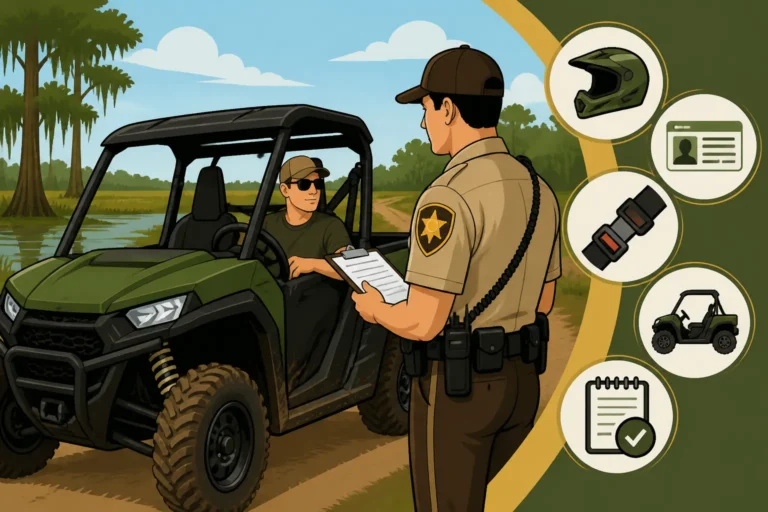
When a Louisiana State Trooper or parish deputy encounters a UTV on a public road, their primary concern is safety and compliance. They're trained to quickly assess several key factors. First, they'll check for signs: Is this road actually designated and visibly signed for UTV use? Without those signs, your argument for legality is severely weakened. Next, they'll scrutinize your UTV's equipment: Do you have working headlights, taillights, brake lights, turn signals, mirrors, and a horn? Are they all functional and visible?
They'll also check your personal documentation: Do you possess a valid Class E driver's license? Is your UTV properly registered with the OMV and displaying a license plate? Do you have current proof of insurance? Finally, they'll observe your driving behavior: Are you obeying the speed limit? Are you stopping at stop signs? Are you driving safely and responsibly? Any deviation from these requirements can be grounds for a stop and potential citation. [What a Louisiana State Trooper Can Ask to See]
The Real Costs of Non-Compliance
Ignoring Louisiana's UTV road rules can be a very expensive lesson. The immediate cost is often a citation and fine, which can easily run into hundreds of dollars. These tickets can also carry court costs and administrative fees, adding significantly to the total. Depending on the violation, you might even be required to appear in court, potentially incurring legal fees and taking time away from work or other responsibilities. [Louisiana Ticket Costs for Road Riding]
Beyond fines, one of the most severe consequences is the impoundment of your UTV. If your machine is found to be illegally on a public road, law enforcement has the authority to have it towed and impounded. You'll then be responsible for towing fees, daily storage fees, and potentially other administrative charges to get your machine back. This can quickly add up to thousands of dollars. Furthermore, traffic violations can lead to points on your driver's license, potentially affecting your insurance rates or even leading to license suspension for repeat offenses. It’s a stark reminder that the cost of compliance is almost always far less than the cost of non-compliance.
Advocating for More Designated Roads
While the enforcement of existing laws is strict, it doesn't mean the situation is static. Many riders and off-road enthusiasts are actively working to expand safe, legal UTV access on parish roads. One of the most effective ways to do this is through organized advocacy. Joining local ATV/UTV clubs or creating new ones provides a unified voice. These groups can research and present compelling proposals to parish councils and police juries, highlighting the economic benefits of responsible UTV tourism, the utility for rural residents, and proposed safety measures.
Effective advocacy involves more than just asking for access; it involves demonstrating a commitment to safety and responsibility. This means promoting rider education, encouraging helmet use, and advocating for strict adherence to all laws. By working collaboratively with local governments, showcasing the positive impact of UTV use, and committing to responsible riding practices, the off-road community can help shape the future of UTV access on Louisiana's parish roads, making it safer and more accessible for everyone.
Disclaimer
This article is for general informational purposes only and does not constitute professional advice. Laws, prices and regulations vary by location and change over time. Consult a qualified professional for guidance on your specific situation.