Generator Rules on a Mud Park RV Site
A generator can keep an RV comfortable at a Louisiana mud park, but it can also create noise, exhaust, and fire risks. The tricky part is that generator hours and site rules are usually set by the park, not by one statewide schedule. Confirm the park’s policy before towing in, then plan where and how you’ll run the unit safely.
Check the park’s generator policy before you travel
An RV hookup does not automatically mean generators are allowed whenever you want. Some parks limit generator use to certain hours, restrict it during quiet hours, or prohibit it on particular sites. Others may have different policies for event weekends, primitive camping, or powered RV spaces. Do not assume a rule from one park applies at another.
Ask the park directly, preferably before you reserve or leave home. If you are booking a site at a Louisiana mud park, ask whether the generator policy changes for an event weekend and whether the answer differs for an RV site with power. The park’s own Louisiana Private Park Camping Rules can help you understand the kinds of site policies to check, but the property’s current instructions are the ones to follow.
Get clear answers to these questions:
- Are portable generators allowed at the site you booked?
- What are the permitted operating hours?
- Are there quiet hours, and do they apply to generators?
- Is generator use allowed overnight or only when staff are present?
- Are there limits on generator type, sound, fuel storage, or exhaust direction?
- Does the site have a power connection, and what electrical setup does it support?
- Are there event-specific rules, or any restrictions during a fire-risk period?
- Who should you contact if a generator is too loud or appears unsafe?
A short phone call can prevent a frustrating arrival, especially if the site is sold as “RV camping” but does not include a power hookup. If you are considering an event stay at Muddy Bottoms, review Muddy Bottoms’ RV Sites and confirm the details with the park rather than treating general information as a promise that a specific site has power or permits generator use. For a broader comparison of facilities, Louisiana Riding Areas With RV Hookups can help you narrow down places to ask.
| Question | Why it matters | What to confirm |
|---|---|---|
| Is a generator allowed? | Some sites or parks may prohibit them | Rules for your exact site and stay |
| When may it run? | Quiet hours may limit use | Start and stop times, including overnight |
| Where may it sit? | Exhaust and heat can affect people, RVs, and equipment | Required placement and clearance |
| How may it connect? | Improper connections can damage equipment or create hazards | Approved cord, inlet, and electrical limits |
| How much fuel may you keep? | Storage rules and fire conditions can vary | Approved container, location, and quantity |
| What if the policy is unclear? | Staff may interpret or enforce rules on site | A written answer or the staff contact to ask |
If the park’s answer is vague, ask for the written policy or request clarification from the person responsible for site operations. A listing, old event post, or another camper’s recollection may not reflect the current rule. Also check whether your reservation includes a designated generator area; a place where generators are permitted is not necessarily the place where your RV is parked.
Set up the generator for safety, not just convenience
A generator produces carbon monoxide, a gas that cannot be seen or smelled and can cause serious illness or death. Never run one inside an RV, tent, vehicle, enclosed porch, or other enclosed or partly enclosed space. Keep it outdoors and follow the generator manufacturer’s instructions for placement, clearance, and exhaust direction. Do not point exhaust toward an RV window, door, neighboring campsite, or area where people gather.
Do not rely on an open RV window or roof vent to make generator use safe. Carbon monoxide can enter an RV even when the generator is outside. Use working carbon monoxide alarms inside the RV, test them before the trip, and replace batteries or the alarm itself as directed by its manufacturer. An alarm is a backup warning, not a substitute for keeping the generator outside and correctly positioned.
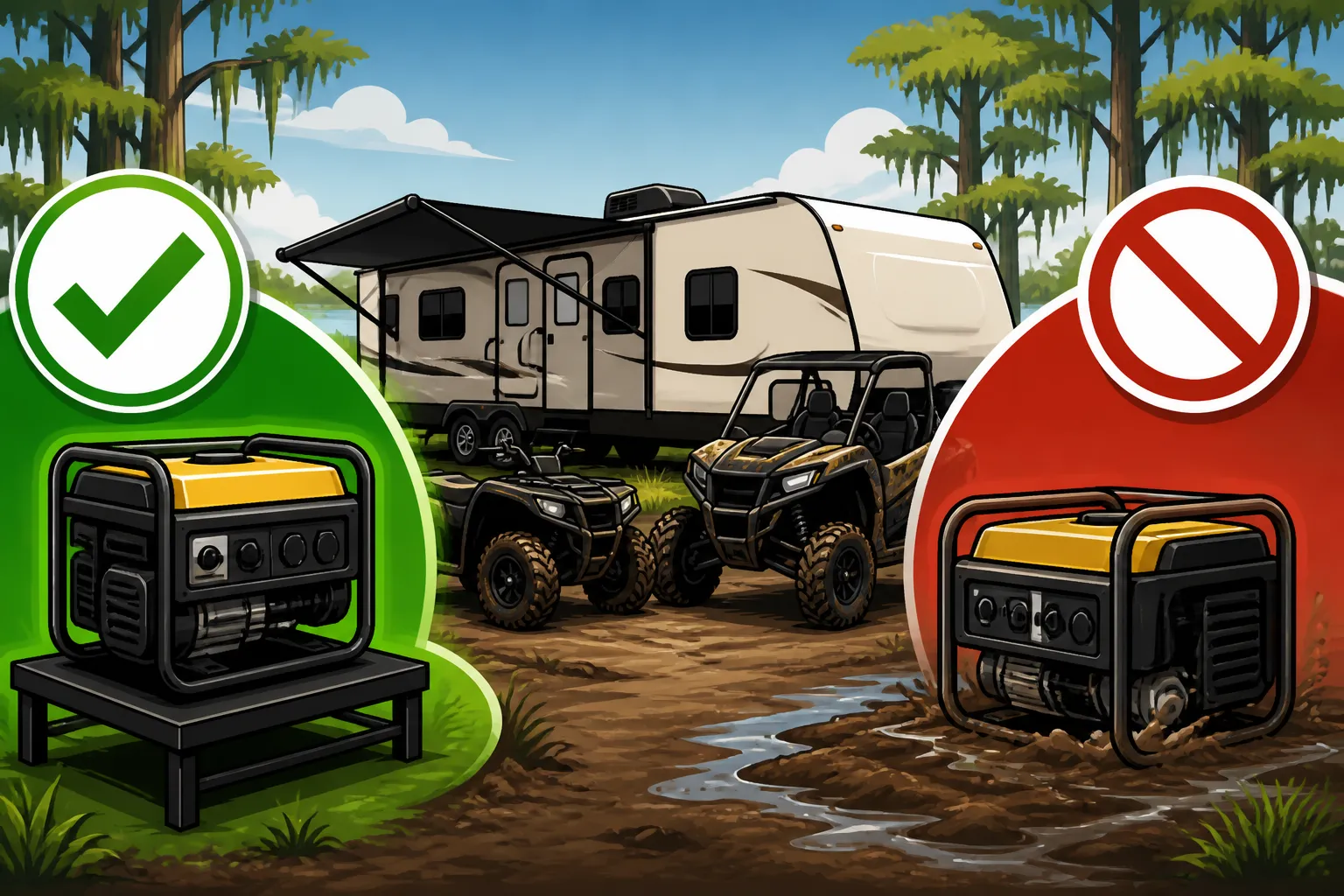
Before starting the unit, choose a stable, dry location that does not block a walkway, vehicle access, or an emergency route. Keep it away from standing water and mud that could reach electrical parts. Louisiana weather can change quickly, so think through where the unit will remain if rain begins. Never cover a running generator with a tarp or improvised enclosure; blocking ventilation can cause overheating and trap exhaust.
A few setup habits make a meaningful difference:
- Inspect the unit, fuel lines, plugs, and cords before each trip. Do not run damaged equipment.
- Place the generator on a stable surface and secure it as the manufacturer recommends.
- Keep the exhaust outlet clear and pointed away from people and occupied spaces.
- Use only cords and connections rated for the load and outdoor conditions.
- Keep cords out of standing water and avoid routing them where tires, doors, or foot traffic can damage them.
- Do not refuel a hot or running generator. Shut it down and let it cool as directed before adding fuel.
- Keep fuel in approved containers, secured and stored only where park rules and equipment instructions allow.
- Keep children and pets away from the running unit, hot surfaces, and electrical connections.
An RV’s power connection is not a reason to improvise. Do not connect a generator to an RV by plugging it into an outlet in a way that can send power back through the system. Use the RV’s proper generator connection and any transfer equipment required by the setup. If you are unsure whether the RV, generator, cord, or adapter is compatible, ask a qualified RV technician or electrician before operating it.
A carbon monoxide alarm and a suitable outdoor-rated cord are basic items to check before a trip; buy equipment that matches the manufacturer’s guidance and the RV’s electrical requirements. If you shop through Amazon or another retailer, compare the actual specifications and safety certifications rather than relying on a product title or a campsite recommendation.
Keep noise, exhaust, and fuel from becoming a campsite problem
A generator that is technically allowed can still disturb nearby campers. Noise carries across open campsites, especially at night, and a busy event can make people more sensitive to constant engine sound. Follow posted quiet hours even if the generator is needed for comfort. If the park allows it, consider running the unit only when necessary, charging batteries during permitted hours, and switching to stored power overnight.
Do not assume an “inverter” or “quiet” label means the unit meets a park’s noise rule. The park may define its own limit, judge noise by location, or prohibit operation during certain hours regardless of generator type. Ask whether the rule is based on a posted sound limit, a time restriction, or staff discretion. If you have a very quiet model, that may help reduce disturbance, but it does not override the policy.
Exhaust is another concern. A generator can bother neighbors even when its sound is modest, especially if fumes drift into a nearby RV or tent. Leave adequate space between the unit and neighboring sites, and adjust its position only if the park allows it and the manufacturer’s clearance requirements remain satisfied. Avoid moving it onto another site, a shared road, or vegetation without permission.
Fuel handling needs the same care. Keep gasoline or other fuel away from flames, hot equipment, and smoking areas. Do not leave a fuel container where it can tip over, get struck by a vehicle, or be reached by children. Never drain fuel onto the ground or into a storm drain. Ask the park where fuel may be stored and whether there are restrictions during dry or windy conditions.
If staff or a neighbor raises a concern, respond promptly. Turn the generator off if requested while you clarify the rule, then speak with park staff rather than arguing across sites. Parks may impose quiet-hour or conduct requirements that apply alongside the written generator policy. See Louisiana Private Park Quiet Hours and Louisiana Private Park Waivers and Rules for related policies that can affect a stay. Rules may be more restrictive during a crowded event, so check before starting the unit rather than waiting for a complaint.
If you are camping with a group, agree on generator hours before arrival. A shared schedule can reduce the number of operating units and limit late-night noise. It also helps to position RVs and generators with neighboring campers in mind, while still meeting the park’s placement and safety requirements.
Make a backup plan for power and changing conditions
A generator is only one part of an RV power plan. Before you travel, check whether your site has a functioning electrical hookup, what connection it provides, and whether your RV can use it safely. If the site is primitive, estimate which appliances you actually need and how much power they draw. Air conditioning, cooking appliances, heaters, and battery charging can place very different demands on a generator.
Do not run several high-draw appliances at once unless the generator and RV setup are rated for that combined load. Check the generator manual and RV documentation for capacity and connection instructions. If a breaker trips, a cord becomes hot, or you notice a burning smell, shut down the equipment and investigate the cause safely. Repeatedly resetting a breaker without finding the problem can make an electrical fault worse.
A practical pre-trip plan includes:
- Confirm the park’s generator rules for your site and dates.
- Check the generator and RV manuals for operating, placement, and electrical requirements.
- Test the generator and carbon monoxide alarms at home, outdoors and according to their instructions.
- Pack the correct outdoor-rated cords and approved fuel container.
- Decide which appliances are essential and avoid exceeding the system’s capacity.
- Identify a backup option if generator use is limited, such as charging batteries before arrival or choosing a powered site.
- Save the park’s contact information so you can ask staff about weather, fire restrictions, or a rule that is unclear.
Heavy rain, flooding, mud, or a change in fire conditions can affect where equipment may be used or stored. Never place a generator where water can collect around it, and do not run electrical equipment in a flooded area. If weather makes your planned setup unsafe, shut down and move only when conditions and park staff allow. Do not assume the site will remain suitable simply because it was dry when you arrived.
For a stay that depends on a generator, consider whether the site’s rules and layout genuinely fit your needs before booking. If quiet hours prevent the operating schedule you require, a powered RV site or a different campground may be a better choice. Primitive camping can work well for some setups, but the limitations are worth understanding; What Primitive RV Camping Gets You at Muddy Bottoms explains the kind of trade-offs to clarify before committing.
Generator rules at a Louisiana mud park RV site are ultimately property-specific. Confirm permission, hours, placement, electrical compatibility, and fuel expectations with the park, then follow the generator and RV manufacturers’ safety instructions. A little planning protects your equipment and helps keep the site safe and comfortable for everyone nearby.
Disclaimer
This article is for general informational purposes only and does not constitute professional advice. Laws, prices and regulations vary by location and change over time. Consult a qualified professional for guidance on your specific situation.