Nature Trails Are Closed to Every Machine
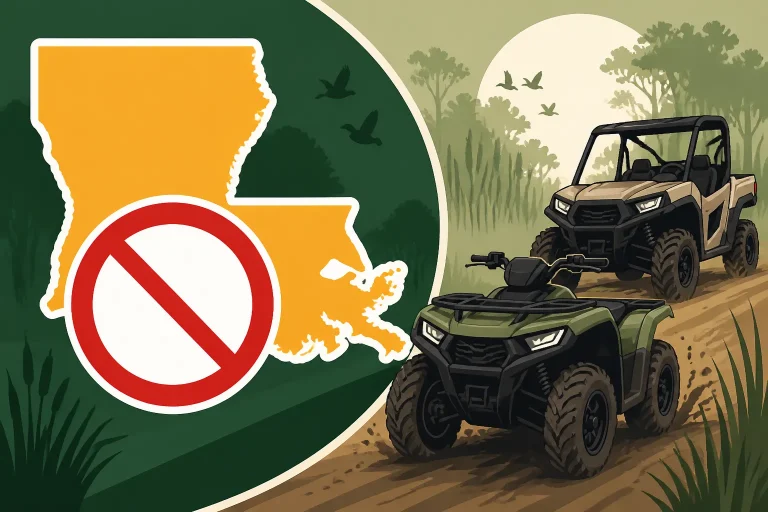
A nature trail may look like a convenient connection between two riding areas, but on Louisiana wildlife management areas, it is not an ATV or UTV route. The restriction applies even if you have the right permit, your machine is otherwise allowed on the property, or the trail looks wide enough to ride. Here’s how to recognize the boundary and avoid turning a legal ride into a violation.
What “closed to every machine” means
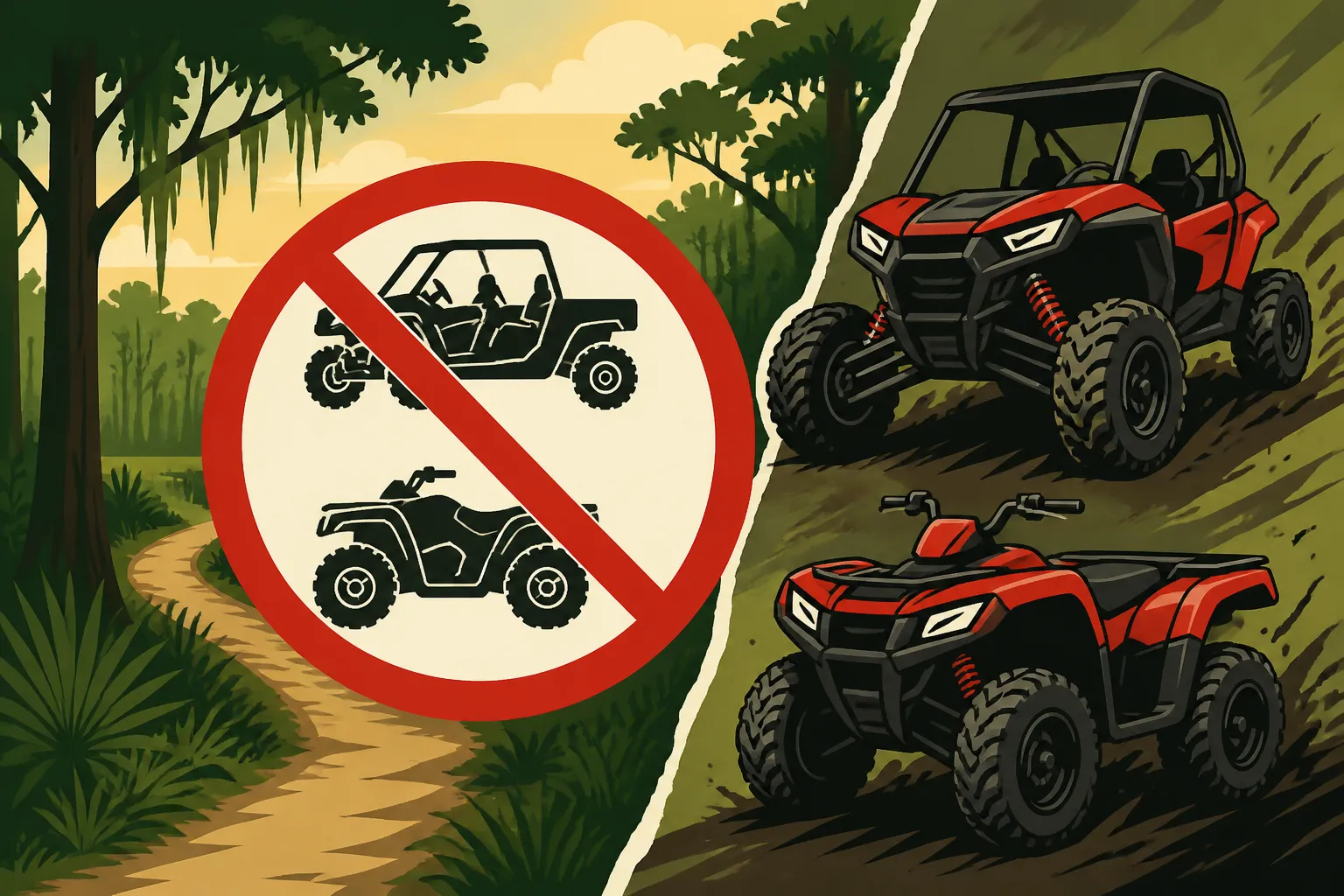
On a Louisiana wildlife management area, a nature trail is not an alternate route for an ATV, UTV, dirt bike, or other motorized machine. The restriction applies even when a machine is small, quiet, registered, or being operated by someone with permission to use other parts of the property. A permit for WMA access does not turn a pedestrian nature trail into an authorized riding trail.
That distinction matters because a WMA can have several kinds of routes on the same property. Some may be open to motorized use under specific rules, while a nature trail is closed to machines. A road, a walking trail, a marked riding trail, and a route shown only on a general property map are not interchangeable. The label and rules for the specific route control.
| What you find | What it means for a rider |
|---|---|
| A trail identified as a nature trail | Do not ride a motorized machine on it |
| A trail shown as an authorized motorized route | Ride only if the route is open and your machine and use meet the applicable rules |
| A trail that is not clearly identified | Do not assume it is open; check the property map and current rules |
| A road or trail with a closed sign, gate, or seasonal restriction | Do not enter by machine, even if the route appears passable |
| A walking route near an open riding trail | Keep the machine on the authorized route; do not use the walking trail as a shortcut |
The practical rule is simple: ride only where motorized use is specifically allowed. Louisiana WMA Designated Trails Only explains why a WMA riding permit does not mean every path on the property is open to machines. A route that is absent from the authorized riding map should not be treated as an unofficial extension of a nearby trail.
This is different from a temporary closure. A route can be closed because of a seasonal restriction, maintenance, weather, or a posted notice. A nature trail’s motorized-use restriction is not something to set aside because the trail looks dry or no one is around. If the route is designated for nature-trail use rather than motorized travel, keep the machine off it.
“Every machine” also means that switching vehicles does not solve the problem. Taking a side-by-side instead of an ATV, or riding a dirt bike rather than a quad, does not make a closed nature trail legal for motorized use. Nor does walking a machine along the trail necessarily make it acceptable to take the machine through the closed area. If you need to get from one open route to another, use an authorized connection or return to a legal access point.
Permits and out-of-state credentials do not override the trail closure
WMA permits and access requirements determine whether you may enter or use a property under the applicable rules. They do not grant blanket access to every trail, road, or part of the land. Think of a permit as one condition of lawful access, not as permission to ride anywhere you choose.
Requirements can depend on the property, activity, and current regulations. Before unloading, check whether the WMA requires a permit or self-clearing permit for your visit and follow the instructions that apply to that site. Louisiana WMA Permit Requirements and Louisiana Self-Clearing Permit Steps cover those separate access obligations. Completing a permit does not authorize riding on a nature trail.
The same principle applies to riders visiting from another state. An out-of-state registration, decal, or riding permit does not automatically open a Louisiana WMA nature trail to motorized use. You still need to follow Louisiana’s property-specific trail restrictions and any permit conditions. If you are bringing a machine across the state line, Riding Louisiana Public Land on an Out-of-State Machine can help separate the questions of machine credentials and public-land access.
A common mistake is to treat permission for the property as permission for a particular route. For example, a rider may have completed the required access paperwork and may be using a machine that meets the area’s equipment requirements. Those steps can still leave the rider in violation if the machine is on a nature trail. Property access, machine eligibility, route authorization, and seasonal status are distinct checks.
Before riding, verify all of the following:
- The property is open to the type of use you plan. A WMA may have restrictions that vary by area or time.
- Your access paperwork is complete. Follow the current permit or self-clearing instructions for that property and activity.
- The route is specifically open to motorized machines. Do not infer authorization from a trail’s width, surface, or connection to another route.
- Your machine meets any applicable limits. Weight, dimensions, tires, and other equipment restrictions may apply on some areas.
- No seasonal or temporary closure affects the route. Check current notices rather than relying on an old map or a previous visit.
These checks are useful for everyone, but especially for visitors who may be familiar with a different state’s public-land system. Rules that apply at a riding area elsewhere do not carry over simply because the trail looks similar. When an official map or sign classifies a route as a nature trail, do not ride it while trying to resolve uncertainty at the trailhead.
How to plan a route without crossing a nature trail
The best way to avoid an accidental violation is to plan the ride around routes that are expressly authorized for motorized use. Start with the current map and regulations for the exact WMA, not a screenshot, a general map of the region, or a route someone shared without explaining its status. Then compare the map with signs and gates on the ground.
Maps can help you locate access points and identify designated riding routes, but they do not make every visible track legal. A worn path, an old logging road, or a trail used by pedestrians might not be open to ATVs or UTVs. If the map does not clearly show a route as available to machines, treat that uncertainty as a reason to stop and check—not as permission to try it.
At the property, pay attention to the trailhead itself. Read posted signs before unloading, and look for closures or restrictions at intersections. A sign may apply to the path beyond it rather than the whole property. Conversely, the absence of a sign at a particular turn does not necessarily make an unmarked trail an authorized route. Use the property’s official map and current rules together.
Build a route that does not depend on cutting through a nature trail. If an open riding trail appears to end near a pedestrian route, do not assume the two connect legally. Turn around, use the marked return route, or choose another authorized route. This may add distance, but it avoids relying on an interpretation that could result in a citation or loss of access.
When the status of a route is unclear:
- Stop before entering the uncertain section.
- Check the current WMA map and posted notices.
- Ask the managing agency or property staff for clarification when available.
- Keep the machine on a route that is clearly authorized while you confirm.
- Do not follow tire tracks as proof that motorized use is allowed.
For a more complete review of common route restrictions, see Louisiana WMA Off-Trail Bans. If your ride depends on dates or hunting-season access, also check Louisiana WMA Seasonal Riding Ban. A route that is normally available may still be closed during a particular period, and a route closed to machines does not become open merely because nearby trails remain accessible.
A useful planning habit is to save or carry the relevant map before leaving cell coverage. A phone map can help with orientation, but it should not replace the official property map or posted instructions. If you cannot tell whether a route is authorized, the safer choice is to stay off it and retrace your path.
Common mistakes and what to do instead
“I have a permit, so the whole WMA is open to me.”
A permit may satisfy an access requirement, but it does not erase route restrictions. Check whether motorized use is allowed on the specific route you intend to ride.
“The trail is wide enough for my machine.”
Width is not a legal designation. A broad, firm path can still be a nature trail closed to machines. Use the route’s official status, not its appearance.
“Other riders have used it.”
Tire tracks do not establish permission. Tracks could be old, unauthorized, or left by someone who misunderstood the rules. Do not use them as evidence that a trail is open.
“My machine is allowed on other parts of the WMA.”
Machine eligibility and trail access are separate matters. A machine that meets applicable requirements still cannot be ridden on a route closed to every machine.
“I’m only crossing the nature trail.”
A short crossing is still machine use on the closed route unless a specific rule or official direction allows it. Plan a legal connection instead of cutting across.
“The trail is empty, so there is no risk.”
The restriction does not depend on whether pedestrians are present. Riding can also damage a route or disturb the area, and an empty trail is not evidence of authorization.
If a route is closed, do not try to work around a barrier or ride beside the trail to avoid a sign. That can create a separate access problem and may damage the surrounding land. Turn around and stay on the designated route. If you have already entered by mistake, stop, leave by the nearest practical route without continuing farther, and review the map before riding again.
A mistake may also affect the rest of your outing. WMA access rules can include conditions beyond the trail itself, so check the regulations for the specific property rather than assuming that the same rules apply everywhere. Riders involved in a game-retrieval situation should review Louisiana Game Retrieval Rules; a retrieval allowance, where applicable, is not a general authorization to ride nature trails for recreation.
The safest approach is to make the route decision before starting the engine: confirm the property’s current rules, complete any required access paperwork, and ride only trails expressly open to motorized machines. If a route is marked or identified as a nature trail, leave the ATV, UTV, and other motorized machines off it.
Disclaimer
This article is for general informational purposes only and does not constitute professional advice. Laws, prices and regulations vary by location and change over time. Consult a qualified professional for guidance on your specific situation.