Louisiana Visitors From Texas
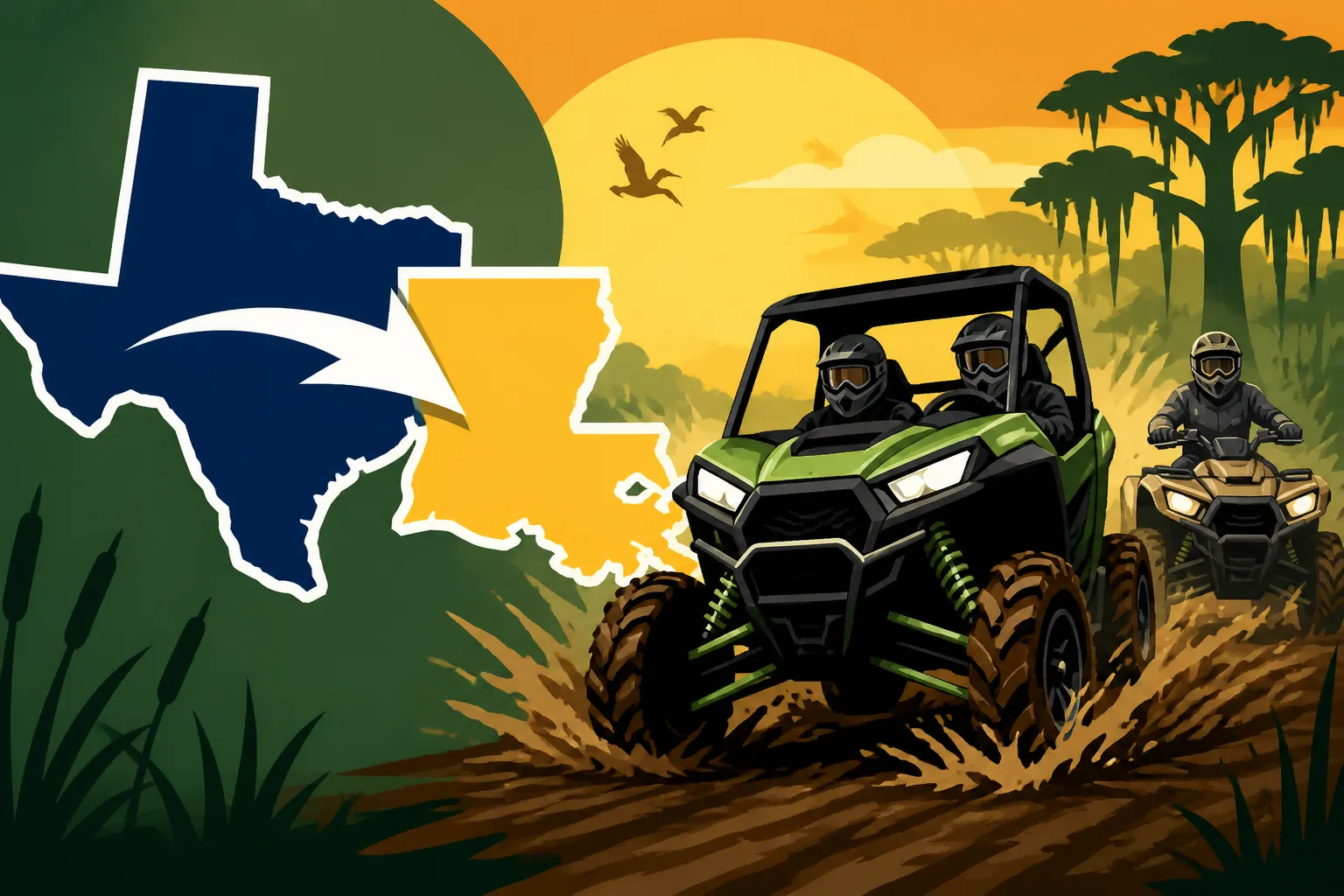
A Texas ATV or UTV decal, registration document, or trail permit may not cover every kind of riding in Louisiana. The key is to separate machine paperwork from access permits and road rules: each can have different requirements. Here’s what Texas visitors should check before unloading, including public-land access, private parks, and riding on public roads.
Check what your Texas paperwork does and does not cover
A document that lets you ride at home does not automatically grant access to every Louisiana trail or public area. Louisiana requirements can depend on the machine, where you plan to ride, and whether you are riding off-road or on a public road.
Before leaving Texas, gather the documents you have for the machine, such as its title or proof of ownership and any registration or off-highway decal. Then ask the Louisiana agency or land manager responsible for your destination whether it recognizes your specific Texas document. Don’t assume that an out-of-state decal is accepted just because it is valid in Texas. The details of reciprocity can matter, and a decal accepted at one site may not meet a separate site’s access rules. For background, see [Louisiana Rules for an Out-of-State Decal].
It also helps to keep these terms distinct:
- Title or proof of ownership: Documents who owns the machine. They do not, by themselves, authorize riding on public land or roads.
- Decal or registration: May identify or authorize the machine under a particular state program. Whether Louisiana accepts an out-of-state credential depends on the applicable rule and location.
- Land-use permit or pass: May be required to enter or ride on a particular public property, regardless of where the machine is from.
- Road authorization: Concerns whether a specific machine may use a particular public road. An off-road decal or land pass is not the same as permission to ride on a road.
If you cannot confirm that your Texas credential is accepted, contact the relevant Louisiana office or land manager before riding. Ask about the exact machine type, the exact riding area, and whether the answer applies to a visitor. Keep the response and any documents you rely on accessible while traveling.
| What you have | What it may establish | What it does not automatically establish |
|---|---|---|
| Texas title or proof of ownership | A record of ownership | Permission to ride on Louisiana public land or roads |
| Texas decal or registration | Compliance with a Texas requirement | Acceptance by every Louisiana land manager |
| Louisiana land pass or permit | Access under the rules of a specific property | Permission to ride on public roads |
| Permission from a private park | Access under that park’s rules | Access to state or federal land |
When the Louisiana requirement applies to the vehicle itself, being a nonresident does not necessarily remove it. When a site has its own permit, a state decal may not replace that permit. Treat each requirement as a separate check rather than relying on one piece of paperwork to cover everything.
Match permits to the place you plan to ride
Louisiana riding areas do not all use the same access system. A forest trail, a wildlife management area, and a private mud park may each have different rules. Check the destination before you go, including whether it is open to your type of machine and whether the current route is open.
National forest trails
Some trails on national forest land require a forest pass or other site-specific authorization. Verify what applies to the trail you intend to use, how to obtain the required pass, and whether the route is open to your ATV or UTV. Start with Louisiana Forest Trail Use Passes and check the official trail status information before towing.
A pass for one property or trail system should not be assumed to cover another. Also confirm the rules for trailers, parking, hours, and machine type. A trail may be closed seasonally or temporarily, even if you have the right pass.
Wildlife management areas
A wildlife management area can have its own permit process and riding restrictions. Some require riders to complete a self-clearing permit step, and riding may be limited to designated routes. Rules can also address vehicle size, tires, operating hours, or seasonal closures. Check Louisiana WMA Permit Requirements and follow the Louisiana Self-Clearing Permit Steps for the area you plan to visit.
Do not treat a hunting access permit, a forest pass, or permission to enter the property as blanket approval to ride any route. Use the current map and confirm that motorized riding is allowed on the specific trail. If your machine is a UTV, check width and other vehicle restrictions rather than assuming a route open to ATVs also allows UTVs.
Private riding parks
Private parks set their own entry conditions. A park may require a waiver, proof of ownership, or compliance with equipment and age rules. Event schedules, trail conditions, camping options, and admission arrangements can also vary. Check directly with the park before departure, particularly if you are planning a group trip or arriving outside a major event.
A private park’s permission applies to that property. It does not provide authorization to ride on a nearby public road, forest, or wildlife area. Keep your plans within the boundaries and rules of the place that granted access.
Don’t confuse off-road access with permission to ride on roads
A frequent source of trouble is assuming that a machine allowed on a trail is also allowed on a public road. That is not a safe assumption in Louisiana. Road use is governed separately, and a Texas registration, a Louisiana land pass, or an off-road decal does not by itself make an ATV or UTV street legal.
Louisiana’s rules differ for ATVs and UTVs, and local road designations may affect where certain UTVs can operate. Requirements can include conditions about the road, the driver, insurance, and equipment. A narrow exception for a particular kind of travel should not be read as a general right to ride around town or connect trails by road.
Before using any public road, identify the machine category and the exact road, then verify that riding is allowed there. Read Louisiana ATV Road Rules Under 32:299 or Louisiana UTV Road Rules Under 32:299.3, as appropriate. If a local designation or sign is part of the rule, confirm that the specific road qualifies. Do not infer permission from a road’s rural appearance or from seeing another rider use it.
For a visitor from Texas, the practical approach is straightforward:
- Plan a route that stays on a trail or property where your machine is permitted.
- Treat any public-road section as a separate legal question.
- Check state and local requirements for that specific road and vehicle.
- If you cannot verify the route, trailer the machine instead of riding it between destinations.
Rules for a farm-related exception should not be treated as a shortcut for recreational travel. An exception may be limited by purpose, location, vehicle, or other conditions. A visitor riding for recreation should not assume that an exception intended for a particular use applies to them.
Plan the trip around the site’s rules
A little confirmation before departure is usually easier than sorting out paperwork at a gate. Start with the precise property name and trail, not just a nearby town or the general region. Then check the land manager’s current information and contact the office if a rule is unclear.
A pre-trip checklist
- Identify the machine: Confirm whether the rules classify it as an ATV or UTV. If the classification is unclear, give the land manager the make, model, and relevant dimensions.
- Gather ownership and Texas documents: Bring the records you have, but ask whether Louisiana accepts each credential for the planned activity.
- Check every permit separately: Find out whether the trail or property needs a pass, permit, or self-clearing step.
- Confirm access and closures: Check that the exact route is open and allows your machine type on the day you plan to ride.
- Check equipment restrictions: Ask about limits that may apply to tires, width, weight, lights, or other equipment.
- Keep road riding out of the plan unless verified: Confirm the legality of each public-road segment rather than assuming off-road access carries over.
- Save the details: Keep permits, maps, proof of ownership, and contact information where you can retrieve them.
If you plan to visit more than one riding area, repeat the check for each destination. A pass or permit that works for one site may not be valid at the next one, and access rules can differ even between nearby properties.
Visitors who are unsure which office handles a particular requirement can ask the destination’s land manager which agency issues the permit and which rules apply to nonresident machines. Be specific: say that the machine is from Texas, identify it as an ATV or UTV, and describe whether you will ride on a forest trail, a wildlife management area, private property, or a public road. Clear details make it easier to get an answer that fits the trip.
The safest planning rule is to treat Texas paperwork as useful documentation, not as a substitute for checking Louisiana’s requirements. Confirm out-of-state decal acceptance, obtain the permit required by the riding site, and keep off public roads unless the route is specifically authorized for your machine.
Disclaimer
This article is for general informational purposes only and does not constitute professional advice. Laws, prices and regulations vary by location and change over time. Consult a qualified professional for guidance on your specific situation.