One Machine in a Retrieval Party
Louisiana’s one-machine rule can be easy to misunderstand when a hunting party needs to bring legally harvested game out of a Wildlife Management Area. The allowance is narrow: it does not give every hunter permission to ride, roam, or search by ATV. Here’s how to think about the limit, plan a retrieval, and avoid treating an exception as general trail access.
What “One Machine in a Retrieval Party” Means
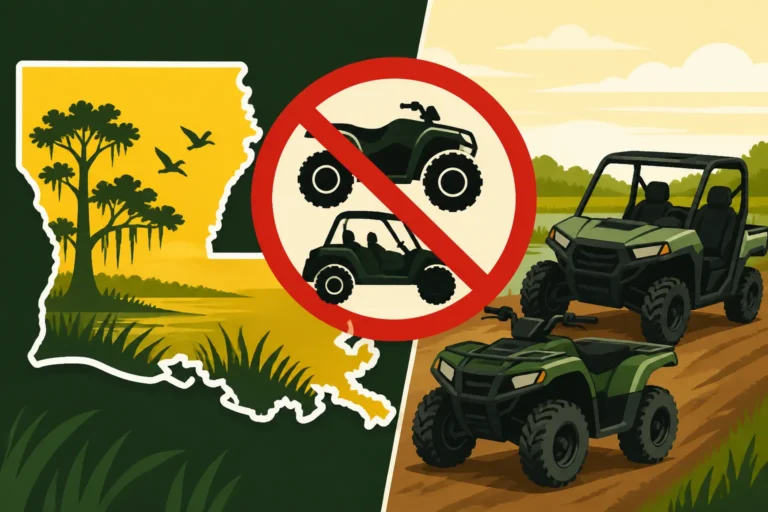
Louisiana WMA rules include a limited machine-use allowance for retrieving legally harvested game. The central limit is that a retrieval party may use one machine—not one machine for every hunter, vehicle, or animal. The allowance is about getting game out, not making the hunt itself easier by using machines throughout the day.
That distinction matters in a group. If several hunters are together, a machine used by one member may still count toward the party’s limit. Bringing another quad for a second person, or sending a separate vehicle to the same retrieval, could put the group outside the allowance. Before riding, check the current regulations for the specific WMA and make sure the people involved understand who is part of the retrieval party.
The term “party” can matter as much as the number of machines. Don’t assume that hunters can avoid the limit simply by dividing into smaller groups after the harvest, taking separate routes, or making multiple trips. If the hunters are working together to retrieve the same game, plan on the one-machine limit applying to the group unless the current WMA rules clearly say otherwise. For the broader rule, see Louisiana Retrieval Party Limits and Louisiana Game Retrieval Rules.
| Situation | A cautious way to apply the limit |
|---|---|
| Several hunters are retrieving game together | Plan for one machine for the retrieval party |
| The party has more than one ATV or UTV available | Leave additional machines parked |
| The party has more than one animal to retrieve | Don’t assume each animal allows another machine |
| A second group wants to help | Check whether the regulations treat the hunters as one party |
| The machine would be used for scouting or travel | Don’t treat retrieval permission as general riding permission |
| The harvest or route is unclear under the rules | Pause and confirm with the WMA’s current regulations |
The allowance is not a substitute for an off-highway vehicle permit or other access requirements. A rider may still need to follow WMA entry procedures, trail restrictions, machine limits, seasonal closures, and other land rules. Review [Louisiana WMA Permit Requirements] and Louisiana WMA Riding Rules for Quads before the trip.
It also helps to separate two questions: “May this machine be used for retrieval?” and “May this machine travel on this route?” A narrow allowance to retrieve game does not automatically answer every question about where a machine may go. Check the WMA’s map and current rules rather than assuming that the shortest route to the animal is automatically an allowed route.
Count the machine, not the number of riders
The limit is easy to misread as a rider limit or a vehicle-per-hunter allowance. For planning purposes, focus on the machine: if the retrieval party is using a quad or another covered machine for the retrieval, don’t add a second machine because another hunter wants a ride. The allowance does not become broader just because the vehicle carries several people or because the group has multiple hunters.
Whether a particular vehicle qualifies as a permitted machine, and which rules apply to an ATV versus a UTV, can depend on the WMA’s regulations. Don’t assume that a side-by-side is treated exactly like a quad for every requirement. Check the relevant definitions and restrictions in Louisiana WMA Riding Rules for UTVs if a UTV will be involved.
Treat the exception as narrow
A retrieval exception should not be read as permission to ride around looking for animals, check multiple areas, or carry hunters between hunting spots. It is tied to a specific purpose: retrieving game that has already been legally harvested. When the retrieval is over, the reason for using the exception is over too.
If the rules for a particular WMA are not clear about your situation, the conservative choice is to leave the machine off the WMA until you can confirm what is allowed. A machine that is legal for a private property trip, trail park, or another public area is not automatically legal on a WMA.
What Counts as Retrieval—and What Does Not
The practical dividing line is whether the animal has already been lawfully harvested. Moving a harvested animal is different from searching for an animal, continuing a hunt, or using a machine to make hunting more convenient. Don’t use the word “retrieval” to describe an activity that is really scouting or searching.
A planned retrieval is usually easier to assess: the party has a legally harvested animal, knows where it is, and is using the permitted machine for the limited purpose of bringing it out, subject to the WMA’s rules. By contrast, riding through the woods to locate an animal, look for sign, or find a wounded animal raises different issues. Consult Reaching a Downed Deer in Thick Cover and Never Searching for Wounded Game for the important distinction between retrieving harvested game and searching.
| Activity | Why it may be different from retrieval |
|---|---|
| Riding to look for a deer before a shot | This is scouting or hunting travel, not retrieval of harvested game |
| Searching for an animal that may be wounded | The retrieval allowance should not be treated as permission to conduct a search |
| Carrying hunters between locations | That is transportation, not bringing harvested game out |
| Checking a trail or hunting area after the retrieval | That extends machine use beyond the stated purpose |
| Moving harvested game toward an approved exit | This is the situation the narrow retrieval allowance is intended to address, subject to current rules |
Even when an animal has been harvested, other requirements still matter. The party must follow hunting and WMA regulations that apply to the species, season, location, and method of take. The machine allowance does not make an unlawful harvest lawful, nor does it override access restrictions.
If the animal is not where the party expected, don’t let urgency turn the retrieval into an open-ended search. Stop and determine what the current rules allow. If the machine cannot reach the animal without crossing a prohibited area or breaking a route restriction, find a lawful alternative rather than assuming the exception covers whatever route seems easiest.
Don’t use a retrieval trip to keep hunting
A retrieval trip is not a second chance to hunt from a machine. Avoid carrying hunting equipment or using the ride to look for other animals, investigate fresh sign, or select a new hunting location. Even if the group intends to retrieve game eventually, extra riding can make it difficult to show that the machine was being used only for the permitted purpose.
The safest approach is to keep the trip direct and task-focused. Decide who is going, which single machine will be used, where the harvested animal is, and what route is allowed. Once the animal is out, return to the permitted access point or follow the WMA’s instructions. Don’t use the retrieval as a reason to continue riding.
Be careful with firearms and other hunting gear
A retrieval allowance does not automatically settle what firearms, ammunition, or other hunting equipment may be carried on the machine. Rules may address these separately, and the answer can depend on the WMA and circumstances. Do not assume that a firearm can remain loaded, be carried in any position, or accompany the machine just because the trip is for retrieval.
Review Retrieving Without a Firearm and the current rules for the WMA before heading out. If those rules require the firearm to be left behind, unloaded, or secured in a particular way, follow that instruction. If the wording is unclear, ask the land manager or the Louisiana Department of Wildlife and Fisheries before the hunt, rather than trying to interpret it at the trailhead.
How to Plan a Compliant Retrieval
A few decisions made before the hunt can prevent a rushed mistake after a harvest. Confirm the rules for the exact WMA, choose one machine, and make a practical plan that stays within both the retrieval allowance and the area’s access restrictions.
- Identify the WMA and its current rules. Regulations can differ by area and season. Check the current WMA information, map, closures, and machine restrictions before you leave home. Don’t rely only on a rule you remember from another WMA or an earlier trip.
- Complete any required entry steps. A retrieval allowance does not necessarily waive a permit or check-in requirement. Review [Louisiana Self-Clearing Permit Steps] and confirm whether the people entering the area need to complete a permit.
- Choose one machine for the party. Agree on which ATV or UTV will be used. Leave the others at a lawful parking or staging location rather than taking them along “just in case.”
- Confirm the route. Identify where the animal is, where the machine may travel, and how the party will exit. Check the posted trail map and restrictions. The exception does not necessarily authorize leaving a designated route.
- Keep the retrieval group clear and limited. Decide who is going to retrieve the animal and who will remain at the hunting location, if applicable. Don’t assume that splitting the group changes how the party limit applies.
- Use the machine only for the retrieval. Keep the ride focused on the harvested animal. Don’t scout, carry other hunters to new locations, or use the trip to look for additional game.
- Stop if the situation changes. If the animal cannot be found, the route is blocked, or the rules do not cover the circumstances, don’t improvise a broader use of the machine. Seek clarification or use a lawful alternative.
A map is useful, but it cannot answer every question by itself. Posted signs, seasonal notices, closures, and area-specific rules can affect access. Review Louisiana WMA Designated Trails Only and Reading a WMA Map Before You Unload before riding. If a sign and an older map appear to conflict, treat the restriction as a reason to stop and verify the current information.
Decide where the extra machines will stay
If members of the party bring multiple machines to the area, choose a place where the unused machines can be left legally and safely. Don’t block a gate, road, trail, or designated parking space. Keep keys and personal gear secure, and don’t leave equipment where it could create an obstruction or invite damage.
It may be easier to bring only the machine the group expects to need. That reduces confusion about which vehicle counts toward the limit and avoids a last-minute decision to take a second machine into the WMA. A retrieval plan should not depend on hoping no one notices an extra vehicle.
Keep the trip direct and practical
A direct route helps show that the machine is being used for the limited purpose of retrieval. It also reduces the chance of accidentally entering a closed or restricted area. This does not mean a rider may choose any direct route; the route still has to comply with the WMA’s rules.
Consider the ground conditions before deciding whether a machine is appropriate. Wet or soft ground can make a route impassable, and trying to force a machine through can damage habitat or create a safety problem. If the permitted route is not usable, stop and find out what other lawful options exist. Don’t turn a difficult retrieval into an excuse to cross a closed area.
Common Mistakes and What to Do Instead
The one-machine limit is only one part of the rules. Confusion often arises because a party remembers the retrieval exception but forgets that it sits alongside other restrictions. A simple way to avoid trouble is to ask three questions before starting: Has the game been legally harvested? Is this one machine being used only for retrieval? Is the planned route allowed?
Mistake: assuming one machine per hunter
The phrase “one machine” does not mean each hunter can bring one. If a hunting party has several members, adding a machine for each person defeats the purpose of a party limit. Plan around one machine for the retrieval group and confirm how the current WMA rules define that group.
Instead: Choose the single machine before the hunt begins and make sure everyone agrees that additional machines will remain out of the WMA.
Mistake: treating every animal as a separate retrieval party
If the same hunters harvest more than one animal, don’t assume each animal creates a new machine allowance. A party should not make several trips with different machines simply because there is more than one animal. The group limit is not automatically multiplied by the number of animals.
Instead: Check the WMA’s rules before the hunt and ask how they apply to multiple harvested animals. If the wording is unclear, do not assume a second machine is permitted.
Mistake: using the machine to search for a wounded animal
A machine used to search can turn a narrow retrieval allowance into a different activity. It may also disturb wildlife or cause the party to travel outside permitted routes. Searching for an animal is not the same as carrying out one that has already been located and harvested.
Instead: Follow applicable hunting rules for a wounded animal, and do not rely on the retrieval exception as authority to ride around looking for it. Never Searching for Wounded Game covers why this distinction matters.
Mistake: assuming a permitted purpose makes any route legal
Even if the purpose is retrieval, that does not necessarily authorize travel across every part of a WMA. A closed trail, seasonal restriction, posted boundary, or off-trail prohibition can still apply. If the route to the animal crosses restricted ground, the machine allowance may not solve that problem.
Instead: Check the map and rules for the area. If you cannot identify a permitted route, contact the WMA manager or the state wildlife agency for clarification before riding.
Mistake: relying on rules from a different WMA
A friend’s experience at one WMA may not apply at another. Access rules, seasons, vehicle restrictions, and local notices can vary. Even a familiar area may have changed conditions or posted closures.
Instead: Confirm the regulations for the specific area and season you plan to visit. Keep a copy of the relevant map or regulations accessible, and read signs at the entrance.
Mistake: thinking a permit makes every machine use legal
A permit or self-clearing form may satisfy an entry requirement, but it does not automatically authorize every kind of machine use. Permit rules, trail rules, hunting rules, and retrieval limits answer different questions.
Instead: Treat each requirement separately. Complete the permit process, check that the machine is allowed, follow trail restrictions, and make sure the specific trip qualifies as retrieval. For permit details, see [Louisiana Self-Clearing Permit Steps].
If a conservation officer or WMA employee asks about the trip, answer plainly and explain the purpose and route. Keep required permits and other documentation available as directed by the area rules. The goal is not to argue that “retrieval” covers any machine trip, but to show that the party understood the limits and followed them.
Frequently Asked Questions
Does one machine mean one ATV for each hunter?
No. The limit is for the retrieval party, not one machine per person. Plan on one machine for the group and confirm how the current WMA rules define the party.
Can the party use a second machine for another harvested animal?
Don’t assume so. Multiple animals do not automatically create extra machine allowances. Check the specific WMA’s current rules before making a retrieval plan.
Can a machine be used to search for a wounded animal?
Do not treat the retrieval allowance as permission to search. Retrieving legally harvested game and searching for an animal are different activities, and the applicable hunting rules still matter.
Does the retrieval allowance let an ATV leave a designated trail?
Not automatically. The allowance does not necessarily override trail limits, closures, or off-trail restrictions. Confirm the route in the current WMA rules and map before riding.
Disclaimer
This article is for general informational purposes only and does not constitute professional advice. Laws, prices and regulations vary by location and change over time. Consult a qualified professional for guidance on your specific situation.