Louisiana Photo ID at the Counter
Picture this: you've spent weeks hunting for the perfect off-road machine, finally found it, gathered what you think is all the paperwork, and dedicated a precious chunk of your day to heading to the Louisiana OMV. You get to the front of the line, feeling pretty good about yourself, only for the clerk to politely — but firmly — send you packing because your photo ID isn't quite right. Talk about a gut punch! This guide is here to help you avoid that frustrating, wasted trip by detailing exactly what kind of photo identification the Louisiana Office of Motor Vehicles expects to see when you're there to title or register your ATV or UTV. We'll cover everything from the basic requirements to less common scenarios, ensuring your visit is as smooth as a freshly paved road.
Why Your Photo ID is Non-Negotiable at the OMV Counter
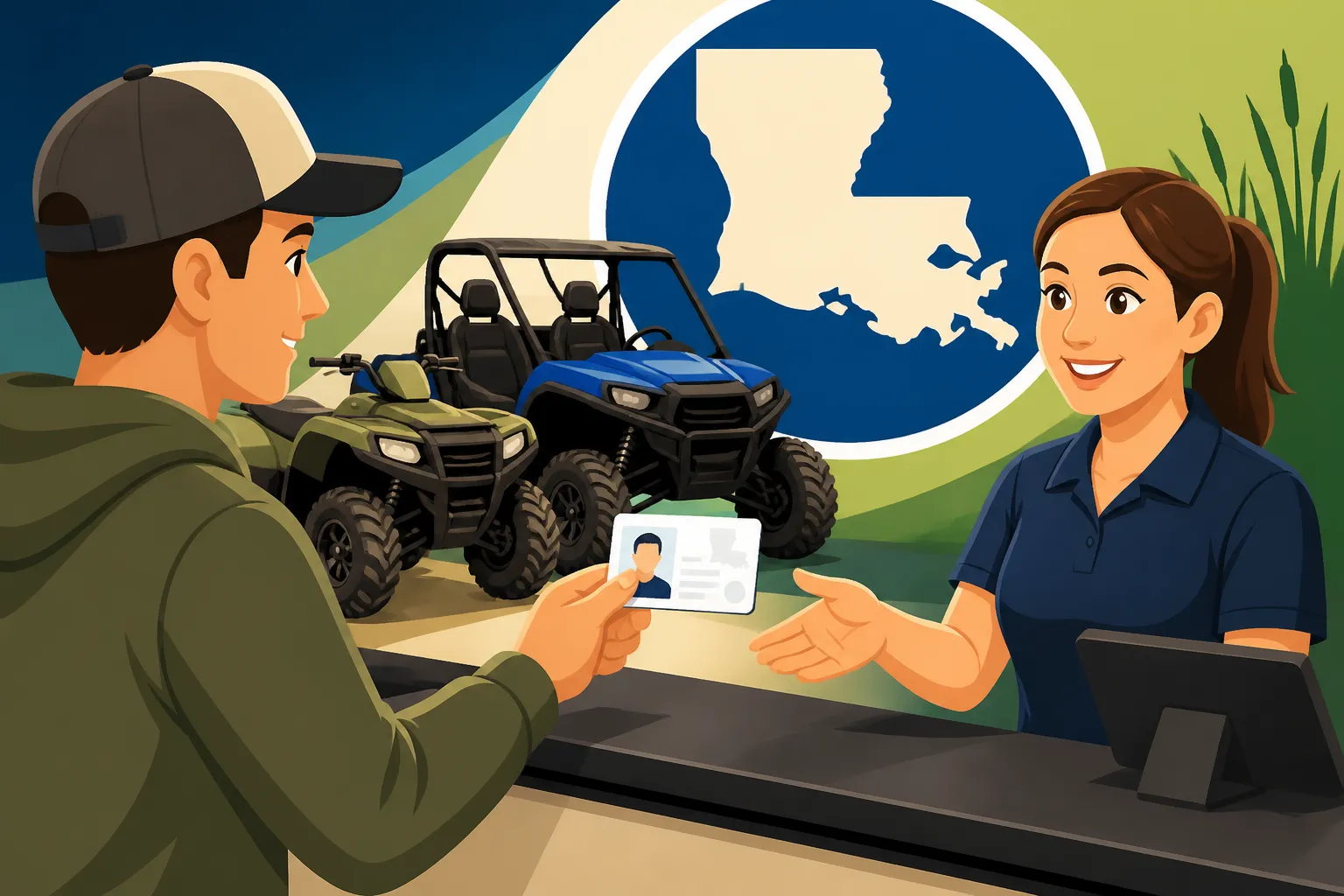
It might seem like a simple formality, but bringing the correct, current photo identification to the Louisiana OMV isn't just a suggestion—it's an absolute requirement. And for good reason! The state wants to make sure that the person standing there, requesting to title a new machine or transfer ownership of a used one, is legitimately who they say they are and has the legal right to conduct that transaction. Without it, you’re just another person with a stack of papers and no official connection to them.
The OMV's Need for Identity Verification
Think about it from the OMV's perspective. They are tasked with maintaining accurate records of every titled vehicle in the state, which is a big responsibility. Every ATV, every UTV, every dirt bike that gets a title in Louisiana becomes part of a public record. This process is ripe for fraud if proper identity checks aren't in place. Imagine if someone could just walk in with a stolen bill of sale and title a machine they don't own! By requiring robust identity verification, the OMV helps prevent stolen vehicles from being re-titled and ensures that the rightful owner is always recorded. This safeguard protects you, future buyers, and the state's integrity in vehicle ownership.
Beyond theft, identity verification also plays a crucial role in other legal matters. If there's ever a dispute over ownership, or if law enforcement needs to trace a vehicle, the OMV's records are the first place they look. Having a clear, irrefutable link between the person who completed the transaction and their legal identity is paramount. It ensures that every step of the process, from issuing new titles to updating existing ones, is conducted with the highest level of security and accountability. This is why the person processing the paperwork, even if it's for a business, must present their own valid ID.
Connecting Your Face to the Paperwork
Your photo ID acts as the physical bridge between you, the individual, and the stack of documents you're presenting. The OMV clerk needs to confirm that the name on your driver's license or state ID matches the name you've signed on the [What to Fill In on the OMV Vehicle Application], on your bill of sale, and on any other official forms. This seemingly small detail is incredibly important for legal traceability. If the names don't align, it raises immediate red flags about who actually owns the machine or who has the authority to sign it over.
This verification also extends to preventing unauthorized transactions. Someone might have access to your paperwork, but without your valid photo ID, they can't pretend to be you at the counter. This protects individuals from having their vehicles registered or titled without their consent. For example, if you're trying to get a [Louisiana Title Without a Bill of Sale], proving your identity is even more critical, as it relies heavily on your sworn statements and established identity. It's not enough to just have the forms; you have to be able to prove that you are the person legally entitled to sign and submit those forms.
Acceptable Forms of Photo ID in Louisiana
Knowing exactly what constitutes an acceptable form of identification can save you a world of trouble. While the OMV generally has straightforward guidelines, it's always good to be prepared with the most universally accepted documents. Don't assume that just any card with your picture on it will do the trick.
Primary Forms of Identification
For most transactions at the Louisiana OMV, a current, state-issued photo ID is your best bet. This includes:
- Louisiana Driver's License: This is the gold standard. It contains your photo, full legal name, current address, and signature, all in one easy-to-verify document. As long as it's not expired, this will almost always be accepted without question.
- Louisiana State Identification Card: If you don't drive, a state ID card serves the same purpose. It's issued by the OMV itself and carries all the necessary identifying information. Like a driver's license, it must be current and intact.
These primary forms are preferred because they are issued by the same state authority that handles vehicle registration and titling. They're designed to be secure and contain all the information necessary to verify your identity quickly and efficiently. When you're dealing with important documents like a new title for your ATV or UTV, especially considering that [Louisiana Titles ATVs Through the OMV], having a clear, unquestionable form of identity is key. It ensures that your [Louisiana ATV Title Cost] and other fees are applied to the correct individual's record.
Secondary and Alternative IDs
Life happens, and sometimes your primary ID might not be readily available or might be expired. In such cases, the OMV may accept other forms of government-issued identification, or a combination of documents. However, it’s crucial to understand that these often come with additional scrutiny or may not be accepted for all types of transactions.
Acceptable secondary forms of ID often include:
- U.S. Passport or Passport Card: These are federal government-issued documents and are generally accepted as proof of identity and citizenship.
- Military Identification Card: Active duty or retired military ID cards are also widely accepted due to their federal issuance and security features.
- Permanent Resident Card (Green Card): For non-citizens, this document serves as proof of identity and legal residency.
What if your Louisiana driver's license is expired or lost? You might be able to use a temporary paper license if it's accompanied by another form of ID, like your old expired driver's license or a passport. However, this is usually at the discretion of the OMV clerk, and it's far safer to have a fully valid primary ID. If you're using a document that doesn't include your current Louisiana address, you'll likely need to provide supplementary proof of residency, such as a utility bill or bank statement. Always call your local OMV office if you're in doubt about what they will accept, especially for complex situations like [Louisiana Titles for an Out-of-State Purchase] or a [Louisiana Title for a New Resident].
Here's a quick guide to common ID scenarios:
| Scenario | Primary ID (Preferred) | Secondary/Alternative ID (May be Accepted) | What to Do If You Don't Have Either |
|---|---|---|---|
| Routine Transaction | Valid Louisiana Driver's License | Valid Louisiana State ID Card | Ensure you have one of the above. |
| Expired Driver's License | N/A | Temporary Paper License + Old Expired DL/Passport | Renew your license before your OMV visit if possible. |
| Lost Driver's License | N/A | Temporary Paper License + Another Photo ID (e.g., Passport) | Apply for a duplicate license before proceeding with other transactions. |
| No Louisiana DL/State ID | U.S. Passport, Military ID, Green Card | Birth Certificate + Social Security Card + Proof of Residency | Contact OMV for specific requirements for non-standard ID situations. |
| Name Change (Marriage/Divorce) | Valid ID with New Name (or Old Name) | Marriage Certificate, Divorce Decree, Court Order | Bring legal documents proving name change in addition to your ID. |
Common Pitfalls and How to Avoid Them at the Counter
You've got your ID, you think you're ready, but sometimes tiny details can derail your OMV visit. It's often the little things that cause the biggest headaches, especially when you're trying to get your [Louisiana ORV Decals and Titles Explained]. Knowing these common pitfalls ahead of time can save you from a frustrating trip back home.
Expired or Damaged IDs
This is probably one of the most frequent reasons people get turned away from the OMV. An expired driver's license or state ID card is, simply put, not a valid form of identification for official transactions. The OMV needs to see that your identity document is current and recognized by the state. If your license expired last month, or even last week, it won't be accepted. The same goes for badly damaged IDs. If the photo is unreadable, if the card is cracked through essential information, or if security features are compromised, it's not going to pass muster.
The solution here is straightforward but often overlooked: check your ID's expiration date before you even leave your driveway. If it's expired, or about to expire, make renewing it your top priority. You can often renew your driver's license or state ID at the OMV, but sometimes it requires a separate visit or specific documentation. Don't try to sneak a damaged ID past the clerk; they're trained to spot these issues. If your ID is compromised, order a replacement. Taking the time to ensure your ID is valid and in good condition is a small step that prevents a massive waste of your time. This goes double if you're planning a trip to the OMV to address something time-sensitive like [Louisiana's 30-Day Decal Deadline].
When Your ID Doesn't Match the Paperwork
Another common issue arises when the name or address on your photo ID doesn't exactly match the name or address on your title application or other supporting documents. This can happen for a variety of reasons, like a recent marriage, divorce, or even a simple typo that's gone unnoticed. For example, if your driver's license still has your maiden name, but you're trying to title an ATV under your married name, you'll hit a roadblock. The OMV needs consistency across all official documents to maintain clear ownership records.
If you've recently changed your name, you must update your driver's license or state ID first. When you go to the OMV to do this, bring your legal documentation for the name change (like a marriage certificate or court order). Once your ID reflects your current legal name, then you can proceed with vehicle titling. Similarly, ensure the address on your ID matches the address you intend to use for your vehicle registration. If you've moved and haven't updated your ID, that needs to happen. Discrepancies create doubt and require additional verification, which often means being sent home to get the proper documentation in order. When dealing with official forms, especially those that might involve [Louisiana Notarized Bills of Sale] or a [Louisiana Itemized Dealer Invoices], consistency is king.
What to Bring Beyond Your ID for a Smooth OMV Visit
While your photo ID is undeniably crucial, it's only one piece of a larger puzzle when it comes to successfully titling and registering your ATV or UTV in Louisiana. Many people show up with just their ID and the primary ownership document, only to find out they're missing several other critical items. To ensure your [Planning an OMV Counter Visit So It Takes One Trip] actually happens, you need to be comprehensive.
The Importance of a Complete Document Packet
Think of your ID as the key that unlocks the door, but you still need all the furniture inside to make it a home. The OMV requires a collection of documents to process a title and registration correctly. These vary slightly depending on whether your machine is new or used, but preparing a complete packet is essential.
For a new machine bought from a dealer:
- Your valid photo ID.
- The original [Louisiana Requires an MSO for a New Machine] (Manufacturer's Statement of Origin). This is the initial ownership document that comes with a brand-new vehicle.
- [Louisiana Requires Proof of Sales Tax First]. This is usually an itemized dealer invoice showing sales tax was collected, or a receipt from the parish tax collector.
- The completed [What to Fill In on the OMV Vehicle Application].
For a used machine bought from a private seller:
- Your valid photo ID.
- The original, properly assigned title from the previous owner. This is your [Louisiana Requires an Assigned Title for a Used One]. Make sure the previous owner signed it correctly in the designated spots, and if there were any liens, they've been properly released.
- A [Louisiana Notarized Bills of Sale]. This helps confirm the sale price and details, especially for sales tax calculations.
- [Louisiana Requires Proof of Sales Tax First]. If the seller didn't collect it (which is common in private sales), you'll pay use tax directly to the OMV.
- The completed [What to Fill In on the OMV Vehicle Application].
Missing any of these documents, even with a perfect ID, will lead to delays. For example, without proof of sales tax, the OMV cannot issue you a title, as Louisiana law dictates that tax must be paid or verified first.
Preparing for a Smooth OMV Visit
The key to a smooth OMV experience, beyond having your perfect photo ID and all required documents, is preparation. Don't wait until you're at the counter to start thinking about these things.
Here are a few tips:
- Make Copies: Always make a set of copies of every single document you plan to bring, including your ID. While the OMV needs originals, having copies can be a lifesaver if anything gets misplaced or if you need to refer back to something.
- Fill Out Forms in Advance: Many OMV forms, like the vehicle application, are available online. Download them and fill them out clearly before you go. This saves time at the counter and reduces the chance of errors when you're feeling rushed. Remember to sign them where required, but some signatures may need to be done in front of the OMV clerk.
- Organize Your Packet: Keep your documents neatly organized, perhaps in a folder, in the order they'll likely be needed. This makes it easier for both you and the clerk.
- Check OMV Hours and Requirements: Before you head out, double-check your local OMV office's hours of operation and any specific local requirements. Some offices have particular rules or might be busier at certain times.
- Use Reliable Resources: If you're unsure about specific forms or need to draft a bill of sale, resources like LawDepot can be helpful for ensuring you have legally sound documents. They can provide templates for things like bills of sale or powers of attorney, which can give you peace of mind that your paperwork is correctly structured before you even walk into the OMV.
By being meticulously prepared, not only with your ID but with your entire document packet, you drastically increase your chances of a one-and-done visit to the OMV. This means you can get your [Louisiana ORV Decals and Titles Explained] and hit the trails much sooner.
Specific Scenarios and ID Requirements at the OMV
While most people walk into the OMV as individuals titling a personal machine, there are situations where the identity requirements become a bit more nuanced. Whether you're dealing with a business vehicle or acting on behalf of someone else, understanding these specific scenarios is crucial for a successful visit.
Titling for a Business or an Organization
Many businesses, from landscaping companies to forestry operations, rely on ATVs and UTVs for their work. When it comes time to title one of these machines under a business name, the process differs slightly from a personal title. While the title itself will be issued in the business's name, an actual human being must still be present at the OMV counter to complete the transaction. And yes, that human being needs their own valid photo ID.
In this scenario, the individual present must not only have their personal photo ID but also present documentation proving they have the authority to act on behalf of the business. This often includes:
- Articles of Incorporation or Organization: For corporations or LLCs, these documents prove the legal existence of the entity.
- Corporate Resolution or Operating Agreement: These documents should clearly state who is authorized to conduct vehicle transactions for the business.
- Power of Attorney: The business owner or an authorized officer might grant a specific individual power of attorney to handle OMV transactions.
For instance, if you're the manager of a hunting camp and titling a [Louisiana Titles for a Business Machine] under the camp's LLC, you'll need your driver's license and a document from the LLC stating you have the authority to do so. The OMV clerk needs to ensure that the person presenting the documents is legitimately representing the organization. Using a service like LawDepot to properly draft corporate resolutions or powers of attorney can be invaluable here, ensuring your business's paperwork is compliant and accepted without issue.
Handling Transactions for Others (Power of Attorney)
What if you need to title an ATV for an elderly parent who can't easily get to the OMV, or perhaps for a friend who is out of state? You can't just show up with their documents and your ID. To conduct an OMV transaction on behalf of another individual, you must have a legally binding document called a Power of Attorney (POA). This document specifically grants you the authority to perform certain legal acts on their behalf.
Here’s what you need to know:
- Your ID is Still Required: The person presenting the power of attorney at the OMV counter must still have their own valid photo ID. The clerk needs to verify your identity as the authorized agent.
- The POA Must Be Valid and Specific: The Power of Attorney document itself must be current, properly executed (often requiring notarization), and specifically grant you the authority to conduct motor vehicle transactions. A general power of attorney might not be enough; it often needs to explicitly mention vehicle titling and registration.
- Bring the Original POA: While copies are good to have, the OMV will typically want to see the original, notarized Power of Attorney document.
This is an area where precision is key. A poorly drafted or improperly notarized Power of Attorney will be rejected, and you'll be sent away empty-handed. Again, this is a perfect situation to leverage resources like LawDepot to create a robust and legally compliant Power of Attorney document, saving you potential headaches and wasted trips. Remember, the OMV's goal is to protect against fraud, and a solid POA, combined with your valid photo ID, ensures they can process the transaction securely.
Disclaimer
This article is for general informational purposes only and does not constitute professional advice. Laws, prices and regulations vary by location and change over time. Consult a qualified professional for guidance on your specific situation.