Tires for Deep Southern Mud
A machine that feels unstoppable on a dry trail can bog down fast in Louisiana gumbo, especially when sticky clay packs the tread and the tires spin smooth. Choosing tires for deep Southern mud means balancing traction, steering, flotation, and the strain on your ATV or UTV. This guide explains what to look for, how to match tires to local riding, and how to avoid common setup mistakes.
How Louisiana Mud Affects ATV and UTV Tires
Clay, standing water, and mixed terrain
“Southern mud” is not one surface. A ride near Kisatchie National Forest may include sandy stretches, pine-needle-covered paths, and wet low spots, while a private mud park can have deep, churned-up holes that hold water. In other areas, slick clay coats the tread and refuses to clear. A tire that works well in one setting may feel frustrating in another.
Clay is especially challenging because it can fill the spaces between tread lugs. Once that happens, the tire loses the edges it needs to bite into the ground. Deep water creates a different problem: the rider may not know whether there is firm ground underneath, a rut, or a hole deep enough to trap the machine. The tread needs to move mud away, but the tire also needs enough contact and control to keep the machine pointed where the rider intends.
Conditions can change during the same ride. A trail that felt manageable in the morning may be rutted and slick after several groups pass through or a shower rolls over the area. Before heading out, check access and conditions for the place you plan to ride. Louisiana Trail Conditions After Rain and Reading a Mud Hole Before You Ride Into It are useful starting points when deciding whether to ride a challenging route or turn around.
What an aggressive mud tread can and cannot do
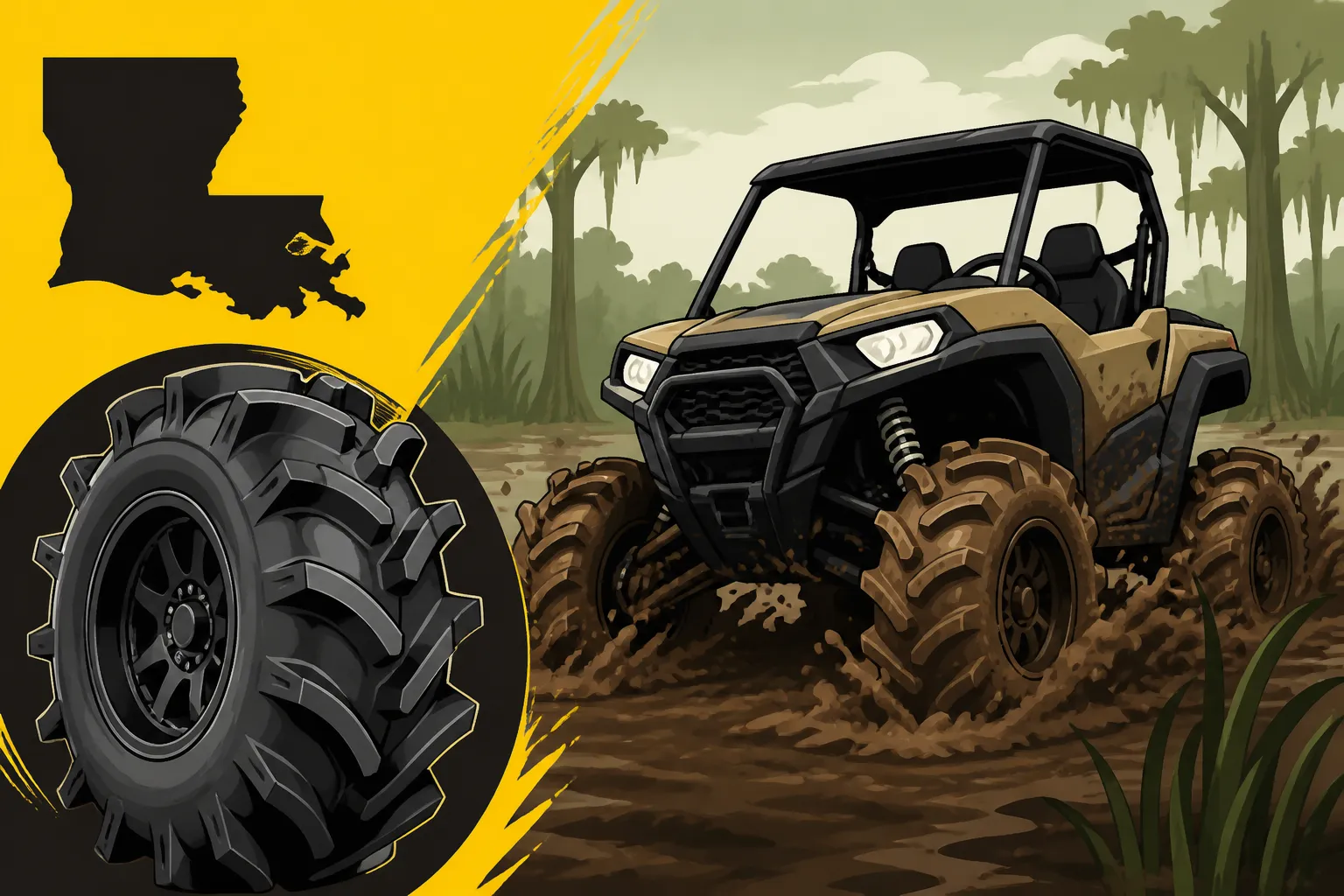
Mud tires usually have prominent, widely spaced lugs intended to dig into soft ground and clear mud as the tire rotates. That open tread design can help when a standard all-terrain pattern packs up. But aggressive tread is not an automatic answer to every Louisiana riding condition.
Large, widely spaced lugs can feel less settled on hard-packed ground, gravel, or roots. They may also make steering less predictable when the surface changes quickly from soft mud to firm ground. On a heavy machine, an aggressive tire can add strain to the drivetrain, especially if the tire is larger or heavier than the original setup. The machine may also feel slower to respond under acceleration.
Think about the ride you actually take most often. Someone who spends weekends in deep, churned mud may accept a rougher ride on firmer trails in exchange for added bite. A rider who mixes forest trails, gravel approaches, and occasional wet sections may be happier with a more versatile tread. Louisiana Trails With Deep Mud can help you consider the type of terrain you expect before settling on a tire style.
Match the tire to the machine and riding area
A tire should fit the ATV or UTV’s approved wheel size and clear the machine through its normal range of movement. “Bigger” is not necessarily better. An oversized tire can rub, affect steering, alter gearing, and place additional demands on components. If you are considering a change from the original size, check your owner’s manual and consult a qualified mechanic or tire professional about fitment.
Also consider who else rides the machine. A solo rider who is comfortable picking a line through ruts may choose differently from a family using a side-by-side on mixed trails. Passengers, cargo, and towing can change how the vehicle behaves in soft terrain. For a UTV, the added vehicle weight can make flotation and tire compatibility particularly important.
| Riding situation | Tire qualities to consider | Main trade-off |
|---|---|---|
| Deep, churned mud | Open tread with substantial lug spacing | Less composed feel on firm ground |
| Mixed forest trails and wet spots | Versatile tread with dependable steering | May not clear sticky mud as aggressively |
| Sandy or loose approaches | Predictable handling and suitable flotation | Deep-mud performance may be less specialized |
| Public land with tire restrictions | Tires that meet the land manager’s rules | May limit the most aggressive options |
| Heavy UTV or loaded machine | Correct fitment and attention to vehicle limits | Oversizing can increase mechanical strain |
Choosing Mud Tires Without Creating New Problems
Lug shape, spacing, and tread depth
When comparing tires, look beyond the word “mud” on the label. Examine how the lugs are arranged, how much open space sits between them, and whether the pattern gives the tire useful edges across its width. A very open pattern may shed sticky mud effectively, while a more closely spaced tread may feel steadier on mixed surfaces. The best balance depends on where you ride and how often the route turns firm, rocky, or sandy.
Tread depth alone does not tell the whole story. A deep lug that cannot clear packed clay may offer less useful traction than a pattern that stays open as it turns. Likewise, a tire with a dramatic tread can still struggle if the machine is too heavy for the ground, the pressure is unsuitable, or the rider enters a hole without checking its depth.
If possible, compare tires in person and ask how they behave on the type of terrain you ride—not just in idealized deep mud. Consider whether the tire is intended for an ATV or UTV and whether its load capacity suits your machine and typical cargo. The tire maker’s fitment information and the vehicle manual matter more than a general claim that a tire is “built for mud.”
Tire size, weight, and gearing
A larger tire can offer added ground clearance, but it can also change how the machine accelerates and steers. More tire mass and diameter can make the engine work harder, particularly when the machine is pushing through thick mud or carrying passengers. That extra effort can make a ride tiring and may increase wear on drivetrain components.
Before changing size, check the machine’s clearances at full steering lock and through suspension movement. Look for possible contact with fenders, suspension parts, or bodywork. Do not assume that a tire that fits while parked will clear once the suspension compresses in a rut. If the proposed tire size differs significantly from the original, ask a mechanic familiar with your machine whether other changes may be needed.
Some riders use gearing changes to compensate for larger tires or demanding terrain, but modifications should be considered as a system rather than a quick fix. Why Heavy Mud Calls for Gear Reduction explains why gearing can matter in mud, but it does not replace choosing a compatible tire or riding within the machine’s limits.
Air pressure and load
There is no single tire-pressure setting that suits every ATV, UTV, tire, load, and trail. Start with the vehicle and tire manufacturers’ guidance. Carrying passengers, tools, or hunting gear changes the load, and conditions underfoot can change during the ride. Avoid making pressure adjustments based only on what another rider runs on a different machine.
Too much pressure can reduce the tire’s footprint on soft ground, while pressure that is too low can increase the risk of tire damage or the tire coming off its bead. The right setup is a compromise between traction, stability, load support, and protection from impacts. Make changes conservatively, use an accurate gauge, and inspect the tire before heading back out.
Public-land rules may further limit your options. Louisiana Wildlife Management Areas have specific machine and tire requirements, so a tire that works well at a private mud park may not be permitted on a WMA trail. Check the regulations for the exact area before loading your machine. Louisiana WMA Tire Rules Explained covers why tire size, tread, and pressure restrictions deserve attention.
Riding Deep Mud With Better Control
Read the route before committing
A capable tire cannot tell you how deep a mud hole is or what lies underneath the surface. Before entering, look for the edges, existing ruts, water movement, and a safe way to turn around. If other riders are nearby, ask about conditions rather than assuming the deepest-looking line is the best one. A firm-looking crust can hide soft ground, and a route that appears shallow from the seat may be deeper than it seems.
Use maps to plan where you are going and confirm that the route is appropriate for your vehicle. onX Offroad can help riders review mapped routes and land information, but a map does not guarantee that a trail is open, passable, or legal for every machine. Check the land manager’s current notices and posted signs, and respect private property boundaries. A mapped line is a planning aid, not permission to ride.
If you cannot see a clear exit, or if the hole is beyond your machine’s ability, turning around is a sound decision. Riders sometimes feel pressure to follow a group into a difficult section, but the cost of a stuck machine, damaged equipment, or an injury can outweigh the thrill of making it through. Louisiana Trail Closures After a Storm offers additional context for deciding when recent weather may have made a route unsuitable.
Keep momentum controlled
In mud, the goal is controlled, steady movement—not a burst of speed that sends the machine into a hidden rut. Sudden throttle can make the tires spin, dig deeper, and leave the vehicle resting on its frame. On the other hand, stopping in a soft section can make it difficult to regain movement. Choose a sensible line, keep a consistent pace, and adjust smoothly when the ground changes.
Steering inputs matter, too. A machine can drift when the front tires lose grip, particularly in slick clay. Keep enough room from other riders to avoid a collision if someone slows or gets stuck. On a UTV, passengers should stay seated and use the available restraints. Avoid leaning or reaching outside the vehicle to push while the tires are turning.
If the machine begins to bog down, ease off rather than repeatedly spinning the tires. Reassess whether there is a safer line, firmer ground, or a practical way to reverse. A winch can help in some recovery situations, but it needs to be used correctly and attached to a suitable anchor point. Winches for a Buried Machine covers recovery considerations to think through before the machine is stuck.
Know when a trail tire is the wrong tool
A private mud park and a public forest trail may call for different tires and different expectations. A tire chosen for aggressive mud riding might be less suitable for narrow, firm trails shared with hikers or horseback riders. It can also leave deeper marks on soft ground. Follow posted rules and ride in a way that avoids unnecessary trail damage.
For forest routes, review local requirements and check whether machines are permitted on the specific trail. onX Offroad can help with route planning, but riders should still confirm access with the relevant land manager before unloading. If a trail is closed, marked for another use, or visibly vulnerable after rain, choose another route.
If your riding is split between public land and private parks, you may need to prioritize the stricter setting when selecting tires. That can mean giving up some deep-mud performance to stay within public-land rules and keep the machine manageable on ordinary trails. The practical choice is the tire that fits your machine, your riding area, and the conditions you can responsibly handle—not simply the tire with the most dramatic tread.
Tire Care Before and After a Mud Ride
Inspect for damage and trapped debris
Before each ride, look for cuts, punctures, missing tread chunks, bulges, and objects caught between the lugs. Check the valve stems and make sure each tire is holding pressure according to the vehicle and tire guidance. A slow leak may be easy to miss in the driveway but become a serious problem once you are far from the trailhead.
After riding, inspect the tires again. Mud can hide damage, and sticks or wire can become lodged in the tread. Remove debris carefully and look for signs that a tire has shifted on the wheel or rubbed against the machine. If you find damage you cannot assess confidently, have it checked before the next outing.
Mud can also cover nearby components and limit cooling. Keep the radiator and surrounding areas clear according to the owner’s manual, especially after riding through sticky clay or tall vegetation. Radiator Screens for Mud explains one issue riders consider when trying to keep cooling systems protected without neglecting cleaning and inspection.
Clean the machine and tires thoroughly
Rinse mud off after the ride, paying attention to the tires, wheel wells, suspension, brakes, and places where packed debris can hold moisture. Avoid directing high-pressure water at seals, electrical connections, bearings, or other sensitive areas. Follow the manufacturer’s cleaning recommendations, and take extra care if the machine has been through deep water.
Once the mud is off, check again for damage that was hidden underneath. Look at the tread, wheel area, and accessible suspension components. Let the machine dry before storage when practical, and follow the owner’s guidance for maintenance after water exposure. Thorough cleaning is not just cosmetic; it makes it easier to spot problems before the next ride. Washing a Machine After a Mud Weekend offers more on post-ride cleanup.
Plan the next ride around conditions
The best tire choice still depends on the route, weather, machine, and rider. Check trail notices before traveling, pack recovery and repair essentials, and avoid assuming that last weekend’s route will be in the same condition today. onX Offroad may help you organize route plans, but confirm current closures and access with the land manager, especially after heavy rain.
For riders who alternate between Kisatchie trails and private mud parks, keep notes about how the tires perform in different conditions. Record what felt stable, where the tread packed up, whether steering became difficult, and how the machine handled loaded. Those observations are more useful than choosing tires based on appearance alone.
Deep mud is part of the appeal of Louisiana riding, but tires are only one part of a safe setup. A properly fitted tire, a suitable route, a careful line choice, and the willingness to turn back when conditions exceed your comfort level all matter. Choosing for the terrain you truly ride can make the day more enjoyable—and help keep your machine ready for the next one.
Disclaimer
This article is for general informational purposes only and does not constitute professional advice. Laws, prices and regulations vary by location and change over time. Consult a qualified professional for guidance on your specific situation.