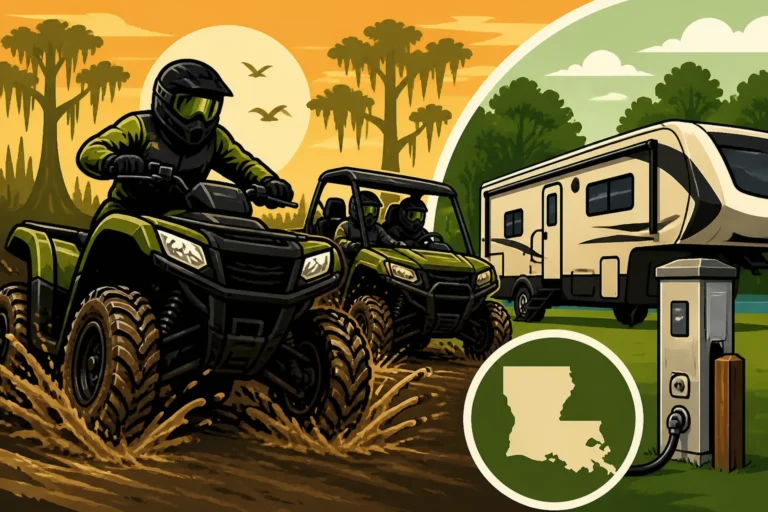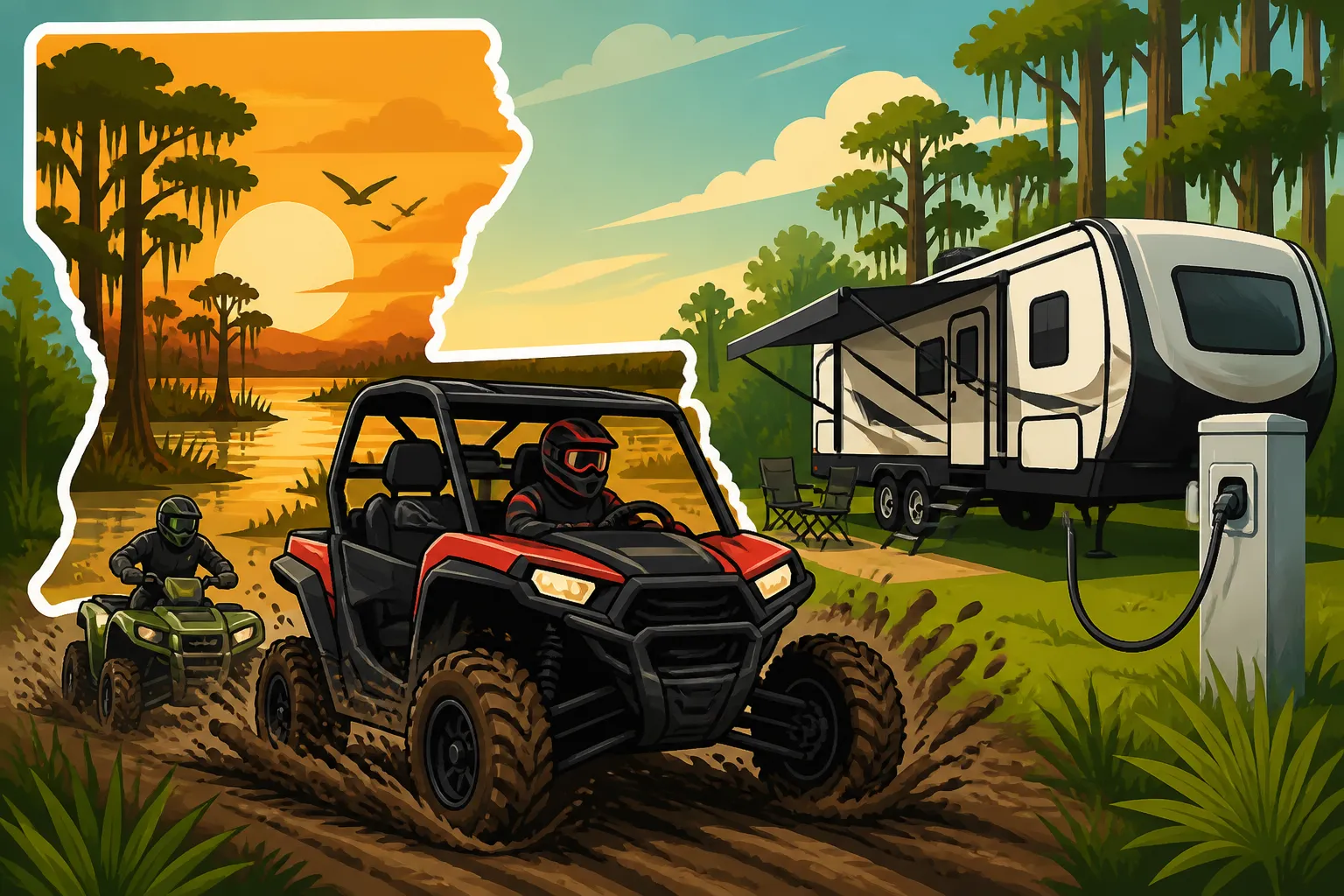
Louisiana Riding Areas With RV Hookups
Finding a Louisiana riding area with RV hookups can be harder than finding a place to ride: a campground may be nearby without being on the property, and “RV site” does not always mean full hookups. This guide explains how to compare trail access, campsite services, event schedules, and seasonal conditions before you tow your ATV or UTV to a Louisiana riding destination.
How to choose a Louisiana riding area with RV hookups
Confirm what “RV hookups” actually includes
Before booking, ask the park or campground to spell out what each site provides. “Hookups” might mean electrical service only, while another site could include water and sewer connections. If your RV depends on a particular electrical connection, confirm that detail rather than assuming every site has the same setup.
Also ask whether the site is a pull-through or back-in, how much room there is for your RV and tow vehicle, and whether you can park a trailer beside the campsite. A long fifth wheel and an ATV trailer can need considerably more space than a motorhome alone. If your group is arriving in multiple vehicles, find out whether additional parking is available and whether it is close to your site.
A useful planning question is whether the campsite is inside the riding property or at a separate campground nearby. Staying on the property can make it easier to get from camp to the riding area, but facilities and access rules still vary. An off-site campground might offer the services you need while requiring you to trailer your machine to the trailhead each day.
Check trail access and campground access separately
A reservation at an RV campground does not automatically authorize ATV or UTV riding on the surrounding land. Ask which trails are open to the machine you plan to bring, whether you can ride directly from camp, and whether you need a separate riding pass or permit. Some public-land areas have specific access rules, designated routes, or seasonal closures. Private parks may set their own requirements for age, helmets, passengers, noise, and riding hours.
For public-land options, start with a destination’s official trail and campground information rather than relying on a map pin or an old social post. The guide to [Louisiana OHV Camping With Trail Access] can help you think through the difference between camping near a riding area and having authorized access from the campsite. Likewise, [Louisiana Trails With Camping] is useful when you are comparing destinations where overnight stays and riding are part of the same trip.
A mapping app such as onX Offroad can help you orient yourself and plan the drive between a campground and a trailhead. Treat mapping tools as a planning aid, not permission to ride: confirm routes, closures, and land-access rules with the park or managing agency. That distinction matters in Louisiana, where public access may depend on designated trails, land boundaries, and current conditions.
Compare the practical fit for your RV and riding group
The best campsite is not always the one closest to the trail. If you are travelling with children, older family members, or friends who are not riding, look at the comfort and layout of the campground as well as the trail system. Ask about restrooms, showers, water availability, shade, quiet hours, and whether the area is suitable for your RV’s size.
For a weekend ride, make a simple comparison before booking:
| What to check | Why it matters | Question to ask |
|---|---|---|
| Hookup type | Electrical service alone may not meet your needs | Does this site have power, water, sewer, or only some of these? |
| Site layout | Your RV, truck, and machine trailer need room | Is the site pull-through or back-in, and how much parking is included? |
| Riding access | A campground may be separate from the trail property | Can we ride from camp, or must we trailer to the entrance? |
| Machine rules | Parks may set different limits for ATVs and UTVs | Are our machine type, size, passengers, and riders allowed? |
| Dates and hours | Some venues operate around events or seasonal schedules | What dates and riding hours are confirmed for our visit? |
| Weather policy | Rain can affect trails, roads, and event plans | Where will closures or schedule changes be posted? |
If your group is still narrowing down places, [Louisiana Riding Areas With RV Hookups] is a natural starting point for comparing destinations. Then use the specific park’s own booking and riding information to confirm what is available for your dates.
Muddy Bottoms and other options to investigate
Muddy Bottoms is a clear place to start your search
Muddy Bottoms near Sarepta is a prominent Louisiana mud-riding destination to investigate when you want to combine RV camping with a ride. Its RV options and event-weekend setup are described in [Muddy Bottoms' RV Sites in Louisiana] and [The 150 RV Hookups at Muddy Bottoms]. Those details make it especially relevant for riders who prefer to camp close to a private riding venue rather than arrange a separate campground and daily trail shuttle.
Still, do not assume every RV site has the same service or that every date offers the same experience. Contact the venue before you plan around a particular hookup, site layout, or riding schedule. Ask whether your chosen site is available for the exact dates you have in mind, what utilities are included, and whether access to riding is covered separately from camping.
Muddy Bottoms is also associated with event weekends, so your trip may depend on the event calendar rather than a simple daily opening schedule. Verify the dates, admission arrangements, campsite reservation process, and any machine rules together. The [Muddy Bottoms' Event Calendar in Louisiana] can help frame the questions to ask, but confirm the details directly before you hitch up the trailer.
Consider the event-weekend tradeoffs
An event weekend can be a fun choice if your group wants a lively atmosphere, organized activities, or a larger gathering of riders. It can also mean more traffic, more people sharing facilities, and less flexibility if you prefer a quiet campsite. Think about your group’s priorities: a family that wants a calm first ride may value a less crowded time, while a group of friends may enjoy the energy of an event.
Ask how early you can arrive, where you unload, whether there are restrictions on riding after dark, and how campground quiet hours work. Also check whether your RV site reservation includes any event access or if those arrangements are handled separately. Those are easy details to overlook when you are focused on securing a campsite, and they can affect both your budget and your schedule.
If you are travelling with a large group, agree on a meeting point and campsite plan before arrival. Cell service can be uneven in rural areas, and a busy event can make it harder to find each other after unloading. A shared map from onX Offroad may help your group coordinate routes and nearby landmarks, but keep the venue’s posted map and directions as the authority for where riding is allowed.
Look beyond the campground name
Some Louisiana riding destinations have camping nearby without offering RV hookups directly at the trail property. That can still work well, but it changes the logistics: you may need to tow your machines to the trailhead, confirm overnight trailer parking, and allow extra time for loading and unloading. Ask the campground whether it permits ATV or UTV trailers and whether the road to the riding area is practical for your RV.
For public forest or wildlife-management-area riding, facilities and access conditions can differ from a private mud park. A campground may provide an RV site while the riding area has separate rules, passes, designated routes, or closures. Review [Louisiana Trail Closures and Seasons] and [Checking a Trail Status Page First] as part of your planning, especially if your trip depends on a particular trail being open.
Do not use a nearby road, field, or timber track as a shortcut unless you have confirmed it is legal and open to your machine. A route visible on a map is not proof of public access. onX Offroad can be useful for organizing your trip, but pair it with official trail information and landowner or park guidance whenever access is uncertain.
Plan the trip around your machine, season, and campsite
Make sure the area allows your ATV or UTV
Not every riding destination allows every type of off-road machine. A trail that welcomes ATVs may have different rules for side-by-sides, and a trail network may impose limits on vehicle size or access. Check the rules for your exact machine rather than relying on a friend’s experience with a different model.
This is particularly important if you ride a wide UTV, bring a passenger, or plan to tow a small trailer. Ask about vehicle dimensions, passenger requirements, age limits, helmets, sound restrictions, and permitted riding hours. For a broader comparison, [Louisiana Trails That Allow Side-by-Sides] can help you identify the kinds of trail-specific questions to verify before setting out.
Bring proof of ownership and any required permits or passes, and keep the park’s rules accessible at camp. If your trip includes riding on public land, requirements may differ from those at a private venue. A campsite reservation does not replace a trail-use permit, decal, or other paperwork that applies to your machine.
Match the season to the trail conditions
Louisiana weather can turn a weekend plan into a very different outing. Heavy rain may make some trails muddy, flood low areas, or lead to temporary closures. Hot, humid weather brings its own challenges, particularly when you are riding for long stretches and returning to an RV that has been sitting in the sun.
Before you leave, check the riding area’s official status and the forecast for both your route and destination. Confirm whether rain changes operating hours or campsite access, and ask how closure announcements are shared. The guide to [Louisiana Trail Conditions After Rain] is a helpful reminder to treat recent weather as part of your route planning, not an afterthought.
Pack for conditions that can change during the day: drinking water, basic first-aid supplies, spare clothes, insect protection, and a way to clean muddy equipment before it enters the RV. If your campsite has limited water or no wash station, plan how you will manage muddy boots, gloves, and gear. A small ground mat and a sealed storage bin can keep the living area more comfortable after a wet ride.
Book and prepare in a practical order
A little sequence can prevent a frustrating arrival. First, choose the riding area and confirm that it is open for your dates. Next, verify that your machine is permitted and determine what riding passes or documents are required. Then reserve an RV site that fits your vehicle and trailer, confirming the hookups and parking arrangement in writing.
Before departure, save directions and reservation details somewhere you can access without a strong signal. Check the route for low-clearance roads, tight turns, or unpaved approaches that could be uncomfortable for a large RV. Use onX Offroad or another mapping tool to organize your riding plans, but download or save any useful information ahead of time and follow the venue’s official directions once you arrive.
Finally, make a short call or check the venue’s official updates close to departure. Confirm that the campground, riding area, and any facilities you are counting on are operating as expected. If your plan depends on an event weekend, a specific trail, or a particular type of hookup, verify each of those details separately.
What to confirm before you reserve
Use a short booking checklist
When you call or message a campground or riding park, keep the questions concrete. “Do you have RV sites?” is not enough to know whether the site will work for your rig. Ask what utilities are connected at the site, what kind of space is available, and whether the machine trailer can stay beside the RV.
Then confirm the riding side of the trip: Is your machine allowed? Are the trails open on your dates? Can you ride from the campground, or do you need to trailer to a separate entrance? Are passes, waivers, or additional reservations required? These questions help uncover the difference between a convenient riding-and-camping destination and a campground that simply happens to be in the same region.
Keep the answers with your reservation confirmation. If there is a mismatch—such as a site that cannot accommodate your trailer, a hookup that lacks the service you need, or a trail schedule that does not fit your arrival—resolve it before travelling. A quick confirmation at home is much easier than trying to rework the plan after towing across the state.
Have a backup plan for weather and availability
Popular weekends can fill, and rain can change trail access. Identify a backup campground or be prepared to shift your travel dates if your first choice cannot accommodate your RV. If you are travelling with friends, agree in advance on how the group will handle a closure or a last-minute site change.
For a trip built around a private mud park, check the event schedule and campground availability together. For public-land riding, confirm the rules and trail status with the appropriate managing agency. Keep a second option in mind that suits your machine and your RV, rather than assuming another nearby trail will allow the same riding.
The most comfortable Louisiana riding trip is the one where camping and trail access are confirmed as separate parts of the plan. Verify the hookups, parking, machine rules, dates, and current trail status before you tow, and you can spend less time troubleshooting at the gate and more time enjoying the ride.
Disclaimer
This article is for general informational purposes only and does not constitute professional advice. Laws, prices and regulations vary by location and change over time. Consult a qualified professional for guidance on your specific situation.