What to Do in a Parish With No Designated Road
A parish with no designated ATV or UTV roads can leave you wondering whether a short trip to a trailhead or a neighbor’s property is allowed. The practical answer is usually no for riding along public roads: without the required local designation and signs, that route is not open to ordinary off-road riding. Here’s how to check, what narrow exceptions may apply, and how to plan another way.
What no designated road means in Louisiana
A parish road is not automatically open to off-road machines
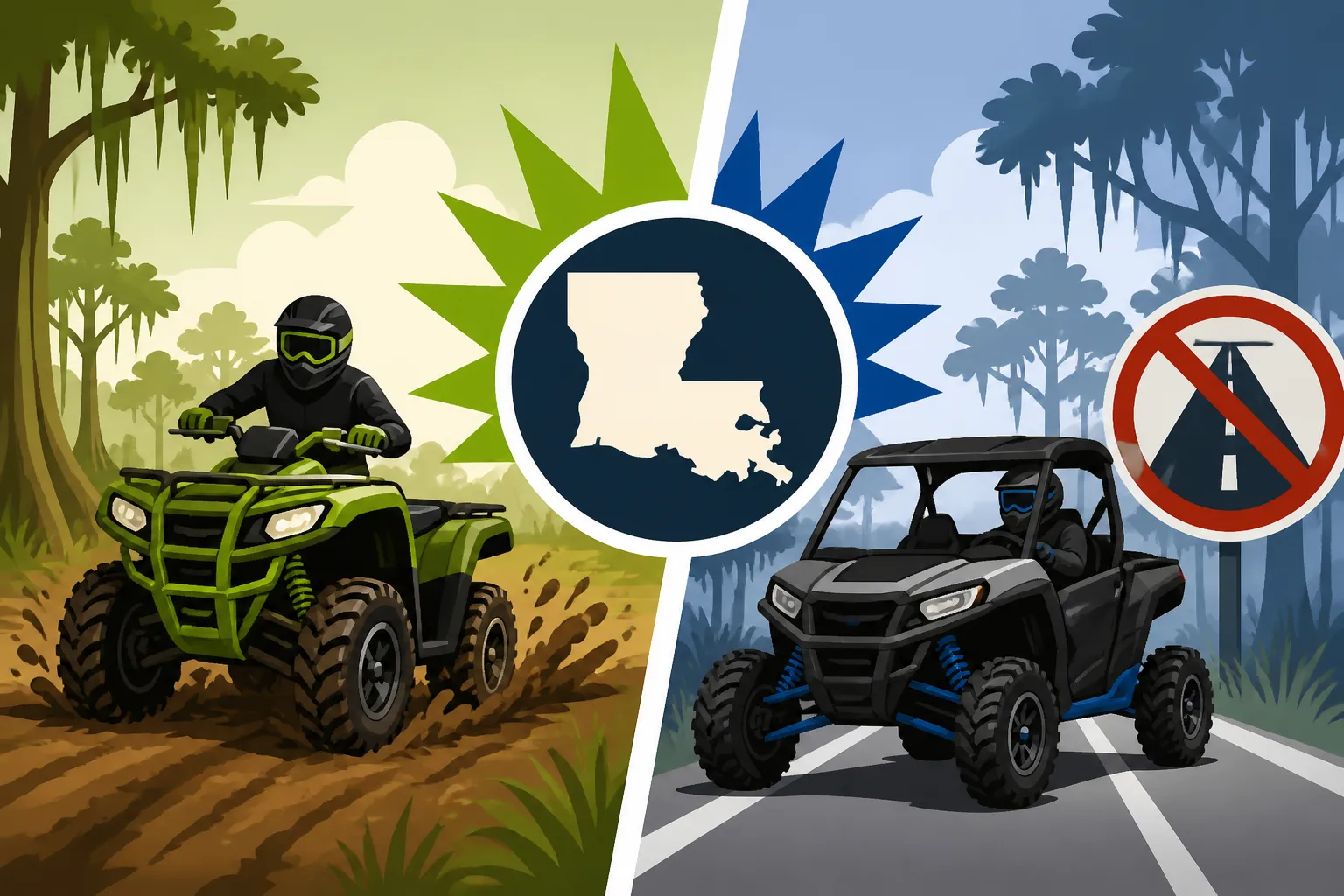
Louisiana has a specific process for allowing certain off-road vehicles on certain public roads. A parish must take the required action to designate a road, and the road must be properly signed. If your parish has not designated a route, you should not assume that an empty country road, gravel road, or road with little traffic is legal to ride.
That can be frustrating when a machine is used for hunting, property maintenance, or a nearby ride. But a road’s quiet appearance does not make it private, and a rider’s permission to use nearby land does not automatically grant permission to travel along the public road that leads there. The safest working assumption is that ordinary road travel is not allowed unless you confirm an applicable legal exception.
This distinction matters for UTVs and ATVs alike, but the rules are not identical. Louisiana’s designated-road provisions for UTVs have their own conditions; ATV operation on public roads is generally much more restricted. For an overview of the distinction, see [Can You Ride an ATV on the Road in Louisiana?](Can You Ride an ATV on the Road in Louisiana?) and [Louisiana UTV Street Legal Rules by Parish](Louisiana UTV Street Legal Rules by Parish).
Local designation and signs are the important checks
Do not rely only on a neighbor’s recollection, an online map, or the fact that you have seen other machines on the road. Ask whether the specific road has been designated for the type of machine you plan to ride, and whether the required signs are posted. A route may be authorized in one part of a parish but not another, and a road’s status may differ if it enters a town or connects with a state highway.
Start with the parish governing authority, often the police jury or parish council. Ask about the exact road name and limits, not just whether the parish “allows UTVs.” You can also ask the sheriff’s office or local law enforcement where riders should direct questions. A designated-road rule is not a blanket permission for every road in the parish. For more on the local process, see [Louisiana Parishes Must Designate and Sign Roads](Louisiana Parishes Must Designate and Sign Roads).
| Situation | Practical approach |
|---|---|
| No parish designation or required signs | Do not ride along the public road |
| A road is signed for UTV use | Confirm the machine and rider meet all other legal conditions |
| The road enters a municipality | Check whether separate municipal rules apply |
| The route includes a state highway | Confirm rules and jurisdiction before planning to use it |
| You need to cross a public road | Treat crossing as a narrow exception, not permission to travel along it |
| You are using a farm-related exception | Check the specific limits and required documentation |
What to do before taking your machine onto a road
Ask the right office the right question
When you contact the parish, give the official the road name, nearby intersection, and the direction or stretch you are asking about. Ask whether that exact road is formally designated for UTV operation and whether the required signs are installed. If the answer is unclear, ask which department keeps the designation records or which parish meeting or ordinance you should review.
If you are near a town boundary, contact the municipal government as well. A road that looks like a parish road may pass into a municipality, where separate rules could apply. For a town-specific check, [Louisiana Municipal Ordinance Lookups](Louisiana Municipal Ordinance Lookups) can help you understand what to verify. For the parish side, use [Louisiana Parish Ordinance Lookups](Louisiana Parish Ordinance Lookups).
It also helps to ask whether the route is open to your vehicle category. “Off-road vehicle” can be used loosely in conversation, while the law may distinguish between an ATV and a UTV. Be precise about what you have, and ask whether the answer applies to that machine rather than assuming a UTV rule also covers an ATV.
Confirm every condition, not just the road’s status
Even where a UTV road has been designated, road access does not mean the machine is automatically street legal in every other respect. Louisiana’s UTV road-use rules include conditions relating to the driver, the vehicle, insurance, and the route. Check what applies before you ride; a decal or title alone should not be treated as public-road authorization.
For example, Louisiana’s UTV road-use rules include a minimum driver age and licensing requirements. Insurance and vehicle-related requirements can also apply. Confirm the full list with an official source before relying on a designated road, and do not treat one condition—such as having a driver’s license—as a substitute for the others. The overview at [Louisiana Traffic Law Still Applies](Louisiana Traffic Law Still Applies) is useful context: road use does not remove ordinary traffic responsibilities.
Keep a record of what you learn. Note the road name, the office or official you spoke with, and any ordinance or designation information they provide. If the route is important to your regular plans, ask how to verify that signs remain in place and whether a change in road status would be announced.
Narrow exceptions are not a substitute for a designated route
A road crossing is different from riding along the road
A limited crossing may be treated differently from traveling down a road. That does not mean you can ride along the shoulder for a convenient distance, use the road to connect two properties, or continue to the next trail entrance. A crossing is just that: a crossing, subject to the conditions that apply to your machine and location.
If your route requires crossing a public road, stop and confirm the rules for the crossing itself. Consider visibility, traffic speed, road layout, and whether you have a safe place to enter and leave the roadway. Never assume that a legal crossing makes the rest of the road available. See [Louisiana Rules for Crossing a Highway](Louisiana Rules for Crossing a Highway) for the specific distinction.
A rider may be tempted to say, “I’m only going a little way.” That short distance can still be road travel rather than a crossing. If the machine is moving along the road to reach a destination, do not treat the trip as an incidental crossing. When in doubt, choose a route that keeps the machine off public roads or get a clear answer from the appropriate authority before riding.
Farm-use rules are limited and fact-specific
Louisiana has a narrow farm-related exception for certain ATV use on a road shoulder. It is not a general-purpose way to ride to a store, a friend’s house, or a recreational trail, and it should not be confused with a parish designation for UTV road use. A machine’s presence on a farm does not automatically make every trip farm-related.
The details matter: the purpose of the trip, the location, the type of road, and any required affidavit or other conditions can affect whether an exception applies. A farm machine used for an unrelated recreational outing may not qualify simply because it is usually used for work. Start with [Louisiana's Shoulder-Only Farm Exception](Louisiana's Shoulder-Only Farm Exception) and [The Exemption That Only Covers Farm Use](The Exemption That Only Covers Farm Use), then confirm the requirements that fit your circumstances.
If you are relying on a farm exception, do not improvise the paperwork or assume that a verbal explanation at a roadside stop will settle the question. Find out what documentation is required, carry it as directed, and make sure the trip itself fits the exception. If the use is mixed—partly farm work and partly convenience or recreation—get a clear answer before treating the road as available.
Safer alternatives when no road is designated
Keep the trip on private land or use a trailer
When there is no designated route, the simplest alternative is to avoid riding on public roads. If you have permission to use private property, plan a route that stays on that property and does not require travel along a parish road to connect separate areas. Permission to ride on one parcel does not grant access across someone else’s land or along a public right-of-way.
For a public riding area, trailhead, or mud park, hauling the machine on a trailer can be less convenient than riding directly there, but it avoids relying on a road route that may not be legal. Before leaving home, check the riding area’s access rules, parking arrangements, and whether the route to its entrance includes any road segments you were planning to ride. A destination being open to off-road machines does not itself authorize road travel on the way there.
If you regularly ride with friends, agree on a meeting point that does not require anyone to take an unapproved road route. A little planning can prevent a group from splitting up or making a risky decision at the last minute because the legal access route turns out to be unclear.
Prepare for the route you can legally ride
A change of plan can mean more time on a trailer, more gear to pack, or a different riding area. Prepare for those practical details rather than trying to make an uncertain road route work. Check that your machine is secured for transport, carry the paperwork relevant to your destination, and plan fuel, water, and recovery equipment around the ride you will actually take.
Recovery gear is especially useful on private trails and in muddy terrain, but it should be selected for the machine and conditions. Some owners compare equipment from brands such as SuperATV when thinking through recovery or protection needs. A winch, for instance, is only useful if it is suitable for the machine and installed and used safely; it does not make an otherwise prohibited road route legal.
Likewise, lighting or other accessories can help with visibility during lawful off-road use, but they do not turn an ATV or UTV into a street-legal vehicle. SuperATV is one brand riders may encounter while researching off-road accessories, but the key question is whether the equipment fits the machine and the riding conditions—not whether an accessory changes the road-use rules. If you expect to travel between private parcels, consider asking the landowners about a private access route instead of treating a public road as the connector.
If you see other riders, do not treat that as approval
It is easy to assume that a route must be legal if local riders use it regularly. They may have permission, be covered by a particular exception, be riding on private land, or simply be taking a chance. The presence of other machines does not establish that a road has been designated or that your own vehicle and trip meet the applicable rules.
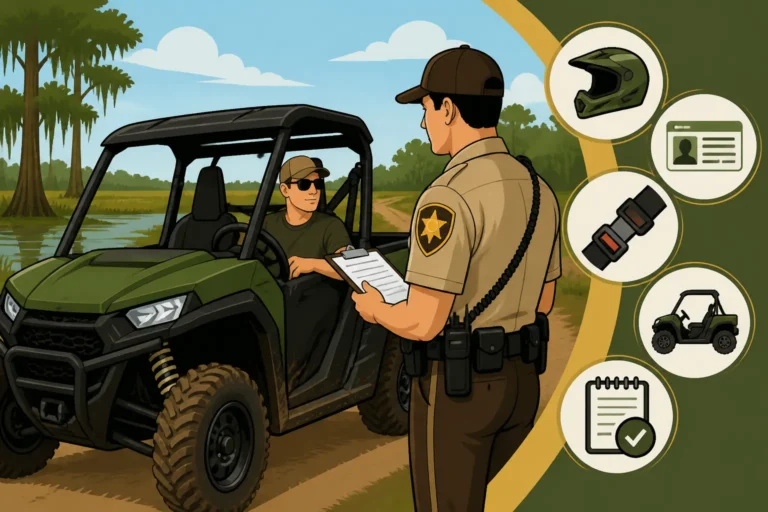
If an officer asks about your route, stay calm and be prepared to explain where you are going and what you understood about the road’s status. Carry relevant ownership and compliance documents as appropriate, but remember that having paperwork for the machine does not necessarily authorize road use. For a practical look at a rural roadside interaction, see [What a Deputy Checks at a Rural Traffic Stop](What a Deputy Checks at a Rural Traffic Stop).
If you are considering asking the parish to designate a route, contact the governing authority and ask about its public process. Do not assume one rider’s request will immediately open a road. The parish may need to review safety, traffic, signage, road ownership, and other local considerations. Until the route is formally approved and properly marked, make riding plans that keep your machine off that public road.
Disclaimer
This article is for general informational purposes only and does not constitute professional advice. Laws, prices and regulations vary by location and change over time. Consult a qualified professional for guidance on your specific situation.