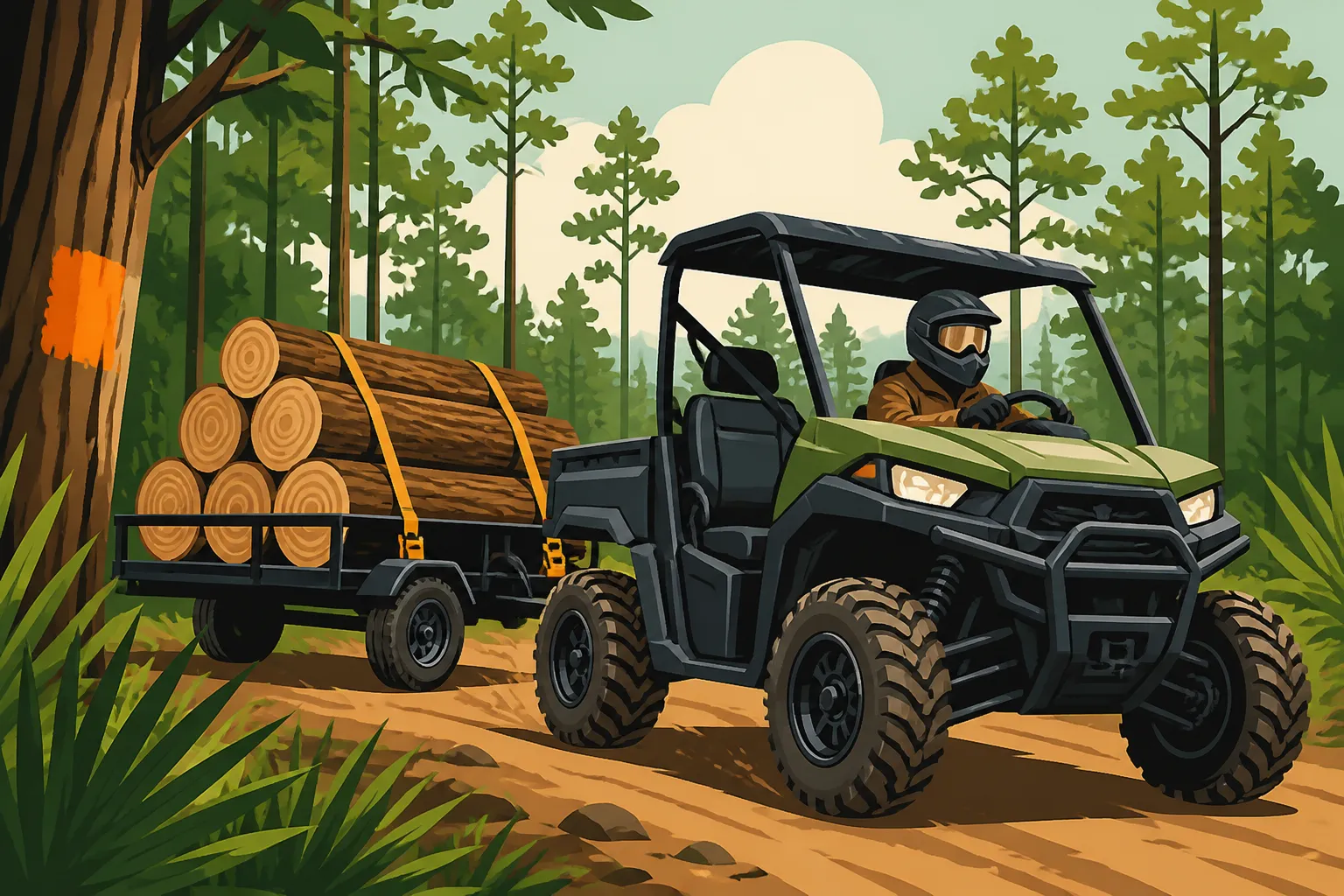
Towing a Load Across Private Timber Ground
There's nothing quite like the satisfaction of a day spent out on private timber ground, whether you're working, hunting, or just maintaining your camp. But when it comes to hauling equipment, timber, or even a trophy buck through that rugged landscape, many of us hit a wall, wondering how to move serious weight safely and efficiently with our ATVs and UTVs. This guide is here to break down the ins and outs of towing a load across those challenging Louisiana timber trails, ensuring you can get the job done without getting stuck or damaging your machine.
Navigating Private Timber Ground: Permission and Respect
Before you even think about firing up your machine, the absolute first step when dealing with private timber ground is securing proper permission. This might seem obvious, but it’s a point that gets overlooked more often than you’d think, leading to awkward situations or worse. Landowners, especially those managing timber, are very particular about who is on their property and what they’re doing there.
Getting Written Permission From the Landowner
Verbal permission might be okay for a quick casual ride, but when you're talking about bringing in trailers, heavy loads, and potentially impacting the ground, you need something more formal. Always, always, always get written permission. This protects both you and the landowner. It should clearly state what you're allowed to do, where you can ride, what type of equipment you can use, and for what duration. This document becomes your lifeline if any questions arise while you're on the property.
Imagine you're trying to haul a new stand deep into a timber plot. Without written permission, if a hunting club member or even a timber company representative comes across you, you could be facing a trespass charge, even if you truly believed you had the owner's blessing. A simple signed letter detailing your agreement can prevent a huge headache. It's not about distrust; it's about clarity and mutual protection, especially when significant activity like towing is involved. You can learn more about securing your access in [Getting Written Permission From a Louisiana Landowner].
Understanding Landowner Rules and Potential Restrictions
Once you have permission, it’s crucial to understand any specific rules the landowner or timber company has in place. These aren't just suggestions; they are often based on property management, safety concerns, or even insurance requirements. They might dictate specific times you can access the land, restrict certain areas, or even limit the weight you can haul to prevent excessive rutting, especially in wet conditions.
For instance, some timberland owners might have active logging operations, and your presence, especially with heavy loads, could interfere or create a safety hazard. They might also have rules regarding how close you can get to certain water bodies or young tree plantations. Always ask about these restrictions upfront and respect them without question. Ignoring these rules can lead to your permission being revoked, not just for you, but potentially for an entire group or club, making future access impossible.
Minimizing Your Impact on the Land
When you're towing heavy loads, especially across soft or wet timber ground, your machine can leave a significant impact. It’s your responsibility to minimize this as much as possible. This means thinking about your route, slowing down, and even postponing a haul if the ground is too saturated. Deep ruts caused by heavy loads can damage young trees, create erosion issues, and make the trail impassable for others.
Consider the time of year and recent weather. After a heavy rain, that path that was just a damp trail last week might now be a bottomless mud pit. Hauling a loaded trailer through that will create massive ruts and potentially get you stuck, requiring even more effort (and damage) to extract your machine. Being mindful of your tires, especially if you have aggressive mud tires, and choosing lighter loads or alternative routes during sensitive times can make a big difference in maintaining good relations with the landowner and preserving the land for future use.
Gearing Up Your ATV or UTV for Heavy Hauling
Towing a substantial load across private timber ground isn't just about having an ATV or UTV; it's about having the right ATV or UTV, properly equipped for the task. Your machine's capabilities and its accessories will play a huge role in how safely and effectively you can move your cargo.
Assessing Your Machine's Towing Capacity
Every ATV and UTV has a specified towing capacity, usually listed in your owner's manual. This number is not just a suggestion; it's a critical safety limit. Exceeding it puts undue stress on your engine, transmission, brakes, and frame, and can lead to dangerous situations, loss of control, and costly mechanical failures. Don’t just guess; know your machine's limits before you hook up a trailer.
For example, a sport quad designed for high-speed trail riding might have a very low towing capacity, perhaps only a few hundred pounds. A utility ATV or a robust side-by-side, on the other hand, might be rated to tow upwards of 1,000 to 2,000 pounds or more. Trying to pull a substantial log or a fully loaded utility trailer with a machine not designed for it is a recipe for disaster. Always factor in the weight of your trailer plus the weight of your cargo when calculating your total load.
Essential Towing Accessories and Upgrades
To safely and effectively tow on private timber land, you'll need more than just a ball hitch. Consider these key accessories and potential upgrades:
- Heavy-Duty Hitch: While most ATVs and UTVs come with a receiver hitch, ensure it's rated for your expected load. Sometimes, a stronger, aftermarket hitch can offer more peace of mind.
- Winch: A winch is invaluable. Not only can it help you recover your machine if you get stuck, but it can also assist in pulling logs or other heavy items out of difficult spots before loading them onto a trailer. A quality winch, like those offered by SuperATV, can be a lifesaver in challenging conditions. [What Deep Mud Costs You in Parts] often includes winches and recovery gear for a reason.
- Appropriate Tires: Aggressive, deep-lugged mud tires can provide the traction needed to pull heavy loads through soft ground, but they can also dig ruts quickly. Consider a tire that balances traction with flotation to minimize ground disturbance while still offering grip.
- Suspension Upgrades: If you regularly tow near your machine’s maximum capacity, your stock suspension might sag, affecting handling and stability. Air shocks, heavy-duty springs, or even a full lift kit can help maintain ground clearance and prevent bottoming out.
- Trailer Type: The right trailer is just as important as the right machine. For timber ground, an off-road utility trailer with high ground clearance, sturdy construction, and robust axles is ideal. Look for trailers with independent suspension if possible, as this can handle uneven terrain much better.
Imagine you're trying to retrieve a downed tree. You've got your side-by-side, a stout hitch, and a well-built trailer. But if your tires are bald, or your suspension is sagging, that heavy log could easily cause you to lose traction, get high-centered, or even flip the trailer on an incline. Investing in the right gear, especially for a dedicated work machine, will pay dividends in safety and efficiency.
Inspecting Your Trailer and Connections
Before every towing operation, a thorough inspection of your trailer and all connections is non-negotiable. This isn't just a quick glance; it's a careful check that ensures everything is secure and in working order. Over rough timber ground, components can loosen, get damaged, or fail without warning.
Start with the trailer itself: check tire pressure and condition, look for any bent axles or damaged frames. Ensure all bolts are tight, especially those holding the hitch coupler or the trailer bed. Then, inspect your hitch receiver and ball on your ATV or UTV – make sure the pin is secure and the ball isn't worn. Finally, double-check the trailer coupler: is it properly seated and locked onto the ball? Are the safety chains crossed and securely attached to your machine's frame? Any lights or brakes on your trailer should also be tested, even if you’re only on private land, as they indicate proper electrical connection and can be a good habit.
Mastering the Art of Towing Safely on Unforgiving Terrain
Towing on groomed roads is one thing; towing on private timber ground is an entirely different beast. The terrain is unpredictable, the loads can be heavy, and safety should always be your top priority.
Proper Load Distribution and Securement
How you load your trailer directly impacts stability and handling. Unevenly distributed weight can cause the trailer to sway dangerously, making your ATV or UTV difficult to control, especially on slopes or uneven ground. The general rule of thumb is to place about 10-15% of the total trailer weight (including cargo) on the tongue, creating downward pressure on your hitch.
Distribute the heaviest items low and centered over the trailer axles. Use straps, chains, or tie-downs to secure your load, ensuring nothing can shift, slide, or fall off during transit. Even on a short, slow trip, a shifting load can cause a sudden loss of control. For example, if you're hauling several lengths of cut timber, make sure they're not only balanced side-to-side but also secured fore and aft to prevent them from sliding forward and hitting your machine when you brake, or sliding backward on an incline.
Navigating Slopes, Mud, and Obstacles
Timber ground often presents a mix of challenges: steep inclines, slick mud, fallen logs, and hidden stumps. Approaching these obstacles with a heavy load requires a slow, deliberate strategy.
- Slopes: When going uphill, maintain a steady, adequate speed to prevent losing momentum and getting stuck. Avoid sudden changes in direction or braking. Descending a slope requires extreme caution. Use your machine’s engine braking (if equipped) and keep your speed very low. Avoid locking up your brakes, as this can cause the trailer to jackknife. Shift into a low gear and let the machine do most of the work.
- Mud: Deep mud, especially with a heavy load, is where many get stuck. If possible, avoid the deepest sections. If you must go through, assess the depth and bottom first. Maintain a steady throttle, but don't spin your tires excessively, as this will just dig you in deeper. Having a good winch and recovery gear is crucial here. [Tires for Deep Southern Mud] are often discussed in the context of these very conditions.
- Obstacles: Go slow over roots, rocks, and small logs. Try to straddle larger obstacles or cross them at an angle that allows your wheels to roll over them one at a time, minimizing jarring to the trailer and load. Never attempt to "jump" or quickly power over an obstacle with a heavy trailer, as this can damage your machine, trailer, or cause the load to shift dangerously.
Remember, your ATV or UTV is less agile and much heavier when towing. Every maneuver needs to be slower and more controlled. What you might normally ride over easily on an empty machine could be a major hazard with a loaded trailer behind you.
Proper Braking and Cornering Techniques
The added weight of a trailer significantly increases your stopping distance and alters your center of gravity. Anticipate stops well in advance, and apply brakes smoothly and gradually. If your trailer has its own brakes, ensure they are properly adjusted and functional. Abrupt braking can cause the trailer to push your machine, potentially leading to a jackknife situation or loss of control, especially on loose or wet surfaces.
When cornering, take wide turns, especially with longer trailers, to avoid hitting trees or obstacles with the trailer itself. Reduce your speed significantly before entering a turn, and accelerate gradually as you exit. Sharp turns can create immense side loads on your trailer's axles and tires, and can even cause the trailer to tip over if taken too quickly. Always keep in mind the entire length of your setup, not just the ATV or UTV.
Troubleshooting Common Towing Challenges on Timber Land
Even with the best preparation, things can go sideways when you're towing across tough terrain. Knowing how to react and troubleshoot common issues can save you time, effort, and potential damage.
Getting Stuck: Recovery Strategies
It's almost a rite of passage when riding on timber land – eventually, you'll get stuck. With a heavy load, it’s even more likely. The key is to remain calm and assess the situation before reacting.
First, identify why you're stuck. Is it lack of traction? High-centered? Too much weight? Don't just floor it, as that can bury your machine deeper or damage something. If you have a winch, this is its moment to shine. Find a sturdy anchor point – a large tree (protect it with a tree-saver strap!) or another vehicle – and slowly winch yourself out. If you're really bogged down, you might need to lighten the load by hand first. This might mean offloading some timber or gear, getting it to higher ground, and then recovering your machine and trailer separately. Sometimes, a shovel and some strategically placed branches or mats under the tires can provide just enough traction to get moving again. For more insights on dealing with deep mud, check out [What a Louisiana State Trooper Can Ask to See] if you ever find yourself needing assistance on a legal road.
Dealing With Trailer Damage or Breakdowns
Timber ground is rough on equipment, and trailers are no exception. Punctures, bent axles, or structural damage can happen. Carrying a small toolkit with basics like a tire repair kit, wrench set, and zip ties can be incredibly useful.
If you get a flat tire, and you’re equipped for it, change it. If not, can you slowly limp the trailer to a more accessible spot? For bent axles or significant frame damage, it might be safer to unhook the trailer, secure the load, and come back with a different means of transport. Attempting to tow a severely damaged trailer can cause further harm to your machine or create a dangerous situation. Think about the most remote spot you could be in, and prepare for potential scenarios. SuperATV makes heavy-duty axles and other components that can stand up to tougher abuse, which might be a worthwhile upgrade if you're frequently in these situations.
Preventing Overheating and Mechanical Strain
Towing heavy loads, especially uphill or through mud, puts immense strain on your ATV or UTV’s engine and drivetrain. This can quickly lead to overheating. Keep an eye on your temperature gauge (if your machine has one).
If you notice the temperature rising, pull over in a safe spot and let your machine cool down. Don't immediately shut off a very hot engine; let it idle for a few minutes to circulate coolant and dissipate heat. Clear any mud or debris from your radiator fins, as this can significantly impede cooling. Consider taking breaks during long, strenuous hauls to give your machine a chance to recover. Also, ensure your cooling system is well-maintained, with proper coolant levels and a clean radiator. Ignoring these signs can lead to severe engine damage, leaving you stranded far from help. Regular maintenance, including checking fluids and belts, is key when subjecting your machine to these kinds of stresses.
Disclaimer
This article is for general informational purposes only and does not constitute professional advice. Laws, prices and regulations vary by location and change over time. Consult a qualified professional for guidance on your specific situation.