Louisiana Rules for Riding in Shreveport
Trying to figure out where you can and can't ride your ATV or UTV in a city like Shreveport can feel like trying to solve a riddle wrapped in an enigma. It's a common frustration for riders across Louisiana, especially when the rules seem to change not just from parish to parish, but sometimes even street to street. This guide is here to untangle the knot of state laws and local ordinances, giving you a clear picture of what's allowed for your off-road machine within Shreveport's city limits.
The General Landscape of Louisiana Road Rules for ATVs and UTVs
When it comes to off-road vehicles (ORVs) like ATVs and UTVs, Louisiana has state-level laws that set the primary framework for road use. It's not a free-for-all, and generally, these machines are intended for off-road environments, private land, or designated trails. The state statutes ([Louisiana ATV Road Rules Under 32:299] and [Louisiana UTV Road Rules Under 32:299.3]) are your starting point, and they’re pretty clear about what’s typically off-limits. Many riders mistakenly believe that if a machine has headlights and taillights, it must be street-legal. That's a huge misconception that can lead to significant problems, especially when you venture into a city like Shreveport. The idea that local rules always override state law, especially for vehicles not designed for public roads, is a pitfall many fall into.
Why State Law Takes Precedence (Mostly)
The fundamental difference lies in how state law classifies and permits these vehicles. ATVs, or All-Terrain Vehicles, are generally barred from public roads and highways throughout Louisiana. This isn't just a suggestion; it's codified in law. There are very limited exceptions, such as specific agricultural use on road shoulders or incidental crossings, but recreational riding on public streets is typically a no-go for ATVs. This blanket restriction is in place because ATVs are designed for off-road stability and performance, not the rigors of paved roads and sharing lanes with cars and trucks. Their suspension, tire type, and handling characteristics are simply not suited for highway speeds and heavy traffic.
UTVs, or Utility Task Vehicles (often called side-by-sides), have a slightly different legal standing, largely due to a statute enacted in 2015 and later amended in 2022. This law ([Louisiana's 2015 UTV Statute] and [Louisiana's 2022 UTV Amendment]) provides a pathway for parishes and municipalities to designate certain roads or streets for UTV use. However, this isn't an automatic right to ride anywhere; it requires an official act by the local governing body, usually a parish council or city council, to pass an ordinance specifically allowing UTVs on particular roads, which then must be clearly marked with signage. An example of a very specific exception is how [Orleans Parish Is Exempt From Louisiana's ATV Statute] entirely, meaning the state law's provisions for ATVs don't even apply there, highlighting that there can be unique situations, though Shreveport is not Orleans Parish.
The Core Restrictions: Where You Can't Ride
Louisiana state law is quite strict about where ATVs and UTVs cannot be operated. Both types of machines are explicitly banned from interstate highways and the main travel lanes of public roads. You cannot simply drive your quad down I-20 through Shreveport, nor can you use it to cruise down Youree Drive in the main traffic flow. These are major arteries designed for highway-legal vehicles, and off-road machines do not fit that category. [Louisiana Bans ATVs From Interstates] and [Louisiana Bans ATVs From Travel Lanes] are not just polite suggestions, but legal prohibitions that carry significant penalties.
Even the shoulder of a public road, while sometimes allowed for specific agricultural purposes for short distances, is generally off-limits for recreational riding. The intent of these machines is not for commuting or casual travel on public infrastructure. The law makes a clear distinction between the limited, functional use of an ORV (like moving between farm fields or utility work) and using it as a general mode of transportation. For the vast majority of riders, this means that your beloved ATV or UTV should stay off public roads unless you have explicit, documented permission via a local ordinance and the proper signage.
Shreveport's Specific Stance on ATV and UTV Road Use
This is where the rubber meets the road, or rather, where the knobby tires meet the asphalt. While state law provides the broad strokes, many riders hope that their specific city, like Shreveport, might have local ordinances that open up more riding opportunities. The reality, however, often falls short of these hopes. Many municipalities, including Shreveport, either do not have specific ordinances designating roads for UTV use, or their ordinances are very limited. In the absence of a specific local designation, the restrictive state laws generally prevail. This means that if Shreveport has not formally passed an ordinance to allow UTVs on certain streets, then UTVs are effectively under the same broad restrictions as ATVs on most public roads within city limits.
The Search for Shreveport-Specific Ordinances
The crucial step for any rider in Shreveport is to actually confirm if the city has designated any roads for UTV use. This isn't something you can assume. You can't rely on seeing someone else riding a UTV on a particular street as proof that it's legal. To find this information, you would typically need to consult the city's municipal code or contact the city clerk's office. Many parishes across Louisiana have to follow similar procedures, as [Louisiana Parishes Must Designate and Sign Roads] for UTVs, and cities often adopt comparable processes. If you call city hall and ask for ordinances pertaining to UTVs on public streets and they tell you there are none, or only very limited ones for specific operational purposes (like city utility vehicles), then you should proceed with extreme caution.
Keep in mind that even if an ordinance exists, it often comes with a host of specific requirements: age restrictions ([Louisiana Requires UTV Drivers to Be 21]), insurance minimums ([Louisiana UTV Insurance Minimums]), equipment standards (like turn signals, mirrors, and seatbelts), and strict limitations on where and when you can operate. The burden of knowing and adhering to these rules falls entirely on the rider. It's not enough to say "I didn't know." The moment you put wheels on a public road, you are expected to be fully compliant with all applicable laws.
The Reality on Shreveport Streets
Based on the general framework of Louisiana law and the typical approach of municipalities, the reality for ATV and UTV riders in Shreveport is quite restrictive. For ATVs, you should assume that riding on any public street, road, or highway within Shreveport city limits is illegal for recreational purposes. This means no quick trips to the corner store, no cruising through your neighborhood, and certainly no using it to get to work. Your ATV is for private land, designated trails, or very specific, legally defined agricultural or utility operations, typically outside urban areas.
For UTVs, while the possibility of designated roads exists, it's rare for a city like Shreveport to open its general street network to these vehicles for recreational use. Designations, if they exist, are often for specific, limited applications or in very rural parts of a parish. You are highly unlikely to find a city ordinance allowing you to operate your UTV freely on busy Shreveport thoroughfares or residential streets for leisure. The risks of being pulled over, cited, and having your machine impounded far outweigh the convenience of a short ride on public roads. The legal default is that if a road isn't explicitly designated and signed for UTV use, it's off-limits.
Practicalities and Penalties of Illegal Road Riding
Ignoring state laws and local ordinances regarding ATV and UTV use on public roads can lead to a host of unpleasant consequences. Many riders take a "calculated risk" thinking they won't get caught, or that the penalty will be minor. However, law enforcement in Louisiana, including the Shreveport Police Department and the Caddo Parish Sheriff's Office, is well aware of these regulations. They understand the safety risks that come with mixing off-road vehicles and street traffic, and they will enforce the law. This isn't just about a slap on the wrist; it can be a significant financial burden and a major headache.
Enforcement and Consequences
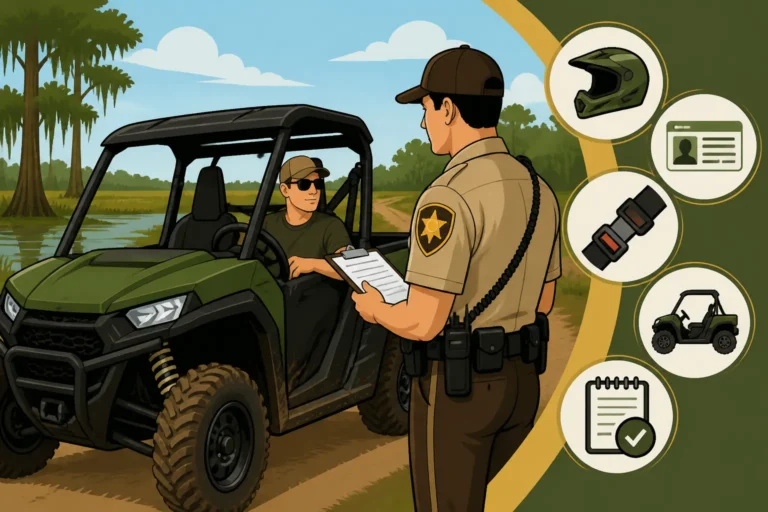
When a law enforcement officer spots an ATV or UTV operating illegally on a Shreveport street, they are within their rights to initiate a traffic stop. During this stop, a trooper or officer can ask for various documents, just as they would with any motor vehicle. [What a Louisiana State Trooper Can Ask to See] includes proof of ownership, and potentially even proof of insurance, especially for UTVs that might be on designated roads. If you're found to be operating an ATV or UTV on a public road where it's not permitted, you're likely looking at a citation.
The penalties for illegal road riding can quickly add up. You could face fines, court costs, and potentially even have your machine impounded. [Louisiana Penalties for Illegal Road Riding] are designed to deter such activity, and the [Louisiana Ticket Costs for Road Riding] can be substantial, often ranging into the hundreds of dollars, not including any towing or storage fees for an impounded machine. Imagine your UTV being towed from downtown Shreveport to an impound lot, and then having to pay towing fees, daily storage fees, and your citation to get it back. That quick, convenient ride suddenly becomes a very expensive mistake, not to mention the time and frustration involved in retrieving your vehicle from impound.
Staying Legal and Safe
The most straightforward way to avoid these penalties and hassles is to ensure you are riding legally and safely. For ATVs, this almost exclusively means sticking to private property with permission, or dedicated off-road parks and trails. For UTVs, it means the same, unless you have absolutely verified that a specific road in Shreveport (or any other locality) has been officially designated for UTV use, and you meet all the associated requirements (license, insurance, equipment, etc.).
If you're looking for places to ride legally in Louisiana, focus on destinations like Kisatchie National Forest, which offers various trails, or private mud parks like Muddy Bottoms ATV Park. These are designed for off-road recreation and provide a much safer and legal environment for your machine. Checking out resources like [Louisiana ATV Trails: Where to Ride] can give you great options for enjoying your machine without the constant worry of legal repercussions. Remember, the peace of mind that comes with legal riding is invaluable.
Gear, Safety, and Common Misconceptions
Beyond the legal aspect, riding an ATV or UTV carries inherent risks. This is why safety gear and understanding the limitations of your machine, especially when considering any form of road use, are paramount. Many riders feel that because they're "just going down the street," they don't need full gear, or that their machine is "almost" street legal if it has a few accessories. These kinds of assumptions are dangerous and can lead to serious injury or legal trouble.
Essential Safety Gear
No matter where you ride—be it a designated trail, private land, or a legally designated street—proper safety gear is non-negotiable. A helmet is your first line of defense against head injuries, and in many places, including potential UTV-designated roads, it's legally required, as detailed in [Louisiana ATV Helmet Rules]. But safety goes beyond just a helmet. Eye protection (goggles or a visor), sturdy over-the-ankle boots, long pants, and a long-sleeved shirt or jacket are all crucial. Gloves can protect your hands from scrapes and blisters, and even provide better grip.
Think of it this way: if you were riding a motorcycle, you wouldn't skimp on gear. The risks associated with ATVs and UTVs are comparable, if not higher in some off-road scenarios. Aftermarket accessories, like those from SuperATV, can enhance your machine's utility and sometimes even its safety features. For example, a quality SuperATV windshield can protect you from debris, and their upgraded lighting kits can improve visibility in low-light conditions. While these accessories don't make a machine street legal, they certainly contribute to a safer riding experience wherever you are permitted to ride. Investing in good gear is an investment in your well-being.
Common Misunderstandings About "Road Legal"
One of the biggest pitfalls for riders in Louisiana, and especially in urban areas like Shreveport, is the misunderstanding of what makes an ATV or UTV "road legal." Many assume that if they add turn signals, a horn, and mirrors, their machine magically transforms into a street-legal vehicle. This is almost never the case. These accessories are helpful for safety and visibility, but they do not circumvent the fundamental legal classifications and restrictions in Louisiana law. A UTV with all the bells and whistles is still not a car, and it's not registered or titled as one.
Another common misconception is relying on what "everyone else does." Just because you see a neighbor or someone on social media riding their ATV or UTV on a public road in Shreveport doesn't mean it's legal. It simply means they haven't been caught yet, or they're operating under an exception that doesn't apply to you, such as a farmer utilizing a shoulder for specific, short-distance agricultural travel under a [Louisiana Farm Affidavits for Road Use]. Your legal defense cannot be "my friend does it." The law applies to you individually. Always check the specific laws, not just what you observe others doing, to protect yourself and your machine.
| Feature | ATV Road Legal Status (Shreveport/LA) | UTV Road Legal Status (Shreveport/LA) |
|---|---|---|
| General Road Use | Generally Prohibited | Prohibited unless road is explicitly designated by local ordinance and properly signed |
| Interstates | Prohibited | Prohibited |
| Travel Lanes | Prohibited | Prohibited unless road is explicitly designated |
| Shoulder Riding | Limited (e.g., agricultural use) | Limited (e.g., agricultural use); recreational use generally prohibited |
| Local Ordinances | Cannot designate for ATVs | Can designate specific roads/streets; requires formal city/parish council action and signage |
| Age Requirement | No specific state-level road use age | 21 years old for road use, even on designated roads ([Louisiana Requires UTV Drivers to Be 21]) |
| Driver's License | Not applicable for road use | Class E license required for road use |
| Insurance | Not required for off-road use | Required for road use on designated roads ([Louisiana UTV Insurance Minimums]) |
| Equipment | Off-road lights, etc. | Must meet highway equipment standards (lights, turn signals, mirrors, seatbelts) if designated for road use |
| Penalties | Fines, impoundment, court costs | Fines, impoundment, court costs if operating illegally or not meeting requirements |
Disclaimer
This article is for general informational purposes only and does not constitute professional advice. Laws, prices and regulations vary by location and change over time. Consult a qualified professional for guidance on your specific situation.