Louisiana DUI Law and Off-Road Machines
It's a common, and frankly dangerous, misconception that Louisiana's tough DUI laws only apply to cars, trucks, and SUVs on paved roads. Many off-road enthusiasts mistakenly believe that once they hit the dirt, the levee, or even their own private hunting camp, the rules about operating a machine while impaired somehow vanish. This guide is here to clear up that confusion and help you understand how Louisiana's Operating While Intoxicated (OWI) statute absolutely applies to your ATV or UTV, regardless of where you're riding.
The Harsh Reality: DUI Laws Don't Stop at the Pavement
Let's get this out of the way upfront: if you can get a DUI in your truck on I-10, you can absolutely get one on your ATV or UTV deep in the woods or kicking up mud in a private park. Louisiana's laws are broad, and the idea that off-road vehicles are somehow exempt is a myth that can lead to severe consequences. Troopers and local law enforcement are well aware that off-road machines are motor vehicles, and they enforce impairment laws just as strictly in rural areas as they do in urban ones.
The critical distinction often lies not in what you're driving, but where you're driving it, and even then, there are very few places where you're truly beyond the reach of the law. This isn't about being a party pooper; it's about staying safe, responsible, and out of serious legal trouble that could impact your life for years to come. Whether you're navigating technical trails or cruising a wide-open field, the same standard of sobriety applies if you're operating a motor vehicle.
Understanding Louisiana's OWI Statute (Operating While Intoxicated)
Louisiana law defines Operating While Intoxicated (OWI), commonly known as DUI, as operating a motor vehicle while under the influence of alcohol, drugs, or a combination of both. The key phrase here is "motor vehicle." An ATV or UTV, with its engine, wheels, and ability to transport people, unequivocally falls under this definition. The statute doesn't discriminate based on the number of wheels or whether the machine is designed for pavement or dirt. If it's a motorized vehicle, it's covered.
This means the standard legal blood alcohol content (BAC) limit of 0.08% for drivers 21 and older applies directly to you on your quad or side-by-side. For commercial drivers, it's lower, and for those under 21, Louisiana has a zero-tolerance policy. It's not just alcohol either; if you're impaired by prescription medication that affects your driving ability or by illegal substances, you're equally susceptible to an OWI charge. The focus is on your ability to operate the machine safely, and any impairment can compromise that.
Where "Off-Road" Machines Get Caught in the Net
One of the biggest misunderstandings riders have is about where law enforcement can actually enforce DUI laws. Many assume that if they're not on a public road, they're in the clear. Unfortunately, this isn't entirely true. While private land offers some protections, public lands, wildlife management areas (WMAs), and even designated riding parks are absolutely fair game for enforcement. Remember, many "off-road" excursions involve crossing or riding on public easements, parish roads, or even forest service trails, all of which fall under public jurisdiction.
| Location Type | DUI Laws Apply? | Common Misconception | Reality |
|---|---|---|---|
| Public Road/Shoulder | Yes | "Only applies to cars" | Applies to any motor vehicle, including ATVs/UTVs |
| WMA Trails | Yes | "It's just the woods" | Public land, state rules apply |
| Designated Parish Roads | Yes | "It's a rural road" | Still a public road, state traffic laws apply |
| Private Mud Parks/Trails | Yes | "It's private property" | Operators can still be cited; park rules often ban it |
| Private Hunting Land (with public access) | Yes | "My land, my rules" | Access roads may be public; laws apply if public can use it |
Even on purely private property, depending on the circumstances, an OWI charge could still be brought, especially if there's an accident involving injury or if law enforcement is called to the scene. For example, if you're riding a utility vehicle, perhaps with some robust upgrades from SuperATV, on your own sprawling property and an incident occurs that brings police involvement, you could still face charges if found impaired. The best advice is always to separate alcohol or drugs from operating any motorized vehicle, no matter the location. You can learn more about specific rules for public roads in [Can You Ride an ATV on the Road in Louisiana?].
The Steep Price: Legal, Financial, and Personal Fallout
An OWI conviction isn't just a slap on the wrist; it's a serious criminal offense with far-reaching consequences that can ripple through your life for years. It's not just about the immediate fines or jail time; it impacts your driving record, your insurance rates, your employment opportunities, and even your personal reputation. Many riders, focused on the fun of the ride, don't fully grasp the gravity of getting caught riding impaired on their machine.
The costs involved can quickly escalate, turning a day of enjoyment into a financial nightmare. From legal fees to increased insurance premiums, the financial burden alone can be crippling. Beyond the wallet, the emotional toll on you and your family can be significant. It's a stark reminder that responsible riding means keeping a clear head whenever you're behind the handlebars or wheel.
Legal Penalties: Fines, Jail Time, and License Suspension
Louisiana's OWI penalties are severe and escalate with repeat offenses. For a first offense, you could face fines ranging into the hundreds or even thousands of dollars, mandatory jail time (which may be suspended or partially suspended with probation), and most critically, a suspended driver's license. This isn't just your car license; it affects your ability to operate any motor vehicle. Imagine being unable to drive to work, pick up groceries, or simply get around your town because of an off-road mistake.
Beyond the initial penalties, you'll likely be required to complete substance abuse treatment programs, attend defensive driving courses, and potentially have an ignition interlock device installed in your personal vehicle at your own expense. These requirements add significant time, cost, and inconvenience to your daily life. Subsequent offenses carry even harsher penalties, including longer jail sentences, higher fines, and extended license suspensions, making the initial mistake even more regrettable. These are far more serious than typical [Louisiana Ticket Costs for Road Riding].
Beyond the Law: Insurance, Machine Seizure, and Personal Risk
The legal penalties are just the beginning. An OWI conviction will almost certainly cause your auto insurance premiums to skyrocket, if your insurer doesn't drop you altogether. Many companies view OWI as a high-risk factor, and finding affordable coverage afterward can be a struggle. Furthermore, depending on the circumstances and local ordinances, your ATV or UTV could be impounded or even seized. This adds storage fees, retrieval costs, and the risk of losing your machine entirely. For instance, while [Louisiana Impoundment for No Decal] is a different offense, it illustrates the state's power to seize your machine.
Then there's the personal risk. Operating an ATV or UTV, even under ideal conditions, carries inherent dangers. Add impairment to the mix, and the risk of a serious accident increases dramatically. You're not just risking a ticket; you're risking severe injury or even death to yourself, your passengers, or others on the trail. This also highlights why quality components, like a durable axle or suspension from SuperATV, are so vital for safety – they help mitigate risks when you're alert, but they can't protect you from impaired judgment. The human cost of an accident caused by impaired riding is immeasurable, and it's a burden no one wants to carry. [Louisiana Accident Reporting for an ATV Crash] applies to any incident, regardless of impairment.
Ride Smart, Stay Legal: Preventing a DUI on Your Off-Road Adventures
The good news is that preventing an OWI charge on your ATV or UTV is entirely within your control. It simply requires making responsible choices and planning ahead, just as you would for any other driving situation. The key is to separate the fun of off-roading from the consumption of alcohol or impairing substances. This doesn't mean you can't enjoy both, but it means they shouldn't happen simultaneously when you're operating a machine.
Thinking ahead about your activities and transportation is crucial, especially when planning outings to mud parks, hunting camps, or group rides. A little foresight can save you a world of trouble and ensure that your off-road adventures remain positive, memorable experiences. There's no reason a great day of riding has to end with a legal headache.
Planning Ahead: Designating a Driver or Staying Sober
The simplest and most effective way to avoid an OWI is to commit to either staying completely sober while operating your machine or designating a sober driver if you plan to consume alcohol. Just like with a car, if you're going to drink, hand the keys over to someone who hasn't. This can be challenging in an off-road setting where everyone might have their own machine, but it's a non-negotiable safety and legal requirement.
If you're at a camp or a private mud park where you plan to socialize and enjoy adult beverages, make a clear rule for your group: no riding after drinking. Enjoy the campfire, the company, and even your custom SuperATV cooler full of beverages, but leave the machine parked until you're completely sober. Consider scheduling your riding for one part of the day and your socializing for another, ensuring there's a distinct separation. This clear boundary protects everyone involved and ensures that nobody finds themselves in a dangerous or legally compromised situation. You should also be aware of [Alcohol at a Mud Park] rules, as many have their own policies.
Understanding Public vs. Private Land Rules
While the OWI statute generally applies across the board, understanding the nuances of public versus private land can help you grasp why enforcement happens in certain areas. On public lands, like Kisatchie National Forest trails or designated [Louisiana WMA Trail Riding] areas, you are clearly subject to all state and federal laws, including OWI. This is because these are public resources, managed for public use, and safety for all users is paramount. Law enforcement patrols these areas and will enforce traffic and safety laws.
On private land, such as your own property or leased hunting land, the situation can be more complex. Generally, law enforcement needs probable cause to enter private property without an invitation. However, if an accident occurs, if you're riding in a way that creates a public nuisance, or if an officer is invited onto the property, you can absolutely be charged with OWI. For example, [Riding Under the Influence on Your Own Land] is still a possibility if authorities intervene due to an incident. Always operate with a clear head, regardless of whose land you're on, to avoid both legal trouble and personal harm.
What a Louisiana Trooper Can Ask to See
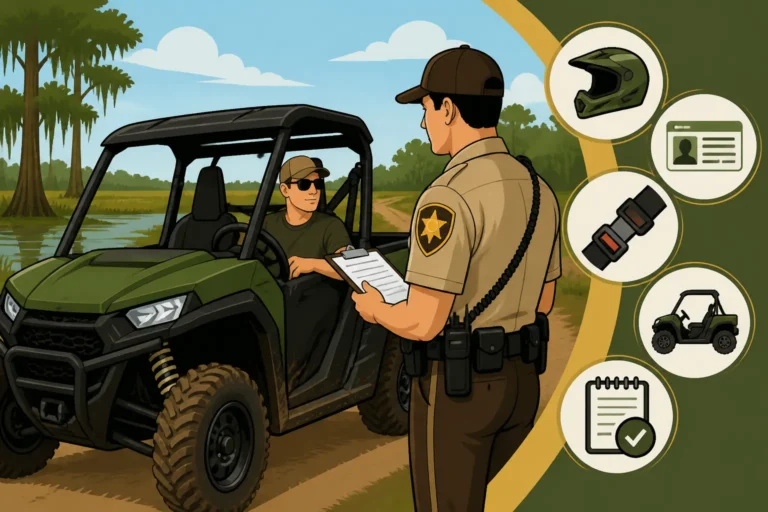
If you encounter law enforcement while riding your ATV or UTV, whether it's on a parish road, a WMA trail, or even crossing an incidental public access point, it's important to understand your rights and responsibilities. A Louisiana State Trooper, sheriff's deputy, or even a game warden has the authority to stop you if they have reasonable suspicion that you are violating a law, including OWI. They can perform [Louisiana Equipment Checks by Troopers] and ask for your identification and proof of ownership.
If they suspect impairment, they can ask you to perform field sobriety tests. Refusing these tests can have consequences under Louisiana's implied consent laws, which suggest that by operating a motor vehicle, you've consented to sobriety testing. It's always best to cooperate politely and clearly, but you have the right to refuse a PBT (Preliminary Breath Test) on the spot, though refusal will lead to an automatic driver's license suspension. The best advice is to never put yourself in this situation by riding impaired in the first place. You can read more about what might happen during a stop in [What a Louisiana State Trooper Can Ask to See].
Disclaimer
This article is for general informational purposes only and does not constitute professional advice. Laws, prices and regulations vary by location and change over time. Consult a qualified professional for guidance on your specific situation.