The Decal a Farm-Exempt Quad Still Has to Carry
The world of ATV and UTV registration in Louisiana can feel like a tangled web of rules, especially when you hear terms like "farm-exempt." Many folks assume that if their quad is strictly used for farm work, it's completely off the hook for any kind of paperwork or decal. But that's a common misunderstanding that can lead to headaches and even fines. This guide is going to clear up the confusion, explaining exactly what a farm-exempt quad is, what paperwork it still needs to carry, and why that little decal is so important, even for dedicated farm machines.
Understanding Louisiana's Farm Exemption for ATVs and UTVs
When we talk about "farm-exempt" ATVs and UTVs in Louisiana, it's easy to picture a machine that operates entirely outside the typical regulatory framework. After all, it's working land, not tearing up public trails for recreation, right? While there's a kernel of truth to that sentiment, the reality is a bit more nuanced. The term "exemption" here applies to very specific aspects of registration and titling, not a blanket pass on all requirements.
What "Farm-Exempt" Truly Means for Your Machine
In Louisiana, an ATV or UTV can indeed be considered "farm-exempt," but this status is tied to its primary use and how it interacts with public infrastructure. Generally, a machine qualifies for certain exemptions if it is exclusively used for agricultural purposes on private land. This could mean hauling feed, inspecting fences, or moving equipment from one field to another. The key word here is "exclusively." If your machine sees any recreational use, like weekend rides through the woods with friends, or if it's used for non-farm commercial work, that exemption flies right out the window.
The main benefits of this farm exemption often revolve around sales tax. Many agricultural machines, when purchased new for bona fide farm use, are exempt from state sales tax, which can be a significant saving. Additionally, some farm-use ATVs or UTVs may be exempt from the standard requirement to obtain a full title from the Louisiana Office of Motor Vehicles (OMV), especially if they never leave private property or are only used in a very limited, defined way on public roads. However, this is where the waters get muddy. An exemption from titling doesn't always mean an exemption from all decals, particularly if your machine ever needs to cross or briefly operate on a public roadway, no matter how brief or necessary that interaction might be for farm operations. It's not a free pass to operate without any official recognition.
The Core Distinction: Not All Exemptions Are Equal
This is perhaps the biggest point of confusion for many Louisiana farmers and landowners. When you hear "farm-exempt," your mind might jump to a complete lack of paperwork. But the state's regulations are designed with public safety and accountability in mind, even for vehicles performing essential agricultural tasks. An ATV or UTV primarily used for farming might be exempt from things like a standard ORV title or even certain sales tax burdens, but that doesn't mean it's exempt from all identifying markers, especially if it ever touches a public road.
The distinction lies in the type of use that triggers the need for specific decals. If your quad is strictly confined to your private fields, barns, and access roads, without ever crossing or traveling alongside a public road, then you might indeed fall into the purest form of "exempt." However, as soon as that machine needs to cross a parish road to get to another field, or briefly travel down the shoulder to access a remote part of your property, it enters a different category. That's when the specific "farm-only" decal becomes a non-negotiable requirement. It's a way for law enforcement to quickly identify that your machine is operating under a specific agricultural exemption for limited public road use, rather than being an unregistered recreational vehicle breaking the law. This is a critical point that often catches people off guard.
The Essential Decal for Louisiana's Farm-Exempt Quads
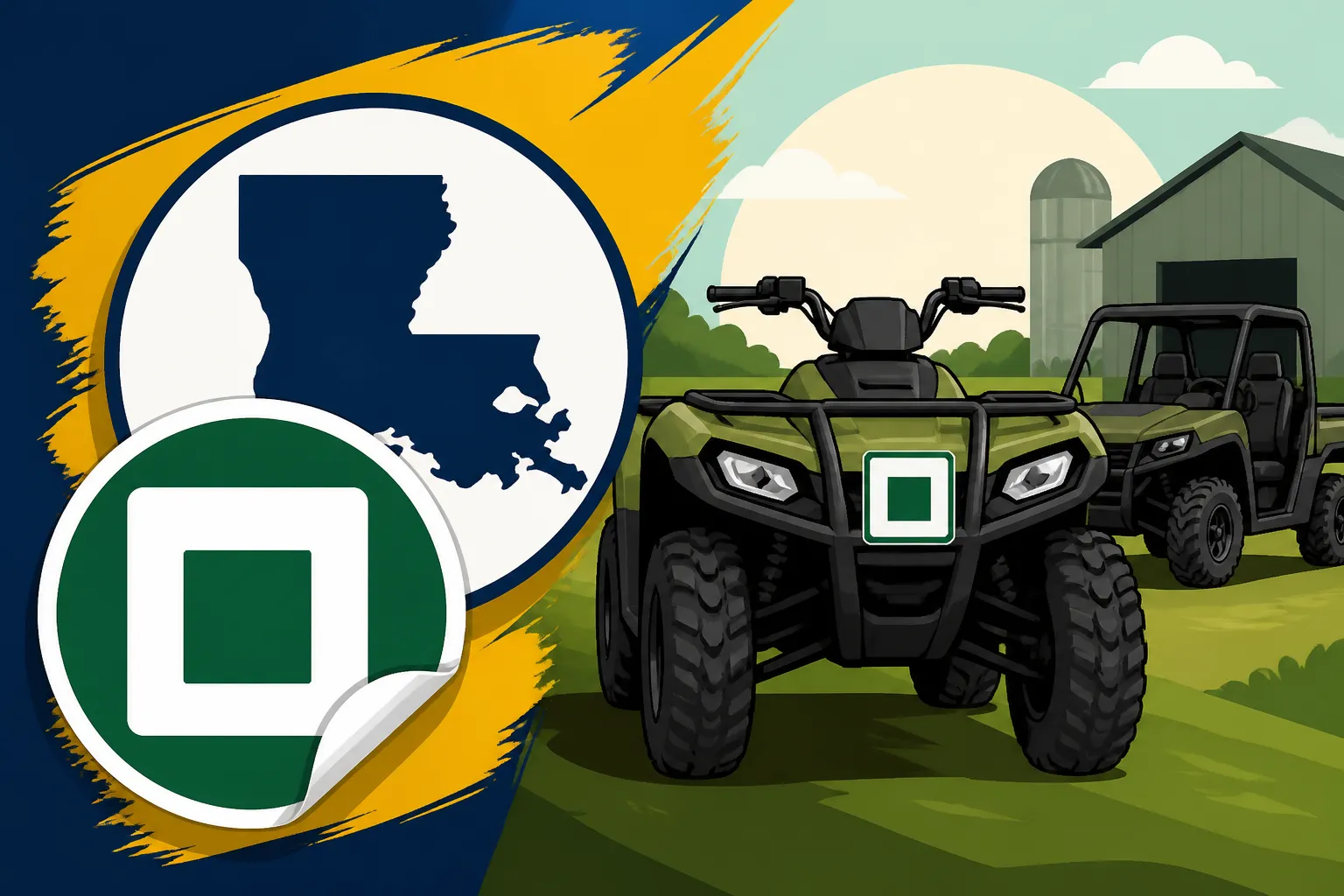
So, your ATV or UTV is a farm workhorse, exclusively dedicated to agricultural tasks. You might have thought you were free from all the OMV paperwork. But hold on, there's a specific decal you absolutely need if your machine ever leaves private property, even for a moment, to interact with a public road. This isn't just a suggestion; it's a requirement that many landowners overlook, leading to unexpected penalties.
Why the "Farm-Only" Decal Is Crucial for Road Use
Louisiana law makes a specific allowance for ATVs and UTVs used in farming operations to operate on the shoulder of certain public roads or to cross them. This is typically limited to a [Louisiana's 5-Mile Farm Radius] from the owner's primary residence or farm operation and must be directly related to the farming activity. However, this privilege comes with a condition: your farm machine must display a special decal, often referred to as the "farm-only" decal. This decal signals to any passing law enforcement officer that your machine is operating under this specific agricultural exemption, distinguishing it from an recreational vehicle that is illegally on the road.
Without this decal, even if you're meticulously adhering to the 5-mile radius, riding on the shoulder, and actively engaged in farm work, a [What a Louisiana State Trooper Can Ask to See] might view your machine as unregistered and illegally operated on a public thoroughfare. The decal serves as visual proof that you've declared your machine's farm-use status to the OMV and are operating within the specific parameters allowed by law. It's a critical piece of the puzzle, and it's distinct from the general [Louisiana's Yearly Off-Road Decal] that recreational riders would need for public trails. Think of it as your machine's official "farm work permit" for limited road exposure.
Applying for the Farm-Use Decal: What You Need
Getting your farm-use decal involves a visit to the OMV and completing some specific paperwork. The cornerstone of this process is often the Louisiana Agricultural Affidavit. This is a sworn statement affirming that your ATV or UTV meets the criteria for farm-only use. It's crucial to fill this out accurately and honestly, as it's a legal document. Many people find preparing these legal forms daunting, but resources are available. For instance, platforms like LawDepot can provide templates and guidance for drafting affidavits and other necessary legal documents, which can be a real help in ensuring everything is in order before you head to the OMV.
Here's a general overview of what you'll typically need:
- Proof of Ownership: This could be a bill of sale, a manufacturer's statement of origin (MSO) for a new machine, or a previous title if one was issued. Even for farm-exempt machines, you need to prove you legally own it.
- Identification: Your valid Louisiana driver's license or state ID.
- The Agricultural Affidavit: As mentioned, this form specifically declares the machine's exclusive use for bona fide farm operations. You'll need to swear before a notary that the information is true. [Swearing an Affidavit That a Quad Is Farm-Only] is a critical step.
- Completed OMV Vehicle Application: Even if it's not being titled in the traditional sense, the OMV still needs basic information about the machine and its owner.
- Fees: While specific title fees might be waived for this exemption, there will still be a nominal fee for the decal itself and potentially an OMV handling fee.
Remember, the OMV is the agency responsible for these decals, not the Department of Wildlife and Fisheries. [The OMV Titles ATVs, Not the Wildlife Department] handles all aspects of ORV registration and decals. Planning your OMV visit with all these documents prepared will save you a lot of time and frustration.
Navigating Public Roads with a Farm-Exempt Machine
So you've got your farm-use decal proudly displayed on your ATV or UTV. That's a huge step toward legal compliance. However, merely having the decal doesn't grant you carte blanche to roam public roads. Louisiana law is very specific about how and where a farm-exempt machine can be operated on public property. Understanding these limitations is just as important as having the decal itself.
The Shoulder and the 5-Mile Radius: What's Permitted
The primary allowance for farm-exempt ATVs and UTVs on public roads in Louisiana is incredibly narrow. Your machine is generally permitted to operate on the shoulder of certain public roads and to cross them, but only under specific circumstances. The law specifies that this use must be for bona fide farm purposes and occur within a [Louisiana's 5-Mile Farm Radius] of the farm or ranch headquarters. This isn't a suggestion; it's a hard limit. You can't just take your farm quad down a parish road for miles to run an errand, even with the decal. The purpose must be agricultural, and the path must be the shortest, most direct route necessary.
Furthermore, the law explicitly states that you must operate on the shoulder of the road, not in the travel lanes. This is a critical safety measure. You're sharing the road with much larger, faster vehicles, and you need to remain as visible and out of the way as possible. This limited use is precisely [Why the Farm Exemption Stops at the Shoulder]. When a trooper sees you on the road, the farm-use decal combined with adherence to these rules signals that you are in compliance. It's also vital to carry all your relevant paperwork, including your agricultural affidavit and proof of ownership, as a trooper can ask to see it at any time. [Louisiana Farm Affidavit Requirements] are not just for the OMV; they're for the road, too.
Potential Pitfalls and Penalties for Non-Compliance
Even with a farm-use decal, stepping outside the narrowly defined legal boundaries can land you in serious trouble. One of the biggest pitfalls is assuming the decal permits broader road use than it actually does. If you're caught riding in the travel lane, venturing beyond the 5-mile radius, or using the machine for non-farm recreational purposes on public roads, that farm-exemption decal offers little to no protection.
Law enforcement officers are trained to recognize these distinctions. If they see a farm-exempt machine operating outside its legal parameters, you could face significant [Louisiana Penalties for No Decal] – or rather, for illegal operation even with a decal. These penalties can range from hefty fines to impoundment of your machine. Imagine being pulled over while crossing a highway to get to another field, only to discover you forgot your affidavit at home. Even with the decal, if you can't produce the necessary documentation or if your use appears to be outside the farm exemption's scope, you're looking at a bad day. The state takes these regulations seriously to ensure public safety and to prevent the misuse of exemptions meant for genuine agricultural operations.
Distinguishing Between Different Louisiana ATV Decals
The existence of a specific "farm-only" decal for ATVs and UTVs in Louisiana often leads to confusion, particularly when compared to the standard ORV decal. Many riders, and even some officials, sometimes blur the lines, but these are distinctly different identifiers for distinctly different types of machine usage. Understanding these differences is key to staying compliant, no matter how you use your quad or side-by-side.
Farm-Use Decal vs. Standard ORV Decal
Let's make this crystal clear: the farm-use decal is not the same as the standard [Louisiana ORV Decal Cost] you'd get for a recreational ATV or UTV. They serve different purposes and are issued under different sets of rules.
-
Farm-Use Decal: This decal is specifically for machines that are exclusively used for bona fide agricultural purposes and only operate on the shoulder or cross public roads within the specified 5-mile radius. Crucially, these machines may be exempt from the full OMV titling process under this specific agricultural exemption. The decal signifies a very limited, purpose-specific allowance for road interaction. It allows for the necessary movement of farm equipment without requiring full registration that might be overkill for machines primarily on private land. The process often hinges on swearing an affidavit.
-
Standard ORV Decal: This is the decal required for any ATV, UTV, or dirt bike that intends to operate on designated public off-road trails (like those in Kisatchie National Forest), or any other public land where ORV use is permitted. Machines with a standard ORV decal must also have a full title issued by the OMV. This decal indicates that the machine has gone through the full registration process, including payment of sales tax and title fees. This is the decal you need if you plan on going to [Muddy Bottoms ATV Park in Louisiana] or riding any WMA trails. It doesn't grant you general access to public roads, but it confirms your machine is legally registered for off-road recreational use.
The table below summarizes the key differences:
| Feature | Farm-Use Decal | Standard ORV Decal |
|---|---|---|
| Primary Use | Exclusive agricultural operations | Recreational off-road riding |
| Public Road Access | Limited to shoulder travel / crossing (5-mile radius) | Generally prohibited on public roads |
| Titling Requirement | Often exempt from full OMV title (via affidavit) | Requires full OMV title |
| Purpose | Acknowledges agricultural road necessity | Authorizes public off-road trail use |
| Governing Statute | Specific agricultural exemptions | General ORV registration statutes |
| Required Affidavit | Yes, typically required | No, not typically required |
When a Farm Machine Needs a Full ORV Title and Decal
It's important to recognize that the farm-use decal is a conditional allowance. There are scenarios where a machine initially used for farming might lose its exemption or require a full ORV title and standard decal. This typically happens when the machine's use shifts or expands beyond the strict definition of farm operations.
For example:
- Recreational Use: If your "farm quad" starts pulling double duty on weekends for recreational rides on public trails or in private mud parks, it no longer qualifies as "exclusively" farm-use. At that point, it would need a full OMV title and the standard ORV decal. You can't have it both ways; the exemption is for a specific, narrow purpose.
- Sale to a Non-Farmer: If you sell your farm-exempt ATV to someone who won't be using it exclusively for farming, the new owner will almost certainly need to title the machine and obtain a standard ORV decal, especially if they plan any public land use. The farm exemption is tied to the use, not just the machine itself.
- Extensive Road Use: While the farm-use decal allows for limited public road interaction, if your operations require significant travel on public roads (e.g., using travel lanes, going beyond the 5-mile radius, or using it as primary transportation between distant farm properties), you might find that the farm exemption is insufficient. In such cases, you might need to explore full registration or other specific permits if available, but generally, ATVs and UTVs are not street-legal in Louisiana.
- Insurance Needs: While Louisiana doesn't mandate insurance for all off-road machines, if you plan to finance your machine or desire more comprehensive coverage for theft or damage, many insurers will require a proper title and registration.
Essentially, the farm-use decal provides a specific, helpful carve-out for genuine agricultural needs. But if your machine's role evolves, or if you acquire a machine that you intend to use for both farm work and recreation, it's safer and legally sound to pursue a full [Louisiana ORV Decals and Titles Explained] and the standard off-road decal. Always verify your specific situation with the OMV or a qualified professional to ensure you're fully compliant.
Disclaimer
This article is for general informational purposes only and does not constitute professional advice. Laws, prices and regulations vary by location and change over time. Consult a qualified professional for guidance on your specific situation.