The Permit Box Waiting at a WMA Trailhead
A self-clearing permit box at a Louisiana Wildlife Management Area trailhead can look like a small formality, but skipping it or filling it out incorrectly may leave you without the required proof of your visit. Here’s how to handle the box, what to keep, and why the permit does not override trail closures or riding rules.
What the permit box is for
A self-clearing permit is a visitor check-in record used at some Louisiana WMAs. When a trailhead or entrance directs you to complete one, follow its instructions before heading onto the area. The form helps record who is using the WMA and for what activity; it is not a general license to ride wherever you choose.
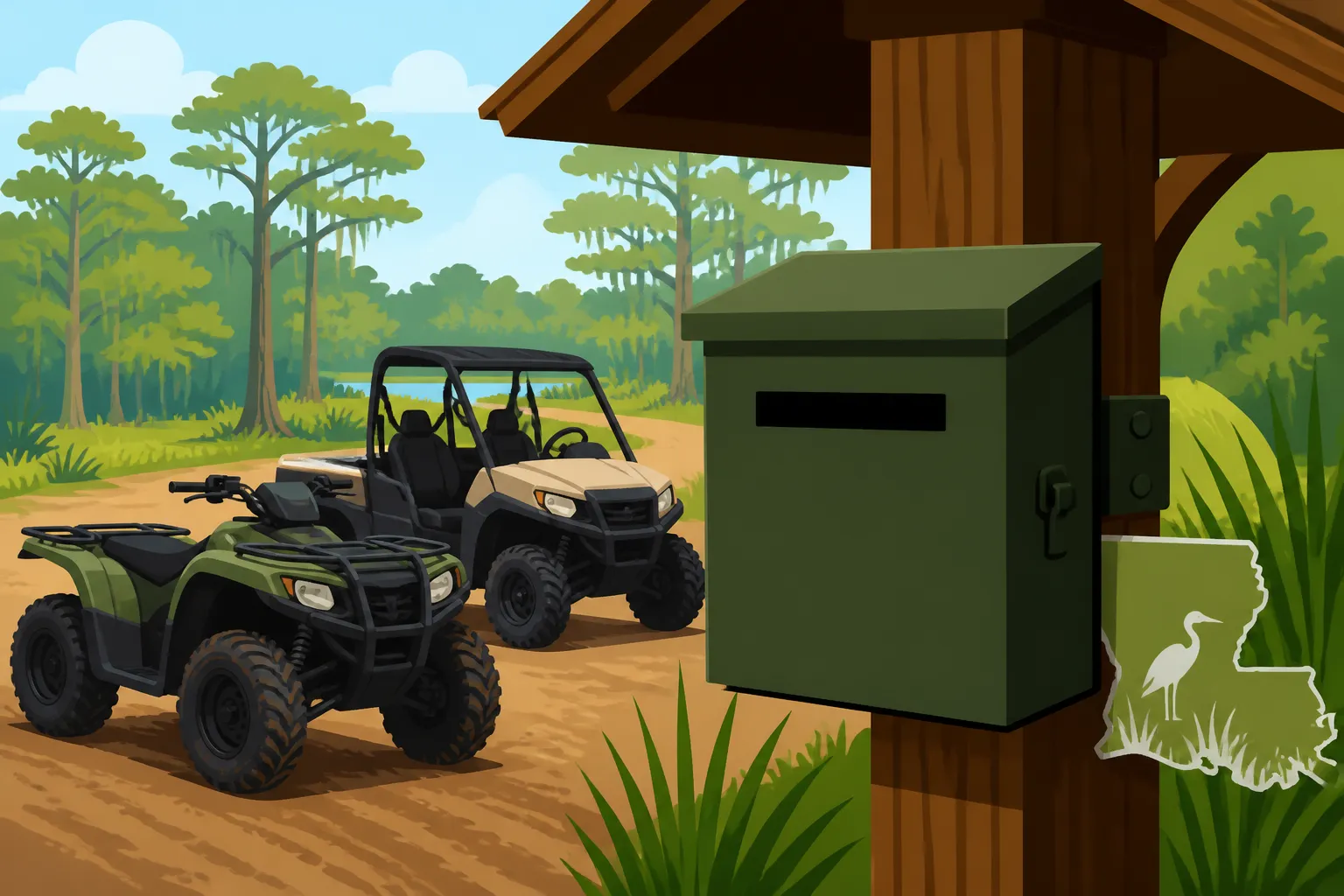
The permit box is often a weather-resistant container near an entrance or trailhead. It may hold paper forms and a slot for returning a completed portion. Trailheads and forms can vary, so use the instructions posted at that location rather than relying on what happened at another WMA.
These permits are easy to confuse with other documents. A self-clearing permit is not the same thing as an ATV title, an off-road decal, a state forest pass, or a hunting license. Requirements for those documents depend on what you are doing and where you are going. For an overview of access rules, see Louisiana WMA Permit Requirements and Louisiana Self-Clearing Permit Steps.
| What you have | What it generally covers | What it does not replace |
|---|---|---|
| Self-clearing permit from a WMA box | The check-in or visitor record required by that area’s instructions | Trail access permission, a hunting license, an ATV title, or an off-road decal |
| WMA access permit or other required authorization | Access under the applicable WMA rules | Permission to ride a closed trail or ignore vehicle limits |
| Forest recreation pass | Use of applicable national forest recreation sites, if required there | A WMA permit or a private park’s admission |
| ATV title or off-road decal | Ownership documentation or decal requirements that apply to the machine | Permission to use a particular public trail |
A completed permit does not make a road, field, or trail open to motorized use. Louisiana WMAs can limit riding to marked routes and can impose vehicle, season, tire, or time restrictions. Start by checking the area’s current map and notices. Louisiana WMA Designated Trails Only explains why riding off a marked route is not a safe assumption.
How to use the box before you ride
Give yourself a few extra minutes at the entrance. A trailhead may have limited cell service, and there may not be another box once you have driven farther into the area. If the form is missing, damaged, or unclear, do not assume that you can skip it. Check the posted notice and contact the relevant WMA office or managing agency before setting out.
A practical routine looks like this:
- Stop where the instructions tell you to stop. Look for signs at the WMA entrance, parking area, or trailhead. If the box is at the entrance, do not drive past it and plan to come back later.
- Read the form and nearby notices first. Confirm that you are using the form for the right area and activity. A permit for one WMA or visit should not be treated as permission for a different location.
- Complete the requested fields accurately. Write the information the form asks for, such as the date, area, or activity if those fields appear. Don’t guess at a field you do not understand; use posted contact information to clarify it.
- Separate and return the correct portion. Many self-clearing forms have a portion to place in the box and a portion for the visitor to keep. Follow the printed directions on that specific form. Do not leave the entire form behind if it instructs you to retain part of it.
- Keep your portion accessible. Carry it with you while using the WMA, rather than leaving it in a truck or trailer parked far from the riding area.
- Check the riding rules before unloading. Confirm that the trail is open to your type of machine, that your vehicle meets any limits, and that your planned route is designated for motorized use.
The form itself is the authority for how to complete that form. Some visitors may expect every box to use the same layout, but instructions and procedures can differ. For a closer look at the usual process, see Filling Out a Self-Clearing Permit at the Gate and Which Half of the Self-Clearing Permit You Keep.
If you are riding with other people, don’t assume that one person’s form automatically covers the whole group. Check whether the instructions require a separate entry for each visitor, one entry per vehicle, or another arrangement. The form or posted notice should answer that question. If it does not, ask before relying on a guess.
What to bring
The permit box is not always staffed, and it may not provide everything you need to complete the form neatly. A pen is a sensible item to keep with your riding paperwork. Bring your area map or a copy of the relevant trail information as well, especially if you expect poor cell service.
It also helps to have your machine’s identifying and ownership information available if other rules or a check require it. That does not mean you need to write those details on the permit unless the form asks for them. Keep the check-in form, the machine’s paperwork, and any required access documents separate in your mind: they serve different purposes.
If the box or form is missing
A missing form does not necessarily mean the WMA is closed, but it also does not prove that the check-in requirement has been waived. Look for a posted alternative, another designated box, or instructions from the area manager. If you cannot confirm what to do, pause before riding and contact the managing office using an official contact method.
Avoid taking a blank form from another location and assuming it is valid for this entrance. Avoid leaving a handwritten note in place of a form unless an official instruction tells you to do so. The goal is to follow the check-in procedure for the area you are entering, not simply to leave something in the box.
What the permit does not let you do
The biggest misconception is that completing the paper permit makes every route on the WMA available. It does not. A self-clearing permit is a check-in step, not a trail pass that overrides signs, closures, or land-use restrictions.
Before riding, verify the following:
- The route is open to motorized vehicles. A path visible on the ground may be a walking trail, an access route for another use, or a route closed to machines. Follow the current WMA map and signs.
- Your machine is permitted on that route. Rules can differ for ATVs and UTVs, and some areas impose limits related to machine size, weight, tires, or other equipment. See Louisiana WMA Riding Rules for Quads or Louisiana WMA Riding Rules for UTVs for the kinds of restrictions to check.
- The season allows riding. WMA access can change with the season, wildlife management activity, or temporary conditions. Do not assume a trail that was open on a previous visit is open now. Louisiana WMA Season Closures covers why checking dates matters.
- You have the other required documents. A self-clearing permit does not substitute for an applicable hunting license, access authorization, title, decal, or other document. Which ones matter depends on your activity, machine, and location.
- You are not treating a WMA like a private riding park. Public-land rules are set for that area and can be more restrictive than the rules at a private mud park. A completed form does not grant permission to leave designated routes or use land beyond the WMA boundary.
Maps deserve particular attention. A WMA boundary may sit close to private land, another public area, or a different management unit. A route can appear continuous on the ground while crossing into a place with different access rules. Compare your location to the WMA map and follow signs at junctions. If you cannot tell whether a route is open, turn back or get clarification rather than testing the boundary.
Weather can also change the practical situation. Heavy rain, flooding, storm damage, or maintenance work may make a route impassable or lead to a temporary closure. A permit completed earlier in the day does not guarantee that conditions remain suitable. Watch for barricades and new notices, and do not move barriers to continue riding.
Common mistakes and a quick trailhead check
Most permit-box problems are avoidable. They tend to happen when riders are in a hurry, assume the process is identical everywhere, or confuse a check-in form with permission to ride. Use this short checklist before unloading:
- Read the notice at the entrance and use the box designated for that WMA.
- Complete the form as directed, with accurate information.
- Return only the portion the form tells you to return.
- Keep any portion you are instructed to retain with you.
- Confirm that your intended trail is marked and open to your machine.
- Check current restrictions and any other access documents that apply.
- If the form is unavailable or the rules are unclear, stop and confirm before riding.
A small mismatch can matter. Returning the wrong half may mean you do not have the requested proof with you. Leaving the whole form in the box may mean you have nothing to show if asked. Filling it out for the wrong area or activity can also defeat the purpose of the check-in. Taking a moment to read the printed directions is more reliable than copying another rider’s routine.
Keep the process simple: follow the sign, complete the form, retain the requested portion, and then verify that the trail itself is open. The box is only one part of a lawful and responsible visit. For more context on where to ride and how WMA access works, see Reading a WMA Map Before You Unload and Louisiana WMA Riding Rules for Quads.
Disclaimer
This article is for general informational purposes only and does not constitute professional advice. Laws, prices and regulations vary by location and change over time. Consult a qualified professional for guidance on your specific situation.