Louisiana WMA Game Retrieval Exception
Louisiana’s WMA game-retrieval exception can help after a legal harvest, but it is not a general pass to ride off-trail. The conditions matter: what you are retrieving, where you ride, what you carry, and which WMA rules apply. Here’s how to understand the exception, avoid common misreadings, and check the requirements before unloading your machine.
What the game-retrieval exception allows
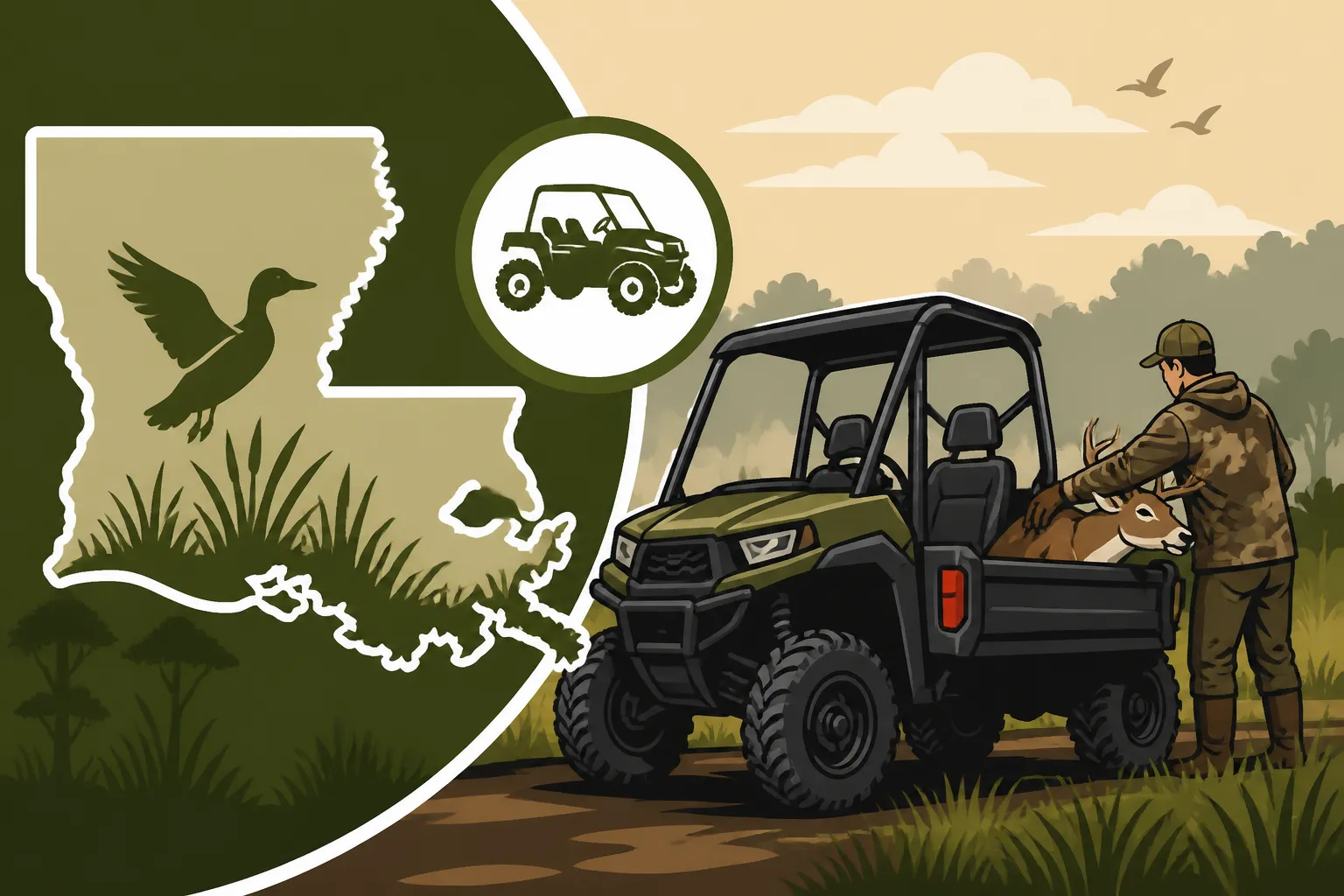
Louisiana Wildlife Management Areas have restrictions on where and when off-road machines may be used. Some areas provide a narrow exception for retrieving game. The point is to help hunters remove an animal they have already lawfully harvested, not to open the WMA to general ATV or UTV travel.
That distinction is central. The exception should not be treated as permission to ride off marked trails for scouting, reaching a hunting spot, carrying supplies, moving between stands, or looking for an animal that may be wounded. Those activities have their own rules, and the retrieval exception does not automatically authorize them.
The exact conditions can depend on the WMA, its access points, and the applicable hunting and land-use rules. Before relying on an exception, check the current rules for the specific area. Start with Louisiana Game Retrieval Rules and the rules for Louisiana WMA Designated Trails Only. A general rule for one WMA should not be assumed to apply everywhere.
| Situation | How to think about the exception |
|---|---|
| A legally harvested animal needs to be removed | This is the kind of situation a retrieval exception may address, subject to that WMA’s rules |
| A hunter wants to scout or reach a stand | Do not assume retrieval rules allow this; ordinary machine-access restrictions still apply |
| A hunter wants to search for a wounded animal by machine | Do not treat the exception as permission to search; confirm applicable hunting rules and use lawful methods |
| A party wants to bring several machines | Do not assume every rider can use a machine for retrieval; party limits may apply |
| A machine is outside its permitted route or area | The retrieval purpose does not, by itself, make otherwise prohibited riding legal |
A useful way to interpret the exception is to ask whether each part of the trip is genuinely necessary to retrieve an animal already taken. If the ride is also serving as transportation, scouting, or recreation, it may go beyond what the exception covers.
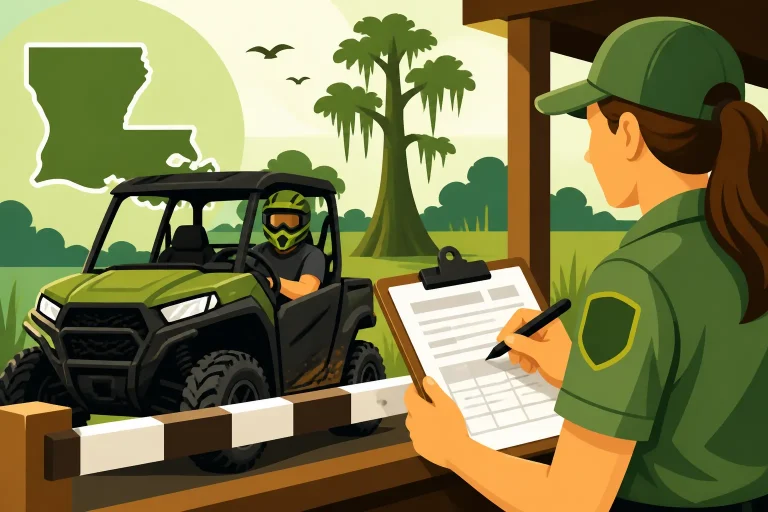
It is also important to separate the right to enter a WMA from the right to operate a machine there. An access permit or self-clearing permit does not necessarily authorize off-trail machine use. Likewise, a retrieval exception does not necessarily replace entry paperwork. See Why Louisiana WMAs Need a Self-Clearing Permit for the separate permit question, and check the WMA’s rules for machine access.
Check eligibility and limits before riding
A retrieval exception is conditional, not a blanket authorization. Before a machine leaves a legal route, confirm that the animal, location, timing, machine, and intended route all fit the rules for that WMA. If any one of those details is unclear, contact the managing office or consult the current official WMA materials before using the exception.
Confirm that the animal qualifies
The exception is meant for retrieval after a lawful harvest, not for a general search. Make sure the animal was taken legally and that the season, method, location, and other hunting requirements were satisfied. Rules may differ by species or by WMA, so do not assume a provision described for deer applies to every type of game.
Keep your hunting licenses, permits, and any required harvest documentation current. If the animal is subject to reporting or tagging requirements, follow those requirements independently of the machine rule. A machine exception does not excuse errors in the harvest or its documentation.
Confirm that the location qualifies
A WMA can have designated trails, closed areas, seasonal restrictions, and other limits on motorized access. A machine may be allowed on a marked route but prohibited from traveling cross-country. Even where retrieval is allowed, it may be restricted to a particular route or area.
Read the current WMA map and regulations before the hunt, not after an animal has been harvested. Look for the boundary of the area, trails open to machines, seasonal closures, and signs at the trailhead. The broader rules in Louisiana WMA Off-Trail Bans are a useful reminder that being on a WMA does not mean riding anywhere on it is permitted.
A route that seems short or convenient may cross a closed area, private boundary, wetland, or other restricted ground. Do not use the animal’s location as a reason to ignore posted signs or leave an authorized area. If the permitted route does not reach the animal, ask the managing office what lawful options are available.
Confirm how many machines may be used
Retrieval rules may limit the number of machines involved in a party’s trip. Do not assume each hunter can ride a separate ATV or that a UTV’s capacity changes the limit. The restriction may apply to the retrieval party rather than just to each individual hunter.
Check the exact wording in the current area rules. Louisiana Retrieval Party Limits and One Machine and No More cover this issue. If the wording is unclear, ask the WMA office before the hunt and describe the number of hunters and machines in your party.
Confirm the machine is allowed
The general WMA rules may impose requirements or restrictions on machine type, size, tires, or other equipment. A machine that is generally suitable for the trail may still be barred by a particular area rule. Do not assume that a game-retrieval purpose waives ordinary equipment restrictions unless the official rule says so.
The same applies to trailers and passengers. A retrieval exception does not automatically authorize towing a trailer, carrying extra riders, or taking a machine onto a route it could not otherwise use. Review the machine requirements for the specific WMA, and use Louisiana WMA Riding Rules for Quads or Louisiana WMA Riding Rules for UTVs as a starting point for identifying what needs to be checked.
Confirm the timing
Access may depend on the hunting season, trail schedule, time of day, or temporary closure. A trail can be closed even when the hunting season is open. Weather, fire danger, maintenance, or other management needs can also affect access.
Check for current closure notices close to the trip. If you arrive at a gate or trailhead and the route is signed closed, do not treat a retrieval need as automatic permission to pass. Contact the WMA manager for direction.
Retrieval is not permission to search for wounded game
One of the most important limits is the difference between retrieving an animal that has already been taken and using a machine to search for wounded game. A retrieval exception should not be read as permission to ride around looking for an animal that may have been hit.
That difference can be easy to blur in the field. A hunter may lose sight of an animal, find blood, or believe an animal is down beyond a trail. Those circumstances do not automatically turn a search into an authorized machine retrieval. The machine rule and hunting rules are separate questions, and the WMA’s restrictions still matter.
If an animal is wounded or its status is uncertain, do not use an ATV or UTV to search for it unless the applicable rules clearly authorize that use. Follow lawful tracking and recovery practices, and ask the WMA staff or appropriate wildlife personnel for direction when necessary. Never Searching for Wounded Game addresses why this boundary matters.
Do not carry a firearm as though retrieval makes the trip a hunt
Some retrieval provisions impose restrictions on firearms. If a rule requires retrieval without a firearm, the presence of a firearm can change the legal character of the trip, even if the stated purpose is to recover an animal. Do not rely on assumptions about an unloaded firearm, a firearm stored in a case, or another party member carrying one. Read the exact rule and follow its terms.
For area-specific considerations, see [Louisiana Firearms and Retrieval Rules] and Retrieving Without a Firearm. If the rule is unclear about what may be carried, ask before setting out. A simple call beforehand is safer than trying to interpret the restriction at a trailhead or during a recovery.
Keep the activity limited to recovery
Once the animal has been recovered, the exception should not become a reason to continue riding off-trail. Return by the route and method allowed by the WMA rules. Do not use the trip to visit another stand, collect gear, or give other riders a ride unless those actions are independently allowed.
The more a machine trip departs from the immediate purpose of retrieving an already-harvested animal, the harder it is to justify as retrieval. Keep the trip direct, avoid unnecessary stops, and follow any conditions stated in the area’s regulations.
Plan the retrieval before the hunt
Retrieval is easier to handle lawfully when the route and requirements are known in advance. Waiting until an animal is down can create pressure to make a quick decision, especially if the terrain is difficult or daylight is fading. A short check before the hunt can prevent a rushed choice.
- Identify the exact WMA. Find the current official regulations and map for the area where you plan to hunt. Do not rely only on a statewide summary or information from another WMA.
- Check entry requirements. Confirm what access permits or self-clearing paperwork you need, and how to complete it. Keep required documents with you while on the area.
- Read the retrieval language closely. Look for the qualifying game, permitted machine, number of machines, route, timing, and any firearm restrictions.
- Mark permitted routes. Know where machine use is allowed and how the authorized route relates to likely hunting locations. Do not plan on crossing a closed area simply because it is the shortest route.
- Check current closures and signs. Review current notices before leaving and again at the access point. Follow posted instructions even if they differ from an older map or a previous visit.
- Decide what the party will do if the exception does not apply. Know how you will seek help or recover the animal through another lawful method if the route, animal, or machine does not qualify.
- Carry useful documents and a way to communicate. Keep required permits and licenses accessible. Cell service can be unreliable in remote areas, so do not rely on a phone call being possible from the recovery site.
A paper map or offline map can help the party stay oriented where service is weak, but a map does not replace official rules or posted signs. Keep documents dry and legible; a sealed pouch is one practical option, including one sourced through Amazon if that is convenient. The important point is that the paperwork remains readable and available, not which retailer supplied the pouch.
If the official wording leaves room for doubt, ask a specific question rather than asking only, “Can I use an ATV?” Explain the WMA, the animal, the machine, the route you intend to take, and whether a firearm will be present. A precise question is more likely to get an answer that applies to the situation.
Common mistakes and a field checklist
The most frequent misunderstanding is treating retrieval as a broad exception to all WMA machine rules. It is narrower than that. The exception may address a specific recovery task while leaving trail restrictions, closures, machine requirements, entry permits, and hunting rules in place.
Another mistake is assuming that what was allowed on a different WMA applies at the current one. Areas can have different access conditions. Rules can also change, and a recollection from a past trip is not a substitute for checking current materials.
Watch for these common errors:
- Riding out to scout first. A later retrieval need does not make earlier scouting by machine part of the exception.
- Taking multiple machines without checking the party limit. Ask whether a restriction applies to the entire retrieval party.
- Using a machine to search for a wounded animal. Do not conflate searching with retrieval after a legal harvest.
- Ignoring a firearm condition. Confirm what the rule prohibits and make sure the whole party understands it.
- Leaving the marked route without verifying permission. A short cross-country trip can still violate area restrictions.
- Assuming a permit covers machine use. Entry permission and off-road machine authorization are different issues.
- Continuing to ride after the animal is recovered. Keep the trip tied to the permitted task.
- Relying on an old map or an unverified online post. Check official area information and signs at the access point.
Before using a machine for retrieval, run through this checklist:
| Check | What to verify |
|---|---|
| Animal | It was lawfully harvested and qualifies under the area’s rule |
| WMA | The exception applies to the specific area you are hunting |
| Access | Required entry or self-clearing paperwork is complete |
| Route | The route is open and permitted for the intended use |
| Machine | The type and equipment meet the WMA’s requirements |
| Party | The number of machines and riders fits the rule |
| Firearms | Any firearm restriction is understood and followed |
| Timing | The area and trail are open at the time of the trip |
| Signs | Current posted instructions do not prohibit the planned route |
If the answer to any item is uncertain, pause and verify rather than assuming the exception covers it. In particular, do not drive into a closed or restricted area to resolve uncertainty. Contact the WMA manager or use another recovery method that complies with the rules.
Frequently Asked Questions
Does the game-retrieval exception let me ride anywhere on a WMA?
No. It should not be treated as general permission for off-trail riding. The exception is narrow, and the WMA’s route, closure, machine, and access requirements still matter.
Can I use an ATV to look for a wounded animal?
Do not assume that you can. Searching for wounded game is not the same as retrieving an animal already taken, and the retrieval exception should not be used as permission to conduct a machine search. Check the applicable hunting and WMA rules.
Can every hunter in my party bring a machine?
Not necessarily. Retrieval rules may limit the number of machines used by a party. Confirm the current rule for the specific WMA before the hunt rather than assuming one machine is allowed for each hunter.
Does a WMA access permit authorize me to use an ATV for retrieval?
Not by itself. An access permit and permission to operate a machine are separate matters. Confirm both the entry requirements and the retrieval conditions for the area.
Disclaimer
This article is for general informational purposes only and does not constitute professional advice. Laws, prices and regulations vary by location and change over time. Consult a qualified professional for guidance on your specific situation.