Louisiana Riding Areas Reachable Without a Truck
If you own an ATV but not a truck, getting to a Louisiana riding area can feel harder than choosing a trail. Public forest routes and private mud parks are spread out, and riding your machine on public roads is not a practical way to reach them. This guide explains realistic transport options, what to check before you leave, and how to plan a ride without a full-size pickup.
What riding without a truck really means
Start with your machine and the way you plan to travel
There are two very different situations: you have an ATV or UTV and need to transport it, or you want to ride but do not have a machine to bring. The first is mainly a hauling problem. The second is about finding a riding area that offers rentals or making arrangements with a friend or group. Sorting out which one applies can save you a wasted trip.
A small car or crossover may be able to tow a lightweight trailer, but the vehicle’s tow rating, the trailer’s capacity, the machine’s weight, and the loaded trailer’s total weight all matter. A single youth quad on a properly rated trailer is a different load from a full-size ATV, a side-by-side, fuel cans, tools, and camping gear. Check the vehicle and trailer limits in their manuals, and include the weight of the trailer itself when you calculate the load.
If you have no suitable vehicle or trailer, do not assume you can unload near a trail and ride the machine the rest of the way. Louisiana’s public-road rules are restrictive, and a route that looks quiet on a map may still be a public road or shoulder. Read [Can You Ride an ATV on the Road in Louisiana?] and [Louisiana Rules for Crossing a Highway] before treating any road connection as rideable.
Compare your practical options
| Option | Best fit | Main things to confirm |
|---|---|---|
| Use a car or crossover with a small trailer | A machine and trailer within the vehicle’s ratings | Tow capacity, trailer capacity, hitch, lights, tie-down points, parking space |
| Borrow a truck or trailer | A one-day or occasional trip | Permission, insurance arrangements, trailer condition, loading help |
| Join a group ride | Riders who can coordinate transport | Whether someone has space, cost-sharing expectations, meeting point |
| Rent a machine near the riding area | People without a machine or a way to haul one | Rental availability, age rules, required documents, equipment, reservation and park rules |
| Choose a nearby ride area and stay overnight | A weekend trip where transport is arranged once | Lodging, trailer parking, access hours, trail status and machine rules |
For many first-time riders without a truck, borrowing a tow vehicle or arranging a ride with someone who already hauls is the simplest solution. If you’re looking at a rental, confirm that the rental machine is actually available for the dates you want and is approved for the trails or park you plan to visit. A park admission ticket does not necessarily include a machine rental, and a rental machine may have its own return, damage, or passenger rules.
Plan the route around legal access, not convenience
A GPS route can make a forest road or trail entrance look close to a highway, but that does not mean an ATV can legally travel between the two. Likewise, a shortcut across a field, levee, hunting lease, or timber road may cross land you do not have permission to use. Use an approved entrance, follow posted directions, and ask the landowner or managing agency when access is unclear.
Mapping tools such as onX Offroad can help you review route options and get a sense of where public lands and roads lie. Treat any map as a planning aid, not permission to ride. Before leaving, check the riding area’s own rules and status information, and confirm that the route you intend to use is open to your type of machine. For public land, [Louisiana ATV Trails: Where to Ride] is a useful starting point for understanding the range of riding options.
Louisiana riding areas to consider without owning a truck
Public forest trails near Kisatchie
Kisatchie National Forest has several OHV riding areas, but a personal ATV still needs to be transported to the designated trailhead. These are not generally places where you should expect to arrive in a passenger car and pick up a machine at the gate. The practical no-truck plan is usually to arrange a ride for your machine, join a group with trailer space, or confirm a rental option separately before making the trip.
Sandstone Multiple-Use Trail is one of the better-known options in the Kisatchie area. It is a forest trail, not a private mud park, so riders need to pay attention to trail status, permitted machines, access requirements, and seasonal closures. The Vernon Enduro Trail is another named riding option in the region, while the Claiborne Multi-Use Trail offers a different location to investigate. Trail access and machine rules can vary, so compare [Kisatchie National Forest OHV Trails in Louisiana], [Louisiana's Sandstone Multiple-Use Trail], and [Louisiana's Vernon Enduro Trail] before deciding where to go.
When you look at these areas, think beyond the distance on a map. Ask how far the trailhead is from the nearest place to park, whether your trailer can be left there, and whether the access road is suitable for your vehicle. A route may be manageable in a car under dry conditions but uncomfortable after heavy rain or when towing. Check [Louisiana Trail Conditions After Rain] and [Checking a Trail Status Page First] as part of your trip planning.
Private riding parks and event-based destinations
Private parks can be more convenient for a rider who needs an organized destination, especially if the park has clear entry procedures, marked facilities, and space for trailers. Muddy Bottoms near Sarepta is a prominent example, but it operates around event weekends rather than as a simple, always-open trailhead. Check its calendar and visitor requirements before traveling; do not assume that a gate will be open just because the location appears on a map.
A private park may be a better fit if you are arranging a group ride and one person can haul several machines. It may also be worth asking whether rentals are available for your intended visit, but confirm directly with the park rather than planning around an unverified listing. Admission, parking, machine access, camping, and event rules are separate details to check. The guides [Muddy Bottoms ATV Park in Louisiana] and [Louisiana Private Mud Parks Compared] can help you narrow down the kind of experience you want.
Private land does not mean rules are optional. Parks can set their own age limits, passenger requirements, helmet rules, speed limits, and restrictions on alcohol or night riding. If you are bringing a borrowed machine or using a rental, make sure the rider meets the park’s requirements and understands what happens if the machine is damaged. Review [Louisiana Private Park Waivers and Rules] before you commit to a trip.
When a riding area may not be a good fit
A trail that is popular with experienced riders may be a poor first destination if you have no transport plan, limited recovery equipment, or no place to leave a trailer. Deep mud can turn an ordinary ride into a recovery job, and forest routes may have limited services or cell coverage. If you are coordinating with someone else, agree in advance on when and where you will meet, who is responsible for hauling, and how you will handle a breakdown.
Public wildlife management areas also have specific access rules, designated trails, permits, and equipment restrictions. They are not a general substitute for a private park, and a machine that is allowed somewhere else may not qualify for a particular WMA trail. Check [Louisiana WMA Riding Rules for Quads] or [Louisiana WMA Riding Rules for UTVs] before planning to ride there.
How to arrange transport without a pickup
Borrow a vehicle or share trailer space
If a friend already rides, sharing transport can be the most straightforward arrangement. Be specific when you ask: give the machine’s approximate weight and dimensions, say whether you need space for a trailer or a machine on a trailer, and mention any extra gear you plan to bring. A side-by-side can take up far more room than a compact ATV, so “Can I come along?” is not enough information for someone to judge the load.
Agree on practical details before the day of the ride. Decide who will pay for fuel, where the group will meet, whether the trailer can be left at the site, and what happens if someone wants to leave early. If you are relying on a shared trailer, check that it has suitable tie-down points and that the machine can be secured without putting pressure on fragile body panels or controls.
A group ride can also make a remote destination feel less stressful. Another rider may know the entrance, parking layout, or routine at the trailhead. Still, do not rely on a group’s memory instead of checking the area’s posted rules and current status. Conditions and access arrangements can change.
Tow with a car only when the setup is appropriate
Some riders can transport a small machine with a properly equipped car or crossover, but the full setup needs to be suitable. Check the vehicle’s towing limit, tongue-weight limit, hitch rating, trailer capacity, and the trailer’s tire and lighting condition. The weight of the machine, trailer, fuel, tools, and camping supplies all contributes to the load. If you cannot confidently confirm the numbers, choose another transport plan.
Loading and securing are just as important as the tow rating. Use rated straps in good condition, secure the machine at appropriate points, and check that the load cannot shift or tip during braking or a sharp turn. Make sure the trailer’s lights work and that the license plate and safety equipment are in place. Before heading onto a busy highway, take a short, low-speed test drive and recheck the straps.
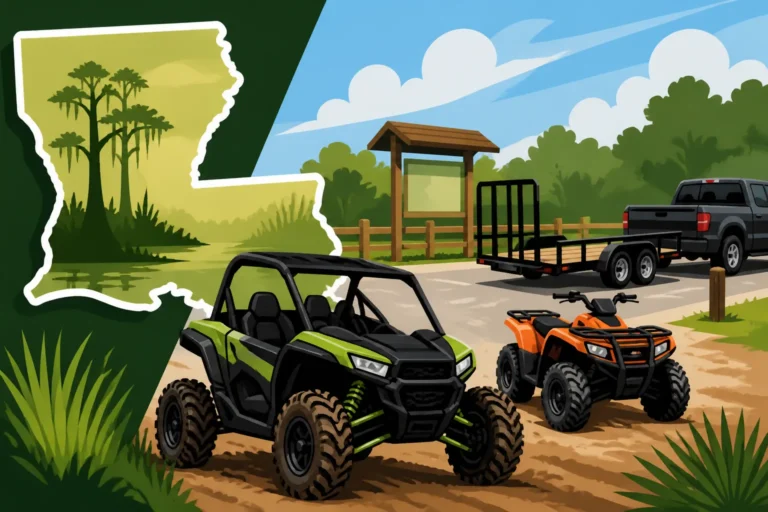
Also consider where you will park. A compact car towing a trailer may fit in a marked space at one destination and be awkward at another, especially if the lot is crowded or the access road is narrow. Call ahead if the riding area’s trailer parking is unclear. For a closer look at hauling basics, see [Trailering to a Mud Park].
Explore rentals, but confirm every detail
A rental may remove the need to transport your own ATV, but it does not eliminate planning. Ask the riding area or rental operator whether machines are available for your specific date, what types are offered, and which areas those machines may be used in. Confirm the pickup and return arrangements, rider eligibility, passenger rules, safety equipment, and what identification or paperwork is required.
Ask what the rental includes and what it does not. Helmets, fuel, recovery gear, and protective clothing may not be included. Find out whether you need to bring a deposit or sign a waiver, and whether the rental can be used on public trails or only within the private property. Do not assume that a rental UTV can be driven on nearby public roads just because it has lights or a windshield.
If you are comparing rentals with borrowing a machine, consider the whole trip. A rental can be convenient when you do not own an ATV, but it may offer less freedom about where and when you ride. Bringing your own machine gives you more control over setup and gear, while requiring a legal and safe hauling arrangement. The best choice depends on the destination, group, and transport you can actually secure.
A no-truck trip checklist
Confirm the riding area before you leave
A simple call or message to the riding area can resolve the questions that cause the most frustration at the gate. Confirm that the area will be open, what types of machines are permitted, whether reservations are needed, and whether your plan involves your own machine or a rental. For public trails, check the managing agency’s updates and permit requirements rather than relying only on old social posts or map listings.
Then verify the route and the parking plan. Know where the entrance is, whether trailers can be parked there, and whether overnight parking is allowed if you are camping. If your route passes through a town or along public roads, do not plan to ride the ATV between trail sections unless the road is specifically legal for that use. Read [Louisiana Proof of Ownership on the Trail] and [What a Louisiana State Trooper Can Ask to See] so you know what paperwork may matter during the trip.
Use onX Offroad or another mapping tool to study the approach, but save the official trail information and address separately. Cell service can be unreliable in wooded areas, so download or otherwise keep the information you need available offline. Carrying a paper map is sensible when you are unfamiliar with the area; [Carrying a Paper Map in the Forest] covers why a backup can help.
Pack for the ride and the return trip
Bring the basics that make a delayed return less miserable: drinking water, a charged phone, weather-appropriate clothing, a first-aid kit, and any required safety equipment. If you are riding in humid heat, plan water and rest breaks before you feel overheated. Mud and standing water can also turn small problems into long delays, so consider a basic tool kit, a tire repair plan, and recovery gear suited to your machine and the trail.
Keep papers and keys secure while riding. If you are borrowing a machine, know where the owner expects you to keep its key and what to do if it will not start. If you are hauling your own ATV, carry the straps and basic trailer equipment needed for the return trip, not just the outward journey. A trailer tire issue or loose tie-down at the end of a muddy day is a miserable way to finish.
Finally, plan the return before you unload. Confirm who is driving, where the vehicle is parked, and whether the group has agreed on a departure time. If you are relying on a rental, leave enough time to return it and complete any required inspection. For a larger group, [Louisiana Group Ride Planning] can help you organize the details before everyone heads out.
Choose a plan that matches your actual setup
For a rider with a small ATV and a suitable car, a properly rated trailer may be enough. For a larger machine, a side-by-side, or a trip with substantial gear, borrowing a truck or sharing transport may be more realistic. If you do not own a machine, ask about rentals early and confirm the details directly. Each route has trade-offs, but none is worth improvising with an overloaded vehicle or an illegal road ride.
The easiest Louisiana ride is usually the one where the transport plan, parking, trail access, and rules are settled before the day of travel. Pick a destination that suits your experience and equipment, confirm the current access information, and leave yourself room to change plans if weather or trail conditions shift.
Disclaimer
This article is for general informational purposes only and does not constitute professional advice. Laws, prices and regulations vary by location and change over time. Consult a qualified professional for guidance on your specific situation.