Louisiana Trails With Camping
Louisiana riders often want to park the trailer, set up camp, and ride without spending half the weekend driving between a campground and a trailhead. That can be tricky: some riding areas have camping nearby but no direct trail connection, while private parks may offer both but open on limited event schedules. This guide explains where to look and what to confirm before you go.
How to choose a Louisiana trail and campground combination
Decide whether you want trailhead camping or a nearby base camp
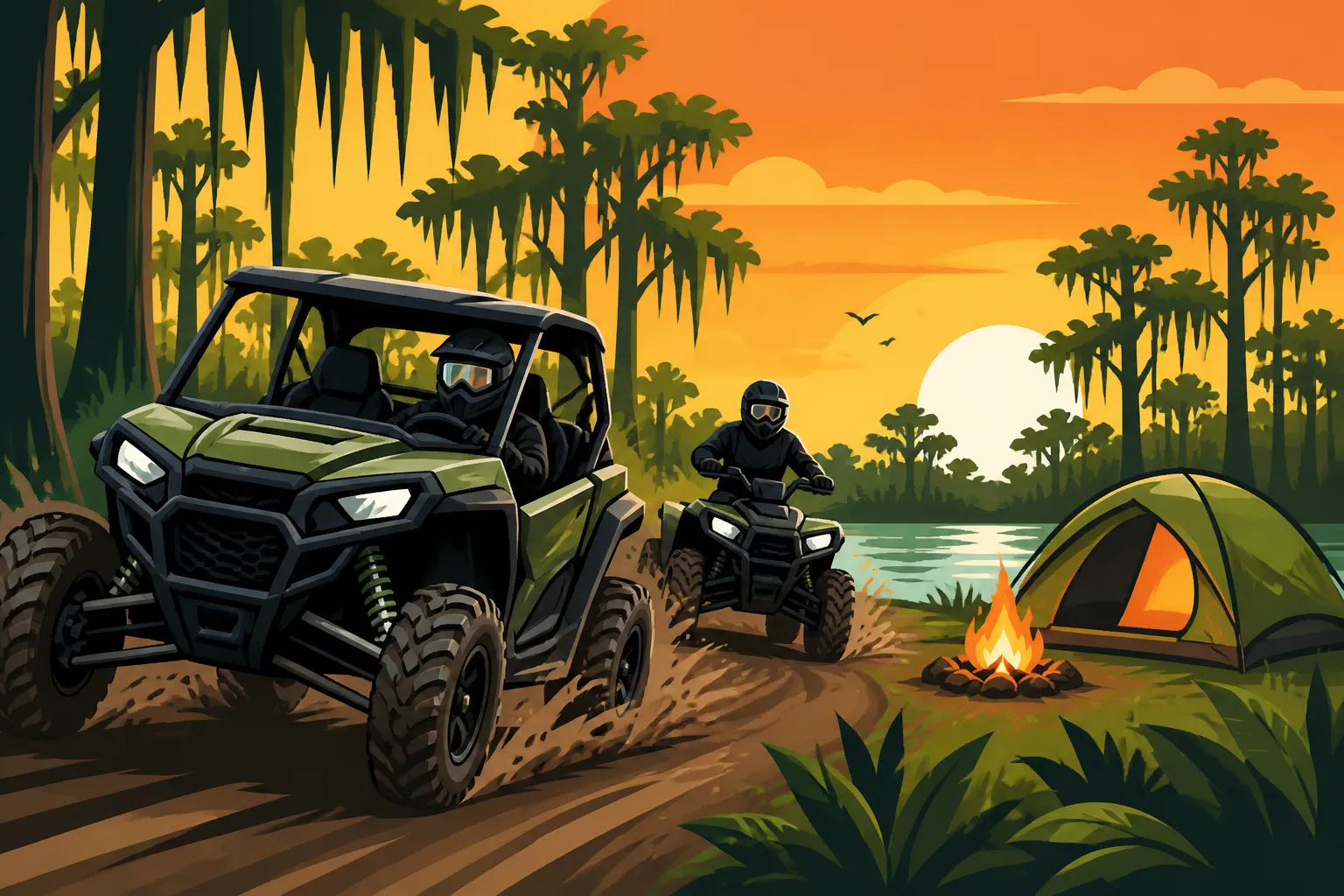
“Camping with trail access” can mean two different things. At some riding areas, a campground is inside or very close to the property, but you still have to trailer your ATV or UTV to the designated trailhead. At others, the campground is part of a private riding park, so you can camp on-site and ride within the park’s boundaries.
That distinction matters when you are traveling with children, towing a large camper, or trying to avoid unloading and reloading machines. Before booking, ask the campground or riding area whether you can ride directly from your site to an authorized trail. Do not assume a nearby forest road, campground lane, or public road is open to off-highway vehicles.
For a broader starting point, see [Louisiana ATV Trails: Where to Ride](Louisiana ATV Trails: Where to Ride). If you are leaning toward national forest riding, [Kisatchie National Forest OHV Trails in Louisiana](Kisatchie National Forest OHV Trails in Louisiana) can help you narrow down which trail systems to research.
Match the campsite to your group and equipment
A tent-friendly site may not work for a family arriving with a long travel trailer, several machines, and a tow vehicle. Check the basics before reserving: site dimensions, surface type, access-road conditions, electrical and water availability, restrooms, showers, dump stations, and whether there is room to park a trailer. At smaller or more remote campgrounds, some comforts you take for granted at a commercial RV park may not be available.
Also think about how you will manage muddy gear. A ride in Louisiana can leave boots, gloves, helmets, and machine parts wet and gritty. A site with room to spread out a wash tub or drying line may be more useful than a scenic spot that leaves you cramped. If your group needs a full-service campground, ask whether it is close enough to make daily trips to the trailhead practical.
Kisatchie National Forest trails and nearby camping
Sandstone and the Forest Hill area
The Sandstone Multiple-Use Trail is one of the Kisatchie riding options worth checking if you are planning a trip in the central part of the state. It is associated with the Kisatchie Hills area near Forest Hill, south of Alexandria. Start with [Louisiana's Sandstone Multiple-Use Trail](Louisiana's Sandstone Multiple-Use Trail) and confirm the trail’s current operating status, permitted machine types, and any seasonal closure before loading up.
Camping takes a little more planning here than at a private mud park. Kisatchie has developed recreation sites in different parts of the forest, but a campground’s presence in the national forest does not automatically mean it is beside an OHV trail or that you may ride between the two. For example, a recreation area can make a comfortable base camp while still requiring you to haul machines to the official trailhead.
Check the Forest Service information for the campground and trail separately. Confirm whether reservations are needed, whether the site accommodates your trailer, and whether the trail is open to the type of machine you plan to bring. [Louisiana OHV Camping With Trail Access](Louisiana OHV Camping With Trail Access) is also a useful topic to review when comparing places to sleep with places where riding is actually permitted.
Vernon Enduro and the Leesville area
The Vernon Enduro Trail is another Kisatchie-area option to research, particularly for riders planning around Leesville and Vernon Parish. Read [Louisiana's Vernon Enduro Trail](Louisiana's Vernon Enduro Trail) before making plans, then verify current trail access and local camping details. Trail conditions and access rules can change, so an old forum post or a remembered visit is not enough to establish that a route is open for your planned weekend.
If your preferred campground is not at the trailhead, treat Leesville or the surrounding area as a base-camp search rather than assuming you can ride from town to the trail. Call ahead about trailer parking, machine washing, quiet hours, and whether the campground allows off-road machines on its internal roads. A quick phone call can prevent the frustrating surprise of arriving with a muddy quad only to learn that the campground has nowhere suitable to park it.
For either Kisatchie trip, look at [Louisiana Forest Trail Status Pages](Louisiana Forest Trail Status Pages) before departure. A mapping app such as onX Offroad can help you plan routes and understand the area, but use official land-manager information to confirm closures, allowed routes, and access rules. Keep a paper or downloaded map as a backup, especially if you will be riding in a spot with weak cell service.
| Riding plan | Camping arrangement to investigate | Key question before booking |
|---|---|---|
| Sandstone near Forest Hill | Kisatchie recreation site or a nearby campground | Is the site close to the official trailhead, and can your trailer fit? |
| Vernon Enduro near Leesville | Local campground or forest recreation site | Will you need to trailer the machine to the trail? |
| Claiborne trail system | Campground or RV park in the wider area | Is there a legal, practical route between camp and trail? |
| Muddy Bottoms near Sarepta | On-site camping options at the private park | Is the park open for your dates, and what does your booking include? |
Claiborne and other forest riding plans
The Claiborne Multi-Use Trail is another forest-system option, in the northern part of Louisiana. Start with [Louisiana's Claiborne Multi-Use Trail](Louisiana's Claiborne Multi-Use Trail), then check where the designated trail access point is relative to your preferred campground. The name “multi-use” is a reminder to pay attention to other trail users and posted rules, not an invitation to ride every road or path in the area.
For forest trips, the practical plan is often to camp where your group is comfortable and trailer to the authorized riding area each day. Confirm whether camping is allowed at the specific site, whether the campground is open for your dates, and whether the trail has any restrictions affecting your machine. Also check any required forest pass or use-fee information through official channels; [Louisiana Forest Passes in Your Budget](Louisiana Forest Passes in Your Budget) can help you remember to include access costs in your trip planning.
Private parks with on-site camping
Muddy Bottoms near Sarepta
If your priority is camping and riding in one place, a private park may be the simplest arrangement. Muddy Bottoms ATV Park near Sarepta is a well-known example to investigate. The park offers riding and camping options, but its schedule and available amenities can depend on the event calendar. Start with [Muddy Bottoms ATV Park in Louisiana](Muddy Bottoms ATV Park in Louisiana), then confirm directly whether the dates you want are open to visitors.
On-site camping can make a big difference for families and groups. You can avoid a daily tow to the trailhead, return to camp for meals, and keep your riding gear close at hand. But do not assume every campsite includes the same facilities or that every event weekend has the same rules. Ask about the site type, hookups, bathroom and shower access, quiet hours, check-in procedures, and whether your machine can be parked beside your campsite.
If you need an RV space, review [Muddy Bottoms' RV Sites in Louisiana](Muddy Bottoms' RV Sites in Louisiana) and confirm the details for your specific reservation. Ask about the space available for your tow vehicle and trailer as well as the camper itself. A site that technically fits an RV may leave little room for a second vehicle or a machine trailer.
What to confirm before committing to an event weekend
Private parks can be busy, especially when a major event is scheduled. Check the park calendar before arranging time off, then ask whether you need to reserve camping separately from admission or riding access. Find out whether the booking covers the full group, whether children have separate requirements, and what happens if weather affects the event. Get the park’s current rules in writing if your group has questions about passengers, pets, alcohol, generators, or night riding.
Also check what “camping” means at the site you are choosing. Primitive camping may be a good fit if you are comfortable bringing your own water and relying on basic facilities. An RV site or cabin can be easier for a longer stay, but availability and amenities vary. Pack for wet ground and humid weather even if the forecast looks calm; a dry campsite can turn uncomfortable after a heavy Louisiana rain.
A practical checklist for planning your trip
Verify access, permits, and trail conditions
Before you leave home, confirm the riding area’s current access rules with the organization that manages it. For a national forest trail, check the official trail information and any applicable pass requirements. For a private park, confirm dates, admission arrangements, camping availability, and park rules with the park itself. If a campground is near a trail but separately managed, contact both places.
Do not treat a GPS route as permission to ride. Apps, including onX Offroad, are useful for planning and orientation, but they do not replace posted signs or land-manager rules. Download maps before you lose service, save the campground address and trailhead directions, and make sure everyone in the group knows where to meet if separated.
A few questions to ask before you book:
- Is the trail open on the dates we plan to visit?
- Are our ATV or UTV types and sizes allowed?
- Is camping available on-site, or will we need to trailer to the trail?
- Can our camper, tow vehicle, and machine trailer fit at the site?
- Are reservations, permits, passes, or separate riding fees required?
- What facilities are available, and what should we bring ourselves?
- Are there seasonal closures, weather-related restrictions, or special event rules?
Pack for the ride and the campsite
For a forest trip, bring the essentials for a day away from camp: water, food, a first-aid kit, basic tools, a tire-repair kit, recovery gear appropriate to your machine, and a fully charged phone or radio. Let someone know your planned route and return time. If you are riding with a group, agree on a regrouping point before entering the trail.
For camping, prepare for mud and moisture. Pack extra socks, a tarp, clothes that can get dirty, and sealed containers for electronics and clean bedding. Bring straps and a plan for securing machines at the campsite. After riding, inspect your machine for packed mud and debris, especially around the radiator, brakes, and moving parts. Cleaning it before the next day can prevent small problems from becoming a trip-ending repair.
The best Louisiana camping-and-riding trip is the one where the logistics match your group. A forest campground can offer a quieter base for a trail-focused weekend, while a private park such as Muddy Bottoms may suit riders who want on-site camping and organized riding. Compare the access, camping setup, and rules—not just the trail name—and confirm the details before you tow.
Disclaimer
This article is for general informational purposes only and does not constitute professional advice. Laws, prices and regulations vary by location and change over time. Consult a qualified professional for guidance on your specific situation.