Louisiana Riding Near Sarepta
Sarepta is one of the easiest places in north Louisiana to plan an ATV or UTV weekend around, but choosing a riding area is only half the job. A private mud park, a public forest trail, and a local road all have different access rules. This guide explains the main options near Sarepta and what to check before unloading.
Riding options near Sarepta
Muddy Bottoms is the closest-known draw
Muddy Bottoms ATV & Recreation Park is in the Sarepta area, making it a natural first place to investigate when you want a dedicated off-road destination close to town. It is a private park, not a public trail system, so access depends on the park’s operating schedule, admission arrangements, and posted rules. That distinction matters: a park may not be open for casual riding just because you are nearby or see machines on its grounds.
The park is known for mud riding and event weekends. That can make it a good fit for riders who want a social atmosphere and a full day built around off-road recreation. It may be less appealing if you are looking for a quiet, lightly used forest trail or want to ride whenever you arrive. Before towing out, check the park’s own current event information and any restrictions that affect your machine, passengers, camping plans, or use of particular areas.
If you are comparing private riding spots around the state, [Louisiana Private Mud Parks Compared] can help you think through the differences between a large event-oriented park and other kinds of riding areas. For Muddy Bottoms specifically, confirm the schedule rather than assuming the grounds are open every weekend. [Muddy Bottoms' Event Calendar in Louisiana] is a useful related topic to review while planning.
Public forest trails require a different kind of preparation
Sarepta is a useful base for exploring north Louisiana, but a public trail ride is not interchangeable with a private-park visit. Forest and wildlife-management-area routes can have designated trail boundaries, access requirements, seasonal restrictions, and machine limits. A trail that appears on a map or has been discussed in a riding group may not be open to motorized use when you arrive.
The broader Kisatchie National Forest trail network is one option to research when planning a public-land ride. Its riding areas are spread across the forest, so check which trail system you intend to visit and how much driving it adds from Sarepta. Do not assume every forest road is an OHV trail; follow the official map and signs for the specific site. [Kisatchie National Forest OHV Trails in Louisiana] provides a starting point for understanding the range of public options.
Other named Louisiana riding areas, such as the Claiborne trail system, may also come up when you search for destinations in the northern part of the state. Treat each as its own trip: check its location, access conditions, allowed machine types, and any required permits before setting out. For an overview, see [Louisiana's Claiborne Multi-Use Trail]. If you are considering several locations, [Louisiana Trails Within an Hour of Shreveport] can help frame the wider regional search, but verify the actual drive and route for your starting point.
Match the riding area to the ride you want
A muddy event park and a marked public trail answer different needs. At a private park, the experience may center on mud, gathering with other riders, and event amenities. On a public trail, the appeal may be a more structured route through forest or other managed land, with access governed by land-manager rules. Neither option is automatically better; the right choice depends on your machine, comfort level, group, and preferred pace.
Think about who is coming. A novice rider may prefer a place where the group can stop and regroup easily, while experienced mud riders might be more interested in challenging terrain. Families may care more about age rules, passenger policies, places to take breaks, and whether the riding area has suitable facilities. These details can change the feel of a trip as much as the trail itself.
A quick comparison can keep the planning practical:
| Riding option | Best suited to | Check before leaving |
|---|---|---|
| Muddy Bottoms or another private park | Event weekends, mud riding, and riding with a group | Opening dates, admission, machine rules, camping, and park-specific restrictions |
| Public forest OHV trail | Marked trail riding and a more independent outing | Trail status, maps, passes or permits, machine limits, and seasonal closures |
| Wildlife management area route | Riding where a designated route is specifically open to machines | Self-clearing permit requirements, permitted trails, equipment limits, and closure dates |
| Parish or private road | Travel only where riding is permitted | Posted signs, landowner permission, local rules, and whether the road is legally designated |
Use that table as a planning prompt, not as a substitute for checking the rules for a particular property or trail. If you want the broader context for choosing a destination, [Louisiana ATV Trails: Where to Ride] covers the range of riding-area types found across the state.
How to plan a Sarepta riding day
Confirm access before you hitch up
The most frustrating kind of riding day starts with a loaded trailer and ends at a closed gate. This is especially easy to run into when you assume a private park is open on ordinary weekends or think a public trail stays available throughout the year. Check directly with the property or land manager, and make sure the information applies to the exact date you plan to ride.
For a private park, confirm whether the day is an event weekend, whether advance arrangements are needed, what areas are open, and what the park allows for your machine. Ask about age limits, passenger rules, required safety gear, camping, pets, and alcohol policies if any of those apply to your group. Parks set their own rules, so a policy you encountered at one property may not carry over to another.
For public land, look for current closure notices and the relevant trail map before driving from Sarepta. Weather, maintenance, seasonal restrictions, fire conditions, or land-management decisions can affect access. [Louisiana Trail Closures and Seasons] is a helpful reminder that open status can vary by location and time of year. It is also worth reviewing [Checking a Trail Status Page First] before you leave cell service behind.
Plan the route and the backup
A destination can be open and still be a poor fit for your group if the route, machine restrictions, or terrain do not match what you had in mind. Identify the exact trailhead or park entrance, where you can park and unload, and whether your trailer can be accommodated. For public trails, verify that your machine is allowed on the specific route rather than relying on a general statement that the area is open to OHVs.
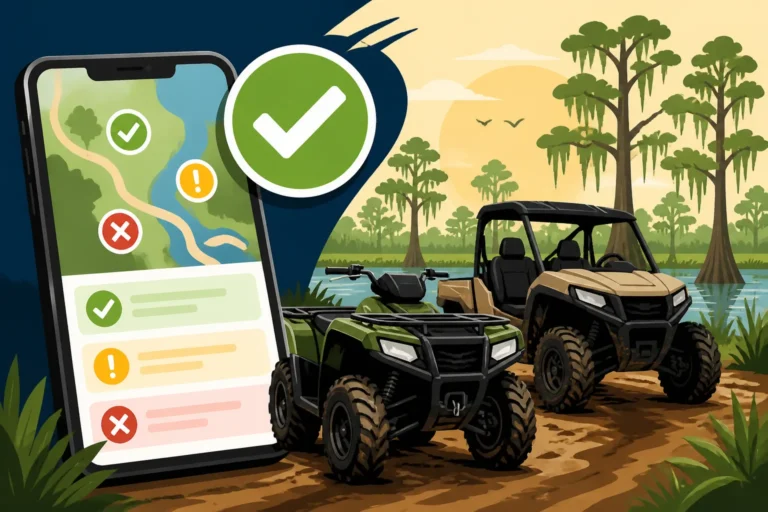
A mapping app such as onX Offroad can help you organize a route and keep track of planned stops. Use it as a planning aid, not as final proof of access: a mapped line does not by itself establish that a route is open, legal, or suitable for your machine. Compare what you see in the app with official trail maps, posted signs, and property rules. Download or save the information you will need before heading into areas with weak reception.
A backup plan helps when weather or access changes your first choice. You might postpone a muddy-park visit if the park is not operating, or switch to a different confirmed riding area rather than searching for unofficial paths near town. Do not treat a public road, forestry track, or private driveway as a substitute trail without checking access rules and obtaining permission where needed. [Louisiana Trail Conditions After Rain] offers useful context for thinking through weather-related changes.
Pack for a long day, not just the ride itself
North Louisiana’s heat, humidity, bugs, and sudden weather shifts can make a short ride feel much longer. Bring drinking water, sun protection, a first-aid kit, and a change of clothes that can stay dry in the tow vehicle. For a mud park, pack towels, cleanup supplies, and a way to keep muddy gear away from food, phones, and clean clothing.
For a forest trail day, carry a paper or offline map, a charged phone, and a basic tool kit suited to your machine. Tell someone where you are going and when you expect to return. If the group is spread across different machines, agree on meeting points and a simple plan for a breakdown before anyone rides out of sight. A person who knows the route and expected return time can help if the group has trouble reconnecting.
Also think through the trip home. Mud, standing water, and debris can collect in places that are difficult to inspect at a dark roadside stop. Bring straps and basic cleanup supplies, and plan a safe place to check the machine before towing. For more packing ideas, [Packing for Humid Heat] and [Trailering to a Mud Park] are relevant to a Sarepta-area outing.
Choosing between private parks and public trails
Private parks can suit groups that want an event atmosphere
A private mud park can make group planning simpler because the riding experience is concentrated in one managed location. Riders can meet there, use the grounds subject to the park’s rules, and build a day or weekend around the activities offered. For friends bringing different skill levels, that can be easier than coordinating a ride across an unfamiliar public trail system.
The trade-off is that private access comes with property-specific conditions. Event schedules may shape when you can ride, and rules can cover machine types, speed, passengers, camping, noise, and safety equipment. Read those rules before the trip, especially if someone in your group has not visited a mud park before. Do not assume a waiver or prior visit at another park settles the requirements at this one.
A park setting can also get busy. If your group includes children or less-experienced riders, decide how you will supervise them, where to meet if separated, and which areas are appropriate for their skill level. Keep the group’s pace conservative around other riders, campgrounds, and shared spaces. [Muddy Bottoms' Bathhouse, Pro Shop and Amenities] is one topic to consult when weighing what facilities may matter to your group, while the park’s own information should guide your final decisions.
Public trails reward riders who follow the designated route
Public trails can offer a different kind of outing: more attention to route-finding, terrain, and land-use rules. The key is staying on routes officially open to your machine. Taking an unmarked shortcut or riding onto a closed route can damage land and create access problems for future riders.
Before you go, learn the route’s restrictions. Public areas may limit machine dimensions, weight, tire size, or where you can ride. Requirements can vary among forest trails and wildlife management areas, so do not assume that one pass or permit covers every location. [Louisiana WMA Riding Rules for Quads] and [Louisiana WMA Riding Rules for UTVs] are useful if a wildlife management area is part of your plan, but check the specific site’s current guidance as well.
Public-land riding also calls for a little more self-sufficiency. A trailhead may not offer the services or amenities you would find at a developed private park, and some locations have limited reception. Bring what you need, respect posted closures, and leave the area as you found it. If a route is blocked or unclear, turn around instead of improvising a new trail.
A mixed itinerary can work if you keep the logistics realistic
Some riders use Sarepta as a base and plan more than one kind of outing across a weekend. That can work if each destination’s access and timing are confirmed in advance. It is less comfortable when the schedule is too tight, the group expects to ride at several places in one day, or the second option is only a vague backup that has not been checked.
For a mixed itinerary, set priorities. Choose the main ride first, then select a backup that is actually open and suitable for your machines. Allow time for loading, fuel, food, cleanup, and the drive between locations. With a large group, appoint one person to confirm the details and share the final plan so everyone arrives with the same expectations.
Mapping tools such as onX Offroad can help keep destinations and planned routes organized, but validate access through the park or land manager. Save the address and directions for the actual entrance rather than relying on a general map pin. A well-planned day is not about squeezing in the most miles; it is about making sure the group can ride legally, safely, and without a last-minute scramble.
Local access, rules, and trail etiquette
Do not assume a road near Sarepta is open to ATVs
Being close to a riding area does not make nearby public roads or private lanes legal trails. Louisiana has specific rules for ATV and UTV use on roads, and any road-use exception is narrower than simply riding from one place to another. A route that looks quiet or rural may still be off limits to recreational riding.
For details on road use, read [Can You Ride an ATV on the Road in Louisiana?] and [Louisiana UTV Street Legal Rules by Parish]. Check the rules that apply to the exact road and parish, and pay attention to signs and local restrictions. Do not rely on another rider’s account as permission to use a route; circumstances and local designations can differ.
Private land is different but still requires permission. A field road, timber track, or access lane may appear to connect two destinations, yet that does not mean riders have a right to use it. Obtain clear permission from the landowner or authorized manager, and respect gates, posted signs, and requests to stay out. Riding only where access is confirmed protects both your trip and the relationships that keep private riding opportunities available.
Build courteous habits into the ride
Trail etiquette matters whether you are on a public route or at a private park. Slow down near people, campsites, trailheads, and areas where visibility is limited. Give other riders space, avoid spraying mud or dust toward camps and vehicles, and make sure everyone in your group understands how you will communicate if the line of sight breaks.
On public land, stay on the designated route and avoid widening it by riding around mud, puddles, or obstacles. Going around a soft spot may create a new track that damages vegetation or encourages others to leave the trail. If conditions seem unsafe or a section is closed, turn back rather than forcing the group through it. [Louisiana Trail Etiquette Locals Expect] is a useful companion read for the small habits that make shared riding areas better for everyone.
At a private event, follow the park’s posted speed, passenger, and safety rules. Be patient at busy crossings and shared facilities, and keep noise and late-night activity considerate of other visitors. A little courtesy goes a long way when many groups are using the same property over a short period.
Check the machine before and after the ride
A quick pre-ride check can catch problems before they become a long walk back to the trailer. Inspect tires, brakes, steering, lights, fluid levels, and visible damage. Confirm that the machine is secured for transport and that you have the keys, safety gear, and any documents required for the riding area. If you ride with a group, make sure every machine has a clear identification method so no one is left guessing which vehicle belongs to whom.
After a muddy ride, clean the machine and inspect it rather than putting it away coated in debris. Mud and water can hide damage and contribute to wear, especially around moving parts and electrical connections. Follow the owner’s manual for cleaning and maintenance, and check areas that took repeated hits or deep water crossings.
If you notice a new vibration, warning light, leak, or handling change, deal with it before the next outing. A machine that felt fine while coated in mud may behave differently once cleaned and back on the road or trailer. [Washing a Machine After a Mud Weekend] and [Louisiana Trail Riding After Heavy Rain] offer further planning and care considerations for conditions common to muddy rides.
A practical checklist for riding near Sarepta
Before you leave home
Start with the exact destination and the date. Confirm that the private park or public trail is open, then check the applicable rules for your machine and group. For public land, verify maps, passes or permits, closures, and machine limits; for a private park, confirm its event details, entry arrangements, and property rules.
Next, make sure the trailer and tow vehicle are ready. Check straps, tire condition, lights, fuel, and the location of the entrance and parking area. Save the address and any maps you will need offline. If you are using onX Offroad to organize navigation, compare its route information with official access details and do not follow a mapped line onto land or roads where riding is not permitted.
Finally, give the group a clear plan. Share the meeting time, expected return, what to bring, and what happens if someone gets separated or has a mechanical issue. This is especially helpful when several families or vehicles are traveling separately to the same destination.
At the riding area
Take a few minutes to read the signs and confirm any instructions from staff or land managers. At a park, ask where your group may ride and whether any sections are restricted. On public land, use the designated route and keep any required permit or access paperwork with you.
Before unloading, check that the parking and staging area can safely accommodate your trailer and machine. Keep vehicles and equipment out of travel lanes, and avoid blocking gates or trail entrances. If the site looks different from what you expected, ask before proceeding; a closed route or restricted area is not an invitation to find another way through.
Set a pace that works for the least-experienced rider in your group. Agree on stops, regrouping points, and a rule that nobody rides off alone without telling someone. Those simple decisions can prevent the most common group-ride headaches.
After the ride
Do a head count before leaving, and check that every machine and piece of gear is loaded securely. Inspect the machines for obvious damage or debris that could create a problem during transport. If you used a public area, make sure you have not left trash or equipment behind.
Before your next trip, note what worked and what did not: whether the trail suited the group, how long loading took, what gear you wished you had brought, and whether the location is worth revisiting. Keep destination notes tied to confirmed access information rather than memory alone. That makes the next Sarepta-area ride easier to plan and less likely to be derailed by a closed gate or an unsuitable route.
Disclaimer
This article is for general informational purposes only and does not constitute professional advice. Laws, prices and regulations vary by location and change over time. Consult a qualified professional for guidance on your specific situation.