Orleans Parish Is Written Out of the Statute
It’s easy to feel lost in a maze of rules and regulations when it comes to riding your ATV or UTV on public roads in Louisiana. Many riders assume a universal state law applies everywhere, only to find themselves scratching their heads when confronted with specific local ordinances or, more confusingly, complete statutory exemptions. This guide aims to clear up a significant point of confusion, particularly regarding Orleans Parish, and help you understand the patchwork of laws governing off-road vehicles on Louisiana's streets.
Understanding Louisiana's Off-Road Vehicle Statutes
Navigating the legal landscape for ATVs and UTVs in Louisiana can feel like trying to find solid ground in a cypress swamp – it's often murky and full of hidden snags. The state has specific statutes that lay down the general groundwork for where and how you can operate these machines, but these are not always the final word, especially when it comes to riding on public roads.
The Broad Strokes of State Law
Louisiana Revised Statute 32:299 specifically addresses ATVs, generally prohibiting their operation on public roads and highways. This statute was put in place to ensure the safety of all road users, as ATVs are designed for off-road terrain, not for mixing with cars, trucks, and other traditional traffic. They lack many of the safety features, like crumple zones or seatbelts (on many models), that are standard in street-legal vehicles. This ban on public roads is a major point of frustration for many riders who just want to get from one part of their property to another or access nearby trails.
Similarly, Louisiana Revised Statute 32:299.3 covers UTVs, or side-by-sides, which are often larger and can carry more passengers, leading some to mistakenly believe they are inherently more suitable for road use. However, the state statute still imposes significant restrictions. These laws are designed to manage the unique risks that come with these vehicles when they are introduced into a shared traffic environment. Think about it: a UTV, while more stable than an ATV, still handles differently than a car, especially at speed, and isn't built to withstand impacts with larger vehicles. The legislature's intent was to prevent accidents and maintain order on our public thoroughfares. [Louisiana Bans ATVs From Travel Lanes]
Exceptions to the Rule: Farm Use and Designated Roads
While the general rule is "no public roads," Louisiana law does carve out some very specific exceptions. One of the most common and important is the agricultural or farm use exemption. This allows ATVs and UTVs to be operated on public roads if they are being used for bona fide farm purposes. There are strict conditions, though: the vehicle must be used for agricultural operations, and the driver typically needs to carry a sworn affidavit attesting to this. Furthermore, this exemption generally limits operation to the shoulder of a public road within a five-mile radius of the farm property. It's not a free pass to drive your machine to the grocery store, even if you just harvested some prize-winning tomatoes.
Beyond farm use, the state also allows individual parishes or municipalities to designate certain roads or streets for UTV use. This is where things get even more localized and often confusing for riders. A parish police jury or city council must pass an ordinance specifically designating which roads are open to UTVs and typically has requirements for signage. These designated roads are the only public thoroughfares where UTVs are permitted under such an ordinance. This means that just because a neighboring parish has designated roads doesn't mean your parish has, or that you can ride your UTV there. It’s a truly localized decision, which means you have to do your homework. Riders who think they can simply hop on any street often face citations because they haven't verified the specific local rules. Always remember that a valid Class E driver's license is required for anyone operating a UTV on a designated public road. [Louisiana Requires a Class E License]
The Orleans Parish Anomaly: Why It's Different
Now, let's talk about the specific situation that often throws people for a loop: Orleans Parish. Unlike virtually every other parish in Louisiana, Orleans Parish stands apart when it comes to the state's ATV and UTV road-use statutes. This exception is not a small footnote; it fundamentally alters how the state laws apply within its borders.
The Specific Exclusion in the Statute
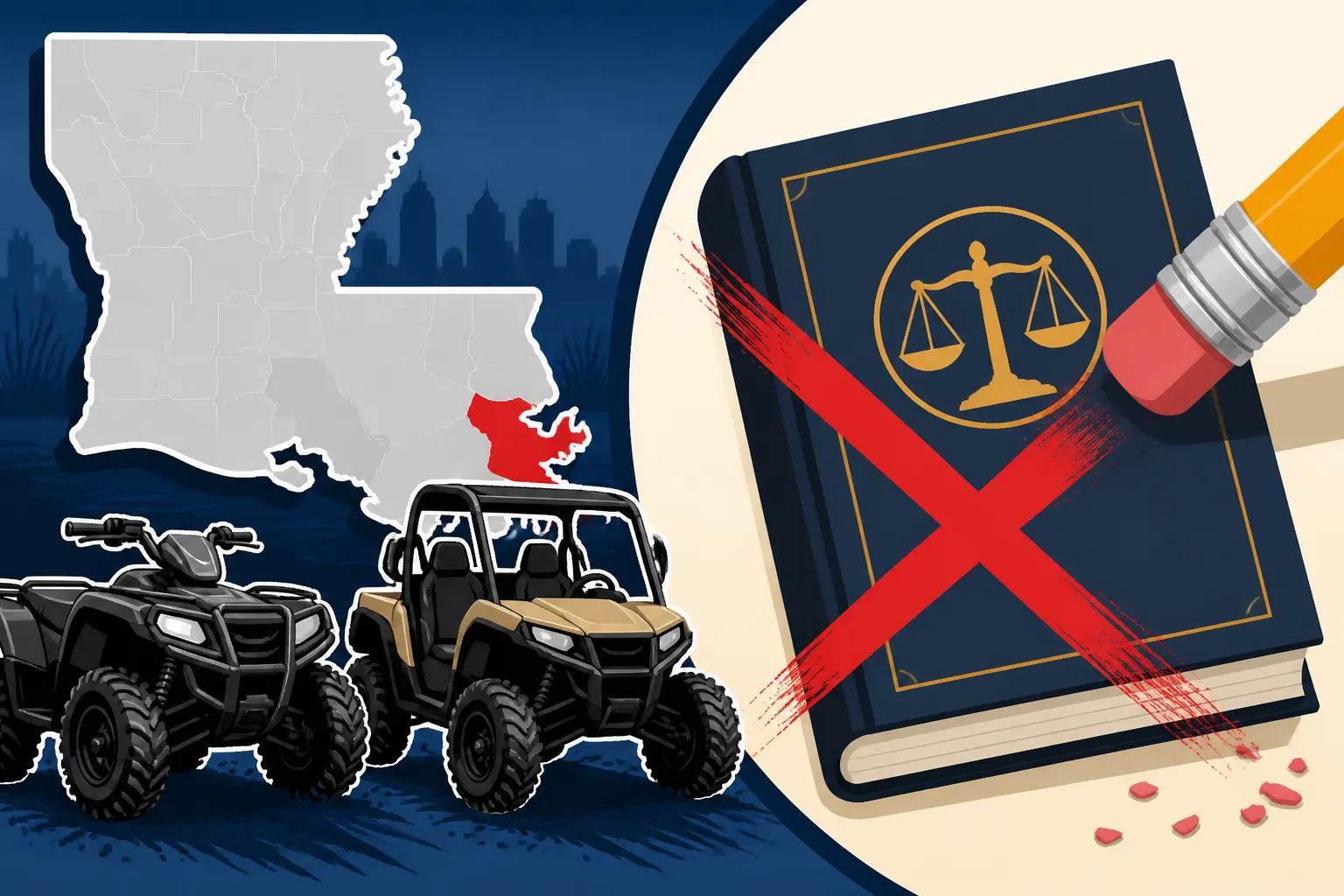
If you take a close look at Louisiana Revised Statute 32:299 (for ATVs) and 32:299.3 (for UTVs), you'll notice specific language that explicitly states these statutes do not apply to Orleans Parish. This means that the statewide prohibitions on ATV and UTV road use, and the specific conditions for exceptions like farm use or designated parish roads, simply do not govern what happens on the streets of New Orleans. It's an exemption written directly into the law itself, setting Orleans Parish in a unique legal position compared to the rest of the state.
However, and this is a crucial "however," this statutory exemption does not mean that ATVs and UTVs are automatically street legal in Orleans Parish. It's not a green light to drive your quad down Bourbon Street. What it does mean is that the state legislature effectively punted the issue to the local government. They decided that the unique urban environment of New Orleans, with its dense population, complex traffic patterns, and often historic, narrow streets, required a more tailored approach than a one-size-fits-all state law could provide. This allows the City of New Orleans to craft its own ordinances and regulations regarding off-road vehicles, free from the constraints of the broader state statutes. It means you can't rely on what you know about ATV laws in, say, Rapides Parish, when you're in the Crescent City.
Local Ordinances and Their Role
Since the state statutes explicitly exclude Orleans Parish, the responsibility for regulating ATV and UTV use on public roads falls entirely to the local government – the City of New Orleans. This means that to understand what you can and cannot do with your off-road machine in Orleans Parish, you must consult the city's ordinances. Ignoring these local laws is just as risky as ignoring state law in any other parish. [Louisiana Parish Ordinance Lookups]
The City Council of New Orleans has the authority to create specific rules, which could range from outright bans on all public roads to specific designations for certain types of utility vehicles used by city agencies or businesses. They might also have particular equipment requirements, time-of-day restrictions, or designated areas for operation. The challenge for riders is that these local ordinances can be harder to track down and might not be as widely publicized as state laws. It's a prime example of why checking hyper-local rules is absolutely essential before you even think about putting tires on pavement. You wouldn't want to assume anything about parking rules in a new city; the same caution applies here.
What Orleans Parish Riders Need to Know
For those who live in or frequently visit Orleans Parish with an ATV or UTV, the unique legal situation requires a heightened level of awareness. You can't just assume the general state rules apply, nor can you assume the state's exemption means you're in the clear.
Navigating New Orleans Streets with an ORV
Given the state's explicit exemption for Orleans Parish, any decisions about allowing ATVs and UTVs on public roads rest squarely with the City of New Orleans. As of now, without a specific designating ordinance from the City Council that details how and where ATVs and UTVs might be operated on public streets, the default stance for most law enforcement will likely be that they are prohibited. New Orleans is a bustling urban environment, and the risks associated with off-road vehicles mixing with cars, streetcars, pedestrians, and cyclists are significant. Commuting on a quad through the French Quarter or the Garden District is simply not a sanctioned activity.
Even for utility use, such as for businesses or individuals needing to move equipment on a UTV, permission would almost certainly need to be obtained through specific city permits or ordinances. Recreational riding on public streets without clear, explicit local permission is a risky proposition, and it's best to assume it's not allowed. You'll often see city-owned utility vehicles, like those used by sanitation or parks departments, but these operate under specific departmental authorizations, not a general public right-of-way. Always remember that even if the state statute doesn't apply, common sense and local public safety concerns still dictate what is permissible. [Louisiana Insurance Proof on Demand]
Consequences of Ignoring Local Rules
The fact that state law doesn't apply to Orleans Parish doesn't grant riders immunity from legal consequences if they operate an ATV or UTV on city streets without permission. Local law enforcement in New Orleans, including the New Orleans Police Department (NOPD) and other city agencies, have the authority to enforce local ordinances and traffic laws. If a local ordinance prohibits ATVs or UTVs on public roads, or if you're operating one in a manner deemed unsafe or unlawful, you could still face significant penalties. [Louisiana Penalties for Illegal Road Riding]
These penalties can include hefty fines, the impoundment of your vehicle, and even more serious citations depending on the nature of the infraction. An impounded machine can mean a significant financial burden, not just from the initial fine, but from towing and storage fees that accrue daily. For instance, if you're pulled over for riding your ATV on a busy street in Mid-City, an NOPD officer would likely be enforcing a local ordinance or general traffic safety rules, not the state's specific ATV statute. It’s critical to understand that the absence of a state restriction does not imply permission; it simply shifts the regulatory burden to the local level. Always verify specific rules with the City of New Orleans before you decide to ride on any public thoroughfare within Orleans Parish.
| Feature | General Louisiana State Law (Excluding Orleans Parish) | Orleans Parish |
|---|---|---|
| ATV/UTV Road Use | Generally prohibited on public roads, with specific exceptions (farm use, designated UTV roads). | State statutes do not apply. Road use determined solely by City of New Orleans ordinances. |
| Farm Use Exemption | Explicitly defined and allowed under strict conditions (affidavit, 5-mile radius). | Not covered by state law. Local ordinances would govern any farm-related exemptions. |
| Designated Roads | Parishes/municipalities can designate roads for UTVs, with signage. | State designation process does not apply. City of New Orleans can create its own designations. |
| Governing Authority | Louisiana Revised Statutes 32:299 and 32:299.3. | City of New Orleans ordinances and local traffic laws. |
| Rider Responsibility | Understand state law and check local parish designations. | Understand City of New Orleans ordinances. |
Practical Steps for Louisiana Riders, Regardless of Parish
Understanding the nuances of ATV and UTV laws in Louisiana, especially with the unique situation in Orleans Parish, can feel overwhelming. However, there are practical steps you can take to ensure you're riding safely and legally, no matter where you are in the state. The key is proactive research and equipping your machine appropriately if local rules permit.
Checking Local Ordinances and Designations
The absolute first step for any rider contemplating taking their ATV or UTV onto a public road, whether it's a small parish road outside Lafayette or a street in New Orleans, is to always check local ordinances. Don't rely on what you think the law is, or what your buddy told you. For parishes outside Orleans, you'll want to check with the parish police jury or the clerk of court's office to see if any roads have been designated for UTV use. Many parishes have their ordinances available online through their official government websites. [Louisiana Municipal Ordinance Lookups]
For Orleans Parish specifically, your inquiry should be directed to the City of New Orleans government. Look for departments responsible for transportation, public works, or the city clerk's office. A phone call or a visit to their official website can often yield the most accurate information. It's a bit of legwork, but it's far better than facing a citation or impoundment. Take a screenshot or print out any relevant ordinances you find, as having proof of your research can be incredibly helpful if you ever encounter a question from law enforcement.
Essential Equipment and Modifications (Where Permitted)
If you're lucky enough to live in a parish or municipality that has designated roads for UTVs, or if Orleans Parish ever creates such designations, your machine will almost certainly need to meet certain equipment standards to be considered street-legal. These often include things that aren't standard on most off-road machines, but are essential for road safety. Think about the basics you see on any car: headlights, taillights, brake lights, and turn signals are typically required. You'll also likely need a horn, rearview mirrors, and a windshield.
Many aftermarket companies, such as SuperATV, offer kits and individual components designed to help UTV owners meet these requirements. You can find everything from universal turn signal kits and DOT-approved windshields to side mirrors and license plate relocation brackets. While these modifications don't make your machine street legal on their own – that's up to the local ordinance – they are necessary prerequisites if road use is permitted. For example, ensuring your UTV has proper lighting, especially if you might be operating it during low-light conditions, is critical. [Louisiana Rules for Riding After Dark] Beyond legal requirements, always consider safety gear like helmets, even if not strictly mandated for UTVs in all street-legal scenarios, as they provide crucial protection. [Is a Helmet Required on a Louisiana UTV?] Equipping your machine correctly shows responsibility and helps protect you and others.
Broader Implications for Off-Road Enthusiasts
The Orleans Parish situation, while unique, serves as a stark reminder of the broader complexities surrounding ATV and UTV laws across Louisiana. It highlights how varying interpretations and local control can create a confusing landscape for riders who simply want to enjoy their machines.
The Patchwork of Louisiana Regulations
Louisiana’s regulatory framework for off-road vehicles is, to put it mildly, a patchwork quilt with many different stitches. On one hand, the state has clear, statewide rules for titling and decals. Whether you buy a new quad from a dealer in Shreveport or a used side-by-side from a private seller in Houma, you'll deal with the Louisiana Office of Motor Vehicles (OMV) for titling and the yearly off-road vehicle decal. These processes are relatively consistent across the state, ensuring a standardized system for ownership and identification. [Why an ATV Needs Both a Title and a Decal]
However, when it comes to where you can actually ride those titled and decaled machines, especially on public roads, the consistency often evaporates. The Orleans Parish exemption is the most extreme example, but even in other parishes, the discretion given to local governments to designate roads for UTVs means that what's legal in one parish might be strictly prohibited just across the parish line. This variability means that a rider from Caddo Parish who travels to Ouachita Parish for a hunting trip might find entirely different rules for using their UTV on access roads. This lack of uniformity can be frustrating and difficult to navigate, often leaving riders guessing or, worse, inadvertently breaking local laws. Many enthusiasts advocate for clearer, more consistent state-level guidance, or at least a centralized, easily accessible database of local ordinances.
Riding Off-Road Safely and Legally
Given the intricate and often restrictive rules regarding public road use, especially in places like Orleans Parish where local ordinances hold sway, the safest and most straightforward option for ATV and UTV enthusiasts remains designated off-road areas. Louisiana boasts a variety of fantastic places to ride, from sprawling private mud parks to extensive trail systems on public lands.
Places like Muddy Bottoms ATV Park or the trails within Kisatchie National Forest offer dedicated spaces where you can fully enjoy your machine without the constant worry of legality on public roads. These areas are designed for off-road vehicles, providing diverse terrain from deep mud to scenic forest trails. While public lands, such as Wildlife Management Areas (WMAs), often come with their own set of rules regarding machine size, tire type, and seasonal closures, they are clearly designated for off-road recreation. You'll typically need to obtain specific permits, such as a self-clearing permit for WMAs or a forest pass for Kisatchie. [Louisiana ATV Trails: Where to Ride] [Louisiana WMA Access Permits] Always check the specific rules of any riding area before you go, but embracing these dedicated off-road spaces ensures a legal, safe, and truly enjoyable experience for everyone.
Disclaimer
This article is for general informational purposes only and does not constitute professional advice. Laws, prices and regulations vary by location and change over time. Consult a qualified professional for guidance on your specific situation.