Louisiana’s 5-Mile Farm Radius
Riding an ATV or UTV in Louisiana often feels like navigating a minefield of rules and regulations, especially when you need to take your machine beyond private property. The frustration is real: you've got work to do, land to manage, or simply need to get from one part of your property to another, but the thought of a ticket for illegal road use can be daunting. This comprehensive guide will demystify Louisiana's specific "5-mile farm radius" exemption, helping you understand precisely when and how you can legally operate your off-road machine on public roads for agricultural purposes without running afoul of the law.
The Core of Louisiana's Road Rules for Off-Road Machines
Let's be clear from the get-go: in Louisiana, off-road vehicles like ATVs and UTVs are generally not considered street-legal. This is a crucial distinction that many riders misunderstand, leading to costly tickets and even impoundments. The state's primary focus is on public safety, and the design of most ATVs and UTVs simply isn't suited for the speeds, traffic, and structural demands of typical road use. They lack many of the safety features, like sealed cabins, airbags, or proper turn signals and brake lights, that are standard on street-legal vehicles.
Why Off-Road Machines Aren't "Street Legal"
The core reason ATVs and UTVs are not street-legal boils down to their design and the statutes governing public roads. Vehicles manufactured for off-highway use prioritize different capabilities: suspension for rough terrain, high ground clearance, knobby tires for traction in mud or dirt, and engines tuned for torque rather than sustained high speeds. These characteristics, while perfect for the back forty or a hunting camp, pose significant safety concerns on paved roads. For instance, the knobby tires, which excel off-road, can provide poor grip and wear quickly on asphalt, leading to unpredictable handling. The lack of proper mirrors, horn, and turn signals also makes them difficult for other motorists to anticipate.
Moreover, state law, particularly [Louisiana ATV Road Rules Under 32:299] and [Louisiana UTV Road Rules Under 32:299.3], explicitly defines what constitutes a "vehicle" suitable for public roads, and ATVs and UTVs typically don't meet these criteria without significant, often impractical, modifications. This means that even if you bolt on a horn or some extra lights, you're usually still in violation of the underlying statutes. The legal framework is designed to protect both the operator of the off-road vehicle and other drivers on the road. The intent is not to prohibit these machines, but to ensure they are used in the environments for which they were safely designed.
The Strict Limitations of Public Road Access
Given their non-street-legal status, any access that ATVs and UTVs have to public roads in Louisiana is strictly limited and almost always tied to specific, narrow exceptions. These aren't blanket permissions to zip down the highway. Think of it as a tightly controlled set of circumstances rather than a right to travel. The general rule is: if it's a public road, stay off it with your ATV or UTV. This applies whether it's a bustling interstate, a quiet parish road, or even the shoulder of a state highway. The law is quite explicit about prohibiting these machines from travel lanes and interstates entirely.
The exceptions that do exist are usually carved out for very specific purposes, such as law enforcement, emergency services, or, as we'll delve into deeply, agricultural use. Even within these exceptions, there are often precise rules regarding when, where, and how the machine can be operated. It's not enough to simply have an agricultural purpose; you must also adhere to the prescribed routes, times, and equipment requirements. For example, even if you qualify for an exemption, you're typically not allowed to cruise down the center of a parish road; you'll be relegated to the shoulder. Understanding these strict limitations is the first step in avoiding legal trouble and ensuring your valuable off-road machine doesn't end up on the wrong side of a state trooper's citation pad.
Understanding the Agricultural Exemption and the 5-Mile Radius
This is where many Louisiana off-road enthusiasts and landowners find a glimmer of hope, but it's often misunderstood. Louisiana Revised Statute 32:299 (for ATVs) and 32:299.3 (for UTVs) provides a very specific, limited exemption for agricultural purposes. It's not about making your machine street legal, but rather about allowing necessary movement for farming or related activities. The core of this exemption is the "5-mile farm radius," which permits limited travel on public roads, but only under very strict conditions.
What Constitutes "Agricultural Purpose" in Louisiana Law
The term "agricultural purpose" is key here, and it’s often broader than just planting and harvesting row crops. In Louisiana, this typically encompasses a wide range of activities directly related to farming, ranching, timber operations, and even certain aquaculture practices. This can include, but isn't limited to:
- Crop Farming: Transporting equipment or personnel to different fields for planting, cultivating, or harvesting corn, soybeans, rice, cotton, or sugarcane. This often involves moving from one side of a property to another, or to a nearby leased field.
- Livestock Management: Checking on cattle, fences, or feed plots, moving small equipment for animal care, or accessing different pastures within the farm operation.
- Timber Operations: Supervising logging activities, checking forestry plots, or transporting small tools and personnel within a designated timber tract.
- Fisheries/Aquaculture: Managing crawfish ponds, checking water levels, or moving small gear between different ponds or processing areas.
- Maintenance of Agricultural Infrastructure: This might involve accessing irrigation systems, repairing farm roads, or maintaining drainage ditches that are integral to the agricultural enterprise.
What it does not include is recreational riding, hunting access (unless directly tied to farm management, which is rare), or general transportation for non-agricultural errands. If you're using your ATV to drive to the local store for a gallon of milk, or to access a deer stand that isn't part of an active farming operation, you are almost certainly outside the scope of this exemption. The intent is strictly for the functional needs of the farm, not for convenience or leisure. It’s important to remember that [Every Legal Road Trip Has to Be Farm Related] when considering this exemption.
Pinpointing the 5-Mile Radius: Where Does it Start?
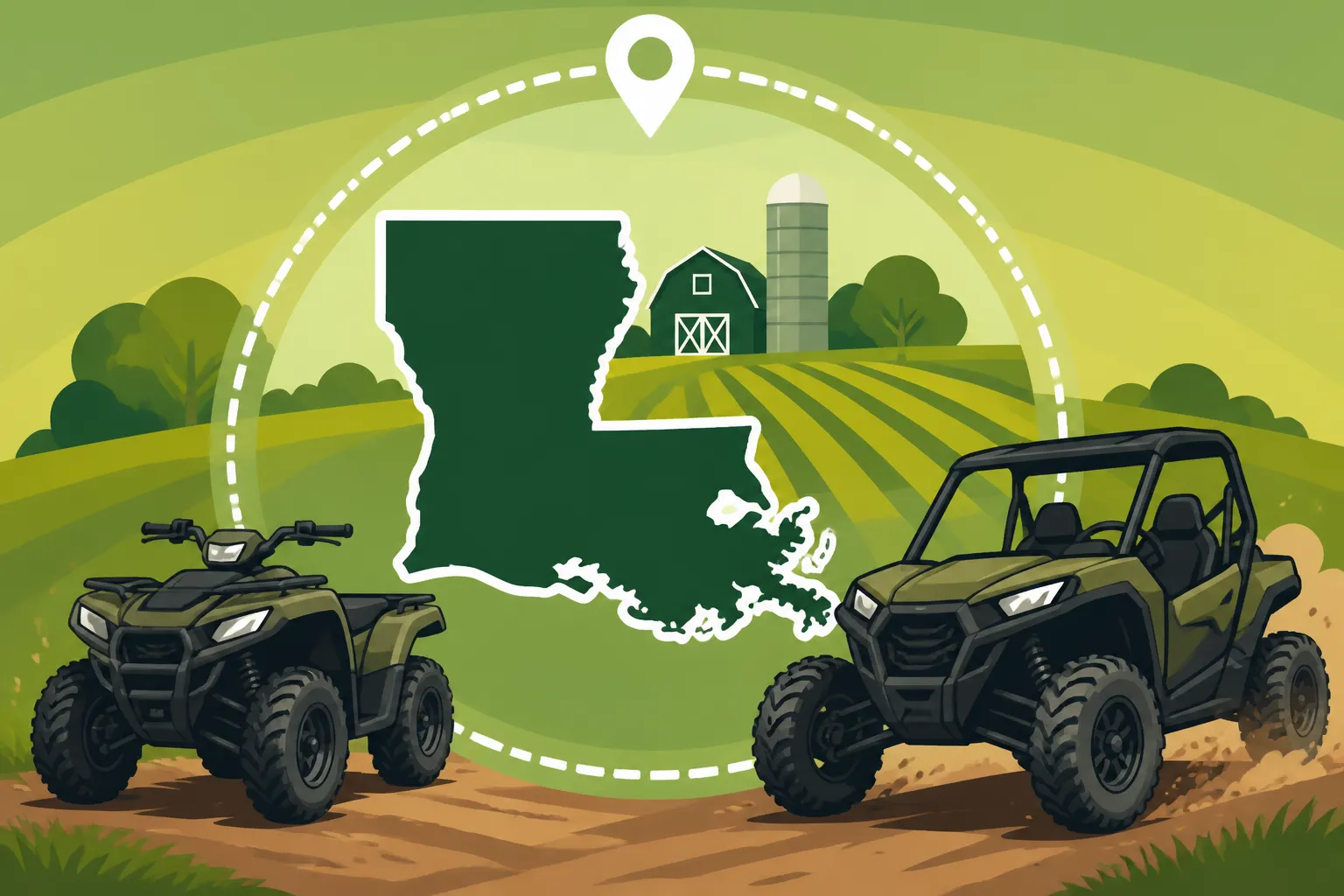
Understanding [Where the 5-Mile Radius Is Measured From] is crucial for compliance. The 5-mile radius isn't an arbitrary circle drawn on a map that allows you to roam freely. Instead, it's a practical limit on how far you can travel from the farm premises itself. The law states that the ATV or UTV must be "operated within five miles of the owner's farm or ranch." This means your point of origin (your farm or ranch property) dictates the radius.
Imagine your main farmstead or the primary parcel of land where your agricultural operations are centered. The 5-mile radius extends outward from the boundaries of that property. So, if you have a field three miles down the road from your main barn, you're likely within the radius. If you have another parcel of land eight miles away, you would generally fall outside of this specific exemption for travel to that distant property. The intent is to facilitate short-distance travel for contiguous or very closely situated agricultural lands, not to enable long-haul transportation. This is about practical, localized farm mobility.
It's not uncommon for farm owners to have scattered parcels of land, and calculating that 5-mile distance can sometimes be tricky. Always err on the side of caution. If you're unsure, it's better to transport your machine by trailer than to risk a citation. The law intends to make farm life more efficient, but not to open public roads to general ATV/UTV traffic.
The Specifics of Permitted Road Use Within the Radius
Even when you are within the 5-mile farm radius and operating your ATV or UTV for a legitimate agricultural purpose, your permissible use of public roads is extremely limited. This isn't a free pass to drive as you would a car. Louisiana law is very precise about how you can use the road, primarily restricting you to the shoulder and only allowing crossings where absolutely necessary and incidental to your farm work.
Riding on the Shoulder: The Only Acceptable Path
When operating an ATV or UTV on a public road within the 5-mile farm radius, [The Statute Allows the Shoulder and Nothing More]. This is a critical point that many riders miss or disregard, often leading to fines. You are not permitted to ride in the travel lanes of the road, even if traffic is light or nonexistent. Your machine must remain on the shoulder, defined as the improved or unimproved area adjacent to the main travel lane. This usually means the gravel, dirt, or grass area directly next to the paved or maintained part of the road.
The purpose of this restriction is safety. Riding on the shoulder keeps your slower-moving, less visible off-road machine out of the direct path of faster-moving vehicles. It acknowledges that farm machinery, including ATVs and UTVs, needs occasional access but prioritizes the safety of the general motoring public. If there is no discernible shoulder, or if the shoulder is impassable due to deep mud, severe erosion, or dense vegetation, then that particular section of road generally cannot be legally used, even if you're within the 5-mile radius and have a valid agricultural purpose. You cannot simply move into the travel lane because the shoulder is difficult.
Operators also need to be mindful of maintaining a safe speed appropriate for shoulder conditions and being acutely aware of surroundings. Other vehicles might pull off onto the shoulder, or pedestrians and cyclists might be present. Visibility is key, especially during dawn or dusk. Equipping your machine with bright, reflective elements can greatly enhance safety, even if not explicitly mandated for this specific type of travel. Aftermarket accessories from companies like SuperATV, known for their durable lighting and safety equipment, could be a wise investment for anyone frequently utilizing this limited exemption.
Crossing Public Roads: Incidental vs. Intentional Travel
The law also makes provisions for [Louisiana Rules for Crossing a Highway] when necessary for agricultural operations. However, this is also a very narrow allowance. You can cross a public road, but only when such crossing is "incidental" to your farm work and essential to get from one part of your farm to another. This means you can't use the act of "crossing" as an excuse for sustained travel along the road.
Let's break down what "incidental" means in this context:
- Permitted Incidental Crossing: Imagine your farm fields are on both sides of a parish road. You need to move your ATV from Field A to Field B to spray crops. Crossing the road directly to get from one field to the other is generally considered incidental. The goal is to move across, not along, the road.
- Not Permitted Intentional Travel: If you need to go from Field A to a supply store five miles down the road, and that trip involves driving for a significant distance on the road, that's generally not considered an incidental crossing. It becomes intentional travel along the road, which is typically prohibited, even if your ultimate destination is farm-related. The 5-mile radius for shoulder riding is a different allowance than "incidental crossing."
The key is that the crossing should be as direct and quick as possible. You should yield to all vehicular traffic and exercise extreme caution. Just like riding on the shoulder, safety is paramount. Make your intentions clear, use hand signals if necessary, and ensure your machine is visible. Being cited for illegal road use is a real possibility if a law enforcement officer perceives your "crossing" as an attempt to circumvent the rules for general road travel. This limited crossing privilege is meant to allow for practical farm movements, not to create loopholes for riders seeking to use public thoroughfares.
Essential Paperwork and Machine Requirements for Farm Use
Understanding the "what" and "where" of the 5-mile farm radius is only half the battle. To truly be in compliance, you also need to ensure you have the correct paperwork on hand and that your machine meets any specific equipment requirements. The state isn't just looking at where you're riding, but how you've documented your agricultural purpose.
The Importance of a Louisiana Farm Affidavit for Road Use
Perhaps the single most critical piece of paperwork for operating your ATV or UTV under the agricultural exemption is the [Louisiana Agricultural Affidavits for an ATV]. This document, often referred to simply as a "farm affidavit," is your official declaration that your machine is being used primarily for bona fide agricultural purposes. It's not something you just write down on a napkin; it must be properly completed and sworn before a notary public. [Swearing an Affidavit That a Quad Is Farm-Only] gives it legal weight and makes it a binding statement.
What does this affidavit do? It serves as proof to law enforcement that you are operating your off-road machine under the specific agricultural exemption provided by state law. Without it, even if you're genuinely on your farm and within the 5-mile radius, you might have a difficult time convincing a state trooper or parish deputy that your road use is legal. The affidavit typically includes details about the owner, the ATV/UTV's VIN, and a sworn statement about its primary use for farming, ranching, timber, or aquaculture operations.
You should carry a copy of this notarized affidavit with you whenever you operate your ATV or UTV on public roads under this exemption. Keep it in a waterproof bag on your machine, or in your wallet, so it's readily available if you're stopped. For machines used purely on private land and never touching a public road, this affidavit isn't necessary. However, if you anticipate even occasionally traversing a road or shoulder within the 5-mile radius for farm work, getting this affidavit squared away is a non-negotiable step. It's your first line of defense against potential penalties for illegal road riding.
Machine Equipment for Legal Road Transit
While the agricultural exemption doesn't require you to turn your ATV or UTV into a fully street-legal vehicle, there are practical and often statutory considerations for basic safety equipment, particularly if you're crossing roads or riding on the shoulder where you might encounter other traffic. The state statute (R.S. 32:299 for ATVs and R.S. 32:299.3 for UTVs) specifies that a special decal is required. [The Decal a Farm-Exempt Quad Still Has to Carry] is essentially your annual permit for this limited road use. It shows that your machine has been recognized for this exemption and that you've paid the minimal yearly fee.
Beyond the decal, while explicit requirements for lights, mirrors, or turn signals for this specific agricultural exemption are less stringent than for designated street-legal UTVs, common sense and general traffic laws still apply when operating on public thoroughfares.
- Lighting: If you're operating near dawn or dusk, or in conditions of reduced visibility, having functioning headlights and taillights is crucial for your safety and to be seen by other motorists. Some UTVs come with good lighting systems from the factory, but for older ATVs, consider adding aftermarket LED lights.
- Visibility: Reflective tape, bright clothing, and even a safety flag can significantly increase your visibility to other drivers, especially on dusty shoulders or at road crossings.
- Brakes and Steering: Ensure your machine's brakes and steering are in excellent working order. This isn't just about legality, but about fundamental safety when sharing any part of a public roadway.
- Tires: While knobby tires are great for mud, ensure they are in good condition and properly inflated if you're riding on the shoulder. Worn or improperly inflated tires can be a hazard, especially on hard surfaces.
Remember, the goal is to safely and visibly navigate the limited public road segments allowed by the agricultural exemption. While Louisiana law for this specific exemption doesn't impose the full gamut of street-legal modifications, basic safety practices are always prudent. You don't want to give a law enforcement officer any reason to question your safe operation, especially when you're already operating under a conditional privilege.
Common Misconceptions and Costly Mistakes
Despite the clear language of the statutes, many ATV and UTV riders in Louisiana fall prey to common misunderstandings regarding the 5-mile farm radius. These misconceptions can lead to citations, fines, and even the impoundment of your machine. It’s vital to distinguish between what the law truly allows and what many people mistakenly think it allows.
The Difference Between Farm Use and Recreational Road Riding
This is perhaps the biggest area of confusion. The agricultural exemption is precisely that: an exemption for farm use. It is not a backdoor way to make your off-road machine street-legal for recreational purposes.
- Misconception: "I can ride my quad to my hunting camp because it's technically on my land, and I'm within 5 miles."
- Reality: Unless your hunting camp is an integral part of an active farming, ranching, or timber operation (e.g., you're managing crops for wildlife food plots as part of a commercial farming enterprise, not just hunting for recreation), this is generally not considered agricultural use. Accessing a hunting camp for recreational hunting, even if it's on your property or leased land, typically falls outside the agricultural exemption.
- Misconception: "I can take my UTV down the road to my neighbor's house because he's a farmer too, and we're both within the 5-mile radius."
- Reality: While visiting a neighbor for farm-related business might fall within the spirit of the exemption, it's a gray area. The exemption is primarily for your farm operations. Social visits, even to other farmers, are unlikely to qualify. If you're moving equipment or discussing specific farm tasks that require the UTV, you might have a better argument, but it's not a guarantee.
- Misconception: "Since I'm allowed on the shoulder, I can ride my ATV to the gas station to fill up for the day's work."
- Reality: While the fuel is for farm work, using the public road solely to purchase fuel is typically seen as a commercial errand, not an direct agricultural operation on the farm. The exemption is for moving on or between farm premises for agricultural tasks, not for conducting general business off-site.
The core principle is intent and direct connection to on-farm agricultural activities. If the primary purpose of your road travel is anything other than directly facilitating your farm, ranch, or timber operation, you are likely outside the bounds of the 5-mile farm radius exemption. Law enforcement officers are trained to discern the difference, and a simple claim of "farm use" without a clear, direct, and immediate agricultural purpose for that specific trip is unlikely to hold up.
Penalties for Exceeding the Farm Exemption
Ignoring the nuances of the 5-mile farm radius or simply misinterpreting the rules can lead to significant consequences. Louisiana law enforcement takes illegal road use of ATVs and UTVs seriously, primarily due to safety concerns for both the operator and other motorists. [Louisiana Penalties for Illegal Road Riding] can range from hefty fines to more severe actions.
- Fines: The most common penalty is a monetary fine. These [Louisiana Ticket Costs for Road Riding] can vary, but they are rarely trivial. They often involve not just the base fine but also court costs and other administrative fees, quickly adding up to several hundred dollars. A first offense might be a warning, but repeat offenses almost certainly result in a ticket.
- Impoundment: In some cases, especially for blatant violations or repeat offenders, law enforcement has the authority to impound your ATV or UTV. Getting your machine back from impound can be an expensive and time-consuming ordeal, involving impoundment fees, storage fees, and potentially other administrative costs, in addition to any fines. This means your valuable equipment could be tied up for days or even weeks.
- License Points/Suspension: While less common for ATV/UTV violations directly, some infractions, particularly if involving reckless driving or other dangerous behavior on public roads, could potentially impact your driving record and even lead to points on your driver's license or suspension, depending on the severity and local jurisdiction.
- Criminal Charges: In extreme cases, such as driving under the influence on a public road with an ATV or UTV, or engaging in highly reckless behavior that endangers others, the penalties can escalate to criminal charges, potentially involving jail time.
The takeaway is clear: the agricultural exemption is a privilege, not a right, and it comes with strict parameters. Understand these rules, carry your proper documentation, and limit your road use strictly to what is necessary for legitimate agricultural purposes. Don't let a misunderstanding turn a convenient farm trip into a costly legal headache.
Navigating the Nuances: Local Ordinances and Other Exemptions
While state law provides the overarching framework for ATV and UTV use on public roads, it's crucial to remember that Louisiana is a patchwork of local jurisdictions. What might be permissible under state law in one parish could have additional restrictions or slight variations due to local ordinances. Furthermore, the 5-mile farm radius is just one type of exemption; understanding how it relates to others is also important.
How Louisiana Parish Ordinance Lookups Impact Farm Use
Louisiana's parishes and municipalities have a degree of autonomy to enact their own ordinances, provided they don't directly conflict with state law. This means that while the state allows the 5-mile farm radius, local governments can sometimes add layers of regulation or specific requirements. For instance, a parish might designate specific roads for UTV use, but that designation might come with additional stipulations on equipment or hours of operation that go beyond the state's agricultural exemption. [Louisiana Parish Ordinance Lookups] are essential for any rider who plans to use public roads, even under an exemption.
Consider this scenario: State law allows you to ride the shoulder of a parish road within your 5-mile radius for farm work. However, a particular parish might have an ordinance that specifies additional lighting requirements for any vehicle operating on parish roads after dark, or it might have specific noise ordinances that impact modified machines. While the state's agricultural exemption generally doesn't mandate specific lighting beyond basic functionality, a parish ordinance could enforce stricter rules if your "incidental" crossing occurs at night.
It's also worth noting that [Louisiana Parishes Must Designate and Sign Roads] if they wish to permit general UTV use, which is a separate process from the farm exemption. Don't confuse a designated UTV road (which usually requires a specific local ordinance and signage) with the farm exemption. The farm exemption applies even on roads not specifically designated for UTVs, as long as all its conditions are met. Always check with your local parish or municipal clerk's office, or their website, for any specific local ordinances that might affect your farm-related road use. Ignorance of a local law is rarely a valid defense.
Comparing the 5-Mile Rule to Other Limited Exemptions
The 5-mile farm radius is just one of several specific, limited exemptions that allow ATVs and UTVs on public roads in Louisiana. It’s important not to conflate them, as each has its own unique set of conditions and requirements.
- Designated Road Use (for UTVs): As mentioned, some parishes and municipalities can pass ordinances allowing UTVs (but generally not ATVs) on certain designated streets or roads. These roads must be clearly marked with signage indicating they are open to UTVs. This exemption typically has age requirements ([Louisiana's 21 Age Minimum for UTV Drivers]), license requirements, and sometimes insurance minimums. This is distinct from the agricultural exemption, which does not require a road to be "designated." If you're riding your UTV on a designated road for non-farm purposes, you'd follow those rules, not necessarily the farm exemption rules. [Louisiana UTV Street Legal Rules by Parish] covers this.
- Law Enforcement and Emergency Personnel: ATVs and UTVs are often used by law enforcement, fire departments, and emergency medical services for official duties. These vehicles are exempt from many road restrictions when being operated by authorized personnel in the course of their work. This includes scenarios like accessing remote accident sites or patrolling large public events.
- Utility/Government Work: Similar to emergency services, employees of public utility companies or other government agencies may use ATVs or UTVs on public rights-of-way when performing official duties, such as line inspection or maintenance.
- Special Events/Parades: Occasionally, local authorities may issue temporary permits for ATVs or UTVs to be operated on public roads for specific events like parades, festivals, or organized charity rides. These are highly specific and time-limited permissions.
The critical distinction is that the 5-mile farm radius is specifically for agricultural use by private individuals or businesses involved in farming, ranching, or timber. You cannot claim the farm exemption if you are a law enforcement officer on duty, nor can you claim a designated UTV road exemption if your parish hasn't designated any roads and you're just riding for recreation. Each exemption has its own precise application, and mixing them up or assuming one covers the others is a recipe for legal trouble.
Practical Advice for Farm Owners and Riders
Navigating the rules for ATV and UTV use on Louisiana roads, especially concerning the 5-mile farm radius, requires more than just understanding the statutes. It demands practical application, common sense, and a commitment to safety. For farm owners and those who regularly use these machines for agricultural purposes, a proactive approach can save a lot of headaches, fines, and potential accidents.
Planning Your Routes to Stay Within the Law
Effective route planning is crucial for farm owners who utilize the 5-mile farm radius exemption. It’s not just about knowing where your fields are, but also knowing the legal limits of your travel.
- Map Your Operations: Take the time to physically map out your farm premises and any satellite parcels of land where you conduct agricultural activities. Then, draw a 5-mile buffer around the main farm. This visual aid will clearly show you which public roads or sections of roads fall within your allowable travel zone.
- Identify Critical Crossings: Pinpoint all the necessary road crossings between your fields or different sections of your property. Ensure these crossings are truly "incidental" and as direct as possible. If a crossing feels like it involves too much sustained travel on the road, consider an alternative.
- Scout Road Conditions: Before you plan to regularly use a particular shoulder for travel, scout it. Is the shoulder wide enough and relatively free of hazards? Are there blind spots for other motorists? If the shoulder is unsafe or nonexistent, you might need to re-evaluate your route or consider trailering your machine.
- Avoid Unnecessary Exposure: The goal is to minimize your time on public roads. If there's an internal farm road, a private easement, or a less-traveled parish road that serves the same purpose, prioritize that over a busier public highway shoulder.
- Consider a Trailer: For longer distances, or if you're frequently working just outside that 5-mile buffer, a utility trailer is your safest and most compliant option. It eliminates all uncertainty about legal road use and ensures your machine is transported legally. [Hauling a Machine to a Mud Park] may be common, but hauling for farm use is equally important.
- Consult with Neighbors: If you have shared access roads or frequently interact with neighboring farms, discuss the rules with them. A collective understanding of the laws can help ensure everyone stays compliant and avoids problems.
By meticulously planning your routes, you not only stay within the letter of the law but also significantly enhance your safety and reduce the stress of worrying about potential citations.
Maintaining Your Machine for Both Farm and Limited Road Use
The demands of farm work are tough on ATVs and UTVs. Add in the occasional need to ride on public road shoulders or make road crossings, and proper maintenance becomes even more critical.
- Regular Inspections: Farm machines get dirty and take a beating. Establish a routine for checking essential components like tires, brakes, steering, lights, and suspension. A broken headlight or worn tire might be an inconvenience in a field, but it can be a safety hazard on a public road.
- Tires: If you're riding on shoulders, your tires will encounter a mix of dirt, gravel, and sometimes pavement. Ensure your tire pressure is appropriate for the varied terrain. While SuperATV might not focus on street-legal tires, they do offer robust, multi-purpose options that can handle rough farm conditions and occasional paved surfaces without premature wear or compromising safety.
- Lighting and Reflectors: As discussed, while not explicitly mandatory for the farm exemption beyond basic functionality, having bright, functional headlights and taillights is a non-negotiable for safety, especially at dawn, dusk, or in adverse weather. Consider adding amber flashing lights or additional reflective tape to enhance visibility to other motorists.
- Brakes: Consistent hard work, especially with heavy loads, can put a strain on your braking system. Ensure your brake pads and fluid are regularly checked and replaced as needed. Your ability to stop quickly and safely is paramount when interacting with traffic.
- Steering and Suspension: Farm use often involves rough terrain and heavy loads, which can wear out steering components and suspension bushings. Keep these in good order to maintain predictable handling, which is essential for safe operation on any public way.
- Cleanliness: While your machine is a workhorse, a quick wash-down after particularly muddy farm work can help reveal potential issues and keep your lights and reflectors clean for better visibility.
A well-maintained machine is not only safer but also more reliable, ensuring you can complete your agricultural tasks efficiently and legally. Investing in quality parts and performing regular maintenance, perhaps with durable components from a trusted supplier like SuperATV, will ensure your ATV or UTV remains a dependable tool for your farm operations, whether on the field or briefly on the road shoulder.
Summary of Louisiana's 5-Mile Farm Radius Rules
To consolidate the key takeaways regarding Louisiana's 5-mile farm radius exemption, here's a table outlining the essential do's and don'ts for operating your ATV or UTV on public roads for agricultural purposes:
| Feature/Action | Do's (Permitted) | Don'ts (Prohibited) |
|---|---|---|
| Purpose of Use | Primarily for bona fide farming, ranching, timber, or aquaculture activities. | Recreational riding, general commuting, hunting access (unless farm-related). |
| Road Travel Limits | Within 5 miles of your main farm/ranch premises. | Exceeding the 5-mile radius from the farm. |
| Road Position | Ride exclusively on the shoulder of public roads. | Ride in the main travel lanes, even if traffic is clear. |
| Road Crossings | Cross public roads directly and incidentally to access farm property. | Use road crossings as an excuse for sustained travel along the road. |
| Required Paperwork | Carry a notarized [Louisiana Farm Affidavits for Road Use]. | Operate without a valid farm affidavit if using the exemption. |
| Required Decal | Display the [Louisiana's Yearly Off-Road Decal]. | Operate without the required annual off-road decal. |
| Machine Equipment | Ensure basic functionality of lights (especially near dawn/dusk) and brakes. | Operate an unsafe machine (e.g., non-functional lights) that poses a public hazard. |
| Local Ordinances | Check [Louisiana Parish Ordinance Lookups] for any additional local rules. | Assume state law is the only applicable regulation; ignore local ordinances. |
| Speed | Operate at a safe, low speed appropriate for shoulder conditions. | Operate at speeds that are unsafe or inappropriate for shoulder riding. |
| Visibility | Enhance visibility with reflective gear, bright clothing, and clean lights. | Ride without adequate visibility, especially during low light conditions. |
This table serves as a quick reference, but remember, the spirit of the law emphasizes safety and the specific agricultural need for road access. Adhering to these guidelines will help ensure your farm operations in Louisiana remain compliant and free from unexpected legal troubles.
Disclaimer
This article is for general informational purposes only and does not constitute professional advice. Laws, prices and regulations vary by location and change over time. Consult a qualified professional for guidance on your specific situation.