Putting Two Names on One Louisiana Title
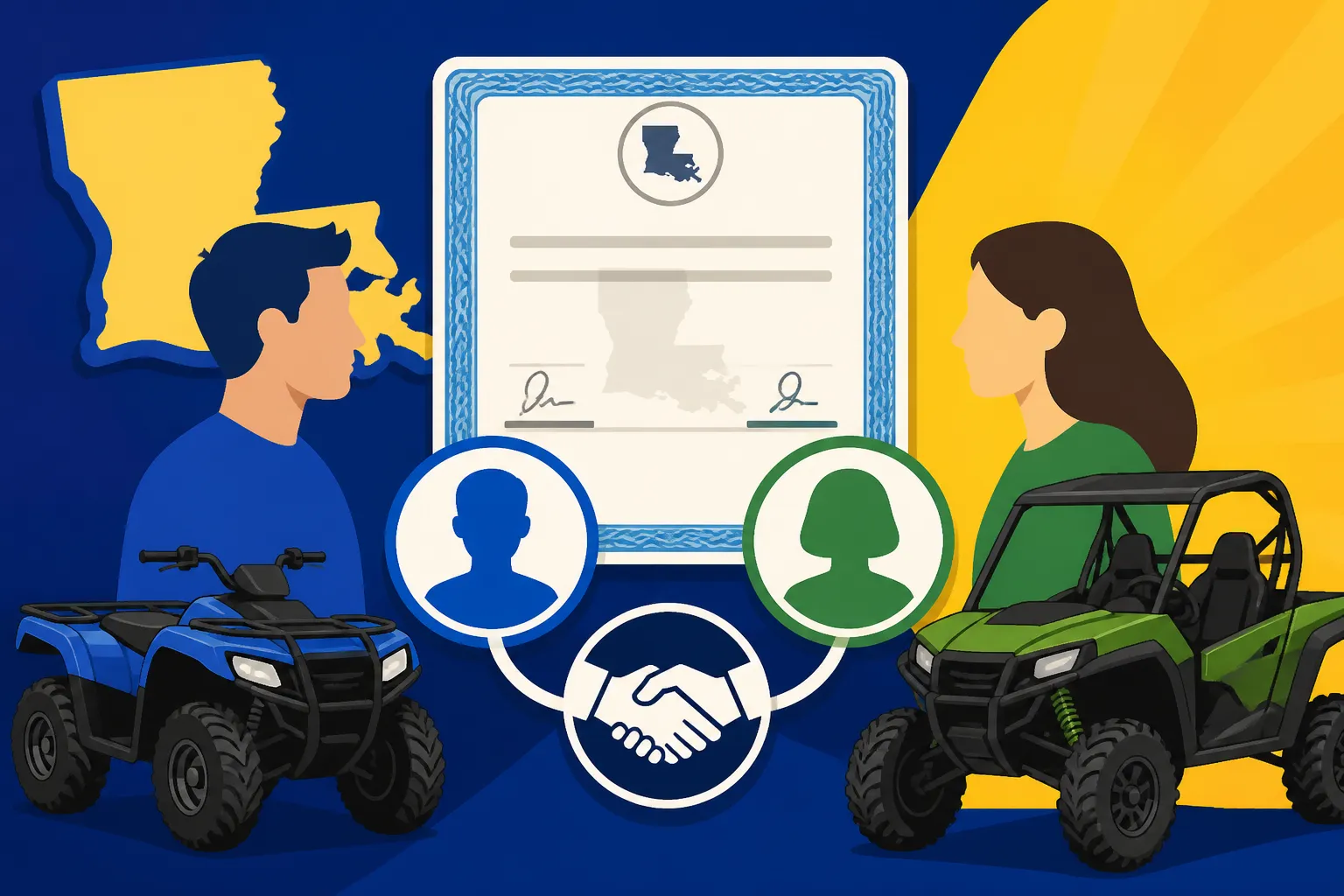
Trying to navigate the paperwork for an ATV or UTV can be a real headache, especially when you're looking to share ownership with someone else. Many folks in Louisiana find themselves wondering how to properly title their new off-road machine in both their name and their spouse's, a family member's, or even a friend's. This guide will walk you through the specifics of putting two names on one Louisiana title, outlining the different ways to co-own, the process at the OMV, and crucial considerations for a smooth experience.
Why Put Two Names on an ATV or UTV Title?
It's a common question, and there are plenty of legitimate reasons why someone would want to list more than one owner on an off-road vehicle title in Louisiana. It’s not just about splitting costs; it’s about shared responsibility, legal recognition, and sometimes even estate planning.
Shared Financial Responsibility
Let's be real, ATVs and UTVs can be a significant investment. For many couples or families, purchasing a machine together makes financial sense. Whether it's a brand-new side-by-side from a dealer in Shreveport or a used quad picked up from a private seller, sharing the initial purchase price, financing payments, and ongoing expenses like maintenance and upgrades can lighten the load considerably. When both names are on the title, it often reflects this shared financial commitment, making it clear that both parties have a vested interest in the asset. This can also simplify things if you ever need to apply for a loan for the machine, as both owners might be considered.
Legal Recognition of Ownership
Beyond finances, putting two names on the title provides clear legal recognition for both individuals. This is especially important for married couples who view their off-road machine as a joint asset, but it also applies to business partners, siblings, or friends who genuinely co-own a machine. It establishes that both parties have rights to the vehicle, which can be crucial in various situations, from insuring the machine to making decisions about its use or eventual sale. Without both names on the title, one owner might find themselves in a tricky spot if the other individual passes away or tries to sell the machine without their consent.
Estate Planning and Survivorship
One of the most significant reasons to opt for joint ownership, particularly for married couples or long-term partners, is the implication for estate planning. Louisiana has specific laws regarding inheritance and community property, and how an ATV or UTV is titled can directly affect what happens to it if one owner passes away. Certain forms of joint ownership allow for the automatic transfer of the vehicle to the surviving owner, bypassing potentially lengthy and complicated probate processes. This can offer peace of mind, knowing that your loved one won't have to jump through endless hoops to keep the machine you enjoyed together. [Titling a Quad You Inherited From a Relative] can be a complex process, so setting up survivorship from the start is often preferred.
Understanding Joint Ownership Options in Louisiana
Louisiana is unique due to its civil law heritage, which impacts how property ownership, including ATVs and UTVs, is structured, especially for married individuals. When you put two names on a title, you're essentially choosing a form of co-ownership.
Community Property
For married couples in Louisiana, the concept of "community property" is paramount. Unless you have a prenuptial agreement stating otherwise, most assets acquired during a marriage are considered community property, meaning they are owned equally by both spouses. This applies to your off-road machine as well. If you and your spouse buy an ATV together while married, it’s generally presumed to be community property, regardless of whose name is physically listed first or even solely on the title in some informal circumstances.
However, for a clear record at the Louisiana Office of Motor Vehicles (OMV), it's still best practice to list both spouses' names on the title. This explicitly documents community ownership and streamlines any future transactions, such as selling the machine or dealing with insurance claims. If only one spouse's name is on the title, and you later need to sell it, the OMV might still require the consent of the other spouse if it's considered community property.
Co-Ownership as Tenants in Common
When two or more people who are not married to each other decide to co-own an ATV or UTV, they typically do so as "tenants in common." This is a very common arrangement for friends, siblings, or business partners. In a tenancy in common, each owner holds a distinct, undivided interest in the property. For example, two friends might each own a 50% share, or perhaps one owns 70% and the other 30%, depending on their agreement.
Crucially, with tenancy in common, there is no right of survivorship. This means that if one owner passes away, their share of the ATV or UTV does not automatically transfer to the surviving co-owner(s). Instead, their share becomes part of their estate and will be distributed according to their will or Louisiana's laws of intestate succession. This can lead to complications, as the surviving co-owner might suddenly find themselves sharing the machine with an heir they don't know or don't get along with. It also means that one owner can sell their share of the ATV to a third party without the consent of the other owner(s), though finding a buyer for a partial interest in an ATV can be challenging.
Joint Tenancy with Right of Survivorship
While traditionally less common in Louisiana for real estate than community property or tenancy in common, "joint tenancy with right of survivorship" is an option that can be specified for certain personal property, like vehicles. This form of ownership means that if one of the owners passes away, their interest in the ATV or UTV automatically transfers to the surviving owner(s) without needing to go through probate. It's often favored for its simplicity in succession.
To establish joint tenancy with right of survivorship for an ATV or UTV, it must be explicitly stated on the title application and reflected on the title itself. The exact phrasing on the title is critical. For instance, the names might be listed as "John Doe AND Jane Smith, with Right of Survivorship." If this language isn't present, the OMV will likely default to treating it as community property (for married couples) or tenancy in common (for unmarried individuals), depending on the circumstances. This option can be very appealing for those who want to ensure their co-owner immediately gains full ownership upon their death.
The OMV Process for Adding a Second Name
Once you understand the ownership types, the next step is the practical process of getting both names on the title at the Louisiana OMV. It involves forms, signatures, and of course, some fees.
Required Forms and Documents
To add a second name to an ATV or UTV title, you'll generally need to complete the standard OMV Vehicle Application form, often designated as DPSMV 1799. This form is used for various title transactions, including transfers and adding/removing owners. [What to Fill In on the OMV Vehicle Application] can guide you through the specifics of this form. Both parties who will be on the title must sign this application.
In addition to the application, you'll need the original certificate of title for the ATV or UTV. If you're purchasing a new machine, the dealer will provide a Manufacturer's Statement of Origin (MSO). For a used machine, you'll need the existing title, properly assigned by the previous owner. You'll also need proof of identity for all named owners, usually a valid photo ID like a driver's license. [Louisiana Requires an Assigned Title for a Used One] or [Louisiana Requires an MSO for a New Machine] clarifies these initial documentation needs.
If the machine was purchased through a private sale, you'll need a bill of sale. For titles involving multiple owners, especially if they are not married, a detailed bill of sale signed by all parties can be helpful, and in some cases, the OMV may require it to be notarized. [Louisiana Notarized Bills of Sale] covers these requirements in more detail. Proof of sales tax payment or an exemption is also crucial, as the OMV won't issue a title without it. [Louisiana Requires Proof of Sales Tax First] explains this important step.
Signatures and Notarization
When adding a second name, all individuals who will be listed on the new title must sign the OMV Vehicle Application form. If you're transferring ownership from one person to two, the original owner will also need to sign off on the transfer portion of the existing title. The OMV is very particular about signatures matching identification, so ensure everyone signs legibly and consistently.
While not always explicitly required for merely adding a name if the original owner is present, having key documents like the bill of sale notarized can prevent future headaches, especially for private sales. A notary public verifies the identity of the signers and witnesses their signatures, adding an extra layer of legal validity. When dealing with shared assets, having this verification can be a good safeguard. Sometimes, for certain types of transfers or if an owner cannot be present, the OMV might specifically request notarized documents.
Associated Fees for Title Changes
Changing or adding names on a title in Louisiana comes with its share of fees. While I can't give you exact figures (since they can change), you should budget for the state's title fee, often a set amount. In addition to the base title fee, there's typically an OMV handling fee that covers the administrative costs of processing your paperwork. If there's a lien involved (for example, if you financed the ATV with a bank), there will also be a fee for recording that lien on the title.
It's always a good idea to check the OMV's official website or call your local office for the most current fee schedule before you visit. They are usually quite transparent about what you'll owe. Remember, these fees are generally per transaction, not per name, but they add up. [Louisiana Title Fees for an ATV] and [Louisiana Handling Fee of $8] provide more context on the types of fees you can expect. Don't forget, if the transaction involves a transfer of ownership that incurs sales tax, you'll need proof of that tax payment before the title can be issued.
Important Considerations and Potential Pitfalls
Adding a second name to your ATV or UTV title isn't just about filling out a form; it has long-term implications that you need to consider carefully. Thinking through these scenarios upfront can save you a lot of trouble down the line.
Selling the Machine with Multiple Owners
When it comes time to sell an ATV or UTV with two names on the title, things can get a little more complicated than if there was only one owner. Both titled owners will typically need to sign the title over to the new buyer. This means that both parties must agree on the sale price, terms, and the decision to sell in the first place. If one owner isn't available or doesn't agree, selling the machine can become a legal tangle.
For instance, imagine you and your friend own a side-by-side as tenants in common. If your friend moves out of state and then decides they don't want to sell, or disagrees on the price, you could be stuck. Even with married couples, while community property often implies mutual consent for major transactions, having both signatures on the title transfer is the cleanest way to proceed. It's a key reason why clear communication and a shared understanding between co-owners are so vital. [Selling a Titled Machine in Louisiana] highlights some of these practicalities.
Disputes Between Co-Owners
Unfortunately, not every co-ownership arrangement sails smoothly. Disputes can arise over everything from who gets to use the machine on a particular weekend to who pays for a costly repair, or even whether to keep it at all. These disagreements can be particularly difficult to resolve if the ownership structure isn't clearly defined beyond the OMV title.
If you are co-owning as tenants in common, remember that each owner has an undivided interest. This means no one owner can claim exclusive rights to the ATV. If a dispute escalates, it might require mediation or, in extreme cases, legal action to resolve. This is where a separate, written agreement, beyond the OMV title, becomes incredibly valuable. It can lay out rules for usage, maintenance, financial contributions, and dispute resolution, giving you a roadmap if conflicts arise.
Impact of Liens on Jointly Titled Machines
If you financed your ATV or UTV, the lender will place a lien on the title. When there are two names on the title, both owners are typically responsible for the loan, making them co-borrowers. This means both of your credit histories are tied to the loan, and both of you are legally obligated to make payments.
If one owner defaults on their share of the payments, the other owner is still fully responsible for the entire loan amount. This can significantly impact the financial health of the innocent party. Furthermore, a lien affects any future transactions; you cannot sell or transfer the machine until the lien is satisfied and released by the lender, regardless of how many names are on the title. [Louisiana Title and Lien Records] explains how these financial claims are recorded. Always be acutely aware of the financial commitments and liabilities when jointly titling a machine with a lien.
The Importance of a Written Agreement
While the OMV title legally establishes co-ownership, it doesn't really delve into the nitty-gritty of how you and your co-owner will manage the machine day-to-day. That's where a separate, written agreement comes in. It's truly a safety net for everyone involved.
Clarifying Responsibilities and Usage
Imagine you and a buddy chip in for a powerful UTV to use for hunting trips. Who’s responsible for routine oil changes? What if one of you wants to upgrade the tires, and the other thinks it’s an unnecessary expense? Who covers the insurance premiums? These are the kinds of questions a written agreement can answer.
This document can outline specifics like:
- Maintenance schedule and costs: How will repairs and regular upkeep be shared? Will there be a joint fund?
- Insurance: Who ensures the policy is active and paid? Who chooses the coverage limits? Does [Does Louisiana Require Insurance on an Off-Road Machine?] apply to your specific use case?
- Storage: Where will the machine be kept? Who is responsible for securing it?
- Usage rules: Are there blackout dates? How do you schedule usage during peak times like deer season? Are there any restrictions on who else can operate the machine?
- Modifications: Do both owners need to approve aftermarket accessories or performance upgrades?
Having these details hammered out in advance prevents misunderstandings and arguments down the road, ensuring everyone is on the same page about their shared asset.
Outlining Processes for Selling or Buyouts
Perhaps one of the most critical aspects of a written agreement is defining what happens if one or both owners want to exit the arrangement. Life happens, and circumstances change. One owner might need cash, or simply lose interest in riding.
Your agreement can specify:
- Right of first refusal: If one owner wants to sell their share, the other co-owner(s) get the first opportunity to buy them out at an agreed-upon valuation method.
- Valuation methods: How will the machine's value be determined if one owner buys out another? Will you get an appraisal, use a Kelley Blue Book estimate, or agree on a fixed price?
- Process for a third-party sale: If both agree to sell the entire machine to an outside buyer, how will the proceeds be divided? What steps need to be taken?
- Dispute resolution: What happens if you can't agree on a buyout price or a sales strategy? Will you use mediation, arbitration, or another method?
Formalizing these exit strategies provides a clear, predefined path, which is far better than trying to figure it out when emotions are running high during a disagreement.
Utilizing Resources like LawDepot
Crafting a comprehensive co-ownership agreement might sound daunting, but you don't necessarily need to hire an attorney from scratch. Resources like LawDepot offer customizable legal document templates that can help you create a formal agreement tailored to your specific situation. These platforms provide frameworks for various agreements, allowing you to fill in the blanks with your agreed-upon terms regarding responsibilities, finances, and exit strategies.
Using a service like LawDepot can be a cost-effective way to get a legally sound document that clearly outlines the rights and obligations of each co-owner. While it's always wise to have a lawyer review any significant legal document, especially one involving substantial assets, a well-structured template from a reputable source like LawDepot gives you an excellent starting point and ensures you cover all the important bases. It provides a level of protection and clarity that the OMV title simply cannot.
Joint Ownership Comparison Table
To help you visualize the differences, here's a quick comparison of the common joint ownership structures relevant in Louisiana for an ATV or UTV.
| Feature | Community Property (Married Couples) | Tenancy in Common (Unmarried Co-owners) | Joint Tenancy with Right of Survivorship (Explicitly Stated) |
|---|---|---|---|
| Applies To | Married spouses (default in Louisiana) | Any two or more individuals (often unmarried) | Any two or more individuals |
| Ownership Share | Equal (50/50) by default | Can be equal or unequal (e.g., 50/50, 70/30) | Equal shares required |
| Right of Survivorship | Generally, no automatic survivorship (goes through probate/estate) | No automatic survivorship (goes to owner's estate) | Yes, interest automatically passes to surviving owner(s) |
| Transfer of Interest | Requires consent of both spouses for sale/transfer | Each owner can sell their share independently | Requires consent of all joint tenants to sell entire property |
| Impact of Death | Deceased spouse's share passes via will/intestacy | Deceased owner's share passes via will/intestacy | Surviving owner(s) automatically receive full ownership |
| Primary Benefit | Default for marital assets, clear marital interest | Flexibility in unequal shares | Avoids probate for the ATV/UTV upon death of an owner |
| OMV Title Requirement | Both names usually listed for clarity | Both names listed | Both names listed with explicit "Right of Survivorship" |
This table should give you a clearer picture of how each type of ownership impacts your rights and responsibilities. Regardless of which type you choose, open communication and a detailed agreement (perhaps drafted with help from resources like LawDepot) are key to a successful shared ownership experience.
Disclaimer
This article is for general informational purposes only and does not constitute professional advice. Laws, prices and regulations vary by location and change over time. Consult a qualified professional for guidance on your specific situation.