Louisiana Title Compared to Arkansas
It's a common headache for off-road enthusiasts living near state lines: you've got your quad or side-by-side, you love to ride, but the moment you consider buying, selling, or even just moving across that invisible border, the rules seem to change entirely. When it comes to titling ATVs and UTVs, Louisiana and Arkansas might be neighbors, but their approaches are surprisingly different, leaving many riders scratching their heads and worrying about getting their paperwork right. This guide will walk you through the distinct requirements of each state, helping you understand the nuances so you can navigate the process with confidence, whether you're bringing a machine into Louisiana from Arkansas or vice-versa.
The Fundamental Differences in Titling Requirements
Dealing with vehicle titles can feel like learning a new language in every state, and off-road machines are no exception. While both Louisiana and Arkansas aim to track ownership and ensure sales tax is collected, their methods for ATVs and UTVs diverge significantly, creating potential pitfalls for the unaware.
Louisiana's Approach to ATV and UTV Titling
In Louisiana, the Office of Motor Vehicles (OMV) is firmly in charge of titling your off-road machine, whether it's an ATV, UTV, or dirt bike. This isn't just a suggestion; it's a requirement. If you buy a brand-new quad from a dealer, it will come with a Manufacturer's Statement of Origin (MSO). This MSO is your golden ticket to getting your first title from the OMV. Just like with a car, the MSO essentially proves the machine's origin and that it's never been titled before. The OMV uses this to create your initial title record. You'll definitely want to keep that MSO safe, because without it, the process becomes much more complicated. [Louisiana Requires an MSO for a New Machine]
For a used machine, the process shifts slightly, but the requirement for a title remains. When you purchase a used ATV or UTV in Louisiana, you'll need an assigned title from the previous owner. This is where clarity and accuracy are paramount. The previous owner must sign over the existing title to you, and that signature must be proper and legible. The OMV scrutinizes these details because they want to ensure a clear chain of ownership. You can't just show up with a bill of sale alone if the machine has been previously titled in Louisiana; that title is the official document of ownership transfer. [Louisiana Requires an Assigned Title for a Used One] Moreover, Louisiana is very particular about sales tax. Before the OMV will even consider issuing a title for your off-road machine, you absolutely must provide proof that the sales tax has been paid. Whether you bought it from a dealer or a private party, that tax receipt is a non-negotiable step in the titling process. This can often catch people off guard, expecting to title first and deal with tax later, but Louisiana flips that script. [Louisiana Requires Proof of Sales Tax First]
Arkansas's Stance on Off-Road Vehicle Titles
Arkansas takes a markedly different approach to ATV and UTV titling, one that often surprises people accustomed to Louisiana's system. For most recreational ATVs and UTVs used exclusively off-road, Arkansas typically does not require a title. This is a critical distinction. The Arkansas Department of Finance and Administration (DFA) handles vehicle titling, but their focus for these types of machines is generally limited.
So, what does this mean for ownership? If an ATV or UTV isn't titled, proof of ownership usually relies on the Manufacturer's Statement of Origin (MSO) for new machines, or a clear, notarized bill of sale for used ones. These documents become the primary evidence that you are the rightful owner. It's a system that prioritizes registration for specific road-use exemptions or for tracking liens, rather than universal titling for all off-road machines. However, if you are planning to finance your ATV or UTV in Arkansas, the lender will almost certainly require a title to be issued so they can record their lien against it. This is one of the primary instances where an off-road machine will receive a title in Arkansas. Additionally, if the vehicle is going to be registered for specific, limited road use allowed in certain areas of Arkansas, it might also require a title as part of that registration process. But for the vast majority of mud-bogging, trail-riding machines, a title isn't a default requirement like it is in Louisiana.
Navigating the Sales Tax and Fees Across State Lines
Sales tax and associated fees are another area where crossing state lines can introduce a maze of regulations. Both Louisiana and Arkansas are keen on collecting their due, but the timing and type of tax can vary, making it essential to understand what you'll owe and when.
How Louisiana Handles Out-of-State Purchases
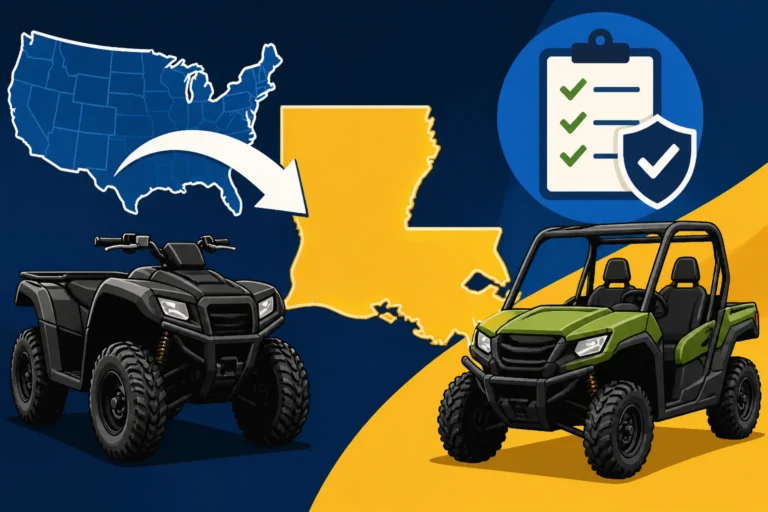
If you're bringing an ATV or UTV into Louisiana from Arkansas, even if you paid sales tax in Arkansas, Louisiana is going to want its share. Louisiana imposes a "use tax" on items brought into the state for use here, and this definitely applies to off-road machines. The good news is that Louisiana typically gives you credit for sales tax already paid in another state. However, if the sales tax rate in Louisiana (which combines state and local parish rates) is higher than what you paid in Arkansas, you'll owe the difference to Louisiana. This can catch people by surprise, especially if they bought a machine in a neighboring state with a lower tax rate. The OMV will demand proof of sales tax payment (or payment of the difference in use tax) before they will process your title application. [Louisiana Tax on an Out-of-State Machine]
Beyond the sales tax, you'll also be on the hook for Louisiana's titling fees. There's a set fee for the title itself, which is a flat rate. On top of that, the OMV charges a handling fee to process all the paperwork. These aren't huge sums individually, but they add up, and it's crucial to factor them into your budget when calculating the true cost of bringing a machine into Louisiana. For example, the Louisiana title fee is currently a specific amount, and there's also an OMV handling fee. [Louisiana Title Fee of $68.50] [Louisiana Handling Fee of $8] Don't forget, if you're planning on riding anywhere other than your private land, you'll also need Louisiana's yearly off-road decal, which has its own nominal cost, proving you've paid your dues for public land access or shoulder riding.
Arkansas's Rules for Cross-Border Acquisitions
If you purchase an ATV or UTV in Louisiana and intend to use it primarily in Arkansas, the sales tax situation will depend on whether you paid Louisiana sales tax and if Arkansas requires a title for your specific situation (e.g., if you're getting a lien). Arkansas has its own state sales tax, and local taxes can also apply. Generally, if you paid sales tax in Louisiana at a rate equal to or greater than Arkansas's combined state and local rate, you might not owe additional sales tax when bringing the machine into Arkansas. However, this is where it gets tricky due to Arkansas's general non-titling policy for off-road machines.
If a title isn't required by Arkansas (because there's no lien and you're not registering it for road use), then the primary point of sales tax collection would have been at the point of sale in Louisiana. If you purchased it from a private seller in Louisiana, you would have been responsible for self-reporting and paying Louisiana's use tax. When bringing it to Arkansas, the DFA will look for proof of sales tax payment from some state. If you didn't pay tax in Louisiana, Arkansas would expect you to pay their sales or use tax. It's always best to have a clear paper trail, including a detailed bill of sale showing the purchase price and any sales tax paid, to avoid double taxation or unexpected fees. The key is understanding that without a title as a mandatory anchor point, the sales tax interaction with the state isn't as rigidly tied to a titling event as it is in Louisiana.
Specific Documentation and Notarization Requirements
Paperwork is often the bane of an off-road rider's existence, but getting it right is the only way to ensure clear ownership and avoid future headaches. Both states have specific demands, and overlooking a small detail can send you back to square one.
Louisiana's Demands for Paperwork Accuracy
Louisiana is quite particular when it comes to the documentation required for titling an ATV or UTV. For starters, if you're buying a used machine from a private party, a bill of sale is crucial. But it's not just any old handwritten note; the OMV often prefers a notarized bill of sale. This adds a layer of legal legitimacy, confirming the identities of the buyer and seller and that the transaction took place. It's a safeguard against fraud and helps establish a clear chain of ownership. [Louisiana Notarized Bills of Sale] Without a properly filled-out and potentially notarized bill of sale, especially if the previous title has issues or is lost, you could face significant delays or even be unable to title your machine. [Louisiana Title Without a Bill of Sale]
Beyond the bill of sale, you'll need to complete the OMV Vehicle Application form (often called Form DPSMV 1799, though forms can change). This form requires precise information about the vehicle, the buyer, and the seller. Any missing signatures, incorrect VINs, or misspelled names can lead to your application being rejected. It's not just about submitting the documents; it's about submitting them correctly. The OMV clerks are looking for accuracy and completeness, so take your time filling out every field. [What to Fill In on the OMV Vehicle Application] You might find it helpful to use a service like LawDepot to generate legally sound bills of sale or other necessary forms to ensure they meet common legal standards, giving you a better chance of OMV acceptance on your first try. The clearer and more professional your documentation, the smoother your experience at the OMV counter will be.
Arkansas's Expectations for Off-Road Documentation
Because Arkansas doesn't routinely title ATVs and UTVs for pure off-road recreational use, the emphasis on other forms of documentation shifts. For new machines, the Manufacturer's Statement of Origin (MSO) remains the cornerstone of ownership proof. This document, issued by the manufacturer, is effectively the birth certificate of your vehicle. Keep it safe, as it's often the only official paper proving you own the machine before any potential titling for a lien or road use.
For used machines that don't have an Arkansas title (which, again, is most of them), a comprehensive bill of sale is paramount. While notarization isn't always explicitly required by the state for a simple proof of ownership for a non-titled machine, it is highly, highly recommended. A notarized bill of sale provides an impartial third-party verification of the signatures and transaction details, making it much harder for someone to dispute ownership later. This can be especially important in a private sale. When dealing with a private party, using a reliable template for your bill of sale, perhaps from a resource like LawDepot, can help ensure all necessary information — like buyer/seller details, vehicle description, VIN, and purchase price — is included, providing robust proof of your transaction. This level of detail helps prevent misunderstandings and protects both parties. Without a formal title, your bill of sale essentially is your primary proof of legal ownership in Arkansas, so treat it with the utmost care.
| Feature | Louisiana ATV/UTV Titling | Arkansas ATV/UTV Titling |
|---|---|---|
| Titling Agency | Office of Motor Vehicles (OMV) | Department of Finance and Administration (DFA) |
| Title Requirement | Mandatory for all ATVs/UTVs, new or used. | Not mandatory for purely off-road recreational use; required if lien exists or for specific road-use registration. |
| Sales Tax Proof | Mandatory before title issuance. Use tax for out-of-state purchases. | Paid at point of sale or via use tax; may not be tied directly to a titling event unless a title is issued. |
| Decal Requirement | Mandatory yearly ORV decal for riding off private property. | Generally no statewide decal for off-road use, but local rules may apply for road use. |
| Bill of Sale | Required for used machines, often preferred notarized. | Crucial for proof of ownership (especially if no title exists), notarization highly recommended. |
| MSO for New | Required to obtain first title. | Primary proof of ownership if no title is issued. |
Practical Scenarios for Cross-State Owners
Life rarely fits neatly into state borders, and neither do our off-road adventures. Understanding how these titling differences play out in real-world scenarios is crucial for avoiding legal snags and enjoying your machine without constant worry.
Moving from Arkansas to Louisiana with an ATV/UTV
Imagine you've been riding your side-by-side happily in Arkansas for years, never needing a title because it was for recreational off-road use. Now, you're moving your life – and your machines – to the Pelican State. This is where Louisiana's titling requirements will kick in. Your Arkansas-centric proof of ownership (likely an MSO and/or a bill of sale) will be the foundation, but you'll need to translate that into Louisiana's system.
First and foremost, you'll owe Louisiana's use tax if you haven't already paid sales tax on the machine at a rate equal to or higher than Louisiana's combined rate. Even if you paid sales tax in Arkansas, if Louisiana's rate is higher, you'll need to pay the difference to the Louisiana Department of Revenue or directly to the OMV when you apply for your title. This step simply cannot be skipped, as the OMV will not proceed with a title application without satisfactory proof of tax payment. Once that's handled, you'll visit a Louisiana OMV office with your proof of ownership (MSO or bill of sale), identification, and any other supporting documents. You'll complete the vehicle application form, pay the [Louisiana Title Fee of $68.50] and the [Louisiana Handling Fee of $8], and then the OMV will issue you a Louisiana title. Finally, don't forget that if you plan to ride your machine off your own property, you'll need to purchase and affix [Louisiana's Yearly Off-Road Decal]. It’s definitely a multi-step process, but entirely manageable once you know what to expect. [Moving to Louisiana With a Quad You Already Own]
Buying from Louisiana and Titling in Arkansas (and vice-versa)
The complexities multiply when you're buying a machine across state lines. Let's say you found a great deal on an ATV in Shreveport, Louisiana, but you live just across the border in Texarkana, Arkansas.
If you purchase a Louisiana-titled machine as an Arkansas resident, the seller in Louisiana should provide you with the properly signed-over Louisiana title. You'll pay Louisiana sales tax to the dealer (or self-report use tax if it's a private sale). When you bring that machine back to Arkansas, if you don't require a title for a lien, you'll essentially retain the Louisiana title as your primary proof of ownership, even though Arkansas itself wouldn't have typically issued one. You'd keep that title, along with your MSO or bill of sale, as your complete ownership packet. You won't typically be required to get an Arkansas title unless you need to record a lien with a lender or register it for specific road use. However, you'll still need to ensure you've properly paid sales tax, either in Louisiana or by paying Arkansas's use tax if the Louisiana rate was lower or no tax was collected. It's always a good idea to bring all your paperwork (Louisiana title, MSO, bill of sale, tax receipts) to the Arkansas DFA to ensure everything is above board, especially if there's any ambiguity. They can advise you on any specific requirements or if any Arkansas use tax is due.
Conversely, buying an off-road machine in Arkansas and bringing it to Louisiana means you'll likely start with just an MSO and/or a bill of sale, as it probably won't have an Arkansas title. This scenario is precisely why Louisiana requires [Louisiana Requires Proof of Sales Tax First] and will then issue its own title based on your previous proof of ownership. Using a robust, legally sound bill of sale, perhaps generated through a service like LawDepot, is crucial here. This ensures that the documentation you bring to the Louisiana OMV is professional and contains all the necessary details for them to confidently issue a new Louisiana title in your name. You'll then proceed with paying Louisiana's use tax, the [Louisiana Title Fee of $68.50], and other associated fees, along with obtaining your annual off-road decal.
The bottom line for any cross-border transaction is always to collect as much documentation as possible: the MSO, a detailed and preferably notarized bill of sale, and any proof of sales tax paid. Each state operates on its own set of rules, and being over-prepared is always better than being caught short.
Disclaimer
This article is for general informational purposes only and does not constitute professional advice. Laws, prices and regulations vary by location and change over time. Consult a qualified professional for guidance on your specific situation.