Why the Farm Exemption Stops at the Shoulder
It’s a common frustration for folks in Louisiana, especially those living and working on rural properties: you’ve got an ATV or UTV that’s essential for farm work, and you need to get it from one field to another, or down the road to a neighbor’s property. The assumption often is, "It's for the farm, so it's allowed on the road, right?" Well, the truth is, Louisiana's farm exemption for off-road machines only goes so far, specifically, it stops right at the shoulder. This guide will clarify the nuances of this rule, helping you understand precisely what's allowed, what's not, and most importantly, why.
Understanding Louisiana's ATV and UTV Road Use Laws
Riding an off-road machine in Louisiana can be a blast, whether you're muddin' at a private park or traversing your own acreage. However, the minute your tires touch a public road, a whole different set of rules kicks in. It's not just about safety; it's about state statutes designed to keep everyone safe.
The General Prohibition on Public Roads
Let's start with the baseline: generally speaking, ATVs and UTVs are simply not street-legal vehicles in Louisiana. They're built for dirt, mud, and rough terrain, not asphalt and high-speed traffic. This fundamental principle is enshrined in Louisiana law, specifically in statutes like [Louisiana ATV Road Rules Under 32:299] and [Louisiana UTV Road Rules Under 32:299.3]. These laws make it clear that these machines lack the standard safety equipment – like turn signals, rearview mirrors, proper headlights and tail lights for road visibility, and often even basic seatbelts or enclosed cabins – that are mandatory for vehicles sharing public highways.
Imagine trying to navigate a busy state highway on an ATV designed for a slow crawl through a swamp. The size difference, the speed disparity, and the lack of protective features make it incredibly dangerous, not just for the rider but for other motorists as well. This general prohibition isn't meant to be a nuisance; it's a critical safety measure put in place after countless incidents highlighted the incompatibility of off-road machines with public road conditions. The law aims to prevent severe accidents by keeping these vehicles where they belong: off the main thoroughfares.
The Limited Exceptions to the Rule
Now, like many rules, there are exceptions. But here’s the crucial part: these exceptions are very specific and often come with their own stringent conditions. They're not broad permissions to cruise down any road you please. For instance, law enforcement and emergency personnel, such as paramedics, may use ATVs or UTVs in their official capacity under certain circumstances, as detailed in statutes related to [Louisiana Law Enforcement Exceptions] and [Louisiana Paramedic Exceptions]. These exemptions are granted because their work often requires off-road access for urgent situations, and they typically operate with specialized training and equipment.
Another exception involves parishes designating specific roads for UTV use, but this requires an official ordinance and signage, and adherence to specific rules regarding age, licensing, and machine equipment. We'll delve into that a bit later. For now, it's vital to remember that these are truly exceptions that prove the general rule. Without a clear, statutory exception that applies to your specific situation, your off-road machine is considered off-limits for public road travel. Assuming an exception applies without thoroughly checking the law can lead to hefty fines and other penalties.
Diving Deep into the Farm Use Exemption
For those who rely on ATVs and UTVs for their livelihood in Louisiana's agricultural sector, the farm use exemption is a lifeline. It acknowledges the practical necessity of moving these machines for legitimate farm-related tasks. However, its scope is often misunderstood, leading to potential legal troubles.
What the Farm Exemption Actually Allows
The farm exemption is specifically designed to accommodate the unique needs of agricultural operations. It allows ATVs and UTVs to be used on public roads, but only for bona fide farming purposes. This means tasks directly related to the production of agricultural commodities, such as crops, livestock, or aquaculture. Think of scenarios like a farmer needing to check irrigation systems in a field across a small parish road, moving livestock from one pasture to another, or transporting tools and supplies between different plots of land that are part of the same farming operation. These are legitimate uses that recognize the ATV or UTV as a piece of essential farm equipment.
Crucially, the exemption isn't about the machine itself, but about its purpose at that specific time. If you’re using your ATV to check fence lines for your cattle operation, that falls under the exemption. If you’re using that same ATV to run to the corner store for a soda, it absolutely does not. The law is very clear that the activity must be directly connected to agricultural production. To help clarify this, Louisiana law often requires an affidavit, like those mentioned in [Louisiana Agricultural Affidavits for an ATV] or [Louisiana Farm Affidavits for Road Use], which essentially serves as a sworn statement confirming the machine's primary use for farming. This documentation can be vital if you're ever stopped and questioned about your road use.
The Critical "Shoulder Only" Limitation
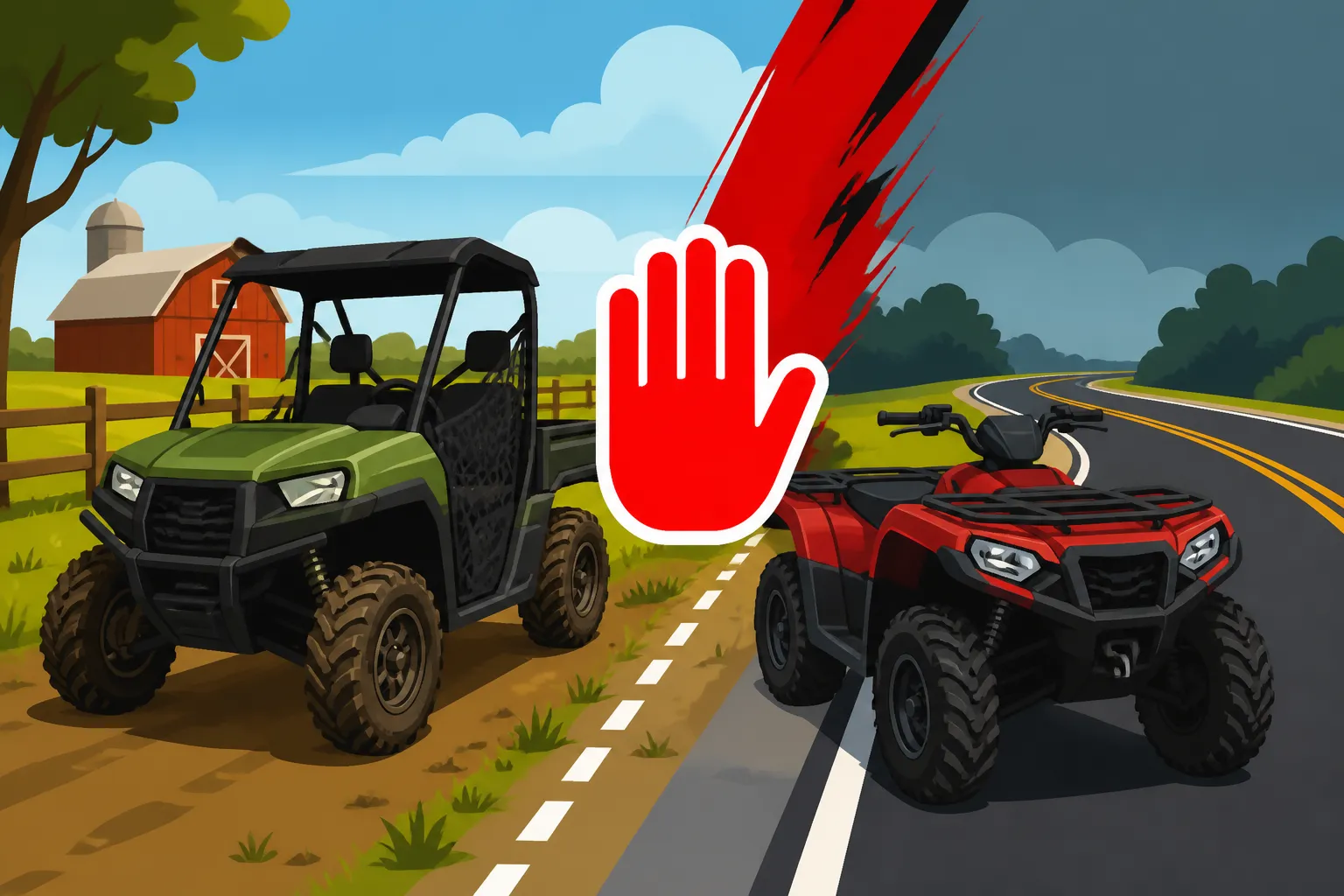
Here's where many people get tripped up: even with a legitimate farm purpose, the exemption for road use is strictly limited to the shoulder of the public road. It means your ATV or UTV is allowed to operate on the unpaved or unimproved strip of land immediately adjacent to the main travel lanes, usually separating the roadway from the ditch or embankment. The statute explicitly states this limitation, making it clear that you cannot enter the paved or graveled travel lanes used by cars and trucks. This is the essence of [Louisiana's Shoulder-Only Farm Exception].
Why this specific restriction? It's a balance. Legislators recognized the need for farmers to move their equipment, but also understood the inherent dangers of mixing off-road vehicles with regular traffic. The shoulder provides a necessary buffer zone. It allows for movement without directly impeding or endangering faster-moving vehicles. It’s a compromise that facilitates agricultural work while maintaining a degree of public road safety. Failing to understand this distinction can have serious consequences. Riding in the travel lane, even momentarily, while claiming a farm exemption, is a violation of the law. You must stay on the shoulder, period, even if it means slowing down or stopping if the shoulder becomes impassable.
The "Why" Behind the Shoulder Limit
Understanding the practical and legal rationale behind the "shoulder only" rule can help prevent misunderstandings and keep riders safe. It’s not an arbitrary restriction; it’s rooted in fundamental differences between off-road machines and street-legal vehicles, as well as the overarching goals of traffic safety.
Safety and Design Considerations
ATVs and UTVs are engineering marvels for rough terrain, but those same design features make them profoundly unsuitable for public roads. Their suspension systems are built for absorbing bumps and uneven ground, not for stable handling at higher speeds on smooth asphalt. Their tires are typically knobby, designed for traction in mud or dirt, which can feel unstable and wear quickly on pavement. Visibility is another major factor: standard ATV/UTV lighting is often sufficient for trails or fields but may not provide the necessary illumination or conspicuity for safe operation alongside cars and trucks, especially at dawn or dusk. Moreover, they often lack turn signals, proper mirrors, and the crush zones or airbags found in road vehicles.
Consider the speed differential. A farmer moving an ATV along the shoulder might be traveling at 10-15 mph, while vehicles in the adjacent lane are moving at 55 mph or more. This creates a massive speed differential, dramatically increasing the risk of rear-end collisions if the ATV were to swerve or accidentally enter the travel lane. The "shoulder only" rule directly addresses these safety disparities by keeping the slower, less protected off-road machine separated from the main flow of traffic, minimizing direct interaction and the potential for catastrophic accidents. It's about acknowledging that an ATV, while versatile, is not a car, and should not be expected to perform like one on public roads.
Legal Interpretation and Intent
The legislative intent behind granting a limited farm exemption while strictly confining it to the shoulder boils down to a fundamental principle: necessity versus public safety. Lawmakers recognized that forcing farmers to trailer their ATVs for every short hop between fields would be an undue burden, hindering essential agricultural work. Therefore, a concession was made. However, this concession was meticulously crafted to ensure it didn't undermine the safety of the general public using the same roads. The shoulder-only rule is a direct reflection of this balance.
The law understands that an ATV used for farming is still an ATV, not a tractor. While tractors are generally slow-moving, they are often much larger, more visible, and sometimes have different road-use allowances. An ATV, despite its utility on the farm, remains a relatively small, fast-accelerating machine that lacks the robust safety features of a typical road vehicle. Therefore, keeping it on the shoulder ensures that any incidental road use for agricultural purposes remains just that—incidental and peripheral to the main flow of traffic. It's a clear legal directive: you can use the edge of the road for farm work, but you cannot become part of the flow of traffic. This is why [The Statute Allows the Shoulder and Nothing More] is such a critical concept for Louisiana riders to grasp.
Practical Implications and Common Misunderstandings
Navigating the farm exemption can be tricky, and even seasoned riders sometimes fall victim to common misconceptions. Understanding these nuances is crucial for staying on the right side of the law and ensuring your safety.
The 5-Mile Radius and Its Context
One of the most frequently misunderstood aspects of the farm exemption is the 5-mile radius. Louisiana law, as detailed in [Louisiana's 5-Mile Farm Radius], allows for the operation of ATVs and UTVs on the shoulders of public roads within a five-mile radius of the farm's primary operations, provided it's for farm-related activities. Many riders mistakenly believe this 5-mile radius grants them free rein to ride on the paved portion of the road, or that it’s a blanket permission for any activity within that distance. This couldn't be further from the truth.
The 5-mile radius simply defines the geographic scope within which the shoulder-only farm exemption can be exercised. It means you can use the shoulder for farm work within five miles of your farm, but beyond that, even the shoulder access for farm use typically ceases. The machine still needs to display a valid [Louisiana ORV Decals and Titles Explained] even if it's primarily used for farm work. This decal indicates it's a registered off-road vehicle, but it doesn't grant unfettered road access. So, you might be within five miles of your property, checking a distant field, but you absolutely must remain on the shoulder. Veering into the travel lane, even for a short distance, will nullify the exemption and could result in a citation.
Documentation and Enforcement
When you're operating an ATV or UTV on a public road's shoulder under the farm exemption, preparedness is key. Law enforcement officers, such as state troopers or parish deputies, have the authority to stop you and verify that your activity falls within the legal parameters. They'll want to confirm you're legitimately engaged in farm work and that your machine meets any other requirements. This is where carrying appropriate documentation becomes vital. As outlined in [What a Louisiana State Trooper Can Ask to See], they might request proof of ownership, your identification, and verification of your farm operations.
This is also where a sworn affidavit, stating the primary agricultural use of your machine, can be extremely helpful. While not always explicitly required to be carried, having a document, perhaps one created using a service like LawDepot for generating legal forms, that clearly outlines your farm's location and the machine's role in its operations, can smooth over any potential confusion during a traffic stop. LawDepot provides templates for various legal documents, and while you'd need to ensure it's properly notarized if required, having a formal declaration can be a strong piece of evidence of your compliance. [Carrying an Affidavit Sworn Before a Notary] is often recommended for situations like this to add an extra layer of official credence to your claims of farm use. Always be courteous and cooperative, and present your documentation clearly to avoid unnecessary complications.
When "Farm Use" Becomes "Illegal Road Use"
The line between legitimate farm use and illegal road use can feel blurry, but the law is quite precise. Any activity that isn't directly related to the production of agricultural commodities immediately voids the farm exemption. This means riding your ATV to the local gas station for snacks, taking your child to a friend's house, joyriding down a country road, or simply using it as a general mode of transportation—even if you happen to live on a farm—is not covered. The exemption is about the purpose of the ride, not just the location of the rider.
For example, if you're pulling a small trailer of hay across a road to a different pasture, that's farm use. If you're pulling that same trailer with your kids in it to a fishing spot, that's recreational use, and it's illegal on the public road or shoulder. Ignoring these distinctions can lead to significant penalties. [Louisiana Penalties for Illegal Road Riding] can include substantial fines, and your machine could even be impounded. It's a costly lesson to learn, which is why it's far better to understand and adhere to the restrictions upfront. When in doubt, it's safer to trailer your ATV or UTV if your activity deviates from direct, shoulder-bound farm operations.
Beyond the Shoulder – Other Limited Road Access for Off-Road Vehicles
While the farm exemption is specific to agricultural use on the shoulder, there are other very limited scenarios where off-road vehicles might legally interact with public roads in Louisiana. It’s crucial not to confuse these with the farm exemption, as each has its own distinct set of rules and requirements.
Designated Parish Roads
Outside of agricultural exemptions, some parishes in Louisiana have taken steps to create ordinances that allow UTVs (but typically not ATVs due to their design differences) on specific public roads within their jurisdiction. This is a separate, distinct legal pathway for road access, and it usually comes with a host of strict conditions. As highlighted in discussions around [Louisiana UTV Street Legal Rules by Parish], these ordinances usually require the UTV to meet certain equipment standards – such as having appropriate lighting, turn signals, brake lights, mirrors, and sometimes a horn – to make them safer for road sharing.
Furthermore, there are often age restrictions for drivers (e.g., typically 21 years old), mandatory insurance requirements, and sometimes even specific signage that the parish must install to indicate which roads are designated for UTV use. For example, [Parishes Have to Post Signs on Designated Roads] is a critical component of these ordinances, ensuring that both UTV operators and other motorists are aware of the rules. If you live in a parish with such an ordinance, you must check the specific details with your local government, as these rules vary widely from parish to parish. Operating a UTV on a designated road without meeting all the specified requirements is still a violation, even if an ordinance exists.
Crossing Public Roads
Even if your ATV or UTV is typically restricted to off-road use, Louisiana law does make a provision for crossing public roads. This is a common necessity for farmers and landowners who have property divided by a public road, or for recreational riders who need to get from one section of a trail to another. However, this is not an invitation to ride on the road. Instead, it’s a very specific, limited allowance to traverse the roadway.
The key here is that the crossing must be "incidental" and performed safely. This means crossing at a 90-degree angle to the roadway, yielding to all oncoming traffic, and doing so only when absolutely necessary to move from one private or permitted off-road area to another. You cannot ride down the road, even for a short distance, with the intent of crossing. The moment you enter the travel lane, you must be in the process of crossing it directly. This distinction is vital and is covered by rules like [Louisiana Rules for Crossing a Highway] and [Crossing Where It Is Incidental]. It's about minimizing the time your off-road machine spends in direct contact with vehicle traffic, prioritizing safety above all else. Always remember to look both ways, yield, and make your crossing as brief and direct as possible.
Louisiana Farm Exemption Road Rules: Do's and Don'ts
Here’s a quick overview of what Louisiana law permits and prohibits when operating an ATV or UTV under the farm exemption on public roads. Remember, these are general guidelines, and it's always best to consult the specific statutes or local authorities for precise details.
| Action | Permitted (Do) | Not Permitted (Don't) |
|---|---|---|
| Roadway Location | Ride exclusively on the shoulder. | Enter the paved or graveled travel lanes. |
| Purpose of Ride | Directly for agricultural work (checking crops, moving equipment). | For recreational use, commuting, or errands. |
| Distance | Within a 5-mile radius of your primary farm operation. | Beyond the 5-mile radius for farm use. |
| Documentation | Carry ID, proof of ownership, and possibly a notarized agricultural affidavit (e.g., from LawDepot). | Ride without any proof of ownership or farm purpose. |
| Machine Requirements | Display a valid [Louisiana ORV Decals and Titles Explained]. | Ride an untagged or unregistered machine. |
| Crossing Roads | Cross at a 90-degree angle, yielding to traffic, when necessary. | Ride along the roadway to find a crossing point. |
| Safety | Be vigilant for traffic, use caution. | Assume other vehicles will see or yield to you. |
Conclusion
The Louisiana farm exemption for ATVs and UTVs offers a vital, albeit limited, allowance for those engaged in agricultural work. It's a pragmatic solution that balances the needs of farmers with the paramount concern for public safety. Understanding that this exemption strictly applies to the shoulder only, and only for legitimate farm purposes within a specific radius, is not just about avoiding a ticket—it's about ensuring your own safety and the safety of everyone else on the road. Always prioritize caution, adhere to the legal requirements, and remember that when it comes to public roads, an off-road machine is best kept to its designated, limited area.
Disclaimer
This article is for general informational purposes only and does not constitute professional advice. Laws, prices and regulations vary by location and change over time. Consult a qualified professional for guidance on your specific situation.